When someone behaves irrationally, or violently, is it their fault?
Should everyone be held accountable for their actions? Should we give mulligans to those suffering from dementia or mental illness? What if their poor lifestyle choices contributed to their condition?
Can someone be possessed by demons, or by mental illnesses, or by both?
Do the symptoms described by St John Climacus fit our modern understanding of certain mental illnesses and/or dementia?
Why is madness so difficult to cure? How did St John Climacus view madness?
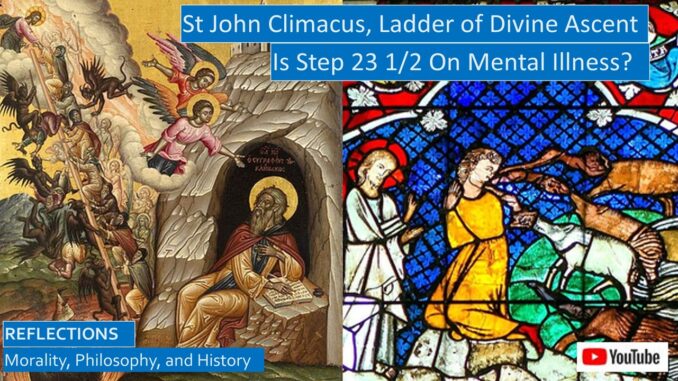
We reflected on a puzzling section of St John Climacus’ step on his Ladder of Divine Ascent on first vainglory, then mad pride. He ponders how highly arrogant pride can lead to a type of madness that can lead to strange behavior. He wondered: Was this caused by demons? He recounts a puzzling situation where a monk starts cursing loudly in the middle of the Divine Liturgy.
However, our saint is reluctant to make a full-throated attack, as he likely sensed that his formerly devout monk was not in his right mind. When modern readers study this, they may wonder: Could this monk be suffering from Tourette’s syndrome, which involves involuntary cursing? Could this be symptomatic of dementia, or another mental illness or condition? These are the questions we will ponder in today’s reflection.
St John Climacus on Vainglory and Mad Pride: Ladder of Divine Ascent, Steps 22-23
https://youtu.be/jdHCOoC808M
https://seekingvirtueandwisdom.com/st-john-climacus-on-mad-pride-and-vainglory-ladder-of-divine-ascent-steps-22-23/
ANCIENT DEMONS VERSUS MODERN DEMENTIA AND MENTAL ILLNESSES
St John Climacus and the ancients blame the experiences that we attribute to mental illness as attacks by demons. Modern people don’t believe in demons, but conditions like schizophrenia, dementia, and other mental illnesses certainly seem to possess people like the demons of old. How can we prove that demons are not behind such experiences? How can we prove that demons do not cause the chemical imbalances and mental deterioration that cause dementia and so many mental illnesses?


Clearly, this does not prove scientifically that demons exist. But to those who suffer from mental illnesses and conditions like dementia, what they experience is so vivid and real and overwhelming that, whether we believe in God or not, we should respect how they wish to view the challenges they are facing. How can we condemn people who believe Jesus saved them from mental illness?
Much has been written about how demons were viewed by the ancient Jews, ancient Greeks, and ancient Romans, and the commentary on the sets of Synoptic verses where Jesus heals the demoniacs is extensive, so this will be a separate reflection.
Mental Illness, Demons, and Free Will in the Bible and Ancient Israel, Greece, and Rome
https://youtu.be/ZdgWzU-sJds
https://seekingvirtueandwisdom.com/do-we-have-free-will-mental-illness-and-demons-in-the-bible-church-fathers-and-the-ancient-world/
Another closely related issue relating to mental illness and free will is the question: Can Christians deceive their loved ones who suffer from dementia, or some other mental illness, so they can be placed into a lockdown facility so they can receive the care they need?
Biblical Morality of Deceiving Those Who Suffer From Dementia In Order to Help Them
https://youtu.be/uukJRpH7k64
https://seekingvirtueandwisdom.com/biblical-morality-of-deceiving-those-who-suffer-from-dementia-in-order-to-help-them/
St John Climacus begins Step 23 with his definition of pride, which is called mad pride in the header:
Step 23.1. “Pride is denial of God, an invention of the devil, the despising of men, the mother of condemnation, the offspring of praise, a song of sterility, flight from Divine assistance, the precursor of madness, the cause of falls, a foothold for satanic possession, a source of anger, a door of hypocrisy, the support of demons, the guardian of sins, the patron of pitilessness, the rejection of compassion, a bitter inquisitor, an inhuman judge, an opponent of God, a root of blasphemy.”
As Father Vassilios points out in our prior reflection, the proud forsake the two-fold Love of God and neighbor, which also encourages our inner anger and madness. If what we think, say, and do are governed by this two-fold Love, our inner life is governed by the straight compass. But if we are seduced by seductive pride, then our faith is all about us, and our internal spiritual life is complicated by our need to justify a life bound around us. St John Climacus warns us: this can lead to anger and madness, giving demons and Satan a foothold in our soul.
Hillel and Jesus, Reflections on Rabbi Telushkin’s Observations
http://www.seekingvirtueandwisdom.com/hillel-and-jesus-reflections/
Comparing Hillel and Shammai to Jesus
http://www.seekingvirtueandwisdom.com/comparing-hillel-and-shammai-to-jesus/
More Stories and Sayings of Hillel and Shammai
http://www.seekingvirtueandwisdom.com/more-stories-and-sayings-of-hillel-and-shammai/
Jesus, Hillel, and Shammai, Loving God and Neighbor
https://youtu.be/ygxn2qqGnOI
There is a link between casting out demons and blasphemy in the three Synoptic Gospel stories where the scribes slander him: “By the prince of demons Jesus casts out the demons.” Jesus counters that, in essence, only the virtuous can cast out demons, asking them: “How can Satan cast out Satan?”
But then Jesus adds: “Truly, I say to you, all sins will be forgiven the sons of men, and whatever blasphemies they utter; but whoever blasphemes against the Holy Spirit never has forgiveness, but is guilty of an eternal sin.”[1]
St John Climacus continues:
Step 23.10. “Chastisement for the proud is a fall, a thorn (in the flesh) is a devil; and abandonment by God is madness. In the first two cases, people have often been healed by men; but the last is humanly incurable.”
Madness is indeed difficult to cure, but many forms of madness are now curable by medication. Prior generations of psychiatrists blamed the mothers of the world for their children’s schizophrenia, but when drugs like Lithium were discovered, many mental institutions released many of their patients.
We reflected on King Saul’s example in our reflection on fear. As he depended too much on himself and not enough on the Lord, he also fell victim to pride, and was abandoned to madness by the Lord. This is no accident: fear can precede vainglory and pride, which in turn can precede madness. The steps on the Ladder of Divine Ascent interconnect.
FDR’s First Inaugural Address and St John Climacus, Ladder of Divine Ascent, on Fear & Cowardice, Step 21
https://youtu.be/RfpFG6_z5Ho
https://seekingvirtueandwisdom.com/fdrs-first-inaugural-address-and-st-john-climacus-ladder-of-divine-ascent-on-fear-cowardice-step-21/
Again, St John Climacus mentions madness:
Step 23.33. “In the hearts of the proud, blasphemous words will find birth; but in the souls of the humble, Heavenly visions.”
STEP 23 ½: CONCERNING UNMENTIONABLE BLASPHEMOUS THOUGHTS
Some editions make this a new step, but compared to the other steps, it is logically half-formed, as if our saint is puzzled by what he has witnessed. He opens this section with:
Step 23.38. “We have heard that from a troublesome root and mother comes a more troublesome offspring:” “unspeakable blasphemy born from foul pride.”
But unlike the other steps in the Ladder of Divine Ascent, St John Climacus is unsure about whether mortal men can combat this malady. He continues:
Step. 23.38. “This is no ordinary creature, but the most cruel of all our foes and enemies. And what is still worse, it is difficult to put into words, to confess, or to expose these thoughts to a spiritual physician. And so, this unholy disease has produced frustration and despair in many, destroying all their hope like a worm in a tree.”
In his commentary, Father Vassilios Papavassiliou is puzzled by the following description, behavior that he has never witnessed:
Step 23.39. “During the divine services, and at the very moment when the Mysteries are celebrated, this vile enemy often blasphemes the Lord and the hold Sacrifice that is being consecrated.”
Again, our kind saint warns that the sufferer may not be to blame for their behavior:
Step 23.40. “The deceiver and corrupter of souls has often driven many out of their mind. No other thought is so difficult to tell in confession as this. That is why it often remains with many to the end of their lives.”
St John Climacus teaches us that we should be tolerant:
Step 23.48. “This demon often likes to haunt the minds of simple and innocent people, and they are more upset and bewildered by it than others.”
We know that monks often lived longer lives than their lay contemporaries, and if a monk who had lived a loyally devout life for many decades starts behaving strangely, how could they throw him out to fend for himself? We now know there are medical conditions such as Tourette’s syndrome where sufferers can display tics, and one of them can be cursing uncontrollably at inappropriate times. Our saint may have puzzled over the odd behavior displayed by an elderly monk who was slipping into dementia, or a mental illness like schizophrenia. These sufferers can also say inappropriate things at inappropriate times.
This is speculation, as our dear saint does not provide enough clues to be sure. The problem is that our moral, religious, and judicial structures are built on the assumption that we have free will, that we are responsible for our actions. But what happens when dementia or mental illness robs you of your free will? Dementia does not as much radically change your behavior as it robs you of your moral compass, making you a hopeless and hapless victim of your emotions.
Often those suffering from dementia will strike out at whoever is trying to help them. Quite often those suffering from dementia alienate those around them by their demented behavior. If someone over seventy exhibits bizarre, confrontational, or sexually inappropriate behavior, should they be granted a mulligan? They could be frustrated, or they have not slept, or eaten, or have a UTI because they have not been drinking enough water. Should we blame them for this anger? How can you tell whether they are suffering from dementia? Even if they have exhibited similar behavior in the past, how can you be sure?
YouTube Playlist on: Dementia and Psychology
https://www.youtube.com/playlist?list=PLJVlY2bjK8lgYFj5b6w1OlsWkviazLeWX
But St John Climacus does warn us that we should not judge our neighbor who sometimes displays irrational or sometimes offending behavior:
Step 23.49. “We ought to stop judging and condemning our neighbor, and then we shall not fear blasphemous thoughts; for the former is the occasion and root of the latter.”
Our saint is reluctant to condemn all who may possibly be demon-possessed, or what we today recognize as dementia or mental illness. Should we be patient towards our elderly who behave inappropriately?[2]
DISCUSSING THE SOURCES
Years ago, when I shared these thoughts with a priest, he quickly condemned my position without trying to understand it, saying we should never psychologize away the teachings of Scripture and the Church Fathers.
That is not the case here. St Augustine teaches us that an interpretation of Holy Scripture, as long as it is not heretical, is beneficial if it increases in the heart of the listener the two-fold Love of God and neighbor, even if it is theologically flawed. My reflections are intended to increase the love of neighbor even when they display demented or insane behavior, behavior that they cannot control, sometimes violent behavior, behavior they should not be held accountable for. Mulligans should be available for the demented and mentally ill.
St Augustine: On Christian Teaching, aka On Christian Doctrine, How To Read Scripture
https://youtu.be/uQCnAJMPoos
http://www.seekingvirtueandwisdom.com/st-augustine-on-christian-teaching-how-to-read-scripture/
Both of these editions of the Ladder of Divine Ascent use the same translation, but each has its own thoughtful introduction, the introduction in the Classics of Western Spirituality is by Bishop Kallistos Ware. We find this work as easy to read as the works of the Stoic Philosophers that influenced Christianity and the monastic tradition.
[1] https://www.biblegateway.com/passage/?search=mark%203%3A22-29&version=RSVCE
[2] St John Climacus, The Ladder of Divine Ascent, translated by Lazarus Moore, updated by others (Boston: Holy Transfiguration Monastery, 1991), Step 23.38-52, pp. 142-145, and Father Vassilios Papavassiliou, Thirty Steps to Heaven, The Ladder of Divine Ascent for All Walks of Life (Chesterton, Indiana: Ancient Faith Publishing, 2103), Step 23, pp. 177-179. Father John Mack has no comments on this section.



2 Trackbacks / Pingbacks