How can we conquer fear? What are the different types of fear? How is fear and pride, or vainglory, connected?
What does it mean to Fear God? Is Fearing God the same as Loving God? Should we be afraid of God?
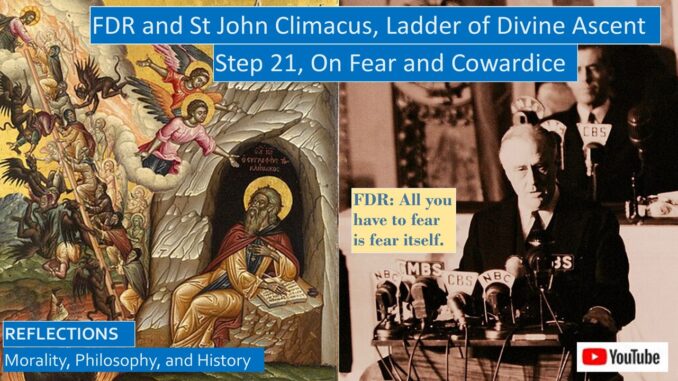
What can we learn from FDR, who, in his first Inaugural Address, proclaimed that all we have to fear is fear itself?
What can we learn from the courage shown by leaders such as FDR and Winston Churchill? What are some Biblical examples of fear and courage?
How do ancient fears differ from modern fears?
YouTube video for this blog: https://youtu.be/2p0GKgRjPkA
ST JOHN CLIMACUS ON FEAR AND COWARDICE, STEP 21
The chapter on fear is both one of the shortest and one of the most puzzling chapters of St John Climacus’ Ladder of Divine Ascent. In part, that is because there are many flavors of fears that spring from our most basal fears: the fear of the dark, the distressing, the dangerous.

More common are those fears that cause us to hesitate. Perhaps we fear what others think of us when we champion the good others do not see. Perhaps we fear rejection and failure. Perhaps we fear that past failures will rob us of future success. Perhaps we fear to do good when we are not encouraged.
As St John Climacus observes:
Step 21.3. “Fear is a rehearsing of danger beforehand; or again, fear is a trembling sensation of the heart, alarmed and troubled by unknown misfortunes. Fear is a loss of assurance.”
Father John Mack explains that “the kind of spiritual fear which St John is describing is reflected in the lives of the Apostles at Jesus’ Crucifixion. Their fear of the unknown, their fear of death, their fear of the power of the evil forces, their fear of public opinion kept them from following after Christ. They abandoned Christ in His Passion because they were afraid.”
Why was King Saul abandoned by God, while King David was esteemed by God? King David was clearly the greater sinner, as his affair with Bathsheba tore his kingdom apart. Before his kingship, Israel was on an upward trajectory, but afterwards Israel fell into a gradual political and spiritual decline.
When the Prophet Samuel came to anoint Saul as the first king of Israel, he was nowhere to be found. Scriptures tell us: “They inquired again of the Lord, ‘Did the man come hither?’ The Lord said, ‘Behold, he has hidden himself among the baggage.’”
But Saul had no reason to hide: his was an irrational fear. Because after they fetched him, they discovered that “when he stood among the people, he was taller than any of the people from his shoulders upward.”[1]

Why does St John Climacus associate cowardice with vainglory, which is sinful pride? Our saint defines and discusses vainglory in the next step on the Ladder of Divine Ascent.
Step 21.2. “Cowardice is a childish disposition in an old, vainglorious soul.”
Step 21.4. “A proud soul is a slave of cowardice; it vainly trusts in itself, and is afraid of any sound or shadow of creatures.”
Father Mack explains how cowardice and fear can lead to sinful pride. “When we follow Christ, for a while, by his grace, we achieve victory, accepting new challenges.” “As we begin, we rely on Him; our prayer life is active, our need for the sacraments is strong, our love for God is high.”
But later, “the intensity of our spiritual life begins to wane.” When we are no longer challenged, “our faith in God is gradually replaced by faith in self.” “But when a new challenge comes into our life, we are overwhelmed by fear! Why? It is our pride and self-reliance. Trusting only in ourselves, we suddenly realize how small and weak we are. Fear reigns!”
Father Vassilios Papavassiliou observes that although “fear is natural, it must be controlled.” What about irrational phobias? “I cannot say whether they are related to a lack of faith, or whether they can be controlled by faith alone. But fear in general can be a very destructive and oppressive force in one’s life. It can dictate our actions and decisions, governing our very lives. Some think Christianity is all about living in fear, but on the contrary, Christians are called to live a fearless life.”
Boethius asks, “Why are we frightened by fierce tyrants who rage without the power to harm us? He who hopes for nothing and fears nothing can disarm the fury of these impotent men; but he who is burdened by fears and desires is not master of himself.”[2]
St John Climacus observes:
Step 21.6. “Although all cowardly people are vainglorious, yet not all who are unafraid are humble, since even robbers and grave plunderers may be without fear.”
Are all of the cowardly vainglorious? We must remember that this classic was written for the monks struggling in the Egyptian desert monasteries; perhaps this is true for them, or perhaps the definitions have changed over the millennia. This step suggests that perhaps grave robbers were still ransacking the pyramids, or that it was still the custom for the prosperous to bury grave goods in their tombs.
St John Climacus encourages us to face and overcome our fears:
Step 21.7. “Do not hesitate to go late at night to those places where you usually feel afraid. But if you yield only a little to such weakness, then this childish and ridiculous infirmity will grow old with you. As you go on your way, arm yourself with prayer.” “When you get rid of the disease of fear, praise Him who has delivered you. If you continue to be thankful, He will protect you forever.”
You must confront your fears or they become part of you. If fear becomes part of you, you will not have a healthy spiritual life; indeed, you will not have much of a life at all. If fear becomes part of you, you may be held in solitary confinement, never seeing the sun, never feeling the rain, spending your life alone locked behind your front door.
What we in the modern world fear differs from what ancient Jews, Greeks, and Romans feared. The ancients feared that one day some hostile power would invade the land, defeat and pillage their city-state, massacre the military-age men, and enslave the women and children. A similar fear is felt today by the citizens of Ukraine and her neighbors.
Ancient Warrior Cultures, Concubines and Slaves, in Ancient Greece, Rome, and Israel
https://youtu.be/7QAZ_s6zw4E
https://seekingvirtueandwisdom.com/ancient-warrior-societies-blog-1-the-warrior-ethos-of-ancient-greece/
Ancient Warrior Societies, Blog 2, Greek and Roman Armies and Navies
https://seekingvirtueandwisdom.com/ancient-warrior-societies-blog-2-greek-and-roman-armies-and-navies/
Ancient Warrior Societies, Blog 3, World of the Old Testament
https://seekingvirtueandwisdom.com/ancient-warrior-societies-blog-3-world-of-the-old-testament/
Ancient Warfare in Ancient Greece, Rome, and Israel. Did Joshua Massacre Pagans in Promised Land?
https://youtu.be/9xKxqAbJ2qY
Ordinary Life for Romans Under Stoic Emperor Marcus Aurelius
https://youtu.be/9hgSbcgbCJw
https://seekingvirtueandwisdom.com/ordinary-life-for-romans-under-stoic-emperor-marcus-aurelius/
Ordinary Life and Justice in Ancient Athens, Rome, and Israel
https://youtu.be/vl8KGL5Yx2w
http://www.seekingvirtueandwisdom.com/ordinary-life-and-justice-in-the-ancient-world/
FDR’s INAUGURAL ADDRESS: ALL YOU HAVE TO FEAR IS FEAR ITSELF
What is our deepest fear in the modern world? It is the fear we will lose our job, not find another, run out of money, and be forced by circumstances to live in a camper in a park somewhere. We fear that we will not be able to save enough to retire comfortably.
The best example of facing this modern irrational fear is FDR’s rousing first inaugural speech, delivered in 1933, in the depths of the Great Depression, which begins with: “The only thing we have to fear is fear itself.”
It is hard to imagine the uncertainty and dread ordinary people felt in the dark days in the depths of the Great Depression. Many homeowners lost their homes, many workers lost their jobs, many people lost their life savings, many families went hungry, many teens left home to ride the rails as hoboes so their parents would not have to feed them. Most banks were insolvent, the banking system collapsed, the currency was worthless, and the country went on a barter system in the days before the Inauguration.
These are some memories of these dark days in William Manchester’s The Glory and the Dream: “Because poverty was considered shameful, people tried to conceal destitution from neighbors, often with considerable success. One could never be sure about the family across the street. The smartly dressed young lawyer who always left home at the same time each morning may have been off to sell cheap neckties, magazines, vacuum cleaners,” or whatever items he could acquire, “door-to-door in a remote neighborhood. He may have changed his clothes and gone to another part of the city to beg. Or he may have been one of the millions who looked for work day after day, year after year, watching his children grow thinner and fighting despair in the night.”
“There were certain skills developed by men who spent their days in the streets. You learned to pay for a nickel cup of coffee, to ask for another free cup of hot water, any by mixing this with the ketchup on the counter, to make a kind of tomato soup. In winter you stuffed newspapers under your shirt to ward off the cold. If you knew you would be standing for hours outside an employment office, you wrapped burlap bags around your legs and tied them in place.”
“Shoes were a special problem. Pasteboard could be used for inner soles, and some favored cotton in the heels.” “But if a shoe was really gone, nothing worked. The pavement destroyed the cardboard and then the patch of the sock next to it, snow leaked in and accumulated around your toes, and shoe nails stabbed your heels until you learned to walk with a peculiar gait.”[3]
In the month before the Presidential election of 1932, “the New York City Health Department reported that over twenty percent of public students suffered from malnutrition.” In the Appalachians, the rate of child malnutrition was sometimes over ninety percent, “with deprived children afflicted by drowsiness, lethargy, sleepiness, and mental retardation. A teacher suggested that one little girl go home and eat something. The child replied: ‘I can’t. This is my sister’s day to eat.’”
“Millions stayed alive by living like animals. In the Pennsylvania countryside they were eating wild weed roots and dandelions; in Kentucky they chewed violet tops, wild onions, wild lettuce, and weeds which previously had been left to grazing cattle. City mothers hung around docks, waiting for spoiled produce to be discarded and then fighting homeless dogs for possession of it.” “A cook in a midwestern hotel put a pail of leftovers in the alley outside the kitchen; immediately a dozen men loomed out of the darkness to fight over it.”[4]
Republican President Herbert Hoover was reluctant to implement broad welfare programs, and lost to the Democrat Franklin Delano Roosevelt by a landslide. “FDR carried 42 of 48 states,” “and won 472 electoral votes. The President-Reject Hoover, as the magazine Time cruelly called him, had but 59.” Although he was elected in November 1932, FDR would not assume office until Saturday, March 4, 1933.[5]
In the weeks before his inauguration, the banking system started to collapse. Many depositors withdrew their savings, demanding gold and currency. William Manchester writes: “Bank panics are always suicidal. In this crisis, they were preceded by three years of deflation. Even the soundest institutions held mortgages and securities which had fallen to a fraction of their former value. America’s banks had about six billion dollars in cash to meet forty-one billion in deposits, and bankers forced to liquidate mortgages and securities to raise cash would suffer heavy losses.”
“Banks everywhere were swarming with breathless depositors taking out cash. In the Bronx a young mother rented her baby, for a quarter a trip, to women who used it to claim preference at the head of withdrawal lines.”[6]
On the morning of the inauguration, the banks were closed. “The financial heart of the country had stopped beating. Banking in every state was wholly or partly suspended. Flags flew in Wall Street honoring the Inauguration, but the Stock Exchange was officially closed, and so, for the first time in eighty-five years, was the Chicago Board of Trade. In Manhattan, Norman Vincent Peale delivered a sermon demanding that bankers and corporation heads get down on their knees before God and confess their sins.”
At noon on Saturday, March 3, 1933, FDR was finally President. With his inaugural speech, Franklin Delano Roosevelt eased the fears of Americans, rich and poor, restoring their confidence that the government would face the challenges facing all Americans:
“Let me assert my firm belief that the only thing we have to fear is fear itself: nameless, unreasoning, unjustified terror which paralyzes needed efforts to convert retreat into advance.”
Manchester recounts: “The radio networks carried his ringing voice across the suffering land, over the sweatshops and flophouses, the Hoovervilles and hobo jungles, the rocky soil tilled by tenant farmers, the ragged men shivering in the iron cold outside factory gates.”
FDR continued: “I shall ask the Congress for” “broad Executive power to wage a war against this economic emergency, as great as the power that would be given me if we were, in fact, invaded by a foreign foe.”
On the next day, on Sunday evening, FDR announced that there would be a four-day banking holiday, and that Congress would be called into emergency session to approve the needed legislation to resolve the banking crisis.
In his Inaugural Address, FDR leveled with the American citizens:
“In a spirit” “of frankness and vigor” “on my part and on yours we face our common difficulties. They concern, thank God, only material things. Values have shrunken to fantastic levels; taxes have risen; our ability to pay has fallen; government of all kinds is faced by serious curtailment of income; the means of exchange are frozen in the currents of trade; the withered leaves of industrial enterprise lie on every side; farmers find no markets for their produce; the savings of many years of thousands of families are gone.”
FDR continues: “Yet our distress comes from no failure of substance. We are stricken by no plague of locusts. Compared with the perils which our forefathers conquered because they believed and were not afraid, we have still much to be thankful for. Nature still offers her bounty, and human efforts have multiplied it. Plenty is at our doorstep, but a generous use of it languishes in the very sight of the supply. Primarily this is because the rulers of the exchange of mankind’s goods have failed, through their own stubbornness and their own incompetence, have admitted their failure, and abdicated. Practices of the unscrupulous money changers stand indicted in the court of public opinion, rejected by the hearts and minds of men.”
St John Chrysostom is even more direct: When we do “not share our own wealth with the poor, we steal from the poor, depriving them of their means of life. We do not possess our own wealth but theirs. If we have this attitude, we will certainly offer our money; and by nourishing Christ in poverty here and laying up great profit hereafter, we will be able to attain the good things which are to come.”[7]
St Basil and many other Church Fathers agree. This message is most clearly seen in the Parable of the Rich Fool and Lazarus.
St John Chrysostom: Lazarus and the Rich Man: When Are the Poor Unworthy? On Wealth and Poverty
https://seekingvirtueandwisdom.com/st-john-chrysostom-lazarus-and-the-rich-man-when-are-the-poor-unworthy-on-wealth-and-poverty/
https://youtu.be/jOi6SNDlo74
Parable of Lazarus and the Rich Man: Church Fathers, Reformers, and Commentators
https://seekingvirtueandwisdom.com/parable-of-lazarus-and-the-rich-man-church-fathers-reformers-and-commentators/
https://youtu.be/zI-7IGuctkg
St Basil on Social Justice: Assisting the Poor During a Famine in a Roman Province
https://seekingvirtueandwisdom.com/st-basil-on-social-justice-assisting-the-poor-during-a-famine-in-a-roman-province/
https://youtu.be/c8YXs7y4RrU
Was St Basil WOKE? St Basil the Great On Social Justice, Parable of the Rich Fool
https://seekingvirtueandwisdom.com/was-st-basil-woke-st-basil-the-great-on-social-justice-parable-of-the-rich-fool/
https://youtu.be/UDQIZ81VfsY
Was St Basil Woke? Basil the Great On Social Justice, Homily To the Rich
https://seekingvirtueandwisdom.com/st-basil-the-great-on-social-justice/
https://youtu.be/PT_I5IrZGzY
FDR spoke of the failings of the rich:
“True they have tried, but their efforts have been cast in the pattern of an outworn tradition. Faced by failure of credit they have proposed only the lending of more money. Stripped of the lure of profit by which to induce our people to follow their false leadership, they have resorted to exhortations, pleading tearfully for restored confidence. They know only the rules of a generation of self-seekers. They have no vision, and when there is no vision, the people perish.”
“The money changers have fled from their high seats in the temple of our civilization. We may now restore that temple to the ancient truths. The measure of the restoration lies in the extent to which we apply social values more noble than mere monetary profit.”
FDR reminds us:
“Happiness lies not in the mere possession of money; it lies in the joy of achievement, in the thrill of creative effort. The joy and moral stimulation of work no longer must be forgotten in the mad chase of evanescent profits.”
FDR continues: “Recognition of the falsity of material wealth as the standard of success goes hand in hand with the abandonment of the false belief that public office and high political position are to be valued only by the standards of pride of place and personal profit; and there must be an end to a conduct in banking and in business which too often has given to a sacred trust the likeness of callous and selfish wrongdoing. Small wonder that confidence languishes, for it thrives only on honesty, on honor, on the sacredness of obligations, on faithful protection, on unselfish performance; without them it cannot live.”
FDR succeeded in reversing the fear that nearly took down the entire banking system. In the week before the Inauguration, hoarders had taken fifteen percent of the nation’s currency out of circulation. But by the Thursday after the Inauguration, “thousands of mattresses were torn open, cans were dug up, hidden boxes were opened. Banks everywhere reported large queues, reminiscent of the preceding week’s panic but comprised this time of men and women carrying briefcases.”
Manchester continues: “By Saturday night the Federal Reserve banks had recovered 300 million dollars in gold and gold certificates.” Savings banks were permitted “to release ten dollars to each depositor. Business began to stir. With a week three quarters of the country’s banks were back in business, and gongs were heard again in the stock exchanges. In New York, where stocks jumped fifteen percent, the Dow Jones ticker clicked off the message ‘Happy Days Are Here Again.’”[8]
This inspiring speech brings home many of the points brought out in St John Climacus discussion of fear, how terrifying fear can be, how we can only defeat our fears by confronting them, how fear sometimes must be confronted daily with courage and persistence before it is defeated.
We remember the words of Jesus in the Sermon on the Mount: Look at the birds of the air, they neither reap nor sow, but yet Our Father in Heaven looks after them. If He cares so much for them, how will He not care for you?[9] How much comfort do these words give us when we are unemployed and watching our bank account dwindle and debts balloon?
Jimmy Carter has memories of sharecropping, hoboes, the New Deal, and Civil Rights as they played out in the rural Georgia of his youth. He also reflected on what is was like to raise crops and livestock, and health and hygiene, in rural Georgia during the Depression.
Jimmy Carter, Memories of Sharecropping, Hoboes, New Deal, and Civil Rights in Rural Georgia
https://youtu.be/P8CCK4cGlVw
https://seekingvirtueandwisdom.com/jimmy-carter-memories-of-sharecropping-civil-rights-and-life-in-rural-deep-south-georgia/
Jimmy Carter, Raising Crops and Livestock, and Health and Hygiene, in Rural Georgia During the Depression
https://youtu.be/P8CCK4cGlVw
https://seekingvirtueandwisdom.com/jimmy-carter-raising-crops-and-livestock-and-health-and-hygiene-in-rural-georgia-during-the-depression/
Jimmy Carter’s Youth and Navy Years: From Plowing With Mules to Nuclear Submarines
https://youtu.be/em5snF_iKkE
https://seekingvirtueandwisdom.com/jimmy-carters-youth-and-navy-years-from-plowing-with-mules-to-nuclear-submarines/
Jimmy Carter: Christmas in Plains Compared to Christmas in the White House and Afterwards
https://wp.me/pachSU-1kv
https://seekingvirtueandwisdom.com/jimmy-carter-christmas-in-plains-compared-to-christmas-in-the-white-house-and-afterwards/
DEAR GOD: WHAT HAVE YOU DONE FOR ME LATELY?
Which of us, when our job is threatened, throw ourselves at God’s feet, asking for his Divine intervention to save us from destitution, and possible homelessness? I certainly have, and God may have put his thumb on my scales when I was hired for my last professional job, since it was in the nick of time, and it was my only offer.
Why did we select the Golden Calf episode for our thumbnail for this section? When the Jews were delivered from the hands of pharaoh, when confronted by the hardships of the desert, they became afraid, grumbling how they left the security of servitude in Egypt. When Moses climbed up the mountain to converse with God, again the Jews became fearful after he was gone for forty days, worried that Moses would never return. They then persuaded Aaron to erect a golden calf that they could worship. They let their petty fears overcome their Fear of God.
My church has many retirees, and every Sunday we pray for those who are sick and seek healing. But should healing be all there is for our Christianity? Should we expect that God will cure ourselves and our relatives whenever we fall ill? Should we show our anger and lose our faith in God when he does not answer our prayers and heal those close to us? Why does God allow us to suffer? Would a good prayer be like that prayer prayed in the Orthodox Liturgy: Asking God that today He will help us live our life free from sin? When we only ask for healing and prosperity, when we fail to ask that our two-fold Love for God and neighbor be increased, do we run the risk of asking God: What have you done for me lately?
Hillel and Jesus, Reflections on Rabbi Telushkin’s Observations
http://www.seekingvirtueandwisdom.com/hillel-and-jesus-reflections/
Comparing Hillel and Shammai to Jesus
http://www.seekingvirtueandwisdom.com/comparing-hillel-and-shammai-to-jesus/
More Stories and Sayings of Hillel and Shammai
http://www.seekingvirtueandwisdom.com/more-stories-and-sayings-of-hillel-and-shammai/
Jesus, Hillel, and Shammai, Loving God and Neighbor
https://youtu.be/ygxn2qqGnOI
In addition to worrying about retirement, we worry about aging and death. Sometimes the elderly seek to escape their suffering through suicide, though this was more prevalent in the ancient world where fewer pain-killing medicines were available. We can pray that God will slow the process of aging, but we will be disappointed if we pray for immortality.
YouTube Playlist on: Old Age and Retirement
https://www.youtube.com/playlist?list=PLJVlY2bjK8lhYGJAe3yctJqdRIWqwjtYm
SAUL’S FLAWED SACRIFICE: HE DID NOT WAIT FOR GOD’S PROPHET
Which Old Testament character allowed his fear of his enemies to override his Fear of God? When King Saul was nervous, wondering when the Philistines would attack Israel, he eagerly awaited seven days for Samuel to offer sacrifices to the Lord, blessing their battle. The seven days came, and the seventh day was getting longer. Like Jesus arriving too late to cure Lazarus, the Prophet Samuel was also late. Saul awkwardly offered the required sacrifices late in the afternoon, but as soon as he finished, he saw Samuel approaching on the horizon.
An angry Samuel said to Saul, “You have done foolishly; you have not kept the commandment of the Lord your God, which he commanded you; for now the Lord would have established your kingdom over Israel forever. But now your kingdom shall not continue; the Lord has sought out a man after his own heart; and the Lord has appointed him to be prince over his people, because you have not kept what the Lord commanded you.”[10]
There are other instances when the Patriarchs lost patience waiting for the Lord, fearing that life would not go their way, rushing God to fulfil His promise. After God promised Abraham that his descendants would be as numerous as the stars in the skies, many years passed, and his barren wife Sarah gave her handmaiden Hagar to Abraham, and she bore him Ishmael. This did not go well: after Sarah bore Isaac, she drove Hagar and Ishmael into the desert out of jealousy, where the Lord protected them.
Jacob was implicitly promised the birthright blessing his elder brother Esau despised. But Jacob and his mother Rebekah rushed the blessing, deceiving Isaac into blessing Jacob over Esau, initiating two generations of deception that ended when Joseph and the pharaoh invited the Jews to settle in Egypt, escaping a severe, multi-year drought.
FEARING OUR DEMONS VERSUS FEARING GOD
St John Climacus teaches us:
Step 21.11. “He who has become the servant of the Lord will fear his Master alone, but he who does not yet fear Him is often afraid of his own shadow.”
What does it mean to Fear God? Is Fearing God the same as Loving God? Does fearing God imply respect? Is respect a necessary precursor to love?
How we struggle to convey immortal ideals in mortal language. What does Scripture say about the Fear of God? In the Old Testament, Proverbs tells us that the “fear of the Lord is the beginning of knowledge,” (Prov. 1:7), and in the Psalms that we should “serve the Lord with fear” (Ps. 2:11). 1 Peter exhorts us to Fear God, but 1 John reminds us that “he who fears has not been made perfect in love.” (1 John 4:18).
One modern commentator notes that “fear in the good sense is a reverential trust in God. In the bad sense it is a sense of recoiling torment in the face of God. While proper fear brings a healthy respect for God, unwholesome fear engenders an unhealthy sense that He is out to get us. Perfect love casts out this kind of “torment.”[11]
Pope Francis teaches us:
“The fear of the Lord, the gift of the Holy Spirit, doesn’t mean being afraid of God, since we know that God is our Father who always loves and forgives us.” It “is no servile fear, but rather a joyful awareness of God’s grandeur and a grateful realization that only in him do our hearts find true peace.” “When the Holy Spirit lives in our heart, he instills consolation and peace in us.”[12]
We reflected on Pope Francis’ complete teachings on the Fear of God.
Pope Francis on the Healthy Fear of God
https://seekingvirtueandwisdom.com/pope-francis-on-the-healthy-fear-of-god/
St John Climacus observes:
Step 21.1. “If you pursue virtue in a monastery, you are not likely to be attacked much by cowardice. But the man who spends his time in more solitary places should make every effort to avoid being overcome by that offspring of vainglory, that daughter of unbelief, cowardice.”
There were three types of monks in the early monastic communities: solitary hermit monks, like St Anthony, who lived and prayed alone; hermit monks who met regularly for meals; and those monks who lived in a community under an abbot, which St John Climacus preferred. Sometimes the solitary hermit monks went mad in the harsh desert climate.
As laymen, this is another reminder that if we wish to live a godly life, we should be part of a faith community, that we should not try to be an island in a hostile ocean of unbelief, that we should faithfully attend the Divine Liturgy, that we should never lose faith.
John Climacus teaches us:
Step 21.10. “It is not darkness and desolateness of place that give the demons power against us, but barrenness of soul. And through God’s Providence, this sometimes happens in order that we may learn by it.”
But fear of the Lord gives us courage. St Anthony fearlessly faced the demons sent to terrorize him in the hot Egyptian desert.
Life of St Anthony, Blog 1, Sell all you have and give to the poor
http://www.seekingvirtueandwisdom.com/life-of-st-anthony-blog-1-sell-all-you-have-and-give-to-the-poor/
Life of St Anthony, Blog 2, Living a monastic life
http://www.seekingvirtueandwisdom.com/life-of-st-anthony-blog-2-living-a-monastic-life/
https://youtu.be/2sR8OCZqzFw
We live in a post-Freudian world where we no longer believe in demons. But post-Freud, haven’t the demons retreated into our subconscious, revealing themselves as neuroses, phobias, and psychoses? What about the many mental illnesses and conditions, where sufferers whose behaviors are created by mental forces they can no longer control?
There is no better example than dementia. If someone over seventy is behaving badly, lashing out at their loved ones and neighbors, sometimes making sexually inappropriate remarks, do they get a mulligan on their behavior? How can you be sure that it is not the early warning signs of dementia?
YouTube Playlist on: Dementia and Psychology
https://www.youtube.com/playlist?list=PLJVlY2bjK8lgYFj5b6w1OlsWkviazLeWX
St John Climacus reminds us that God takes a personal interest in our well-being:
Step 21.12. “In the presence of an invisible spirit, the body becomes afraid; but in the presence of an angel, the soul of the humble is filled with joy.” Therefore, when we feel this joy, “let us quickly hasten to prayer, for our good guardian angel has come to pray with us.”
CONCLUSION
St John Climacus teaches us:
Step 21.8. “Just as it is impossible to satisfy the stomach in one bout, so also it is impossible to overcome fear instantly. It will yield more quickly in proportion as you mourn; but to the extent that our mourning fails, we continue to be cowards.”
We encounter mourning often as we climb the Ladder of our life. Mourning on what could have been, mourning on the pain we have inflicted on others, mourning on the evil we see in the world, mourning on the happiness that should have been had people not been so cruel. Mourning, repentance, and forgiveness: these three will be with us all our life on earth.
Ladder of Divine Ascent, Remembrance of Death, Joy Making Mourning, and Despondency, Steps 6,7, & 13
https://youtu.be/pFwC2nDf1CQ
https://seekingvirtueandwisdom.com/ladder-of-divine-ascent-remembrance-of-death-joy-making-mourning-and-despondency-steps-67-13/
Why do we fear? Father John Mack teaches us that “sometimes we fail to follow Christ because we are afraid of what it will cost us. There is a cost for each step of the spiritual journey: a further detachment from the things of this world, a new step of faith and trust, a greater reliance upon Christ.”
St John Climacus, Ladder of Divine Ascent, On Detachment, Exile, and Pilgrimage, Steps 2 and 3
https://youtu.be/qDtrgYmaAQU
https://seekingvirtueandwisdom.com/st-john-climacus-ladder-of-divine-ascent-on-detachment-exile-and-pilgrimage-steps-2-and-3/
Father John Mack continues: “Other times we falter in our journey towards God because we are afraid of the reactions of others.”
“Other times we are afraid of our own inability to do that which God has asked us to do. Perhaps we have failed so many times in the past that we are afraid of failing again.”
There is another type of fear, the fear of speaking a necessary truth because it is unpopular. According to the Masoretic Hebrew text, Isaiah proclaims before the throne of God: “Woe is me! I am lost, for I am a man of unclean lips, and I live among a people of unclean lips; yet my eyes have seen the King, the Lord of hosts!”[13]
But St Jerome translated his Latin Vulgate from an earlier Hebrew translation, where Isaiah cries out in anguish and says, “Woe is me because I have held my peace,” or in the notes, “I have kept silent.”
St Jerome comments: “Because of his virtues, Isaiah deserved to enjoy the sight of God, and, because of his awareness of his sins, he confessed that his lips were unclean. Not because he had said anything contrary to the will of God, but because he had held his peace, deterred either by fear or modesty, and because he had not exercised the prerogative of a prophet, of condemning a sinful nation.” “If we keep silent about the truth, we are certainly committing a sin.”[14]
History of Hymn: Holy, Holy, Holy, Lord God Almighty
https://youtu.be/EroetX4pOeU
https://seekingvirtueandwisdom.com/history-of-hymn-holy-holy-holy-lord-god-almighty/
St John Climacus rightly finishes his discussion of cowardice:
Step 21.12. “He who has conquered cowardice has clearly dedicated his life and soul to God.”[15]
Soon after Saul’s botched sacrifice, the prophet Samuel anoints young David as the future king of Israel. But unlike Saul, David does not rush God’s timetable for his ascension. Twice he could have killed King Saul when Saul was pursuing David, seeking his life, and twice David proclaimed he would not harm the king whom God had anointed. 1 Samuel has eighteen chapters separating King Saul’s botched sacrifice and his death in battle; these chapters covered events lasting over a decade, which was a very long time in the ancient world, when most people died before they turned forty.
King Saul belatedly found some courage on his final battlefield. He disobeyed the Jewish moral code by asking the witch of Endor to conjure up the ghost of the prophet Samuel, who angrily revealed to Saul that he would give the Israeli army up to the Philistines, and that he would not survive the battle. Saul showed courage in leading his army in battle, but his was not a brave courage, as he did not charge the opposing king, seeking the glory ancient soldiers so often sought.
In First Samuel: “Saul said to his armor-bearer, ‘Draw your sword, and thrust me through with it, lest these uncircumcised come and thrust me through, and make sport of me.’ But his armor-bearer would not; for he feared greatly. Therefore, Saul took his own sword and fell upon it.”[16]
How would the ancient Jews hear this story? Contrast it with the story of Achilles in the Iliad. His mother, the goddess and sea-nymph Thetis, revealed that if he took up arms in the Trojan War, he would die a hero’s death on the battlefield.
The Iliad Blog 5, the Tide of Battle Turns Against the Greeks
http://www.seekingvirtueandwisdom.com/the-iliad-blog-5-the-tide-of-battle-turns-against-the-greeks/
The Iliad Blog 6, Embassy to Achilles, Oration, Failed Meeting
http://www.seekingvirtueandwisdom.com/the-iliad-blog-6-embassy-to-achilles-oration-failed-meeting/
The Iliad Blog 7, the deaths of Patroclus and Hector
http://www.seekingvirtueandwisdom.com/the-iliad-blog-7-the-deaths-of-patroclus-and-hector/
The Iliad of Homer: Glory, Honor, Madness and Futility of War
https://youtu.be/7lI2ZQ50wRc
The Warrior Cultures of the Iliad and the American Indian, Bravely Visiting the Enemy Camp
https://youtu.be/ynIx-AVI2f8
http://www.seekingvirtueandwisdom.com/iliad-blog-3-visiting-the-enemy-camp-greeks-vs-indians/
We can contrast Saul’s weak valor with that of Alexander the Great and Cyrus the Younger. Alexander won when his calvary unit charged the brigade unit surrounding King Darius, compelling him to flee the battlefield, winning the battle for Alexander against superior numbers. Likewise, Xenophon recounts how Cyrus the Younger charged the brigade surrounding the Persian king, but since he had little actual battlefield experience, his attempt failed in his death and his army’s defeat.
What would have happened had King Saul charged the brigade surrounding the king of the Philistines? Could God have changed his mind and granted him victory? But even in defeat, Saul would have won kleos, or glory in battle, that descendants could retell in campfire stories to their children for generations.
Xenophon’s Cyropaedia, Moral Sayings of Cyrus the Great, King of Persia
https://youtu.be/Y3ULbvPEmik
https://seekingvirtueandwisdom.com/xenophons-cyropaedia-moral-sayings-of-cyrus-the-great-king-of-persia/
Xenophon’s Anabasis: The Persian Expedition, an Ancient Adventure Story
https://youtu.be/DBG3JvyLP1E
https://seekingvirtueandwisdom.com/xenophons-anabasis-the-persian-expedition-an-ancient-adventure-story/
During World War II, Pope Pius XI showed courage when he smuggled copies of an encyclical condemning Nazi racial ideology into Germany to be read in Catholic pulpits on Palm Sunday.[17]
Mussolini’s Fascist Regime and the Catholic Church
https://youtu.be/LvNynEdZFuM
http://www.seekingvirtueandwisdom.com/mussolinis-fascist-regime-and-the-catholic-church/
Why did Hitler permit the evacuation of hundreds of thousands of Allied troops from the beaches of Dunkirk in the opening days of World War II? There were many reasons, but one may have been that Hitler thought the British would agree to leave the continent to the Germans as long as she could keep her empire. Winston Churchill bravely stated he would rather lose the British Empire than allow the Nazis to rule all of Europe indefinitely. In his first speech to Parliament as Prime Minister, he proclaimed that all he had to offer the English people was Blood, Toil, Tears, and Sweat in their efforts to defeat the Nazis.
After Dunkirk, when many feared the Nazis would cross the English Channel and invade England, Winston Churchill delivered his famous Fighting on the Beaches speech:
“Even though large tracts of Europe and many old and famous States have fallen or may fall into the grip of the Gestapo and all the odious apparatus of Nazi rule, we shall not flag or fail. We shall go on to the end. We shall fight in France, we shall fight on the seas and oceans, we shall fight with growing confidence and growing strength in the air, we shall defend our island, whatever the cost may be. We shall fight on the beaches, we shall fight on the landing grounds, we shall fight in the fields and in the streets, we shall fight in the hills; we shall never surrender.”[18]
St John Climacus: Ladder of Divine Ascent, Step 5, Repentance, and Perseverance of Winston Churchill
https://youtu.be/NiuWNsy4x4Q
http://www.seekingvirtueandwisdom.com/st-john-climacus-ladder-of-divine-ascent-step-5-repentance-and-perseverance-of-winston-churchill/
The BBC broadcasts on Christianity during World War II greatly encouraged the British people during the frightening Luftwaffe bombing raids on London and other British cities. These broadcasts were later summarized in his classic book, Mere Christianity.
Facing the Nazi Menace: CS Lewis’ Mere Christianity and Viktor Frankl’s Memoirs on Auschwitz, Books 1-4
https://seekingvirtueandwisdom.com/facing-the-nazi-menace-cs-lewis-mere-christianity-and-viktor-frankls-mans-search-for-meaning/
https://youtu.be/x-9FeH9Gyng
On the morning that Americans and their Allies stormed the beaches at Normandy, FDR led the nation in prayer:
“Almighty God: Our sons, pride of our Nation, this day have set upon a mighty endeavor, a struggle to preserve our Republic, our religion, and our civilization, and to set free a suffering humanity.”
“Lead them straight and true; give strength to their arms, stoutness to their hearts, steadfastness in their faith.”
We now assume that our victory over the Nazis in this invasion of France was inevitable, but had we not landed in weather so bad that it caught the enemy off-guard, our soldiers could have easily been thrown back into the sea.
We quoted FDR’s prayer for the troops in its entirety in a companion reflection.
Franklin Delano Roosevelt’s Prayer For Allied Soldiers Landing on the Beaches of Normandy
FDR concluded this prayer praying for courage, both among the American young men storming the beaches and their siblings and parents on the home front:
“Give us strength, too – strength in our daily tasks, to redouble the contributions we make in the physical and the material support of our armed forces.
And let our hearts be stout, to wait out the long travail, to bear sorrows that may come, to impart our courage unto our sons wheresoever they may be.”[19]
PAST AND FUTURE RUNGS OF THE LADDER
Each step of the Ladder of Divine Ascent builds on the prior steps, beginning with the first step, the renunciation of the world, which includes wise advice to laymen on how to live a godly life. This is followed by Detachment and Exile from the values of this sinful world, followed by the need for Obedience to the Law and the Gospel, and how we should be persistent in our Repentance, which we compared this struggle to the struggle of the Allies in fighting the Axis of Evil Fascism during World War II.
John Climacus: First Step of the Ladder of Divine Ascent
http://www.seekingvirtueandwisdom.com/st-john-climacus-first-step-on-the-ladder-of-divine-ascent/
https://youtu.be/Fco0W3bt5GA
St John Climacus, Ladder of Divine Ascent, On Detachment, Exile, and Pilgrimage, Steps 2 and 3
https://seekingvirtueandwisdom.com/st-john-climacus-ladder-of-divine-ascent-on-detachment-exile-and-pilgrimage-steps-2-and-3/
https://youtu.be/qDtrgYmaAQU
Ladder of Divine Ascent, St John Climacus, Rung 4 on Obedience
https://seekingvirtueandwisdom.com/ladder-of-divine-ascent-st-john-climacus-rung-4-on-obedience/
https://youtu.be/_bjQcNvzb-c
St John Climacus: Ladder of Divine Ascent, Step 5, Repentance, and Perseverance of Winston Churchill
http://www.seekingvirtueandwisdom.com/st-john-climacus-ladder-of-divine-ascent-step-5-repentance-and-perseverance-of-winston-churchill/
https://youtu.be/NiuWNsy4x4Q
This is followed by the steps on remembrance of death, joy-making mourning, and why we should battle despondency. We are then reminded that we should be free from anger, not holding grudges for the wrongs we suffer, and the strength of meekness. In the next step, we combat slander, lying, and gossip. In the step we reflect on gluttony and fasting, and also eating a healthy diet, which is a modern asceticism unknown to the ancient monks of Egypt.
Ladder of Divine Ascent, Remembrance of Death, Joy Making Mourning, and Despondency, Steps 6,7, & 13
https://seekingvirtueandwisdom.com/ladder-of-divine-ascent-remembrance-of-death-joy-making-mourning-and-despondency-steps-67-13/
https://youtu.be/pFwC2nDf1CQ
St John Climacus, Ladder of Divine Ascent, Freedom from Anger, Meekness, Remembrance of Wrongs, Steps 8 and 9
https://seekingvirtueandwisdom.com/st-john-climacus-ladder-of-divine-ascent-freedom-from-anger-meekness-remembrance-of-wrongs-steps-8-and-9/
https://youtu.be/2mEjh425sJk
St John Climacus in Ladder of Divine Ascent on Lying, Talkativeness, and Slander, Steps 10, 11 and 12
http://www.seekingvirtueandwisdom.com/st-john-climacus-in-ladder-of-divine-ascent-on-lying-talkativeness-and-slander-steps-10-11-and-12/
https://youtu.be/SLBIdDHRy3A
St John Climacus on Gluttony and Fasting, Ladder of Divine Ascent, Step 14, and Eating for Health: DASH diet
https://seekingvirtueandwisdom.com/eating-for-health-dash-diet-st-john-climacus-on-gluttony-and-fasting-in-ladder-of-divine-ascent/
https://youtu.be/KM0eMjE1fXc
This is followed by the steps on purity and chastity, on avarice and poverty, on insensibility, sleep, and prayer.
St John Climacus on Love, Lust, and Marriage: Ladder of Divine Ascent, Step 15, on Purity and Chastity
https://seekingvirtueandwisdom.com/st-john-climacus-on-love-lust-and-marriage-ladder-of-divine-ascent-step-15-on-purity-and-chastity/
https://youtu.be/YOlrP6-6YP0
St John Climacus, Ladder of Divine Ascent, On Avarice and Non-Possessiveness, Steps 16 & 17
https://seekingvirtueandwisdom.com/st-john-climacus-ladder-of-divine-ascent-on-avarice-and-non-possessiveness-steps-16-17/
https://youtu.be/8viBLzhjMrI
St John Climacus on Insensibility, Sleep, Prayer, and Vigil: Ladder of Divine Ascent, Steps 18-20
https://youtu.be/BDojtLhnPOY
https://seekingvirtueandwisdom.com/st-john-climacus-on-insensibility-sleep-prayer-and-vigil-ladder-of-divine-ascent-steps-18-20/
In the near future, after our reflection on pride and vainglory, we will reflect on cowardice, pride, and vainglory, and speculate on whether Step 23 ½ is really about mental illness, which was not well understood by ancient monks. And next we will reflect on meekness and humility, and then discernment. There are only four rungs of the ladder remaining after this.
DISCUSSING THE SOURCES
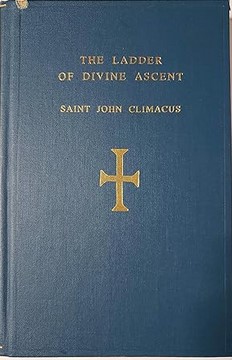
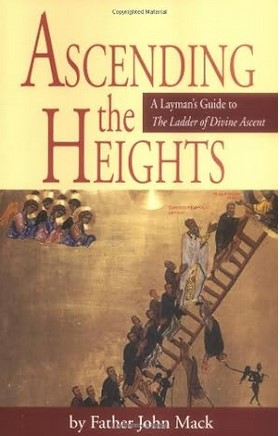
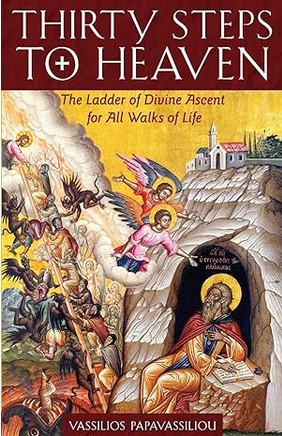
Both of these editions of the Ladder of Divine Ascent use the same translation, but each has its own thoughtful introduction, the introduction in the Classics of Western Spirituality is by Bishop Kallistos Ware. We find this work as easy to read as the works of the Stoic Philosophers that influenced Christianity and the monastic tradition, but we also have the commentaries by Father John Mack and Father Vassilios Papavassiliou, which are valuable because they reflect their experience as priests hearing confessions.
I read William Manchester’s Glory and the Dream many decades ago, and I remember his superb painting of the struggles many Americans faced during the Great Depression, and later when fighting the Second World War. His history reads like a novel, he is just a superb writer.
[1] https://www.biblegateway.com/passage/?search=1%20Samuel%2010%3A22-23&version=RSVCE
[2] Boethius, The Consolation of Philosophy, translated by Richard Green (Mineola, NY: Dover Publications, 1962, 2002, originally 524), Book 1, Poem 4, p. 7.
[3] William Manchester, The Glory and The Dream, A Narrative History of America, 1932-1972 (New York: Bantam Books, 1973, 1975), Chapter 1, The Cruelest Year, pp. 34-35.
[4] William Manchester, The Glory and The Dream, Chapter 1, The Cruelest Year, pp. 41-42
[5] William Manchester, The Glory and The Dream, Chapter 1, The Cruelest Year, pp. 53-54
[6] William Manchester, The Glory and The Dream, Chapter 2, Roosevelt, pp. 72-73.
[7] https://blog.acton.org/archives/18664-chrysostom-on-the-poor.html quoting St John Chrysostom, On Living Simply, Sermon XLIII, also in collection of essays, On Wealth and Poverty, https://www.oca.org/reflections/fr.-steven-kostoff/st.-john-chrysostom-who-is-the-poor-man-and-who-is-the-rich
[8] William Manchester, The Glory and The Dream, Chapter 2, Roosevelt, pp. 76-80 and the text of the Inaugural Address: https://avalon.law.yale.edu/20th_century/froos1.asp
[9] https://www.biblegateway.com/passage/?search=Matthew%206%3A26-30&version=RSVCE
[10] https://www.biblegateway.com/passage/?search=1%20samuel%2013%3A13-14&version=RSVCE
[11] https://defendinginerrancy.com/bible-solutions/1_John_4.18.php which is an excerpt from Norman Geisler and Thomas Howe, When Critics Ask: A Popular Handbook on Bible Difficulties (Wheaton, Ill.: Victor Books, 1992, 2014).
[12] https://www.ewtnnews.com/vatican/pope-fear-of-the-lord-an-alarm-reminding-us-of-whats-right and https://en.wikipedia.org/wiki/Fear_of_God
[13] https://www.biblegateway.com/passage/?search=isaiah%206%3A5-7&version=NRSVCE
[14] St Jerome, Against the Pelagians 2.24, Ancient Christian Commentary on Scripture, Old Testament, Volume X, Isaiah 6, p. 52.
[15] St John Climacus, The Ladder of Divine Ascent, translated by Lazarus Moore, updated by others (Boston: Holy Transfiguration Monastery, 1991), Step 21, pp. 130-132, and Father Vassilios Papavassiliou, Thirty Steps to Heaven, The Ladder of Divine Ascent for All Walks of Life (Chesterton, Indiana: Ancient Faith Publishing, 2103), Step 21, pp. 159-163, and Father John Mack, Ascending the Heights, Laymen’s Guide to the Ladder of Divine Ascent (Ben Lamond, California: Conciliar Press, 1999), Step 21, pp. 107-110.
[16] https://www.biblegateway.com/passage/?search=1%20samuel%2031%3A4-5&version=RSVCE
[17] https://en.wikipedia.org/wiki/Mit_brennender_Sorge
[18] https://en.wikipedia.org/wiki/We_shall_fight_on_the_beaches

2 Trackbacks / Pingbacks