Psalm 137: Should We Bash the Babylonian Babies? Spiritual and Historical Interpretations
Biblical Interpretation

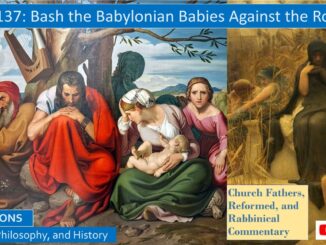
Psalm 137: Should We Bash the Babylonian Babies Against the Rocks? Spiritual and Historical Interpretations

Happy shall they be who take your little ones
and dash them against the rock!
Origen was one of the first Church Fathers who interpreted this troublesome verse allegorically, as did St Ambrose, who catechized and baptized the young St Augustine. Origen teaches us that “the little ones of Babylon, which signifies confusion, are those troublesome sinful thoughts that arise in the soul, and one who subdues them by striking their heads against the firm and solid strength of reason and truth, is the person who ‘dashes the little ones against the stones;’ and he is therefore truly blessed.”[2] Likewise, St Ambrose comments that we should “dash all corrupt and filthy thoughts against Christ.” […]

Psalm 71: Encouraging Us In Our Old Age
Biblical Interpretation

Psalm 71: Encouraging Us In Our Old Age

John Calvin speculates that David composed Psalm 71 after experiencing the trauma of losing the life of his son Absalom during his rebellion against him, which was sparked by the favoritism Davis showed towards his newly resented wife, Bathsheba. “The particular reference which David makes to his old age renders this conjecture not improbable.”
If so, this psalm should be a comfort to those who old age is lonelier due to mistakes, miscalculations or misfortunes occurring many years earlier. […]

Psalms 40 and 70: Deliver Both Young and Old from Suffering and Trials
Biblical Interpretation

Psalms 40 and 70: Deliver Both Young and Old from Suffering and Trials

St Ambrose rejoices: “Christ has heard the prayer of his own servants and has brought us out from the pit of misery and from the mire of dregs. We were drowning there; our whole flesh was clinging to the mire, trapped in the whirlpool of our sins. Our soul was powerless to save itself; fallen and ruined as it was by the multiplicity and dreadfulness of our offenses.”
St Ambrose continues: “Christ came to save us from the pit and slime of this world, from the mud and mire of this earth, from this body doomed to death.” “May that rock, which follows those who thirst, confirm the weak and unsteady; may that water never be lacking to those who long for it; and may that firm foundation never be wanting to those in danger of falling.” […]

Was St Paul a Former Slave
Biblical Interpretation

Was St Paul a Former Slave? Were His Parents Enslaved by the Romans?

Our authors in Christianity Today note that several prominent Biblical scholars in past 150 years have speculated that Paul’s parents were enslaved, perhaps in “the uprising in 4 BC, when Varus, Roman governor of Syria, burned entire cities and crucified 2,000 people. In Galilean cities like Sepphoris, Josephus wrote in Antiquities of the Jews, ‘troops made its inhabitants slaves.’” Furthermore, in St Jerome’s commentary on Philemon, written around the end of the fourth century, likely using Origen’s commentary as a source, states St Paul’s parents were Gischala in Judea, and were among the Jews exiled to Tarsus by the Romans. A few centuries later, St Photius, the scholarly bishop of Constantinople, confirms this, adding that St Paul was born to enslaved parents in Tarsus. These ancient sources are highly regarded by modern scholars. […]

Anders Nygren, On Christian Agape-Love and Eros-Love in Gospels and Pauline Epistles
Biblical Interpretation

Anders Nygren, On Christian Agape-Love and Eros-Love in Gospels and Pauline Epistles

Anders Nygren emphasizes that “Old Testament piety with its devotion to the Law was by no means the external legalism it is often assumed to have been. There was an inward bond that held the godly man to the Law. The righteous felt no sense of external compulsion when confronted by the Law, but a sense of inner solidarity with it. Its observance gave him value and made him acceptable to God. His prevailing mood was expressed in Psalm 1,” the Psalm that sings of Law as Gospel. […]

Q & A on Topic: Why Did You Leave Your Religion?
Biblical Interpretation

Q & A on Topic: Why Did You Leave Your Religion?

To the ancients who lived in a warrior culture, Stoic philosophy is very appealing. The Stoics don’t ask the question: Why do bad things happen to good people? Instead, they admit that good and bad things happen to everyone, that the rain falls on both the bad and the good. Bad things happen to good people, that is part of life. The real question is: How can God help us endure and prevail over our suffering? […]

Biblical Interpretation

Blessed Are the Poor, Woe to the Rich, and Other Woke Compassionate Bible Verses

Among the Church Fathers, St Ambrose teaches us,
“Blessed are the poor. Not all the poor are blessed, for poverty is neutral. The poor can be either good or evil,” unless he is the blessed pauper described by Proverbs 19:22, “’A righteous poor man is better than a rich liar.’ Blessed is the poor man in whom the prince of this world finds nothing. Blessed is the poor man who is like that poor Man who, although he was rich, became poor for our sake,” […]

Biblical Interpretation

Do Christians Need To Go To Church? Which Type of Church Should You Attend?

St Augustine’s memorable reflection on our question appear in his Confessions, which is really one of the first testimonials. St Augustine tells us the story of Victorinus, a philosopher who studies the Gospels and the Church Fathers but declines to attend services, asking “Do the walls of the Church make you a Christian?” Victorinus was a learned man, an erudite pagan Platonic philosopher, the Word of the Lord spoke directly to him from the page, perhaps he felt intellectually superior to many simple Christians he knew.

In the words of St Augustine, in his studies Victorinus became “resolute, he was seized by the fear that Christ might deny him before the holy angels if he was too faint-hearted to acknowledge Christ before men, and he felt himself guilty of a great crime in being ashamed of the sacraments instituted by the Word of God in his lowly state.” […]

Biblical Interpretation

St Augustine: On Christian Teaching, How To Read Scripture

St Augustine teaches, “Whoever thinks he understands the Holy Scriptures, or any part of them, but interprets them in a way that does not build up this two-fold Love of God and love of neighbor, does not truly understand the Scriptures. If, on the other hand, a man draws a meaning from Scriptures that builds up the two-fold Love of God and love of his neighbor, although he does not precisely understand the exact meaning of the author, his error is not pernicious, and he is wholly clear from the charge of deception.” […]

Biblical Interpretation

Biblical Interpretation in the Catholic Church, the 1994 Pontifical Biblical Commission Decree

Historically, the Catholic Church has defended itself from attacks, both real and imagined, from enemies of the faith, and this defensiveness also extended to Biblical studies. The twentieth century saw a relaxing of this defensiveness, culminating in the decree Dei Verbum pronounced by Vatican II, encouraging Catholic scholars to use more modern methods of interpreting the Scriptures, under the guidance of the Vatican office, the Pontifical Biblical Commission. […]