Plutarch’s Life and Works, Including His Greek and Roman Lives, and Moralia, His Stoic Sayings
Book Reviews and Miscellaneous

Plutarch’s Life and Works, Including His Noble Greek and Roman Lives, and Moralia, His Stoic Sayings

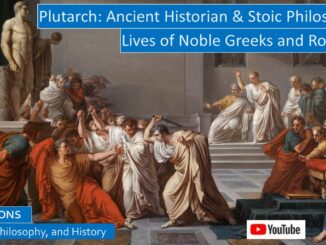
Over half of Plutarch’s Lives of Noble Romans influenced the history of the corrupt and violent last years of the Roman Republic, and the rise of the Roman Empire under Julius Caesar. Plutarch paired Greek and Roman lives based on their personalities and accomplishments. For example, Julius Caesar is paired with Alexander the Great, and the Greek companion to Cicero is Demosthenes, the renowned Greek orator who opposed Alexander the Great’s conquest of Greece. Plutarch used Xenophon as one of his sources for his lives of the Spartan Kings Agis and Agesilaus, Alcibiades, the lost life of Epaminondas of Thebes, and possibly Lycurgus of Sparta. The majority of Plutarch’s Roman lives featured the strivings of great men during the breakdown of the Roman Republic, and the subsequent struggles and civil wars that culminated in the reign of the first two emperors of the Roman Empire, Julius Caesar and Caesar Augustus, or Octavian.
Plutarch is more interested in highlighting the moral and character strengths and weaknesses of the famous men of history than he is in revealing how these great men influenced historical events. For this reason, you cannot consult only Plutarch for a complete historical review. We also consulted Will Durant’s account in his Story of Civilization, Volume 3, Caesar and Christ. Will Durant often quotes Cicero directly, and Plutarch is his primary source out of necessity. We also consulted the Wikipedia article on Cicero to fill in some background and details. […]

Stoic Quotes from Paul Harris, Founder of Rotary International
Philosophy

Stoic Quotes from Paul Harris, Founder of Rotary International

Early in its history, the Rotary Clubs adopted the Four-Way Test. The Rotary website states that “the Four-Way Test is a nonpartisan and nonsectarian ethical guide for Rotarians to use for their personal and professional relationships.
Of the things we think, say, or do:
Is it the TRUTH?
Is it FAIR to all concerned?
Will it build GOODWILL and BETTER FRIENDSHIPS?
Will it be BENEFICIAL to all concerned?”
The Four-Way Test is a restatement of the Golden Rule that is the core teaching of all Judeo-Christian traditions, encouraging fellowship among Rotarians.[3] The Four Way Test is a restatement of the Golden Rule that is the core teaching of all Judeo-Christian traditions, with an emphasis on developing fellowship with fellow Rotarians. […]

Polycarp, Christian Martyrs, and Stoic Philosophers: Dying the Good Death
Epictetus and Rufus

Polycarp, Christian Martyrs, and Stoic Philosophers: Dying the Good Death

Did the Christian martyrdoms and the Stoic view towards suicide both reflect the ancient Greek and Roman concern that the virtuous person should die the good death, facing death with courage, not fearing death?
What we are not concerned with is whether the Christian views towards martyrdom affected the Stoic views of suicide, or the reverse, or vice versa. How one influenced the other is both impractical to conjecture and impossible to prove.
We cannot assume that all Stoic philosophers enthusiastically condoned suicide. In the City of God, St Augustine opposed suicide in all cases. The Stoic Seneca obsessed about suicide because he spent his last few retirement years wondering when the evil Emperor Nero would send his sword-wielding soldiers to his estate to insist that he commit suicide. Like St Augustine, the Stoic philosopher Epictetus opposed suicide in most circumstances. […]

Cicero on Friendship and Virtue
Philosophy

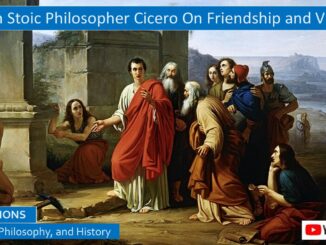
Roman Stoic Philosopher Cicero On Friendship and Virtue

Cicero advises us: “The first and sacred law of friendship: Seek only good from friends, do only good for the sake of friends, and don’t wait to be asked! Be always attentive! Banish hesitation! Be ready to give advice freely! Take seriously the good advice of friends. Be ready to offer it openly, even forcefully, if the occasion demands, and also be ready to follow when it has been offered.”
In contrast, Antisthenes, the first Cynic philosopher who studied under Socrates, advises us: “Pay attention to your enemies, for they are the first to notice your faults.” Often, friends are reluctant to tell us what we need to know, preferring to tell us what they think we want to hear. […]

Roman Stoic Philosopher Cicero on Aging and Death
Philosophy

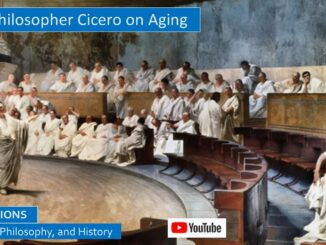
Roman Stoic Philosopher and Politician Cicero on Aging and Death

Cicero advises us: “Enjoy the blessing of strength while you have it, and have no regrets when it has gone, any more than young men should regret the end of boyhood, or those approaching middle age lament the passing of youth. Life’s course is invariable: nature has one path only, and you cannot travel along it more than once. Every stage of life has its own characteristics: boys are feeble, youths in their prime are aggressive, middle-aged men are dignified, while the elderly are mature. Each of these qualities is ordained by nature for harvesting in due season.”
Cicero continues: “Age must be overcome; its faults need vigilant resistance. We must combat them as we should fight a disease: following a fixed regime, exercising in moderation, and consuming enough food and drink to strengthen” but not too much. “The mind and spirit need even more attention than the body, for old age easily extinguishes them, like lamps” with too little oil. […]

Seneca on Aging Death and Suicide
Aging

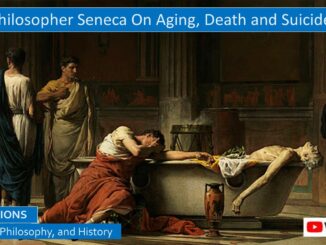
Roman Stoic Philosopher Seneca on Aging, Death, and Suicide

Seneca reminds us: “There is indeed a limit fixed to us,” “but none of us knows how near he is to this limit. Therefore, let us so order our minds as if we had come to the very end. Let us postpone nothing. Let us balance life’s account every day.” “Let us begin at once to live and count each separate day as a separate life.” What is important is “not how long you live, but how nobly you live. And often living nobly means that you cannot live long.” […]

Modern Stoic Philosophers: My Favorite Maxims: Viktor Frankl, Nelson Mandela, and Others
Philosophy

Modern Stoic Philosophers: My Favorite Maxims: Viktor Frankl, Nelson Mandela, and Others

Why don’t the Roman Stoics discuss justice as much as Plato? In the direct Radical Democracy of Athens, the citizens served on the juries and passed the laws, which meant that ordinary citizens participated in rendering justice. This is why Socrates sought to educate ordinary citizens on justice. But in the Roman Empire, the totalitarian Emperors and their servants were responsible for the administration of justice, the ordinary citizens no longer directly influenced the administration of justice. But that is not the case in modern America and most democracies, many ordinary citizens serve on juries and vote for many political officials, local and national. Justice should be our concern.
You can make a strong argument that Stoicism, like Judaism and Christianity, is founded on the two-fold Love of God and neighbor, that you should Love God with all your heart and all your soul and all your mind and all your strength and love your neighbor as yourself. Plus, we have the St Maximus the Confessor corollary, that we should be eager to forgive our neighbor. […]

Greek Stoic and Cynic Philosophers: My Favorite Sayings
Greek Philosophy

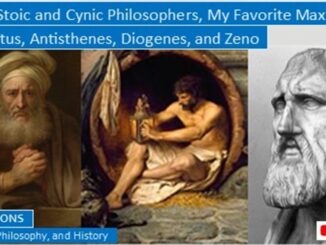
Greek Stoic and Cynic Philosophers: My Favorite Maxims: Heraclitus, Antisthenes, Diogenes, and Zeno

Diogenes was an exile in Athens who wanted to study under Antisthenes. Although Antisthenes threatened him with his staff, Diogenes was obstinate, he wanted to be his student, he shouted, “Strike, for you’ll not find wood hard enough to keep me away from you, as long as I think you have something to say.”
Diogenes noticed a mouse scurrying about in Athens, and he decided that, like the mouse, he would not be concerned about where he lived, so he lived in a tub, a large earthenware pot in the marketplace. When he saw a boy drinking water with his hands, he threw away the cup he owned, and later he threw away his bowl. He went barefoot even in the winter, his possessions consisted of a cloak and what he could carry in a knapsack.
Once, when traveling, he was captured by pirates and sold to a man who employed him to raise his sons to follow Cynic Philosophy. When his friends offered to ransom him from slavery, he refused, saying that “lions are not the slaves of those who feed them; it is the feeders, rather, who are the lions’ slaves. For fear is the mark of a slave, and wild beasts make men fearful.” […]

Major Roman Stoic Philosophers, My Favorite Maxims: Epictetus, Rufus, Seneca & Marcus Aurelius
Philosophy

Major Roman Stoic Philosophers, My Favorite Maxims: Epictetus, Rufus, Seneca & Marcus Aurelius

Many of the writings of the Stoics sound like passages from the Pauline Epistles. Indeed, Seneca was a contemporary of St Paul. There are epistles written between them, though nearly all scholars think they are spurious. Was St Paul inspired by the Stoic writings of Seneca? Although the Jewish rabbinic tradition was the primary source of inspiration for the Epistles and the Gospels, stoicism was an important secondary influence. In particular, stoicism deeply influenced the desert monastic tradition, which in turn influenced medieval monasticism. […]

Heraclitus, Pre-Socratic Philosopher, Inspiration for Stoics and Clement of Alexandria
Philosophy

Heraclitus, Pre-Socratic Philosopher, Inspiration for Stoics and Church Fathers

What can we learn from reflecting on the surviving fragments of Heraclitus, the Pre-Socratic Philosopher? Many of his pithy sayings inspired the later Cynic and Stoic Philosophers, and the Church Fathers, including Clement of Alexandria and Hippolytus of Rome. These sayings by Heraclitus include: “God is day and night, winter […]