
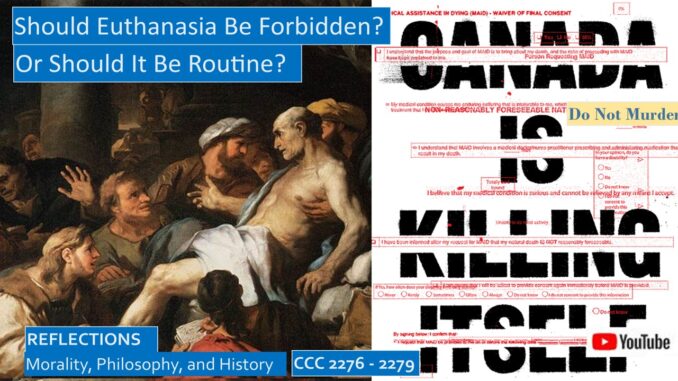
Should Euthanasia Be Forbidden? Or Should It Be Routine?
What are the teachings of the Catholic Church and Jewish Rabbis on euthanasia?
Who Do Proponents Refer to euthanasia as Death With Dignity?
Should euthanasia be an option for all people, including minors and those suffering from dementia or mental illness? What restrictions should be placed on euthanasia where it is permitted?
YouTube Video for this blog: https://youtu.be/RfF5hLEpXtA
DR JACK KEVORKIAN: DOCTOR OF DEATH
Those of us whose years exceed twice-twenty will remember Doctor Death, Jack Kevorkian, who declared: “Dying is not a crime,” and who constructed the Thanatron, or Death Device, whose button his suicidal patients pressed to inject death-delivering drugs into their veins. After Kevorkian’s medical license was revoked, cutting off his deadly drug supply, he constructed the Mercitron gas mask, which dispensed carbon monoxide so his suicidal patients could breathe in their last breaths.[1]

The formerly Doctor Jack Kevorkian assisted in over a hundred suicides between 1990 and 1998. Between 1994 and 1997, he was tried four times for murder, with three acquittals and one mistrial. Finally, in 1998, the charges stuck: he was charged and soon convicted of murder, serving eight years of a ten-to-twenty-five-year sentence. He was released on parole on the condition he would not participate or advise in an attempted suicide or promote the practice publicly. However, he did lecture extensively and grant media interviews where he discussed euthanasia and related topics.
Kevorkian was not silenced: he was not convicted of these parole violations. After his interview with Kevorkian, Dr Sanjay Gupta proclaimed: “This wasn’t just about assisted suicide; this was about upholding the ability for people to do whatever they wanted to do, without interference from doctors, the states or the federal government.”
Kevorkian claimed that all his patients had thorough mental health exams before their departures, and supposedly he turned down many patients. However, in a Detroit Free Press article, he was accused of being too quick to assist with suicides, and not adequately determining if someone was suffering from mental illness, or even if they truly suffered from a terminal illness. Gupta added: “For what it is worth, he never charged for his services.”
Kevorkian passed away from a blood clot in 2011 when he was 83 years old. Fortunately, no organized movement survived him.[2]
Many of Kevorkian’s patients suffered from Lou Gehrig’s disease, as did my mother, who passed away peacefully. We never remotely considered euthanasia. Lou Gehrig’s is a wasting disease, causing discomfort rather than pain, where the patient loses the use of their legs, and then their arms, and where the patient has trouble breathing near the end.
How was euthanasia practiced in the ancient world? In ancient Greece and Rome, infants with deformities were often exposed in the marketplace or in the woods, to be either picked and raised as slaves or devoured by wild animals. This practice was outlawed after the Roman Empire adopted Christianity. This was the most common form of euthanasia in the ancient world.
CATHOLIC CATECHISM FORBIDS EUTHANASIA
Whether or not you are Catholic, and I am not, the Catholic Catechism it is an excellent guide for the moral dilemmas we face in our modern world, since bishops the world over pondered, offering suggestions. Regarding euthanasia, the Catholic Catechism is firm: Euthanasia is NEVER condoned, no matter how much the victim is suffering from unending pain.
The Catechism proclaims:
2276. “Those whose lives are diminished or weakened deserve special respect. Sick or handicapped persons should be helped to lead lives as normal as possible.”
- “Whatever its motives and means, direct euthanasia consists in putting an end to the lives of handicapped, sick, or dying persons. It is morally unacceptable.”
The Catechism continues: “Thus, an act or omission which, of itself or by intention, causes death to eliminate suffering constitutes a murder gravely contrary to the dignity of the human person and to the respect due to the living God, his Creator.” In other words, the Catholic Church is not real fond of death machines.
“The error of judgment into which one can fall in good faith does not change the nature of this murderous act, which must always be forbidden and excluded.
However, the Catechism does permit halting overly heroic medical procedures:
2278. “Discontinuing medical procedures that are burdensome, dangerous, extraordinary, or disproportionate to the expected outcome can be legitimate; it is the refusal of over-zealous treatment. Here one does not will to cause death; one’s inability to impede it is merely accepted.”
“The decisions should be made by the patient if he is competent and able or, if not, by those legally entitled to act for the patient, whose reasonable will and legitimate interests must always be respected.”
The Catholic Church encourages the use of painkilling drugs for those eligible for hospice care:
2279. “Even if death is thought imminent, the ordinary care owed to a sick person cannot be legitimately interrupted. The use of painkillers to alleviate the sufferings of the dying, even at the risk of shortening their days, can be morally in conformity with human dignity if death is not willed as either an end or a means, but only foreseen and tolerated as inevitable. Palliative care is a special form of disinterested charity. As such it should be encouraged.”[3]
These paragraphs are followed by a discussion of suicide, which we reflected on previously. Summarizing: When priests field inquiries about suicide, how does the Catechism advise them to respond? In essence, if someone is contemplating suicide, they are told, in no uncertain terms, that if they commit suicide, they will be thrown straight into hell; they will not pass GO; they will not collect two hundred dollars. Emphatic condemnation will hopefully convince them not to attempt this heinous act so painful to those they leave behind.
But if someone inquires about a loved one who has committed suicide, the church is sympathetic and hopeful for their soul, since those who commit suicide are deemed to suffer from anguish and possible mental illness.
The opening chapters in St Augustine’s City of God discuss suicide, since so many Romans contemplated their horrible demise when their cities were sacked by barbarian invaders, who often burned down your house, stole your possessions, and raped your daughters and wives. Even for those facing these challenging times, St Augustine opposed suicide under any circumstances. St Augustine taught that rape was assault if the woman did not consent, and without consent, they were considered spiritually chaste and without sin.
Opposing Suicide: According to the Bible, Catholic Catechism, and St Augustine’s City of God
https://wp.me/pachSU-1sJ
https://seekingvirtueandwisdom.com/opposing-suicide-biblical-exhortations-catholic-catechism-and-church-father-teachings/
The Roman Stoic philosophers were more nuanced. St Augustine condemned Cato’s famous suicide when he refused to live under Caesar’s dictatorial regime, since it was pointlessly theatrical. Seneca obsessed over suicide, since he spent years in informal exile waiting for Nero’s soldiers to show up at his door to give him a choice between their sword and his suicide. Cicero lived under a similar cloud during the dying days of the Roman Republic.
Although Epictetus condemned suicide in most circumstances, he has some ambivalent remarks about it. Perhaps he condoned suicide in circumstances where pain became unbearable and inescapable in those ancient times where there were so few painkilling medications.
In my reflection on the philosophy of Epictetus, I remember how my mother, suffering from Lou Gehrig’s disease, welcomed slipping into a quiet demise on her own.
Roman Stoic Philosopher Seneca on Aging, Death, and Suicide
https://youtu.be/c9JXjqRKgBE
https://seekingvirtueandwisdom.com/roman-stoic-philosopher-seneca-on-aging-death-and-suicide/
Roman Stoic Philosopher and Politician Cicero on Aging and Death
https://seekingvirtueandwisdom.com/roman-stoic-philosophers-cicero-on-aging-and-death/
https://youtu.be/ne9T2N2mvZY
Epictetus, Eminent Stoic Philosopher, on Living Well, Dying Well, and Opposing Suicide
https://youtu.be/MDRCc8Gu4y8
https://seekingvirtueandwisdom.com/epictetus-eminent-stoic-philosopher-on-living-well-dying-well-and-opposing-suicide/
NAMI Speaker on Suicide Prevention, Sunrise Rotary, November 2025
https://youtu.be/2rm0i92XwS4
Rotary https://youtu.be/1N6HagRuZHs
In the ending summary, the Catholic Catechism concludes:
2324. “Intentional euthanasia, whatever its forms or motives, is murder. It is gravely contrary to the dignity of the human person and to the respect due to the living God, his Creator.”[4] Dignity is a key word in Second Vatican Catholicism.
The Catholic Catechism was followed by a much longer pastoral letter on Euthanasia in 1980. This discourse notes that in the ancient world, euthanasia had a different meaning: it meant an “easy death without severe suffering.”
The Pastoral Letter explains: “Ultimately, the word Euthanasia is used in a more particular sense to mean ‘mercy killing,’ for the purpose of putting an end to extreme suffering, or having abnormal babies, the mentally ill or the incurably sick from the prolongation, perhaps for many years of a miserable life, which could impose too heavy a burden on their families or on society.”
Furthermore: “The pleas of gravely ill people who sometimes ask for death are not to be understood as implying a true desire for euthanasia; in fact, it is almost always a case of an anguished plea for help and love.”
This pastoral letter reaffirms the teaching of the Catechism, and if you are facing this question, it is a valuable resource to ponder. The Pastoral Letter concludes: “Life is a gift of God, and on the other hand death is unavoidable; it is necessary, therefore, that we, without in any way hastening the hour of death, should be able to accept it with full responsibility and dignity.”[5]
RABBI JOSEPH TELUSHKIN ON EUTHANASIA
Rabbi Joseph Telushkin, in his book, Loving Your Neighbor As Yourself, discusses withholding treatment when death is certain, and also euthanasia, which confirms most of the Catholic teaching on these topics. Both believe that life should not be unnaturally extended by artificial means, and that death cannot be rushed. We highly recommend anyone facing these challenges to consult his reflections.
Our beloved rabbi remembers at length a heart-breaking communication with a son whose father told him he preferred death to the indignity of dementia. But the son just could not bring himself to break Jewish law to do the deed; he loved his father too much to honor his wishes, although his father had lost all of his memories, mistaking his family as strangers.
Rabbi Telushkin teaches us: “Judaism regards life to be immeasurably valuable.” “The Mishnah teaches us: ‘Whoever saves a single life, it is as if he saved an entire world.’” “God created humankind with only one person, Adam. Had he been killed, all humanity would have been destroyed; and, if he were saved, all humanity would survive. Because God deemed it worthy to create the world for the sake of one person, Judaism reasons that each person’s life, like Adam’s, is of infinite value.”
Jews view euthanasia as plain murder. Rabbi Moshe Feinstein wrote: “It is absolutely forbidden to do anything or to provide any drug that will shorten a patient’s life for even a moment. To do so would be an act of murder.” Rabbi David Bleich confirms: “No matter how laudable the intention of the person performing an act of mercy killing may be, it is still homicide.”
Rabbi Telushkin notes: “The Mishnah rules that it is forbidden to close the eyes of a dying person.” The Talmud comments that this would be “like touching the dying flame of a candle, and thereby extinguishing it.” “The one who does so is regarded as a shedder of blood.”[6]
AN ALTERNATE VIEW ON EUTHANASIA: DEATH WITH DIGNITY
Although active euthanasia is illegal in all fifty states, twelve states and jurisdictions permit physician assisted suicide, including California, New York, and New Jersey, and not including the former Confederate states.[7]
Another podcaster who has many compassionate end-of-life reflections, Hospice Nurse Julie, has a video on Death With Dignity where she discusses how euthanasia is administered in California. Of course, the laws vary among states that permit physician-assisted suicide.
In California, a patient has to jump through multiple hoops to qualify for physician-assisted suicide. A doctor needs to certify that they have only six months to live; two doctors must affirm that the patient is alert and is able to make their own choices; the patient must pass a psychiatric evaluation to determine if they are suicidal; and the patient must prove that they can take the medication themselves. As a practical matter, Alzheimer’s and Parkinson’s patients do not qualify, since their cognition and motor skills deteriorate so much near their end.
On the day selected for their demise, they first take some anti-nausea medication an hour before they swallow the bitter-tasting, death-dealing medication. About five minutes later they fall into a deep and permanent sleep. I don’t wish to encourage anyone to pursue death with dignity, so I will not repeat Hospice Nurse Julie’s closing remarks.[8]
IS LEGALIZED EUTHANASIA IN CANADA NOW ROUTINE?
The Atlantic magazine published a recent troubling article in 2025 titled: Canada is Killing Itself, with the subtitle: The country gave its citizens the right to die. Doctors are struggling to keep up with demand.
Canada has permitted euthanasia for the past decade. Elaina Plott Calabro covers the Euthanasia Conference held at a Sheraton Hotel in Canada, a networking event attended by about three hundred professionals. Now physician-assisted suicides account for five percent, or one out of twenty, deaths in Canada. This exceeds the deaths from Alzheimer’s and diabetes combined. Plus, Canadians are considering expanding the option of euthanasia to minors and those suffering from mental illness.
Calabro reveals: “There have been unintended consequences: Some Canadians who cannot afford to manage their illness have sought doctors to end their life. In certain situations, clinicians have faced impossible ethical dilemmas. At the same time, medical professionals who decided early on to reorient their career toward assisted death no longer feel compelled to tiptoe around the full, energetic extent of their devotion to euthanasia. Some clinicians in Canada have euthanized hundreds of patients.”
To summarize her longish article, with many troubling scenarios, we can only say that now, euthanasia is routine in Canada. Calabro reports: “The details of the assisted-death experience have become a preoccupation of Canadian life. Patients meticulously orchestrate their final moments, planning celebrations around them: weekend house parties before a Sunday-night euthanasia in the garden; a Catholic priest to deliver last rites; extended-family renditions of Auld Lang Syne at the bedside.”
How horrifying! How many patients were manipulated into early deaths by greedy relatives? How can we so readily celebrate the taking of a life? How can we be sure there are no innocent victims persuaded to pull the plug? How many of these exterminated patients could have beat the odds to live a long and fruitful life? We can never know.
Calabro reports: “When the question of medically assisted death had come before Canada’s Supreme Court, Etienne Montero, a civil-law professor and at the time the president of the European Institute of Bioethics, warned in testimony that the practice of euthanasia, once legal, would be impossible to control.” I must admit, I could only scan this article, I do not have the stomach to read it in detail.
What is crystal clear is that many professionals and patients in Canada have become accustomed to quick and easy death. Calabro also interviews those who are not, or who once were but who no longer support death by appointment. Many have regrets. In Canada, murky deaths are as many as they are routine.[9]
We have previously reflected on abortion. We dislike the terms pro-life and pro-choice. Pro-life implies that all their enemies are pro-death, and that is a slander. Likewise, pro-choice implies that these proponents wish to defy God’s commandments, which is another slander. We prefer the terms pro-compassion and pro-doctor, as abortion is a difficult and heart-wrenching issue.
A Democrat Christian Ponders Abortion and Morality
https://youtu.be/C4rH6qhhw70
http://www.seekingvirtueandwisdom.com/a-democrat-christian-ponders-abortion-and-morality/
Supreme Court Dobbs Case Overruling Roe v Wade: Should Christians be Pro-Compassion? Pro-Doctors?
https://youtu.be/Jb_vUFnAf3g
https://seekingvirtueandwisdom.com/supreme-court-dobbs-case-overruling-roe-v-wade-should-christians-be-pro-compassion-pro-doctors/
Regarding Abortion, Should Christians Be Pro-Compassion? Answering Questions, Further Reflections
https://youtu.be/ll9wOR0t2yQ
https://seekingvirtueandwisdom.com/regarding-abortion-should-christians-be-pro-compassion-answering-questions-further-reflections/
DISCUSSING OUR SOURCES
We have a video on how the Catholic and Lutheran Catechisms can be valuable guides on how to live a godly life. The footnotes of the Catholic Catechism are a roadmap to studying the writings of the Church Fathers from the ancient world to the current day.
The Decalogue, Vatican II, and the Catholic and Lutheran Catechisms
https://youtu.be/i8WXS7l4OzE
http://www.seekingvirtueandwisdom.com/who-should-study-the-catholic-catechism/
Rabbi Joseph Telushkin writes extensively on the moral lessons in the Jewish tradition. Both laymen and scholars will benefit from pondering his works.
[1] https://en.wikipedia.org/wiki/Euthanasia_device
[2] https://en.wikipedia.org/wiki/Jack_Kevorkian and https://www.cnn.com/2010/HEALTH/06/14/kevorkian.gupta/index.html
[3] https://www.vatican.va/archive/ENG0015/__P7Z.HTM dated 1993.
[4] https://www.vatican.va/archive/ENG0015/__P82.HTM
[5]https://www.vatican.va/roman_curia/congregations/cfaith/documents/rc_con_cfaith_doc_19800505_euthanasia_en.html
[6] Rabbi Joseph Telushkin, Love Your Neighbor As Yourself (New York: Bell Tower Publishers, 2009), Chapter 28. When Illness and Pain Make Life Intolerable, pp. 379-395.
[7] https://en.wikipedia.org/wiki/Euthanasia_in_the_United_States and https://en.wikipedia.org/wiki/Assisted_suicide_in_the_United_States
[8] https://www.youtube.com/watch?v=-Y-ghylLHYc
[9] https://www.theatlantic.com/magazine/archive/2025/09/canada-euthanasia-demand-maid-policy/683562/


Be the first to comment