
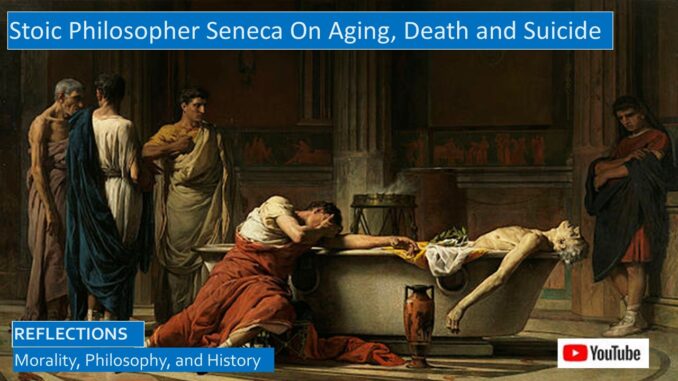
How can we benefit from the study of moral philosophy? Can studying philosophy help the elderly face death?
How did Seneca deal with the reality that in the last few years of his life, any day Roman soldiers could knock on his door demanding his life? How did Paulina, his wife, react to these soldiers knocking on their villa door?
How were Stoics able to meet death cheerfully? How can you prepare for death so you can meet it cheerfully?
Is death an evil, or is death neither good nor evil? Why doesn’t God listen to our prayers when our loved one is dying?
QUICK BIOPIC OF SENECA
Seneca was born in about the year 4 BC. Due to his wealth and family connections, he was elected to the Roman Senate. As part of his civil duties, he was appointed as tutor of the future Emperor Nero and was his chief advisor from AD 54 to 62. During the last part of his reign, as Nero became cruelly erratic, Seneca spent more time at his distant estates, going into semi-retirement.[1] During this voluntary exile, Seneca wrote over a hundred letters or Moral Discourses, where he is obsessed with how he will respond to the expected Roman soldiers when they finally knock on his door demanding his life.
Seneca lived during the time of St Paul. There is a purported collection of letters between them, but scholars universally agree they were fanciful, based in part on their content. Previously, we reflected on his Discourses on Aging and Retirement, plus we have several reflections on our favorite sayings of Seneca, and also our favorites of our favorite sayings of all Stoic philosophers.
Roman Stoic Philosopher Seneca on Old Age and Retirement
https://seekingvirtueandwisdom.com/roman-stoic-philosopher-seneca-on-old-age-retirement/
https://youtu.be/hmJoI9-s1q8
Seneca, Moral Epistles, Blog 1, Living Well, Dying Well
http://www.seekingvirtueandwisdom.com/seneca-moral-epistles-blog-1-living-well-dying-well/
Seneca, Moral Epistles, Blog 2, Stoicism and Living a Godly Life
http://www.seekingvirtueandwisdom.com/seneca-moral-epistles-blog-2-stoicism-and-living-a-godly-life/
Seneca, Moral Epistles, Blog 3, Loving Philosophy, Loving God, Loving our Neighbor
http://www.seekingvirtueandwisdom.com/seneca-moral-epistles-blog-3-loving-philosophy-loving-god-loving-our-neighbor/
Seneca, Moral Epistles, Blog 4, Stoic Concepts of Virtue and the Good
http://www.seekingvirtueandwisdom.com/seneca-moral-epistles-blog-4-stoic-concepts-of-virtue-and-the-good/
Seneca, Moral Epistles, Blog 5, On the Benefits of Friends and Keeping Score
http://www.seekingvirtueandwisdom.com/seneca-moral-epistles-blog-5-on-the-benefits-of-friends-and-keeping-score/
Seneca, Moral Epistles, Blog 6, Stoicism and the Golden Rule
http://www.seekingvirtueandwisdom.com/seneca-moral-epistles-blog-6-stoicism-and-the-golden-rule/
Seneca, Moral Epistles, Blog 7, Precious Stoic Nuggets of Wisdom
http://www.seekingvirtueandwisdom.com/seneca-moral-epistles-blog-7-precious-stoic-nuggets-of-wisdom/
Seneca the Younger, Roman Stoic Philosopher, Short Biography and Sayings
https://youtu.be/wgD8skYi3I0
Seneca: Stoic Sayings on Virtue, Friendship, Pleasure, Joy, and Philosophy
https://youtu.be/m4mcP2F9c4w
Major Roman Stoic Philosophers, My Favorite Maxims: Epictetus, Rufus, Seneca & Marcus Aurelius
https://seekingvirtueandwisdom.com/major-roman-stoic-philosophers-my-favorite-maxims-epictetus-rufus-seneca-marcus-aurelius/
https://youtu.be/E0qQgqGkoOE
SENECA ON THE IMPORTANCE OF STUDYING PHILOSOPHY
Seneca included a reflection on the importance of studying philosophy in his letter pondering The Natural Fear of Death, which means that this study can be comforting when we face old age and death, plus any suffering we may need to endure.
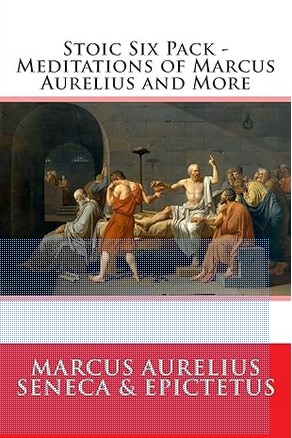
Seneca urges: “Leisure without study is death; it is a tomb for a living man. As if the real causes of our anxieties did not follow us across the seas! What hiding place is there, where the fear of death does not enter?”
“Therefore, gird yourself with philosophy, an impregnable wall. Though it be assaulted by many engines, Fortune can find no passage into it. The soul stands on unassailable ground, if it has abandoned external things; it is independent in its own fortress; and every weapon hurled at it falls short of the mark.”
Philosophy for most Stoics in the ancient world was first and foremost moral philosophy, or how we should love and seek the good, and love our neighbor as ourselves. Therefore, when Christians read the Stoics, they should include within the definition of philosophy the study of Scripture and the writings of the Church Fathers.
Hillel and Jesus, Reflections on Rabbi Telushkin’s Observations
http://www.seekingvirtueandwisdom.com/hillel-and-jesus-reflections/
Comparing Hillel and Shammai to Jesus
http://www.seekingvirtueandwisdom.com/comparing-hillel-and-shammai-to-jesus/
More Stories and Sayings of Hillel and Shammai
http://www.seekingvirtueandwisdom.com/more-stories-and-sayings-of-hillel-and-shammai/
Jesus, Hillel, and Shammai, Loving God and Neighbor
https://youtu.be/ygxn2qqGnOI
Seneca states that philosophy girds itself with “knowledge of self and of the world of Nature. The soul should know whither it is going and whence it came, what is good for it and what is evil, what it seeks and what it avoids. Reason distinguishes between the desirable and undesirable, taming the madness of our desires and calming the violence of our fears.”
Seneca explains: “Some men flatter themselves that they have checked these evils by themselves even without the aid of philosophy; but when some accident catches them off their guard,” then they confess their error. You might say to such men: “It was easy for you to challenge evils that were not nearby; but here comes pain, which you declared you could endure; here comes death, against which you uttered many a courageous boast!”
Seneca concludes: “Strength of heart will come from constant study, provided that you practice, not with the tongue but with the soul, and provided that you prepare yourself to meet death.”[2]
SENECA PONDERING DEATH AND POSSIBLY SUICIDE
For the last few years of his life, during the time when he was writing his Discourses, Seneca was compelled to live with the threat that, any day, Nero’s soldiers would come to his villa demanding his death. Because of this sword perpetually hanging over him, Seneca obsesses over death by suicide more than any other Stoic Philosopher.
Seneca declares: “No man can have a peaceful life who thinks too much about lengthening it, or believes that living through many consulships is a great blessing.” In more tranquil times, serving a one-year term as consul was the greatest honor a citizen could earn, but under a cruel emperor such as Nero, serving in a high office could lead to your death.
Seneca continues: “Rehearse this thought every day, that you may be able to depart from life contentedly; for many men clutch and cling to life, even as those who are carried down a rushing stream clutch and cling to briars and sharp rocks.” “Make life as a whole agreeable to yourself by banishing all worry about it.”[3]
Seneca is inspired by his good friend Bassus, “that noble man, shattered in health and wrestling with his years.” Fortunately, his mind was still active. “Philosophy bestows this boon upon us; it makes us joyful in the very sight of death, strong and brave no matter in what state the body may be, cheerful and never failing though the body fails us,” ready “to depart calmly when the inevitable hour arrives.”
“Other kinds of death contain an ingredient of hope: a disease comes to an end, a fire is quenched,” “the soldier draws back his sword from your neck. But those whom old age is leading away to death have nothing to hope for; old age alone grants no reprieve. No ending, to be sure, is more painless; but there is none more lingering.”
Seneca remembers his friend: “Bassus says it is as foolish to fear death as to fear old age; for death follows old age precisely as old age follows youth.” “If it falls to the lot of any man to be set gently adrift by old age, not suddenly torn from life, but withdrawn bit by bit, he should thank the gods, because after he has had his fill, he is removed to a rest which is ordained for mankind, a rest that is welcome to the weary.”[4]
Seneca reminds us: “Every day and every hour reveal to us how insignificant we are, and remind us with fresh evidence that we have forgotten our weakness; then, as we plan for eternity, they compel us to look over our shoulders at death.”
Seneca tells us the story of another acquaintance who met death suddenly. “After a comfortable dinner, he was suddenly seized with an acute attack of quinsy,” which was likely tonsilitis, “and with his breath clogged tightly in his swollen throat, barely lived until daybreak. So, within a very few hours” “he passed away.”
“There is indeed a limit fixed to us,” “but none of us knows how near he is to this limit. Therefore, let us so order our minds as if we had come to the very end. Let us postpone nothing. Let us balance life’s account every day.” “Let us begin at once to live and count each separate day as a separate life.” What is important is “not how long you live, but how nobly you live. And often living nobly means that you cannot live long.”[5]
DEATH IS NEITHER GOOD NOR EVIL, BUT IS INDIFFERENT
There are virtues and evils, but many aspects of life the Stoics, including Seneca, “classify as indifferent, neither good nor evil, including sickness, pain, poverty, exile, and death.” For example, “it is not poverty we praise, it is the man whom poverty cannot humble or bend.” “It is not pain we praise, it is the man whom pain has not coerced. One praises not death, but the man whose soul death takes away before it can confound it. All these indifferences are neither honorable nor glorious; but any of them can be made honorable and glorious when touched by virtue. The decisive question is whether wickedness or virtue has laid hold upon them.”
Although death itself is not evil, Seneca informs us that “it still has a semblance of evil.” We all possess a love of self that desires “existence and self-preservation,” but death robs us of our abundant material possessions “to which we have become accustomed.”
Seneca warns us: “Although death is something indifferent, it is not something we can easily ignore. The soul must be hardened by long practice, so that it may learn to endure the sight and approach of death.”
Seneca warns us: “Our mind will never rise to virtue if it believes that death is an evil; it will rise to virtue if it holds that death is a matter of indifference.” Man will be reluctant to “proceed to a destiny which he believes is evil.” “But nothing glorious can result from unwillingness and cowardice; virtue does nothing under compulsion.”
However, the Christian psychologist Paul Tournier counters that just because a Christian faces death with fear and trembling does not detract from their Christian witness, that many famous as well as ordinary Christians find Christ through their anxieties. We can infer that this is also influenced by our individual personalities and tendencies.
Classical Christian Psychologist Paul Tournier on Old Age, Death, and Faith
https://seekingvirtueandwisdom.com/classical-christian-psychologist-paul-tournier-on-old-age-death-and-faith/
https://youtu.be/gRaY2hTaEGk
What matters most is how we live our lives: Do we truly Love God and love our neighbor as ourselves?
Hillel and Jesus, Reflections on Rabbi Telushkin’s Observations
http://www.seekingvirtueandwisdom.com/hillel-and-jesus-reflections/
Comparing Hillel and Shammai to Jesus
http://www.seekingvirtueandwisdom.com/comparing-hillel-and-shammai-to-jesus/
More Stories and Sayings of Hillel and Shammai
http://www.seekingvirtueandwisdom.com/more-stories-and-sayings-of-hillel-and-shammai/
Jesus, Hillel, and Shammai, Loving God and Neighbor
https://youtu.be/ygxn2qqGnOI
Seneca is inspired by the bravery of the Three Hundred Spartan warriors blocking thousands of Persian soldiers at the Pass of Thermopylae. “The Spartans had no hope of victory, no hope of returning. The place where they stood would be their tomb.”
Bravely did the Spartan King Leonidas address his men! He said: “Fellow soldiers, let us eat our breakfast, knowing that we will sup in Hades!”
Keep in mind that the ancient Greeks, and many ancient Romans, believed that when you died your soul went to a quiet place called Hades where all souls, virtuous and evil, flitted about aimlessly, which is not the same as the Christian notion of Hell.
Seneca continues: “The food of these Spartans did not grow lumpy in their mouths, or stick in their throats, or slip from their fingers; eagerly did thy accept the invitation to breakfast, and to supper also!”[6]
The Greek historian Herodotus recounts that Xerxes sent a man on horseback to report back on the strength and activities of the Spartan force at Thermopylae. He was astonished to see some Spartans “stripped for exercise, while others were combing their hair.” Xerxes asked Demartus, a Greek in his service, what this meant, he answered, “It is the custom of the Spartans to pay careful attention to their hair when they are about to risk their lives.”[7]
SENECA ON MEETING DEATH CHEERFULLY
Seneca declares: “In my old age I have ceased to desire what I desired as a boy.” Now the “object of my thoughts is to put an end to my chronic ills,” one of his letters describes how he suffers from asthma, which must have been a terrifying ailment with few treatments available to the ancients. “I endeavor to live every day as if it were a complete life.” “I am ready to depart because I am not over-anxious as to the future date of my departure.”
Seneca continues: “Before I was old, I tried to live well; now that I am old, I shall try to die well; but dying well means dying gladly. See to it that you never do anything unwillingly.” “May we reflect upon our end without sadness.” “To have lived long enough depends neither upon our years nor upon our days, but upon our minds.”[8]
Some of us will be tortured with pain near the end of our days, though today hospice care can alleviate some of the pain, unlike for the ancients. Seneca hopes: “I should prefer to be free from torture; but if the time comes when it must be endured, I shall desire that I may conduct myself with bravery, honor, and courage.” “If I must suffer illness, I hope that I may do nothing which shows lack of restraint, and nothing that is unmanly. The conclusion is not that hardships are desirable, but that virtue is desirable, which enables us to endure hardships.”
Seneca then compares this to the brave struggle of Publius Decius Mus, who centuries before helped lead the Romans to victory in battle during the Latin War. “Decius sacrificed himself for the state; he set spurs to his horse and rushed into the midst of the foe, seeking death.” “Do you doubt whether it is best to die gloriously, performing some deed of valor? When one endures torture bravely, one is using all the virtues. Endurance may perhaps be the only virtue that is made manifest; but bravery is there too, and endurance and resignation and long-suffering are its branches.”
Seneca declares: “If I am tortured, but bear it bravely, all is well; if I die, but die bravely, it is also well.” “Nothing is more excellent or more beautiful than virtue; whatever we do in obedience to her orders is both good and desirable.”[9]
FAMOUS ROMANS WHO FACED SUICIDE OR THE FIRE
We could likely excuse Seneca’s suicide, since that alternative would have been worse: for his family to witness the more horrible sight of Roman soldiers plunging their sword through his flesh. To brace himself for this eventuality, he remembered several incidents in ancient Greek and Roman history where the heroes faced death with a Stoic mindset, seeking to die the good death if necessary.
Seneca is comforted by his thought: “Socrates in prison spoke to his friends, and declined to flee when certain persons gave him the opportunity. He remained there, in order to free mankind from the fear of two most grievous things, death and imprisonment.”
Both Plato and Xenophon wrote an Apology of Socrates’ trial and death, and Xenophon in particular was upset how his beloved teacher goaded the Athenian jury to condemn him to death, displaying a death wish. At his trial, Socrates actually had more votes condemning him to death than finding him guilty in the first place. Not only that, but a guard offered to let him escape to another town, and he declined.
We cannot really say that the Church Fathers would have approved of Socrates’ behavior in his last hours, noble though it appeared.
Trial of Socrates in Apology and Crito, Blog 1
http://www.seekingvirtueandwisdom.com/trial-of-socrates-in-apology-and-crito-blog-1/
Sentencing and Execution of Socrates in Apology and Crito, Blog 2
http://www.seekingvirtueandwisdom.com/sentencing-and-execution-of-socrates-in-apology-and-crito-blog-2/
Pondering the Death of Socrates in Xenophon, Plato, and Aristophanes
http://www.seekingvirtueandwisdom.com/pondering-the-death-of-socrates-in-xenophon-plato-and-aristophanes/
https://youtu.be/Mip1vgRKH1E
Plato: Euthyphro, Who Won’t Listen
http://www.seekingvirtueandwisdom.com/plato-euthyphro-who-wont-listen/
https://youtu.be/etK0eIpYPPg
Socrates, Aristophanes and The Clouds, Capitol Riots, Georgia, and the Big Lie
http://www.seekingvirtueandwisdom.com/aristophanes-socrates-georgia-and-the-capital-riots/
https://youtu.be/Pn7wYntimjo
Summary of Platonic Dialogues on Love and Friendship, With Commentary by Copleston and Anders Nygren
https://seekingvirtueandwisdom.com/summary-of-platonic-dialogues-on-love-and-friendship/
https://youtu.be/cjXRXQc6Ff4
Seneca also referred to an example known to most Romans of how, early in Rome’s history, the aristocrat Mucius volunteered to sneak into the enemy camp of the Etruscan King Porsenna to relieve his siege of Rome.
This is how the Roman historian Livy described his courageous act: “The Senate granted him permission, so Mucius started on his way, a dagger concealed in his cloak. Arriving at the Etruscan camp, he stood in the crowd, close to the raised platform where the king was sitting. A great many people were present, as it was payday for the army. By the side of the king sat his secretary, very busy; he was dressed much like his master, and, as most of the men addressed themselves to him, Mucius could not be sure who was the secretary and who was the king.”
Livy continues: “Fearing to inquire, lest his ignorance betray him, Mucius took a chance and stabbed the secretary. There was a cry of alarm; he was seized by the guards as he tried to force his way through the crowd with his blood-stained dagger and dragged back to where King Porsenna was sitting.”
He said to the king, “I am a Roman, and my name is Gaius Mucius. I came here to kill you, my enemy. I have as much courage to die as to kill. It is our Roman way to do and to suffer bravely. Nor am I alone in my resolve. Behind me is a long line of men eager for the same honor.”
Livy continues his account: “In rage and alarm, King Porsenna ordered the prisoner to be burnt alive.” “Mucius cried out: ‘See how cheap men hold their bodies when they care only for honor!’ He thrust his hand into the fire,” “and let it burn there as if he were unconscious of the pain.”
“Porsenna was so astonished by the young man’s almost superhuman endurance that he leapt to his feet and ordered his guards to drag him from the altar.” He shouted to the brave Roman Mucius: “Go free! You have dared to be a worse enemy to yourself than to me. I shall bless your courage.” “I, as an honorable enemy, grant you pardon, life, and liberty.”
King Porsenna was spooked when Mucius told him three hundred noble Romans were willing to follow his example. He then decided to make peace with the Romans and withdrew.
Seneca says this: “Mucius put his hand into the fire. It is painful to be burned; but how much more painful it is to inflict such suffering upon oneself! Here was a man of no learning, not primed to face death and pain by any words of wisdom, and equipped only with the courage of a soldier, who punished himself for his fruitless daring; he stood and watched his own right hand falling away piecemeal on the enemy’s brazier, nor did he withdraw the dissolving limb, with its uncovered bones, until his foe removed the fire.” “See how much keener a brave man is to lay hold of danger than a cruel man is to inflict it: Porsenna was more ready to pardon Mucius for wishing to slay him than Mucius to pardon himself for failing to slay Porsenna!”
In this incident, Rome was clearly defending herself, and from the point of view of the Stoic soldier, this was indeed a noble act that broke the siege that could have claimed numerous Roman lives. But there is no clear answer to the question: How could such an act advance the two-fold Love of God and neighbor?
Cato was a leading senator when Caesar crossed the Rubicon, entering Rome with troops loyal to him, overthrowing the corrupt Roman Republic. After accompanying the army that unsuccessfully challenged Caesar, Cato refused Caesar’s pardon.
Cato, after he put his affairs in order, drawing a sword, cried: “I have fought for my country’s freedom,” “to live among the free. Now, since the affairs of mankind are beyond hope, let Cato be withdrawn to safety.” “So saying, Cato inflicted a mortal wound upon his body. After the physicians had bound it up, Cato had less blood and less strength, but no less courage. Angered now not only at Caesar but also at himself, he rallied his unarmed hands against his wound and expelled that noble soul which had been so defiant of all worldly power.”
Metellus Scipio was a supporter of Cato who commanded a fleet off the coast of Africa opposing Octavian, his forefather had defeated the Carthaginians under Hannibal some generations previous. After he was defeated, he “pierced his body with a sword” rather than be captured. He told his sailors, “All is well with the commander,” and Seneca proclaimed: “It was a great deed to conquer Carthage, but a greater deed to conquer death.”
Neither of these suicides is justified by either Christians or by Epictetus, as Cato could have continued the political struggle and died a nobler death by the sword of Caesar’s soldiers than his own.
Seneca then offers advice that was echoes several millennia later by Franklin Roosevelt in his first inaugural address in the depths of the Great Depression, “The only thing we have to fear is fear itself!” Seneca advises us to “strip things of all that disturbs and confuses,” “you will then comprehend that they contain nothing fearful except the actual fear.”
“Have you only at this moment learned that death is hanging over your head, at this moment exile, at this moment grief? You were born to these perils.” “Do not drown your soul in petty anxieties, lest your soul be dulled and have little vigor left when the time comes for it to arise.”
Seneca continues: “We do not suddenly fall on death, but advance towards it by slight degrees; we die every day. For every day a little of our life is taken from us; even when we are growing, our life is on the wane. We lose our childhood, and then our youth.” “The final hour when we cease to exist does not of itself bring death; it merely completes the death process.”
Seneca emphasizes: “Epicurus upbraids those who crave death as much as those who shrink from death.” Epicurus says: “It is absurd to run towards death because you are tired of life, when it is your manner of life that has made you run towards death.” “What is so absurd as to seek death, when it is through fear of death that you have robbed your life of peace?” Sometimes, “men are so mad that through the fear of death that they force themselves to die.”
Seneca advises us to “strengthen our mind for the endurance alike of death and of life.” We should not “love or hate life too much. Even when reason advises us to make an end of it, the impulse is not to be adopted without reflection or at headlong speed.”[10]
This is where Christian morals differ from Seneca’s stoicism, one should never ponder suicide. In his City of God, St Augustine expressly condemns Cato’s suicide, since it was not necessary. If Cato told his son not to follow his example and cultivate his relations with Caesar, why couldn’t Cato? Caesar did guarantee that he would pardon Cato. Cato did not know for sure whether Caesar would or would not honor his pardon.
YOUTUBE
ROMAN HISTORIAN TACITUS ON THE DEATH OF SENECA
When there was an unsuccessful conspiracy to eliminate Nero, he moved against both the conspirators plus others, like Seneca, whom he no longer trusted. He ordered his Praetorian Guards to demand Seneca’s life. Seneca desired to read his will to his friends, but the centurion refused.
Seneca then told his friends: “Prevented from rendering thanks for your services, I leave you my one last, and most beautiful possession: the cast of my life.” Responding to their tears, he asked his friends: “Where are philosophy’s teachings, where is reason’s response to the future looming, pondered over so many years? Who is not familiar with Nero’s brutality?” Nero murdered his “mother and brother,” and now he “slaughters his teacher and guide!””
He then embraced Paulina, his wife, asking that she refrain from perpetual grief: “In contemplation of a well-lived life, endure your longing for your husband with honorable consolations.”
She answered, “Death is my intent too.”
“Seneca, who was not opposed to her glory and was also moved by love,” said, “To life’s comforts I would have pointed you, but you prefer death’s honor. I will not begrudge you a name. In this brave death, constancy may belong equally to both, but in your end, there is more renown.”
“Thereafter, with a single stroke of the sword, they let flow their arms.” Since Seneca’s aged body was slim from scanty diet, he bled slowly, so “they ruptured his shin and knee veins also. Worn out by cruel pains, lest he damage his wife’s courage with his suffering or himself lapse because of her torments, he persuaded her to withdraw into another room. He was eloquent even in his final moments.”
“Nero, having no hatred for Paulina, and lest antipathy for his cruelty grow, kept her from death. At the soldier’s urging, slaves and freedmen bound her arms and stopped the bleeding, she may have been unconscious.” “She lived a few years in praiseworthy remembrance of her husband, her face and limbs white to a pallor as she lost much of her vital spirit.”
“Seneca, with death still dragging and slow, requested” that a close friend “supply the poison prepared earlier. Seneca took it in vain, his limbs already cold, his body closed to the poison’s power. Finally, he entered a hot bath.” After he was “conveyed to a sauna, he expired in its heat and was cremated without a funeral.”[11]
Why was there no funeral? Perhaps if there were a funeral, those attending would attract Nero’s wrath as potential conspirators. Quite likely, Seneca’s suicide in these circumstances was excusable, but it was fortunate that his wife Paulina’s suicide attempt was thwarted, as it was not excusable according to Christian norms.
Cicero also reflected on aging, death, and retirement. Plutarch wrote a biopic on Cato, and also for Cicero, who was murdered by troops loyal to Mark Antony. The Roman Stoic Epictetus was a commoner who only faced the philosopher’s exile, and he stridently opposed suicide.
We have reflected on the classical Christian psychologist Paul Tournier’s reflections on Acceptance of Old Age, Retirement, and Death, and plan another short reflection for widows and housewives. Jimmy Carter also reflected on Aging and Retirement in his Virtues of Aging.
We will soon reflect on the common views of Stoics and early Christian martyrs on living the good life, and dying the good death, and on Biblical and Church Teachings on Suicide, Psychology and Suicide Prevention, and an Evangelical View on Aging and Retirement.
DISCUSSING THE SOURCE
Seneca was admired by many early Christians: the early Church Father Tertullian referred to him as “our Seneca.” His Moral Discourses, our source for his reflections on aging, death, retirement, and suicide, were written during his enforced retirement from Nero’s court, and are mostly easy to read, though the translation often is too wordy.
Please view our first video on Seneca’s views on Aging and Retirement for more comments on this source.
Roman Stoic Philosopher Seneca on Old Age and Retirement
https://seekingvirtueandwisdom.com/roman-stoic-philosopher-seneca-on-old-age-retirement/
https://youtu.be/hmJoI9-s1q8
[1] https://en.wikipedia.org/wiki/Seneca_the_Younger
[2] Seneca, Moral Discourses, in Stoic Six-Park – Meditations of Marcus Aurelius and More, translated by Richard Gummere, (Enhanced Media, 2014, first published 1925, originally 65 AD), Letter LXXXII, On the Natural Fear of Death, pp. 393-395.
[3] Seneca, Moral Discourses, Letter IV, On the Terrors of Death, p. 222.
[4] Seneca, Moral Discourses, Letter XXX, On Conquering the Conqueror, pp. 271-272.
[5] Seneca, Moral Discourses, Letter CI, On the Futility of Planning Ahead, pp. 487-489.
[6] Seneca, Moral Discourses, Letter LXXXII, On the Natural Fear of Death, pp. 393-395.
[7] Herodotus, Histories, translated by Aubrey De Selincourt (London, New York: Penguin Classics, 2003, 1954, originally Fifth Century BC), Book VII, Chapters 208-209, pp. 488-489.
[8] Seneca, Moral Discourses, Letter LXI, On Meeting Death Cheerfully, p. 324.
[9] Seneca, Moral Discourses, Letter LXVII, On Ill-Health and Endurance of Suffering, pp. 341-343.
[10] Seneca, Moral Discourses, Letter XXIV, On Despising Death, pp. 260-263, and Livy, The Early History of Rome, translated by Aubrey De Selincourt (New York: Penguin Books, 2012, 1960, originally 9 BC), 2.12-2.13, pp. 1221-123, and https://en.wikipedia.org/wiki/Quintus_Caecilius_Metellus_Pius_Scipio
[11] Tacitus, The Annals, translated by Cynthia Damon (New York: Penguin Classics, 2012, originally AD 116), Book 15, Chapters 60-64, pp. 333-335.


5 Trackbacks / Pingbacks