
Should Morality Trump Theology? Why We Are Not Reflections in Theology and Philosophy
Biblical Interpretation

Does Morality Trump Theology? Why My Channel Is Not Named Reflections in Theology and Philosophy

The main reason why I prefer the word Morality over Theology is that today most people use theology to prove why their denomination is the true religion; and is thus superior to all other denominations, especially if they are converts. However, I am reluctant to condemn this: doesn’t everyone want to cheer their chosen football team? Don’t all fans see their chosen team in the best light, while judging all others who hopefully will be on the losing teams this next season?
Mine is the Mere Christianity of CS Lewis. As an Episcopalian, you can be as Catholic, Orthodox, or Protestant as you want to be, it is the most ecumenical and tolerant of all the denominations, in my experience. […]

Psychology

Reflections on Mental Health Awareness, and Sunrise Rotary Speakers 2024/2025

What would happen if the demented patient is turned out in the street by the eviction? If a lost and wandering dementia patient is not found within two days, there is a one in four chance they will be found face down in a ditch or canal. But if someone is not looking for a demented patient, the odds are worse. […]

Book Reviews and Miscellaneous

My Favorite Reflections on Morality, Philosophy, and History

Scholars, like most everyone else, are social creatures, and are eager to please their teachers. This means they usually repeat the narratives they have been taught. Additionally, professors are often so hyper-specialized that they overlook connections to other fields. And, as Professor Steven Pinker noted, back in the day, professors dared not study consciousness until they attained tenure.
Is there anything new under the sun? What I hope to find is someone from the past who confirms my insights, because original insights are most valuable when they are old truths long forgotten, or connections are overlooked because prior generations were blind to how current events affected their views. Even when there is no direct confirmation, I sometimes find reflections from past generations that indirectly confirm, or at least do not disprove my perspectives.
For me, creativity is not a problem, so I prefer to include quotes from ancient and modern authors, to encourage my listeners to read them on their own. Why restate aphorisms in my own words when they are so inspiring when originally uttered? The eastern Church Fathers did not see a need to reword inherited ancient teachings, so why should I? […]

Cicero on Friendship and Virtue
Philosophy

Roman Stoic Philosopher Cicero On Friendship and Virtue

Cicero advises us: “The first and sacred law of friendship: Seek only good from friends, do only good for the sake of friends, and don’t wait to be asked! Be always attentive! Banish hesitation! Be ready to give advice freely! Take seriously the good advice of friends. Be ready to offer it openly, even forcefully, if the occasion demands, and also be ready to follow when it has been offered.”
In contrast, Antisthenes, the first Cynic philosopher who studied under Socrates, advises us: “Pay attention to your enemies, for they are the first to notice your faults.” Often, friends are reluctant to tell us what we need to know, preferring to tell us what they think we want to hear. […]

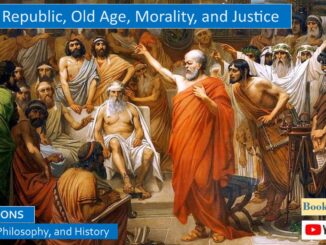
Plato’s Republic, Book 1, Reflecting on Old Age, Morality, and Justice
Aging

Plato’s Republic, Book 1, On Aging and Morality, a Better Word for Justice

Reading Robin Waterfield’s translation was like breathing fresh alpine air. When I thought that Plato’s Republic was about justice, I reasoned that this was because Socrates sought to train Athenians to be better citizens in a direct democracy, a skill that would not be needed in the later totalitarian Roman Empire. But Robin Waterfield’s translation of the Republic makes more sense and is more in line with Stoic and Christian moral values. I demur from the conventional scholarly opinion that who the translator is does not matter. […]

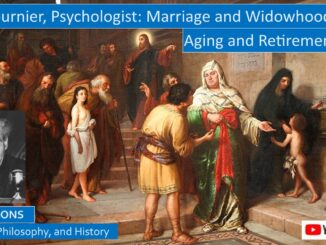
Paul Tournier, Christian Psychologist on Marriage and Widows in Old Age and Retirement
Aging

Paul Tournier, Christian Psychologist on Marriage and Widows in Old Age and Retirement

What is the ideal, according to Paul Tournier? “Growing old together, husband and wife can come to know a love which is, in a way, a prefiguration of heaven, for it is less tumultuous than the love of youth, being less directed towards selfish pleasure-seeking, and because a slow advance in mutual comprehension permits more authentic communication.” […]

Joys of Successful Aging, by Evangelical George Sweeting, Moody Bible Institute
Aging

Joys of Successful Aging, by Evangelical George Sweeting, Moody Bible Institute

George Sweeting writes: “Age adds maturity and richness to life. Age smooths the rough edges of life and adds gentleness and compassion. They say: ‘The older the violin, the sweeter the music.’ Some speak of seniors as ancient, faded, frail, shriveled, senile, withered, wrinkled, and worthless!” I prefer to say seniors are “experienced, dependable, mature, patient, seasoned, steady, wise, tested, survivor, and veteran!” […]

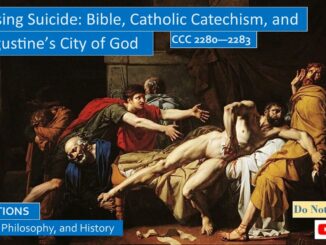
Opposing Suicide: According to the Bible, Catholic Catechism, and St Augustine’s City of God
Command 6 Do Not Murder

Opposing Suicide: Biblical Exhortations, Catholic Catechism, and St Augustine’s City of God

CCC 2281. “Suicide contradicts the natural inclination of the human being to preserve and perpetuate his life. It is gravely contrary to the just love of self. It likewise offends love of neighbor because it unjustly breaks the ties of solidarity with family, nation, and other human societies to which we continue to have obligations. Suicide is contrary to love for the living God.” […]

Epictetus, Eminent Roman Stoic Philosopher, on Living Well, Dying Well, and Opposing Suicide
Aging

Epictetus, Eminent Roman Stoic Philosopher, on Living Well, Dying Well, and Opposing Suicide

Is it wise to complain? Epictetus observes: “If someone dies young, he blames the gods because he is being taken before his time. If someone lingers on into extreme old age, he too blames the gods.” “Despite this, at the approach of death, he wants to stay alive; he sends for the doctors and begs him to do all he can.” “It is quite remarkable to see how people want neither to live nor to die.”
“Is health good and illness bad? No, man. What, then? Health managed well is good, but when badly managed, it is bad.”
Epictetus points out: “If you look at yourself in isolation, it is natural for you to live to an old age, to be rich, to be healthy. But if you look at yourself as a human being and as part of some whole, for the sake of that whole, it may be appropriate for you to be ill, or risk your life at sea, or be poor, or die young. Why get angry then?” “What is a human being? A part of a city made up of gods and human beings,” “a small copy of the universal city.” […]

Roman Stoic Philosopher Cicero on Aging and Death
Philosophy

Roman Stoic Philosopher and Politician Cicero on Aging and Death

Cicero advises us: “Enjoy the blessing of strength while you have it, and have no regrets when it has gone, any more than young men should regret the end of boyhood, or those approaching middle age lament the passing of youth. Life’s course is invariable: nature has one path only, and you cannot travel along it more than once. Every stage of life has its own characteristics: boys are feeble, youths in their prime are aggressive, middle-aged men are dignified, while the elderly are mature. Each of these qualities is ordained by nature for harvesting in due season.”
Cicero continues: “Age must be overcome; its faults need vigilant resistance. We must combat them as we should fight a disease: following a fixed regime, exercising in moderation, and consuming enough food and drink to strengthen” but not too much. “The mind and spirit need even more attention than the body, for old age easily extinguishes them, like lamps” with too little oil. […]