Should Euthanasia Be Forbidden? Or Should It Be Routine?
Command 6 Do Not Murder

Should Euthanasia Be Forbidden? Or Should It Be Routine?

Those of us whose years exceed twice-twenty will remember Doctor Death, Jack Kevorkian, who declared: “Dying is not a crime,” and who constructed the Thanatron, or Death Device, whose button his suicidal patients pressed to inject death-delivering drugs into their veins. After Kevorkian’s medical license was revoked, cutting off his deadly drug supply, he constructed the Mercitron gas mask, which dispensed carbon monoxide that his suicidal patients could use to breathe in their last breaths.[1]

The formerly Doctor Jack Kevorkian assisted in over a hundred suicides between 1990 and 1998. Between 1994 and 1997, he was tried four times for murder, with three acquittals and one mistrial. Finally, in 1998, the charges stuck: he was charged and soon convicted of murder, serving eight years of a ten-to-twenty-five-year sentence. […]


Should Morality Trump Theology? Why We Are Not Reflections in Theology and Philosophy
Biblical Interpretation

Does Morality Trump Theology? Why My Channel Is Not Named Reflections in Theology and Philosophy

The main reason why I prefer the word Morality over Theology is that today most people use theology to prove why their denomination is the true religion; and is thus superior to all other denominations, especially if they are converts. However, I am reluctant to condemn this: doesn’t everyone want to cheer their chosen football team? Don’t all fans see their chosen team in the best light, while judging all others who hopefully will be on the losing teams this next season?
Mine is the Mere Christianity of CS Lewis. As an Episcopalian, you can be as Catholic, Orthodox, or Protestant as you want to be, it is the most ecumenical and tolerant of all the denominations, in my experience. […]

Aging

Humorous Yet Serious Reflections on Facing Aging, Retirement, and Death

Epictetus advises us: “When the doctor pays you a visit, don’t be afraid of what he might say, and don’t be overjoyed if he says, ‘You are doing splendidly!’” Keep in mind that ancient doctors were not nearly as effective as doctors are today, who study and are supervised for over a decade before practicing medicine.
Epictetus continues: “Don’t be depressed if your doctor says, ‘You are doing badly.’” What does that mean? “It means that you are close to the separation of the soul from the body. What is there to fear in that? If you are not close now, you are going to be close later, aren’t you? Is the world going to come to an end when you die?”
His students asked him: “What if friends of mine in Rome die?” Epictetus answered, “Well, that is just the death of some mortal beings. Do you really expect to reach old age without seeing the death of any of those you love along the way?” […]

Psalm 1 Law as Gospel
Biblical Interpretation

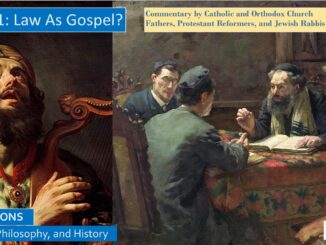
Psalm 1: The Law as Gospel? Church Fathers, Protestant Reformers, and Jewish Rabbis Comment

Rabbi Joseph Telushkin observes that, rather than describing what a “virtuous person does, the First Psalm describes what a virtuous person avoids: association with the wicked.” The assumption is “that bad companions generally assert a stronger influence than do good ones.” This psalm does not describe the righteous who avoid the wicked as good or wise. Rather, they are described as happy.” […]

Biblical Morality of Deceiving Those Who Suffer From Dementia In Order to Help Them
Biblical Interpretation

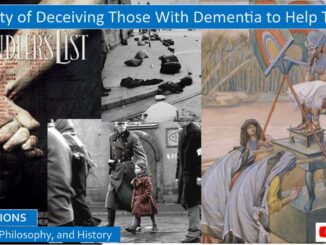
Biblical Morality of Deceiving Those Who Suffer From Dementia In Order to Help Them

Often adult children just do not want to lie to their parents. They want to empower them and involve them in the decisions about their care. They expect their parents suffering from dementia to reason with them, and that is impossible.

On rare occasions, you are compelled to tell a white lie for their own good. The commandment is not worded: Do not lie. Rather, it is worded: Do not bear false witness against your neighbor. In part, this reflects the reality that ancient jurisprudence relied heavily on eyewitness testimony, unlike modern jurisprudence that relies more on forensic evidence. […]

Mental Illness, Demons, and Free Will in the Bible and Ancient Israel, Greece, and Rome
Dementia and Alzheimers Disease

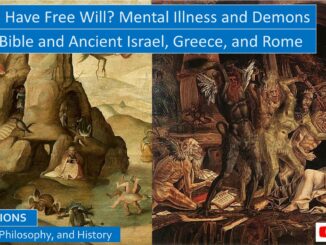
Do We Have Free Will? Mental Illness and Demons in the Bible, Church Fathers, and the Ancient World

Did the early Christians believe in free will? Or could demons rob them of their free will; just as dementia and mental illness rob modern patients today? The New Testament does not discuss whether we have free will, it simply accepts that we are subject to forces in the divine realm. Jesus often heals those who have lost their minds, driving out their demons. Also, St Paul in his epistles argues for divine determination, which St Augustine later develops into his doctrine of predestination. […]

St John Climacus on Demons, Blasphemy, and Mental Illness: Ladder of Divine Ascent, Step 23 ½
Ladder of Divine Ascent

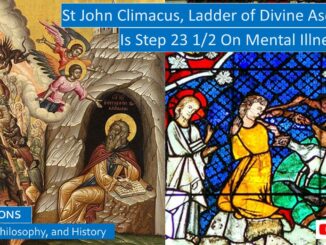
St John Climacus on Demons, Blasphemy, and Mental Illness: Ladder of Divine Ascent, Step 23 ½

We reflected on a puzzling section of St John Climacus’ step on his Ladder of Divine Ascent on first vainglory, then mad pride. He ponders how highly arrogant pride can lead to a type of madness that can lead to strange behavior. He wondered: Was this caused by demons? He recounts a puzzling situation where a monk starts cursing loudly in the middle of the Divine Liturgy.
However, our saint is reluctant to make a full-throated attack, as he likely sensed that his formerly devout monk was not in his right mind. When modern readers study this, they may wonder: Could this monk be suffering from Tourette’s syndrome, which involves involuntary cursing? Could this be symptomatic of dementia, or another mental illness or condition? These are the questions we will ponder in today’s reflection. […]