
Never in my life have I cried. Never. The closest I have come is slight tearing watching an extreme tear-jerking movie. But as far as breaking down with sobs, never.
Does mourning require tears? Can discomfort connote compassion?
For many years, I facilitated divorce support groups with the ubiquitous tissue boxes. Often women, and sometimes men, would weep profusely. I was vicariously sympathetic. When I tell people this, they say I should not keep my tears bottled up, I should let my emotions go. But there is nothing to let go. Truly, I have lived my life vicariously as a compassionate observer.
Consequently, I wondered, if someone facing death looked to me for comfort: Would I be able to comfort them? Would my consolations be beneficial?
This has only happened infrequently. Once, when I had a casual conversation at church with a successful engineer facing death, whose wheelchair bound was pushed by a black nurse. It seemed to me but a casual conversation, but his son later told me that whatever it was that I said, that it greatly eased his father’s anxiety.
Somehow the conversation wandered to my mother’s last moments. “Burt, my mother was suffering from Lou Gehrig’s disease, which is a kind disease: She was not in pain, nor did she lose her mind, she just lost the ability to walk, and later she could not move her arms. Because I was working and could no longer find aides to help with her daily life activities, I was compelled to find a place for her in a nursing home.”
“It was a typically chilly February day in Jacksonville, Florida. My mother caught pneumonia and was transported to the hospital next door. She stayed for a week, and all our family visited her. Although she was somewhat stable, she was not improving, but she told the night nurse that she really wanted to go home.”
“My mother now regarded as her home her humble bed in her shared rehab hospital room next door. So, the next day the nursing home contacted me so I could accompany her on the one-block ambulance trip.”
“When I arrived at the hospital, she was sleeping, she was tired, so we did not talk. I accompanied the attendant pushing her home on a gurney. We were met in the nursing home lobby by the head nurse. My mother then departed for a place in Elvis’ choir, which nobody noticed until we walked into her room.”
Horrified and panicked, the attendant looked at us both, insistently: “She died, she died! We have got to revive her! We must revive her!”
The nurse matched his insistence. “We can’t revive her! We cannot! She signed a DNR, she doesn’t want to be resuscitated!” (DNR means Do Not Resuscitate.)
The attendant was unconvinced. “But you don’t understand! We must revive her! We MUST!!!!”
The head nurse pushed back: “She signed a DNR! We are not going to revive her!”
The attendant was panicking: “You do not understand! She is the third patient who has died in my ambulance this month! My boss told me if another patient dies on my shift, I am going to lose my job! And I can’t lose my job!”
The head nurse finally calmed him down: “Look, she signed a DNR, her health was fragile. I promise you, I will call your boss and explain everything, this was not your fault.”
This was not the story that Burt was expecting. The ice broke, and both he and his black nurse started laughing. Death is just part of life. What happens next?
This is a true story. How can we tell? In the real world, life goes on. One example is the story of the seductress in The Graduate: What were holiday dinners like, when Dustin Hoffman and his bride shared turkey dinners with his cougar mother-in-law seductress and her father?
And so, the story continues. Residents of nursing homes are unsettled by the too frequent sight of the exceedingly polite, clean-cut men of slight build, wearing white shirts, black suits, and shiny black shoes, quietly pushing their body carts. He came by where my mother was, parked his cart there, but stopped nonplussed.
My mother was pure blood Scandinavian, and she was as slim as a Brunhilda could be. The short, slightly-built funeral director looked at me with imploring eyes, and quietly asks: “Could you please help me lift her? She is just dead weight.”
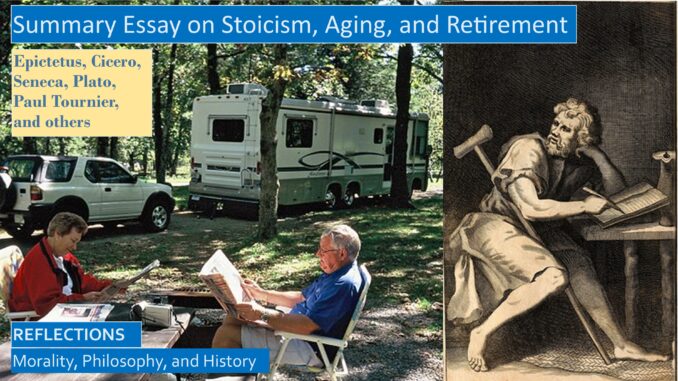
I have puzzled over this for many years, but finally found a possible explanation when reading the writings of the Stoic philosopher Epictetus: “I show myself to you as a trustworthy, self-respecting, honorable, and serene person. Do I mean that I shall show myself to be immortal, unaging, and immune to illness? No, but as one who is capable of dying and being ill with godlike dignity. That is within my power and capacity, but those other qualities aren’t.”[1]
Epictetus advises us: “When the doctor pays you a visit, don’t be afraid of what he might say, and don’t be overjoyed if he says, ‘You are doing splendidly!’” Keep in mind that ancient doctors were not nearly as effective as doctors are today, who study and are supervised for over a decade before practicing medicine.
Epictetus continues: “Don’t be depressed if your doctor says, ‘You are doing badly.’” What does that mean? “It means that you are close to the separation of the soul from the body. What is there to fear in that? If you are not close now, you are going to be close later, aren’t you? Is the world going to come to an end when you die?”[2]
His students asked him: “What if friends of mine in Rome die?” Epictetus answered, “Well, that is just the death of some mortal beings. Do you really expect to reach old age without seeing the death of any of those you love along the way?”[3]
Epictetus, Eminent Stoic Philosopher, on Living Well, Dying Well, and Opposing Suicide
https://seekingvirtueandwisdom.com/epictetus-eminent-stoic-philosopher-on-living-well-dying-well-and-opposing-suicide/
https://youtu.be/MDRCc8Gu4y8
I asked my pastor why I did not weep when my mother departed to sing with Elvis. He opined that since I was her caretaker, I had been facing death for many months, and had already processed these stages. Or perhaps different people simply process death differently, just as they process life differently.
Why did I not process through the Kubler Ross stages of grief? Why did I not feel denial, anger, bargaining, and depression? Why did I skip straight to acceptance? When reflecting on her book, On Death and Dying, I realized this was a thoroughly modern book,[4] that there are no echoes of such thoughts among the ancient Stoics. Death was a bigger part of life in the ancient world, the high infant mortality rate meant most people died before they were twenty. Death during childbirth was so common that Roman women often put their affairs in order when pregnant. But today, we can count on doctors for magical drugs and cures, today doctors protect us from premature death, and today, we can look forward to retirement.
Modern readers find Epictetus fatalistic when he warns us: “If you kiss a child of yours or your wife, tell yourself that you’re kissing a human being, because then you won’t be upset if they die.”[5] “Has your child died? It has been returned. Has your wife died? She has been returned.”[6]
Perhaps Epictetus refers to a newborn child as “it,” because many ancient parents would not immediately name their child, fearing they might quickly pass away. To understand the Stoic viewpoint, we must remember that the infant mortality rate in the ancient world was incredibly high: between a quarter and a third of infants died in their first year of life. Even for wealthy families, infant mortality was high.
Ordinary Life and Justice in Ancient Athens, Rome, and Israel
http://www.seekingvirtueandwisdom.com/ordinary-life-and-justice-in-the-ancient-world/
https://youtu.be/vl8KGL5Yx2w
For example, the Stoic Emperor Marcus Aurelius’ wife bore him fifteen children, but only six survived to adulthood.[7] He includes in his Meditations some fatalistic thoughts on how ancient parents can cope with this high mortality rate:
- “Pray not for some way to save your child, but for a way to lose your fear of this.
- Your children are like leaves. The wind scatters some of them on the ground; such are the children of men.
- As you kiss your son goodnight, whisper to yourself that he may be dead in the morning.”[8]
Ordinary Life for Romans Under Stoic Emperor Marcus Aurelius
https://seekingvirtueandwisdom.com/ordinary-life-for-romans-under-stoic-emperor-marcus-aurelius/
https://youtu.be/9hgSbcgbCJw
Kubler-Ross’ book contributed to the founding of the modern hospice movement in the 1970s, where specialists both administer medications to control pain and also counsel the patients and their families on the dying process; [9] possibly leading to greater acceptance of death, and perhaps a lesser need for her dying steps.
HOW ARE YOU DOING? FIRST RESPONSE FOR THE AGING
What should you say when you are past thrice-twenty, and someone asks, “How are you doing?” You can say you feel like Willie Nelson did when he sang:
“I woke up this morning, not dead yet again.”
Willie Nelson continues:
“The internet said I passed away.
If I died I wasn’t there to stay.”
“I ride up and down the road,
Making music as I go,
They say my pace would kill a normal man.
I have never been accused of being normal anyway,
I woke up this morning, not dead again today.”[10]
After leaving office, Jimmy Carter observed: “Experience is what you’ve got plenty of when you’re no longer able to hold the job.” He recalls: “I was just fifty-six years old when I was involuntarily retired from my position in the White House. What made losing the job even worse was that it was a highly publicized event, with maybe half the people in the world knowing about my embarrassing defeat!”
Jimmy Carter realized that, as ex-President, he still had considerable prestige that could be wielded for good. He had always been active in Habitat for Humanity, and as President he and Rosalyn had initiated many health, education, peace, and anti-poverty initiatives to better the lives of ordinary people, so why not continue these efforts? So, attached to his planned Presidential Library in Atlanta would be the offices of his non-profit Carter Center, initiating and continuing these many initiatives. In their retirement, both Jimmy and Rosalyn discovered they could earn healthy royalties from publishing books about their experiences, opinions, and future projects.[11]
Jimmy Carter offers encouragement that is especially helpful for those who retire: “It is a sign of maturity when we can accept honestly and courageously that frustrated dreams, illness, disability, and eventual death are all normal facets of a person’s existence, and that despite these, we can still continue to learn, grow, and adopt challenging goals.”[12]
Retirement can be especially challenging for those who face their retirement years alone, either because they are widows or widowers, or are divorced. It was sad to hear sweet woman in my divorce support meetings who mourned that they would not live out their happy retirement years with their husband who left them for one reason or another. Often men find they are estranged from at least some of their children although they had attempted to keep their marriage together.
Paul Tournier, Christian Psychologist on Marriage and Widows in Old Age and Retirement
https://seekingvirtueandwisdom.com/paul-tournier-christian-psychologist-on-marriage-and-widows-in-old-age-and-retirement/
https://youtu.be/5zqGYiX4LKg
Jimmy Carter does not offer much encouragement here, since he was fortunate to be married to his first wife whom he married when they were young. When I was a facilitator for my divorce support group, I simply observed that their relationships with their ex-spouse and children will either improve or decline, and that reconciliation usually means that everyone is slightly less angry and slightly more caring today than they were yesterday. Never give up, and keep reaching out for as long as you live.
What if you were not successful in your business career? Can you yet accomplish great achievements? Look on the bright side: The main advantage of drawing social security is you are no longer obligated to be a success. And you no longer have to worry about what you are going to be when you grow up. But if you are a man, and perhaps a woman, whether you are seventy or seven, you must run your water over the log,[13] or in the bowl, before traveling.
Both Jimmy Carter and Paul Tournier suggested many ways in which those of us who are retired can give back to the community, Jimmy Carter suggested various charities who appreciate the efforts of volunteers. Also, AARP accepts volunteers. Another way to give back to the community is to join a local Rotary Club, my main regret is that I did not join decades earlier.
History and Philosophy of Rotary International, and My Personal Experience
https://seekingvirtueandwisdom.com/history-and-philosophy-of-rotary-international-and-my-personal-experience/
https://youtu.be/gN6tb3YawI0
I also volunteered to serve as Treasurer of my over-55 Condominium Association. We nearly foreclosed on an owner with advanced dementia with no family, and no money. Nobody pitied him; many of his neighbors were turned off by his demented behavior.
How I Halted a Foreclosure on a Destitute Owner with Advanced Dementia! We Discuss Dementia
https://seekingvirtueandwisdom.com/how-i-halted-foreclosure-on-owner-with-advanced-dementia-reflecting-on-dementia/
https://youtu.be/_uAJPCCRNQ8
NOTE TO EDITOR: This can be expanded to a more consequential essay, but to entice the Alzheimer’s Association, for which I am a volunteer, to pay attention and provide quotations, I need the credibility of recent publication, or to have the article “assigned” to me.
What would have happened to him if the foreclosure had proceeded? Quite likely, upon eviction, the local police would likely have referred him to the appropriate agency, who would then place him in a lockdown facility.
But what would have happened to him if the police showed no pity? Experts warn that if someone suffering from dementia wanders off, and they are not found in two days, there is a one in four chance that they will drown in a canal or a ditch.[14]
Why Are Dementia Patients Who Wander So Drawn to Water? Why Do They Drown?
https://seekingvirtueandwisdom.com/why-are-dementia-patients-who-wander-so-drawn-to-water-why-do-they-drown/
https://youtu.be/aZMgG1YzpD0
Are we are brother’s keeper? Cain asked this question after he murdered Abel. The Lord answered that YES, unfortunately, or fortunately, he was his brother’s keeper. But many property managers and board members often have no pity. They say they are running a business, not a nursing home.
Do Not ENVY: Teachings from the Medieval Rabbis: Rashi, Rambam, Ramban, and the Talmud
https://seekingvirtueandwisdom.com/the-decalogue-in-the-torah-blog-4-coveting-the-sin-that-leads-to-many-other-sins/
https://seekingvirtueandwisdom.com/the-decalogue-in-the-torah-blog-5-coveting-tempts-you-to-harm-your-neighbor/
https://youtu.be/TOJr5J7N9Xc
How can we help these poor demented souls who have even fewer friends than me? In Florida, property managers are required to take a professional CAM exam and attend annual professional education classes, and board members of condominium associations attend classes each year also. Perhaps we could persuade the legislatures to require that they learn the basics of dementia and mental illness, including schizophrenia and autism, and most importantly, who to call local for assistance.
Lobbying the Florida Legislature to pass this law could be an achievable goal for our humble advocacy group, Advocates for Mental Illness and Community Associations, and even if we don’t succeed, we will successfully the public on how to love their neighbors, even when they have dementia, or are mentally ill. We could also submit articles to local, regional, and national media, and sponsor Health and Wellness education seminars through the Rotary and other organizations. Maybe we can get into the pages of the Atlantic Magazine. That would be better than being on the cover of the Rolling Stone![15]
The Christian psychologist Paul Tournier, in Learn To Grow Old, is grateful for his retirement plans: “As an intellectual, I am specially privileged. It is true that the better educated people are, the more chance they have to enjoy their retirement. First, intellectual work” is not physically taxing. “Second, the capacity for intellectual work is retained longer than physical ability. It can even increase in old age as long as disease does not affect the mental faculties. But most of all, the more one exercises one’s mind, the more pleasure it gives to exercise it. The more one learns, the more one wants to learn, and the easier study becomes.”
During the years before I retired, I bought books that I could study during retirement, books that would improve my soul, books that would increase my compassion for my neighbor. I don’t buy books merely for entertainment, though I do occasionally read books for pleasure. Quite often, when I pick these books off the shelf, I find myself buying other books they recommend or footnote to provide background. We include books on history because you cannot truly comprehend philosophy and theology unless you have a basic understanding of the historical times in which they developed and evolved over the centuries.
Our Reflections on Morality, Philosophy, and History: Ancient and Modern Classics
http://www.seekingvirtueandwisdom.com/our-philosophy-for-this-blog-reflections-on-ancient-and-modern-classics/
https://youtu.be/Si0TsO5bNr0
Paul Tournier warns: “The problem of boredom merits our full attention, such is the suffering it brings to the hearts of many of the old.”
“Retired people are divided into two quite distinct categories.” “The one consists of people who enjoy their retirement wonderfully, spontaneously find useful and interesting things to do, and are never bored. The others are like a car that has broken down. Without that motive power in their lives provided by work, they are depressed, resigned, or in revolt.” “The first group do not need us and our advice.” “But how difficult it is to advise and help the other group!”
Paul Tournier observed from his counseling practice: “The kindly person becomes kinder as he advances in age. The critical person never stops grumbling.” “Grumbling when old is weakness and causes enfeeblement. Complaints, regrets and worry, when they go along with a feeling of impotence, become obsessive.”
“Therefore, if one’s old age is to be happy, there must be a change of attitude. This inner reformation should take place early. The task of the doctor is not merely to cure the disease, but to help the patient become aware of his problems and resolve them while there is still time.”
Paul Tournier speaks from his experience as a counselor: “Reforming lives, however, is no small matter! The vicious circles are powerful. To break them requires more than advice and good intentions. It requires an inner revolution, a decisive turn-around, as sort of conversion.”[16]
Paul Tournier observes: “There are old people who struggle to continue their professional career, which they will certainly have to give up one day.” Not certainly, my doctor is over seventy and has no plans to retire. He keeps up with his profession, and he has many interns that refresh his knowledge constantly.
Unfortunately, “there are others who turn in upon themselves in idleness and boredom, in a sort of resignation from real life and from society. There are yet others who fill the void left by their retirement with so-called leisure activities which do not always suffice to give meaning to their lives, so long as they remain mere distractions.”[17]
Classical Christian Psychologist Paul Tournier on Old Age and Retirement
https://seekingvirtueandwisdom.com/classical-psychologist-paul-tournier-on-old-age/
https://youtu.be/HE3LNGB0nUA
Cicero, in On Aging, encourages us: “Age must be overcome; its faults need vigilant resistance. We must combat them as we should fight a disease: following a fixed regime, exercising in moderation, and consuming enough food and drink to strengthen” but not too much. “The mind and spirit need even more attention than the body, for old age easily extinguishes them, like lamps” with too little oil.
“Wrongheadedness and sensuality are more prevalent in young men than in old; yet they are not found in all young men, but only in youths of inferior character. Likewise, senile imbecility” “does not occur in all old men but only in those of feeble mind.”[18]
Today, scientists know this is not true. While some scientists speculate that those elderly who have an active intellectual life are less likely to develop dementia, many highly educated people do succumb to dementia. For example, I know of a case where a college language professor who succumbed to dementia, who spoke gibberish in seven different languages.
Paul Tournier declares: “I believe that God has a plan for every man at every moment.” What could that plan be? How detailed is God’s plan for us?
Perhaps the general plan is simple: Love your neighbor! Love God! Or if you prefer the Neoplatonist version: Love and seek the good! Your life will always have purpose if you can be kind to your neighbor tomorrow! May everyone we meet be slightly better people because we were in their lives.
Hillel and Jesus, Reflections on Rabbi Telushkin’s Observations
http://www.seekingvirtueandwisdom.com/hillel-and-jesus-reflections/
Comparing Hillel and Shammai to Jesus
http://www.seekingvirtueandwisdom.com/comparing-hillel-and-shammai-to-jesus/
More Stories and Sayings of Hillel and Shammai
http://www.seekingvirtueandwisdom.com/more-stories-and-sayings-of-hillel-and-shammai/
Jesus, Hillel, and Shammai, Loving God and Neighbor
https://youtu.be/ygxn2qqGnOI
But we know what is not in God’s plan: Death by retirement. Paul Tournier relates that, in his day, many men who retire after working on the railroad all their lives often lived only a few years after their retirement.[19]
HOW ARE YOU DOING? SECOND RESPONSE FOR THE AGING
What should you say when you are old, and someone asks, “How are you doing?” Looking sad, you can dourly lament, “Unfortunately, I am on the downhill slope.”
Then they ask quizzically, “Why is that?” Then you answer: “When you are twenty, you are on the uphill slope. When you are twice-twenty, you are even-keel. But when you are thrice-twenty, you are on the downhill slope.”
We know this is true. When we are young, our talk is uphill talk about pretty girls, weekend plans, where we will go to college, and what we will be when we grow up. But when we are old, our talk is downhill talk about our aches and our pains and our knees and our hips and assorted TMI topics. In your uphill years, you run and play; while in your downhill years, you meet and eat.
But this is not bad news for the aging Stoic philosopher Seneca: “Life is most delightful when it is on the downhill slope but has not reached the abrupt decline.” “The very fact of our not wanting pleasures has taken the place of the pleasures themselves. How comforting it is to have tired out one’s appetites, and to be done with them!”
Seneca continues: “But, you say, it is a nuisance to be looking death in the face! Death, however, is faced by young and old alike,” and this was far more true in the ancient and medieval worlds, where spoilt food could do you in before the next sunrise. “But nobody is so old that it would be improper for him to hope for another day of existence. Every day is a stage of life’s journey.”[20]
Seneca faces old age and death as only a Stoic could. “Old age is a time of life that is weary rather than crushed.” Nevertheless, I am thankful, “for age has not damaged my mind, though I feel its effects on my constitution. Only my vices” “have reached senility; my mind is strong,” “it is alert,” “it declares that old age is when it blooms.” “My mind bids me to consider how much this peace of mind and moderation of character I owe to wisdom and how much to my time of life; it bids me to distinguish carefully what I cannot do and what I do not want to do.” “There is only one chain that binds us to life, and that is the love of life.”[21]
Jimmy Carter offers encouragement for retirees: “It is a sign of maturity when we can accept honestly and courageously that frustrated dreams, illness, disability, and eventual death are all normal facets of a person’s existence, and that despite these, we can still continue to learn, grow, and adopt challenging goals.”[22]
The Beatles did not look forward to their thrice-twenty years:
When I get older, losing my hair,
many years from now,
Will you still be sending me a valentine?
Birthday greetings, bottle of wine?
If I have been out until a quarter to three,
Would you lock the door?
Will you still need me?
Will you still feed me?
When I am sixty-four?[23]
Apart from being older than sixty-four, this ditty may shed light on why my mother called me by my middle name rather than my first name, the name of my father, William. My father retired from the Navy, and after a night of heavy social drinking he drug home at 3 AM, but my mother wouldn’t let him in until he signed over the house. My suspicion, and I can no longer confirm since they both have been singing with Elvis for many years, is that she preferred to call me by my more unique middle name.
My father was a big man. There was no rancor in their relationship, no anger, no bitterness. When sober, he was always pleasant. But when he came home drunk there was much shouting, but never more than that. The fights always ended when he fell asleep. They divorced when I was in high school, and after a few years he would bring over his laundry, and they would talk for hours. But he could never bring himself to visit her in the nursing home.
We all do slow down as we age, though. Not too long ago my daughter and I attended a Beach Boys concert during the day, which seemed more like a Beach Boy and Grandchildren concert. Who ever heard of holding rock concerts in the middle of the day? I asked an attendant, they said that most old people don’t like to drive at night. Who could have thunk this sixty years ago? How are Mick Jagger and Keith Richards of the Rolling Stones able to rock in their eighties?
Paul Tournier reminds us: “The problem of old age does not concern only the old. It calls into question the whole of our society and exposes its faults.” When we are young, “we are too weak to defend ourselves.” As an adult, we can fight and strive, “but when old age comes, we find ourselves powerless once again, and feel once more the pain of the faults in our civilization.”[24] Do older women slowly begin to disappear when they live unnoticed after fifty, when they turn fewer admiring eyes after forty?[25]
Paul Tournier observes: “Contempt for old people” “contributes greatly to their becoming a heavy burden on society. What is the origin of this contempt?” Perhaps it results from the rising number of the elderly. In contrast, “the old were highly respected in ancient society because they were a rarity.”[26]
But he reminds us: “The old have a terribly important job: to restore to our impersonal society of the human warmth, the soul that it lacks.” “When we are old, and when we are retired, either partially or completely, our job no longer absorbs all our energies, and our experience and our understanding of life has been enriched, and so we have the time and the qualifications necessary to a true ministry of personal relationships.”[27]
Paul Tournier observes: “Prosperity, like liberty, can make people afraid. What are we to do with our liberty, what are we to do with the prosperity acquired through work, when we have spent our whole lives thinking only about work, valuing people only in terms of their labor, and condemning idleness as a vice?”
“Retired people hide themselves away and make themselves as inconspicuous as possible. They feel themselves to be a dead branch of society, like the remnant at the end of a roll of cloth, sold off cheaply after all the best of the material has gone at a good price.”[28]
Psychiatrists once thought, and many still do, that there is a strict barrier between the mentally healthy and the mentally ill. But Paul Tournier quotes a colleague who agrees that “the idea of this barrier is a mere prejudice, and that the psychiatrist’s own mental and emotional reactions are not so very different from those of their patients.”
Classical Christian Psychologist Paul Tournier on Old Age and Retirement
https://seekingvirtueandwisdom.com/classical-psychologist-paul-tournier-on-old-age/
https://youtu.be/HE3LNGB0nUA
Paul Tournier, Christian Psychologist on Marriage and Widows in Old Age and Retirement
https://seekingvirtueandwisdom.com/paul-tournier-christian-psychologist-on-marriage-and-widows-in-old-age-and-retirement/
https://youtu.be/5zqGYiX4LKg
Our family was blessed to spend time with my mother during her last days in the hospital, but although I accompanied her, I was not able to hear her last words the day she departed to sing in Elvis’ choir.
Unfortunately, we could not spend any time or talk to my father in the weeks before he passed. My father was a hermit. He had a phone installed since his landlord was in poor health, but he discovered a painful truth: that if you own a telephone, sometimes people call you. So, he requested that the phone company take their phone back.
Over the course of his life, my father did drink a tad too much. Like many ex-military men, drinking was his social life, he often hung out at an American Legion bar or a topless bar. He was never comfortable around children. Before our divorce, he only saw his grandchildren at Christmas, wrapping his presents in crumpled paper. After our divorce, he never visited or called his grandchildren.
Beer hastened his demise. His landlord eyes the dreaded overly plump flies in the windowsills. My father opened the refrigerator to get a beer, and keeled over backwards. The mortician said he was not viewable.
Since my dad was a Korean War veteran, his final posting was in the Barracks Eternal in the pine tree forests of Bunnell, Florida. His funeral was several hours’ drive from Jacksonville. I was accompanied only by my favorite youngest daughter and a then close friend, whose friendship Trump later ruined.
Every veteran, no matter his rank, no matter how successful he was, even if he was homeless, is sent away with a twenty-one-gun salute by an honor guard in uniform. Afterwards, we were permitted to watch the small cemetery backhoe dig his last resting place in the next available everlasting bunk.
My father accomplished so little, dying divorced and nearly broke, estranged from his grandchildren. Was my father’s life a waste? Most importantly, my father was a kind man, he did not seek to hurt anyone close to him. At the lowest time in my life, he was there, sharing his humble hovel, and loaning me a thousand dollars out of his meager savings so I could restart my professional career in South Florida.
My father lived a better life than those who destroy thousands of lives to live in mansions and float in luxurious yachts, whose funerals are often attended by a multitude. Certainly, my father was not disappointed at how few people attended his funeral, since he did not complain. So, whoever attends my funeral, I suppose I won’t complain either.
Joys of Successful Aging, by Evangelical George Sweeting, Moody Bible Institute
https://seekingvirtueandwisdom.com/joys-of-successful-aging-by-evangelical-george-sweeting-moody-bible-institute/
https://youtu.be/ngh_uIZ6r2o
Cicero’s Cato begins: “A person who lacks the means, within himself, to live a good and happy life will find any period of his existence wearisome. But rely for life’s blessings on your own resources, and you will not take a gloomy view of any of the inevitable consequences of nature’s laws. Everyone hopes to attain an advanced age; yet when it comes, they all complain!”
“Age does not steal upon adults any faster than adulthood steals upon children. Besides, if they were approaching eight hundred years instead of eighty, they would complain of the burden just as loudly!”
Cicero’s Cato continues: “There has to be a time of withering, of readiness to fall, like the ripeness which comes to the fruits of the trees and of the earth. But a wise man will face this prospect with resignation, for resistance against nature is as pointless as the battles of the giants against the gods.” This refers to the mythical battle waged for a decade between the Olympian gods and their allies, led by Zeus or Jupiter, and the Titans, the giants who formerly controlled the earth.
Cicero’s Cato observes how many elderly complain how “they had lost all material pleasures, and without those, life was not life at all. They also complain that those who had once been attentive to them were now neglectful.”
In contrast, “I have known many old men who had no complaints about their age.” “If a man controls himself and avoids bad temper and churlishness, then he can endure being old. But if he is irritable and churlish, then any and every period of his life will seem to him tiresome.”
Cicero’s Cato further observes: “Old age has its own appropriate weapons: namely the study and practice of decent, enlightened living. Do all you can to develop these activities all your life, and as it draws to a close, the harvest you reap will be amazing.”[29]
Roman Stoic Philosopher and Politician Cicero on Aging and Death
https://seekingvirtueandwisdom.com/roman-stoic-philosophers-cicero-on-aging-and-death/
https://youtu.be/ne9T2N2mvZY
Plato’s Socrates had likely visited the Piraeus before, because the aging Cephalus greets him as an old friend. Cephalus immediately reveals what is uppermost on his mind: “In my case, declining interest in physical pleasures is exactly matched by increasing desire for and enjoyment of conversation,” welcoming Socrates.
Socrates responds: “I enjoy talking with very old men, because I think we ought to learn from them. They’ve gone ahead of us on a road which we too will probably have to travel, and we ought to find out from them what the road is like: whether it is rough and hard, or easy and smooth.” Since Cephalus has reached the “threshold of old age,” Socrates asks him: “Is this a difficult period of your life?”
Cephalus tells him that so many who are old complain, missing the pleasures of youth, the loving, the drinking, the feasting. Others complain that their families treat them like dirt. Then Cephalus remembered Sophocles’ answer when someone asked him: “How do you feel about sex, Sophocles? Are you still capable of having sex with a woman?”
Sophocles replied: “Be quiet, man! To my great delight, I have broken free of that, like a slave who has got away from a rabid and savage monster.” [30]
Many women opine that there is a woman for every man, but I am skeptical. How can this be true for those well past thrice-twenty? Cephalus wonders: Is romance possible when concupiscence is not? The renowned relationship expert, Rodney Dangerfield, opined that “everyone says that looks don’t matter, age doesn’t matter, money doesn’t matter. But I have never met a woman who has fallen in love with an ugly old man who’s broke.”[31] Besides, why would any old lady my age tolerate me, when they should be helping raise their grandchildren? I am too old for high-school level romantic drama, and dinosaur dances[32] depress me. Why would I want to be reminded of my impending mortality by these old ladies my age?
Cephalus observes that a man’s character determines how well he will cope with old age. “If someone is self-disciplined and good-tempered, old age isn’t too much of a burden; otherwise, it’s not just a question of old age, Socrates, such a person will find life difficult when he is young as well.” [33]
Plato’s Republic, Book 1, On Aging and Morality, a Better Word for Justice
https://seekingvirtueandwisdom.com/platos-republic-book-1-on-aging-and-morality-a-better-word-for-justice/
https://youtu.be/JY1ILO3weZI
HOW ARE YOU DOING? THIRD RESPONSE FOR THE AGING
What should you say when you are old, and someone asks, “How are you doing?” You can answer, “I am another day closer to death.”
Once I said this to a Latina cashier at our Latin grocery store, and she was quite puzzled, so I told her:
“Soy un diá acerca de muerto.”
She was horrified, how could I say that? Why is everyone so afraid of death? For me, the end is near, there is so little time, there is so much to do. At my age, the Social Security website tells me that, statistically speaking, I only have fourteen years left. The good news is that if I live for fourteen years, then, statistically speaking, I will have another seven years remaining, and if I last those years, then there will be another three years after that. Eventually, though, unfortunately, the cruel math will converge for everyone.[34] But if you have a whole-life policy, the advantage of being statistically dead at age one hundred is that the policy will immediately mature and pay-out, although some newer policies mature at the Biblical and Social Security life limit of one hundred and twenty years.[35]
But we can’t despair! Not only can we not despair, but to despair is a sin, as the Eastern monastic St John Climacus teaches us: “The fear of death” “comes from disobedience, but trembling at death is a sign of unrepented sins.” Those who fear death the most are the disobedient who live only to party, who live for today, who live for themselves, and do not live for others, they are the unrepentant who tremble at death’s gates. Even “Christ fears death, but does not tremble,” so He can show us that he is both God and man. “It is impossible to spend the present day devoutly unless you regard it as the last day of our whole life.”[36]
Ladder of Divine Ascent, Remembrance of Death, Joy Making Mourning, and Despondency, Steps 6,7, & 13
https://seekingvirtueandwisdom.com/ladder-of-divine-ascent-remembrance-of-death-joy-making-mourning-and-despondency-steps-67-13/
https://youtu.be/pFwC2nDf1CQ
NOTE TO EDITOR: We can save this funny story for a future essay on divorce. And throwed is an ebonic colloquial continuing past tense, and it adds umph to the story, IMHO.
We must always think positively. When I was laid off prematurely, soon after I turned thrice-twenty, from my last professional job, after a Fortune 500 company bought us out, they provided us a helpful resume drafting service and an Employee Separation Depression Hotline. So, I called them.
“Hello. How can we help you?”
“I work for so-and-so, whom you bought out, and I will be laid off after my retention period, since you are centralizing your accounting and IT functions. Which makes me somewhat depressed.”
She asked me for my social security number so she could look up my personnel files. “I see that you were divorced some time ago. How did that make you feel?”
“Those were tough times.”
“I bet that when you got throwed out of your house you had to pay a lot of money. But look at this way: With your generous retention and separation bonuses, this time, when get throwed out of your office, now we will pay you a lot of money. Does that make you feel better?” Which it did.
We will not live forever. The Stoic philosopher Seneca warns: “There is indeed a limit fixed for us” by Fate, “but none of us know how near we are to our limit. Therefore, let us order our minds as if we had come to the very end. Let us postpone nothing. Let us balance life’s account each day.” Let us “begin to at once to live and count each separate day as a separate life.” What is important is “not how long you live, but how nobly you live. And often living nobly means that you cannot live long.”[37]
What does the Bible reveal about aging? Only Psalm 71 explicitly reflects on facing the challenges of aging, and Genesis reveals that, after the Flood, we are limited to one hundred and twenty years.[38] Would we want to live for seven, eight, or nine-hundred years, like the Patriarchs did before the Flood? What a horrible thought! Would we wish to have kids at five hundred, like Noah?[39] Does that mean we would graduate from college at one hundred? Or qualify for social security at seven-hundred years old?
Psalm 71: Encouraging Us In Our Old Age
https://seekingvirtueandwisdom.com/psalm-71-encouraging-us-in-our-old-age/
https://youtu.be/NrzVItznE1E
During a 2019 church service, Jimmy Carter reflected on his cancer scare and the possibility he was going to die. He said he was “absolutely and completely at ease with death.” “I assumed, naturally, that I was going to die very quickly,” he said. “I obviously prayed about it. I didn’t ask God to let me live, but I asked God to give me a proper attitude toward death, and I found that I was absolutely and completely at ease with death.”[40]
Jimmy Carter puzzled about this verse from Ecclesiastes: “Whoever watches the wind will not plant; whoever looks at the cloud will not reap.” What was Solomon trying to tell us? He explained to his Sunday School class:
“Don’t be too cautious; take a chance! If you wait for perfect conditions, you may end up living a timid and diminished life. The prospect of failure always exists, and it is painful and often embarrassing when we do fail. But it is better to fail while striving for something adventurous and uncertain than to say, ‘I won’t try, because I may not succeed completely.’”[41]
Jimmy Carter adds: “Our primary purpose in our golden years is not just to stay alive as long as we can, but to savor every opportunity for pleasure, excitement, adventure, and fulfillment.”[42]
THREE (or FOUR) MAGICAL CURES FOR AGING
NOTE TO EDITOR: Most of this section could be a separate essay, I have more humorous observations and material I could add. And I could add to the title: SIX MORE REMEDIES TO PREVENT DEMENTIA[43] and HOW TO LIVE LONGER.
How can you answer when you are asked about your doctor’s appointment? If you are past twice-twenty, you can dolefully answer: “My doctor has informed me that my condition is terminal.”
When they look shocked and inquire sympathetically, you can elaborate: “The diagnosis is uncertain, so he wants me to come in every four months or so to monitor the situation. But at most, he says I have only twenty, maybe thirty, years left.”
Why not fourteen years? Because everyone knows we must think positively.
Several decades ago, the doctor revealed that my triglyceride and cholesterol numbers were sky high, he provided some simple dietary advice, especially to avoid drinking fruit juice. This is bottled sugar concentrate: while eating or two oranges is healthy, drinking the juice from dozens of oranges is not. And he wrote out a prescription.
Four months later, the nurse asked how I was doing with my prescription, and she huffed out when I told her I did not fill it. Instead, I asked Dr Googe and Dr Wikipedia to inform me on the DASH and Mediterranean diets. Since I am single, I was able to radically change my diet, and my numbers plummeted into the healthy range. I told the doctor that if I both took the medication and changed my diet, if I were able to bring the numbers down into the healthy range, I would not know whether the drugs or the diet was the cause of the improvement.
These diets basically favor fish, turkey, and chicken, eliminate most processed starches in favor of unprocessed grains, like brown rice, with the bulk of your calories provided by vegetables, fruit, and legumes. That is what I eat, but if you have an incorrigible eighty year old diabetic uncle, don’t fuss at him for sneaking some cake and ice cream, I say let him enjoy the few years he has left.
St John Climacus on Gluttony and Fasting, Ladder of Divine Ascent, Step 14, and Eating for Health: DASH diet
https://seekingvirtueandwisdom.com/eating-for-health-dash-diet-st-john-climacus-on-gluttony-and-fasting-in-ladder-of-divine-ascent/
https://youtu.be/KM0eMjE1fXc
DASH and Mediterranean Diets: Healthy Living, My Weekly DASH Recipes
https://seekingvirtueandwisdom.com/dash-and-mediterranean-diets-healthy-living-my-weekly-dash-recipes/
https://youtu.be/7Unic4BqrpU
What are the three magical cures for most any ailment? Diet, exercise, and sleep. Jimmy Carter advises us to be active, he quotes a study that states that “half of those over seventy-five are couch potatoes, and only a fifth exercise regularly.” “Moderate exercise can dramatically improve our lung capacity, bone strength, and mental sharpness.” His best advice is to “use recreation to preserve health rather than to use medicine and treatments to regain health.” [44]
How much exercise? If you are a couch potato, more than you are exercising now. How can exercise help improve your brain and your memory? Your brain consumes much of the oxygen you breathe in, and when you exercise, your brain gets more oxygen, promoting better brain health. The elderly need more sleep than they did when they were younger. Plus, everyone needs six to eight hours of sleep a night.
Jimmy Carter repeats the common wisdom that a fourth cure is cultivating many friends. Does this mean that introverts die young? Or can fewer friends can be closer friends? Will I truly live longer if I have more friends?
Jimmy Carter on the Virtues of Aging and Retirement
https://seekingvirtueandwisdom.com/jimmy-carter-on-the-virtues-of-aging-and-retirement/
https://youtu.be/JozGKCnUyaI
Why would someone want to spend their retirement simply socializing? This mystifies me, but if anyone ever asks me why I have so few friends, I respond by answering that I have dozens and dozens of friends: they memorialized their thoughts and feelings dozens or hundreds or thousands of years ago. But if you want to socialize in your final years, then you can find friends on either the Meetup[45] or Stitch[46] internet networks.
DORIS DAY, QUE SERA, SERA; QUE SEPA, SEPA
My favorite is the song Doris Day sang on hope, on future possibilities, and on childhood and family. Her chorus reminds us that our future will bring us a certain randomness, uncertainty, and often unfairness, that we can only do our best, that we cannot control the future, that we can only accept what comes.
When I was just a little girl
I asked my mother, “What will I be?”
“Will I be pretty? Will I be rich?”
Here’s what she said to me:
“Que será, será
Whatever will be, will be,
The future’s not ours to see,
Que será, será
What will be, will be.”
When I grew up and fell in love
I asked my sweetheart, “What lies ahead?
Will we have rainbows day after day?”
Here’s what my sweetheart said:
“Que será, será
Whatever will be, will be,
The future’s not ours to see,
Que será, será
What will be, will be.”
Now I have children of my own
They ask their mother, “What will I be?
Will I be handsome? Will I be rich?”
I tell them tenderly
“Que será, será
Whatever will be, will be,
The future’s not ours to see,
Que será, será
What will be, will be.”[47]
Doris Day’s movie career dried up when she refused the lead part of the cougar seductress in the Graduate, starring the young Dustin Hoffman. Later, after her third husband of two decades passed away, Doris Day discovered that he and his manager had embezzled millions of her dollars and left her hundreds of thousands of dollars in debt. After she won in court, the business manager declared bankruptcy, but fortunately she was still able to collect a quarter of the damages awarded by the court.[48]
Less well known are the three ending verses composed much later that reflect on how old age often looks back, regretting its past, bearing its consequences:
Now that my hair is thinning grey
I asked my shrink, “Where did my years go?”
“Why am I wrinkled? Why am I poor?”
Here’s what she said to me:
“Que sepa, sepa
Whatever is past, is past,
I don’t know who stole your years,
Que sepa, sepa
What is past, is gone.”
For years I have been living alone
I asked my ex-wife, “Why did you steal my youth?”
“Can I have my years back? Where did they go?”
Here’s what she said to me:
“Que sepa, sepa
Whatever is past, is past,
I don’t know who stole your youth,
Que sepa, sepa
What is past, is gone.”
Everyone is busy, too busy
I asked my children, “Why are you resentful?”
“Why don’t you call me? Why ignore me?”
Here’s what they said to me:
“Que sepa, sepa
Whatever is past, is past,
We all know who stole our youth,
Que sepa, sepa
What is past, is gone.”
Doris Day, Everyone’s Girl Next Door: Que Será, Será? Que Sepa, Sepa?
https://seekingvirtueandwisdom.com/doris-day-everyones-girl-next-door-que-sera-sera-que-sepa-sepa/
https://youtu.be/35BpVJIYNm8
How can we best face our ending years? The Anglican Book of Common Prayer prays:
“Look with mercy, Lord, on all whose increasing years bring them weakness, distress, or isolation. Provide for them homes of dignity and peace; give them understanding helpers, and the willingness to accept help; and as their strength diminishes, increase their faith and their assurance of your love.”[49]
[1] Epictetus, Discourses, included in Epictetus, The Complete Works, Discourse 2.8.26-28, pp. 157-158.
[2] Epictetus, Discourses, included in Epictetus, The Complete Works, Discourse 3.10.13-14, pp. 234-235.
[3] Epictetus, Discourses, included in Epictetus, The Complete Works, Discourse 3.24.27, p. 271.
[4] Elisabeth Kubler-Ross, On Death and Dying (New York: Simon and Schuster, 1969, 2014).
[5] Epictetus, Handbook, included in Epictetus, The Complete Works, Chapter 3, p. 46.
[6] Epictetus, Handbook, included in Epictetus, The Complete Works, Chapter 11, p. 48.
[7] Frank McLynn, Marcus Aurelius, A Life (Philadelphia, PA, Da Capo Press, 2009), p. 86.
[8] Frank McLynn, Marcus Aurelius, A Life, p. 93, his footnotes include references to the Meditations.
[9] https://en.wikipedia.org/wiki/Hospice_care_in_the_United_States
[10] https://www.youtube.com/watch?v=J34esa_aJxc
[11] Jimmy Carter, Virtues of Aging, Chapter 1, Kicked Out, Broke, but Fighting Back, pp. 1-7.
[12] Jimmy Carter, Virtues of Aging, Chapter 14, A Successful Life, pp. 121-122.
[13] In one of James Fenimore Cooper’s short stories or novels, Indians run their water over the log when in the woods.
[14] https://www.dbs-sar.com/LPB/Dementia.pdf, excerpted or summarized from: Robert J Koester, Lost Person Behavior: A Search and Rescue Guide on Where to Look – for Land, Air, and Water, 2008.
[15] https://www.youtube.com/watch?v=KuvfIePDbgY
[16] Paul Tournier, Learn to Grow Old, pp. 112-119.
[17] Paul Tournier, Learn to Grow Old, pp. 125-126.
[18] Cicero, On Old Age, included in Selected Works, Chapter 3, Consolation for Lost Strength, pp. 226-227 and https://en.wikipedia.org/wiki/Triumph_of_Cicero_(Franciabigio_and_Allori) .
[19] Paul Tournier, Learn to Grow Old, pp. 155-158.
[20] Seneca, Moral Discourses,” in Stoic Six-Park – Meditations of Marcus Aurelius and More, translated by Richard Gummere, (Enhanced Media, 2014, first published 1925, originally 65 AD), Letter XII, On Old Age, p. 235.
[21] Seneca, Moral Discourses, Letter XXVI, On Old Age and Death, p. 235.
[22] Jimmy Carter, Virtues of Aging, Chapter 14, A Successful Life, pp. 121-122.
[23] https://youtu.be/HCTunqv1Xt4?si=w0LTC3bcMN7Gt__2
[24] Paul Tournier, Learn to Grow Old, p. 36.
[25] https://www.theatlantic.com/entertainment/archive/2019/02/akiko-busch-mrs-dalloway-shows-aging-has-benefits/583480/
[26] Paul Tournier, Learn to Grow Old, p. 38.
[27] Paul Tournier, Learn to Grow Old, p. 43.
[28] Paul Tournier, Learn to Grow Old, pp. 51-52.
[29] Cicero, On Old Age, included in Selected Works, translated Michael Grant (New York: Penguin Classics, 1971, 1960, originally about 50 BC), Introduction and Chapter 1, Cato and His Friends, pp. 7-9 and 213-219 and John Davie, translator, Introduction to: Cicero, On Life and Death (Oxford University Press, 2017), p. xx and https://en.wikipedia.org/wiki/Titans and https://en.wikipedia.org/wiki/Cato_the_Younger
[30] Plato, The Republic, translated by Robin Waterfield, Book 1, 328d-330c, pp. 5-7.
[31] https://www.azquotes.com/quote/782605#google_vignette and after 8:55: https://www.youtube.com/watch?v=e3gQGqUJrE4
[32] https://www.youtube.com/watch?v=zYKupOsaJmk
[33] Plato, The Republic, translated by Robin Waterfield, Book 1, 328d-330c, pp. 5-7.
[34] https://www.ssa.gov/oact/STATS/table4c6.html
[35] https://en.wikipedia.org/wiki/Whole_life_insurance
[36] St John Climacus, Ladder of Divine Ascent (Boston: Holy Transfiguration Monastery, 1991, originally written 1100’s, translated by Colm Luibheid and Norman Russell), Step 6, pp. 66-69 and Step 13, pp. 95-97.
[37] Seneca, Moral Discourses, Letter CI, On the Futility of Planning Ahead, pp. 487-489.
[38] https://www.biblegateway.com/passage/?search=genesis%206%3A3&version=NRSVCE
[39] https://www.biblegateway.com/passage/?search=genesis%206%3A3&version=NRSVCE
[40] https://www.today.com/health/jimmy-carter-health-rcna100953
[41] Jimmy Carter, Virtues of Aging, Chapter 10, What Is Successful Aging, pp. 92-93.
[42] Jimmy Carter, Virtues of Aging, Chapter 5, Family Accommodations We Have Made, pp. 39-40.
[43] https://plus.thegreatcourses.com/preventing-alzheimer-s-what-you-can-do
[44] Jimmy Carter, Virtues of Aging, Chapter 7, Good Health for the Elderly, p. 55-63.
[47] https://en.wikipedia.org/wiki/Que_Sera,_Sera_(Whatever_Will_Be,_Will_Be) and https://www.youtube.com/watch?v=_91hU6LDjoA
[48] https://en.wikipedia.org/wiki/Doris_Day
[49] https://bcp2019.anglicanchurch.net/wp-content/uploads/2019/08/56-Occasional-Prayers.pdf



Be the first to comment