The Hymn Inspired by John I AM the Bread of Life
Bible Stories and Parables

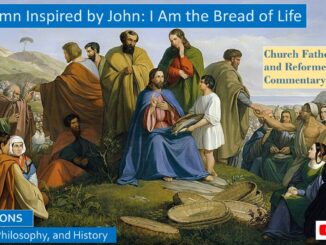
The Hymn inspired by John, I Am the Bread of Life, with Commentary by Church Fathers and Reformed Preachers

John Chrysostom teaches us: “Jesus calls this the true bread, not because the miracle of the manna was false, but because it was a type and not the very truth itself.” “After Jesus says, ‘Moses did not give,’ he does not say, ‘I give,’ but says that the Father, and not Moses, gives.”
“When they heard this, the people replied: ‘Give us this bread to eat.’ They still thought it was something material, and they yet expected to satisfy their appetites, and so they quickly ran to him. What does Christ do? Leading them on little by little, he says, ‘The bread of God is he who comes down from heaven and gives life to the world.’” […]

Psalm 137: Should We Bash the Babylonian Babies? Spiritual and Historical Interpretations
Biblical Interpretation

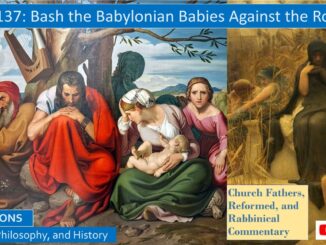
Psalm 137: Should We Bash the Babylonian Babies Against the Rocks? Spiritual and Historical Interpretations

Happy shall they be who take your little ones
and dash them against the rock!
Origen was one of the first Church Fathers who interpreted this troublesome verse allegorically, as did St Ambrose, who catechized and baptized the young St Augustine. Origen teaches us that “the little ones of Babylon, which signifies confusion, are those troublesome sinful thoughts that arise in the soul, and one who subdues them by striking their heads against the firm and solid strength of reason and truth, is the person who ‘dashes the little ones against the stones;’ and he is therefore truly blessed.”[2] Likewise, St Ambrose comments that we should “dash all corrupt and filthy thoughts against Christ.” […]

Psalm 71: Encouraging Us In Our Old Age
Biblical Interpretation

Psalm 71: Encouraging Us In Our Old Age

John Calvin speculates that David composed Psalm 71 after experiencing the trauma of losing the life of his son Absalom during his rebellion against him, which was sparked by the favoritism Davis showed towards his newly resented wife, Bathsheba. “The particular reference which David makes to his old age renders this conjecture not improbable.”
If so, this psalm should be a comfort to those who old age is lonelier due to mistakes, miscalculations or misfortunes occurring many years earlier. […]

Psalms 40 and 70: Deliver Both Young and Old from Suffering and Trials
Biblical Interpretation

Psalms 40 and 70: Deliver Both Young and Old from Suffering and Trials

St Ambrose rejoices: “Christ has heard the prayer of his own servants and has brought us out from the pit of misery and from the mire of dregs. We were drowning there; our whole flesh was clinging to the mire, trapped in the whirlpool of our sins. Our soul was powerless to save itself; fallen and ruined as it was by the multiplicity and dreadfulness of our offenses.”
St Ambrose continues: “Christ came to save us from the pit and slime of this world, from the mud and mire of this earth, from this body doomed to death.” “May that rock, which follows those who thirst, confirm the weak and unsteady; may that water never be lacking to those who long for it; and may that firm foundation never be wanting to those in danger of falling.” […]

My Favorite Commentaries on the Psalms
Book Reviews and Miscellaneous

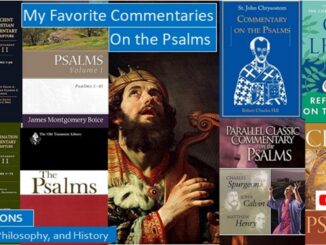
My Favorite Commentaries on the Psalms

One excellent example of reading the Bible allegorically is the verse in Psalm 137 where the Jews are encouraged to bash the brains of Babylonian babies against the rocks. The Church Fathers equate these babies with our small sins, that we should strive to be perfect, even as our Heavenly Father is perfect, bashing both our large and small sins.
We must remember that the Psalms are poetry, and Hebrew poets are like poets in any language, they sometimes use obscure words for better rhythm. This means the Psalms pose more translation problems than most of the books in the Bible. If you cannot make sense of a passage, it may be that scholars are not quite sure what the original passage meant. […]

Protestantism, Catholicism, Orthodoxy, and Judaism: Which Is True
christianity

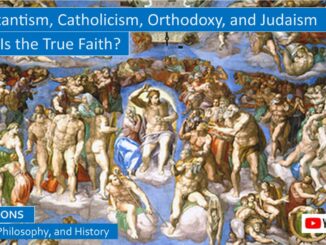
Protestantism, Catholicism, Orthodoxy, and Judaism: Which Is True?

We agree with CS Lewis when, in his Preface to Mere Christianity, he states that “the reader should be warned that I offer no help to anyone who is hesitating between two Christian denominations. You will not learn from me whether you ought to become an Anglican, a Methodist, a Presbyterian, or a Roman Catholic.” CS Lewis compares his Mere Christianity to a central hall opening up to many rooms, representative of the various denominations, saying that this hall is a place to wait while you try the different doors.
CS Lewis continues: “There is no mystery of my own position. I am a very ordinary layman of the Church of England, not especially high, nor especially low, nor especially anything else.” […]

Was St Paul a Former Slave
Biblical Interpretation

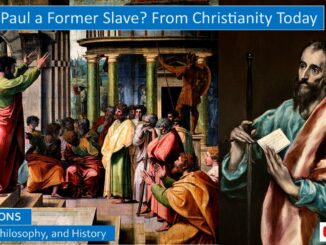
Was St Paul a Former Slave? Were His Parents Enslaved by the Romans?

Our authors in Christianity Today note that several prominent Biblical scholars in past 150 years have speculated that Paul’s parents were enslaved, perhaps in “the uprising in 4 BC, when Varus, Roman governor of Syria, burned entire cities and crucified 2,000 people. In Galilean cities like Sepphoris, Josephus wrote in Antiquities of the Jews, ‘troops made its inhabitants slaves.’” Furthermore, in St Jerome’s commentary on Philemon, written around the end of the fourth century, likely using Origen’s commentary as a source, states St Paul’s parents were Gischala in Judea, and were among the Jews exiled to Tarsus by the Romans. A few centuries later, St Photius, the scholarly bishop of Constantinople, confirms this, adding that St Paul was born to enslaved parents in Tarsus. These ancient sources are highly regarded by modern scholars. […]

History

Slaves in the Ancient World, Blog 1, Were Slaves the Employees of the Ancient World?

We are tempted to view slavery as something that went away with the Civil War, that with regards to slavery the modern world is so morally superior to the ancient world. The truth is that there were no employees in the ancient world, that slaves in the ancient worlds did the work that employees are hired to do in today’s world.

To understand the role of slaves in the ancient world we have a totally distorted picture when we only focus on the moral wrong of owning another person, treating servants like talking draft animals. The other aspect of slavery is paying someone such low wages that they cannot feed their family with dignity, that they feel like they live forever on the edge of the abyss, where the slightest crisis could force them to live in the streets. Someone who earns starvation wages is very much a modern-day slave. […]