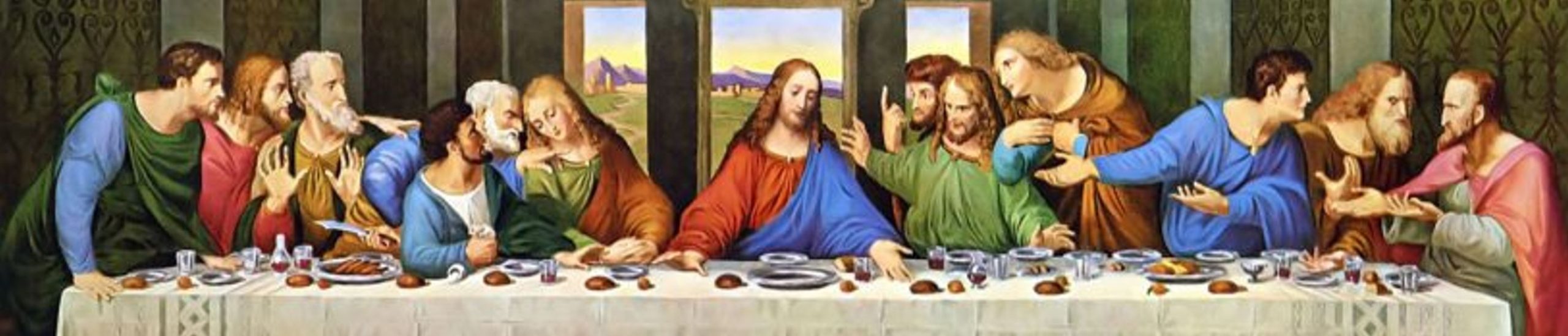
After Easter, we sung this simple hymn in our Episcopalian Church:
I am the bread of life.
He who comes to me shall not hunger;
he who believes in me shall not thirst.
No one can come to me
unless the Father draw him.
CHORUS:
And I will raise him up,
and I will raise him up,
and I will raise him up on the last day. [1]
YouTube video for this blog: https://wp.me/pachSU-1yC
Why did Suzanne Toolan write this famous hymn? She explains:
“I wrote I Am the Bread of Life for a San Francisco Catholic archdiocesan event in 1964. I was teaching high school at the time and wrote the song during my free period. When the bell rang for the next class, I decided I didn’t like the music, so I tore it up and threw it away.”
“As I left my classroom, a freshman girl asked: ‘What was that? It was beautiful!’ I went back into my classroom, took the manuscript out of the waste-paper basket and taped it together. I Am the Bread of Life began to appear in archdiocesan liturgies. Many purple ditto copies were going around.”
Suzanne Toolan continues: “Not everyone liked the hymn. Some people objected to it because they felt by placing the words of Jesus into the mouths of the assembly, those words were being attributed to the assembly. But travelers to Europe and Asia in the 1970s and 80s would tell me about hearing I Am the Bread of Life in different countries and many other languages. It is included in hymnals of other Christian faith traditions.”
“I could never figure out how the hymn became popular. I know in our Roman Catholic tradition, it came at the beginning of our use of the vernacular, and we simply didn’t have much to sing in our own language. But I also think its popularity stems from its message of resurrection, which is so strong in these words of Jesus. We so need that message of hope. I am always touched when people tell me that at the funeral of a mother, father or friend, these sung words of Jesus gave them consolation. Then I know the hymn has done its work.”[2]
These are the remaining verses of this famous hymn:
The bread that I will give
is my flesh for the life of the world,
and he who eats of this bread,
he shall live forever,
Unless you eat
of the flesh of the Son of Man
and drink of his blood,
you shall not have life within you.
I am the resurrection,
I am the life.
He who believes in me
even if he die,
he shall live forever.[3]
COMMENTARIES ON JOHN 6, THE BREAD OF LIFE
Dr Wikipedia suggests that this hymn was drawn from John 6, and from the story of Jesus raising Lazarus from the dead in John 11.[4]
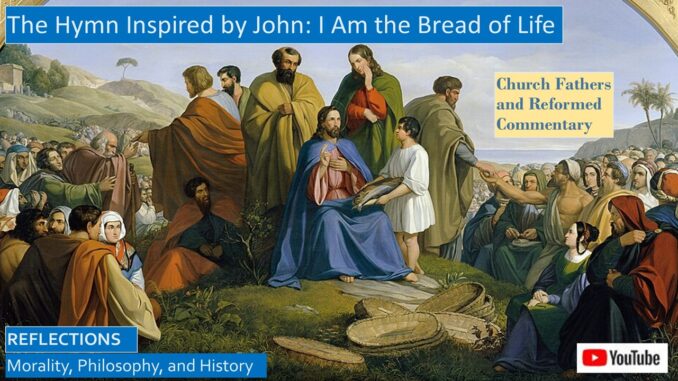
In the beginning verses of John, Jesus feeds the five thousand who came to hear him preach from the five loaves and two fish donated by an anonymous boy. This is seen as a repetition of the miracle where God provided the Israelites with manna from heaven.[5]
In John 6, the crowd said to Jesus:
31 Our ancestors ate the manna in the wilderness; as it is written, “He gave them bread from heaven to eat.”
32 Then Jesus said to them, “Very truly, I tell you, it was not Moses who gave you the bread from heaven, but it is my Father who gives you the true bread from heaven.
33 For the bread of God is that which comes down from heaven and gives life to the world.”
34 They said to him, “Sir, give us this bread always.”
35 Jesus said to them, “I am the bread of life. Whoever comes to me will never be hungry, and whoever believes in me will never be thirsty.”[6]
St John Chrysostom teaches us: “Jesus calls this the true bread, not because the miracle of the manna was false, but because it was a type and not the very truth itself.” “After Jesus says, ‘Moses did not give,’ he does not say, ‘I give,’ but says that the Father, and not Moses, gives.”
“When they heard this, the people replied: ‘Give us this bread to eat.’ They still thought it was something material, and they yet expected to satisfy their appetites, and so they quickly ran to him. What does Christ do? Leading them on little by little, he says, ‘The bread of God is he who comes down from heaven and gives life to the world.’”[7]
St Ephrem the Syrian teaches us: “Our Lord made bread in plenty from just a little bread in the desert and changed water into wine at Cana. Jesus first sought to accustom their mouths to his bread and to his wine until the time would come for him to give them his blood as well as his body. Jesus allowed the crowds to accustom their mouths to his bread and wine until the time would come for him to give them his blood as well as his body. Jesus allowed them to taste a superabundance of transitory bread and wine, so that he might excite them to a superabundance of his living body and blood.”[8]
Tertullian teaches us, “For Christ is our bread because Christ is Life, and bread is life. ‘I AM,’ says Christ, ‘the Bread of Life.’” “In petitioning for our daily bread” in the Lord’s Prayer, “we ask for perpetuity in Christ and indivisibility from his body. But because bread is” sensed by “our carnal sense,” to experience it in a spiritual sense requires from us a “religious remembrance of spiritual discipline.”[9]
St Augustine teaches us, “As the Samaritan woman, to whom it was said, ‘Whosoever drinks of this water shall never thirst,’ thought Jesus meant natural water and said, ‘Sir, give me this water,’ thinking she might never be in want again. In the same way, these people say, ‘O Lord, give us this bread’ that refreshes and sustains us and yet never fails.”[10]
Martin Luther asserts that “out of the mass of powerful words in the Holy Scripture there is almost no stronger word than Christ is a bread and meal given by God, and that whoever eats this bread lives forever and becomes content, no longer hungering or thirsting.” Here “the Lord is speaking about spiritual food, for he himself explains it as the hunger and thirst of the soul.”
Luther continues: “The soul wants to live forever, to not be cursed, to have a merciful God, to be able to stand before the wrath and judgment of God, to not be condemned by sin and the law, or go to hell. Those are the soul’s desires. It is a spiritual thirst and hunger for which we need a spiritual meat and drink. And so the Holy Spirit comes and says, ‘If you do not want to die or be damned, then come to Christ, believe in him, and cling to him. Eat this spiritual meal, believe in Christ, that is what is most important.”[11]
John Calvin teaches us: “There is no other way in which we eat Christ than by believing; but the eating is the effect and fruit of faith rather than faith itself. For faith does not look at Christ only as at a distance, but embraces him, that he may become ours and may dwell in us. It causes us to be incorporated with him, to have life in common with him, and, in short, to become one with him. It is therefore true that by faith alone we eat Christ, provided we also understand in what manner faith unites us to him.”[12]
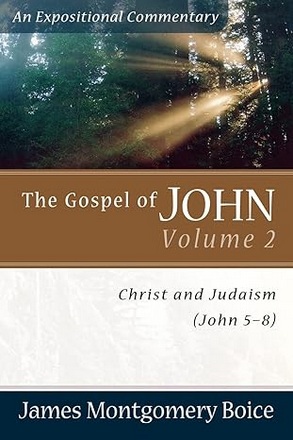
My favorite modern commentator is the Presbyterian James Montgomery Boice. He is a stimulating scholar who brings God’s word home, never forgetting that the purpose of Scripture is to teach the ordinary Christian how he must Love God and love his neighbor as himself.
For these verses, James Boice asks, “What is important about bread?”
First, “Bread is necessary for life.” As James Boice explains: “In Christ’s day, bread was even more essential than in our own time, for it was the only staple in most people’s diets. Without bread, men died.” Without Jesus, we die.
“Are you trying to do without him? Are you going your way saying, ‘I will take care of myself, I can get by. I don’t need Jesus: I have a house, a car, plenty to eat, a good job, a wife, a family.”
Boice continues: “What if everything in this entire life should go well for you, but you should lose your soul? Would there be a gain?”[13]
This reminds us of Jesus’ Parable of the Rich Fool: “The land of a rich man produced abundantly. And he thought to himself, ‘What should I do, for I have no place to store my crops?’ Then he said, ‘I will do this: I will pull down my barns and build larger ones, and there I will store all my grain and my goods. And I will say to my soul, Soul, you have ample goods laid up for many years; relax, eat, drink, be merry.’ But God said to him, ‘You fool! This very night your life is being demanded of you. And the things you have prepared, whose will they be?’ So it is with those who store up treasures for themselves but are not rich toward God.”[14]
St Augustine comments that the rich fool was “planning to fill his soul with excessive and unnecessary feasting and was proudly disregarding all those empty bellies of the poor. He did not realize that the bellies of the poor were much safer storerooms than his barns.”[15]
We reflected on a curious apocryphal story how Apostle Thomas put into literal practice the directive that we should store treasures in heaven rather than on earth. When St Bail pondered the parable of the Rich Fool, he teaches us that “the more you abound in wealth, the more you lack in love.”[16]
Do Not Envy: Lessons from Eeyore’s Birthday Party and the Gnostic Acts of Thomas
https://seekingvirtueandwisdom.com/do-not-envy-lessons-from-eeyores-birthday-party-and-the-gnostic-acts-of-thomas/
https://youtu.be/Nq_UwpKe84A
Was St Basil Woke? Basil the Great On Social Justice, Homily To the Rich
https://seekingvirtueandwisdom.com/st-basil-the-great-on-social-justice/
https://youtu.be/PT_I5IrZGzY
St Basil on Social Justice: Assisting the Poor During a Famine in a Roman Province
https://seekingvirtueandwisdom.com/st-basil-on-social-justice-assisting-the-poor-during-a-famine-in-a-roman-province/
https://youtu.be/c8YXs7y4RrU
Was St Basil Woke? Basil the Great On Social Justice, Homily To the Rich
https://seekingvirtueandwisdom.com/st-basil-the-great-on-social-justice/
https://youtu.be/PT_I5IrZGzY
“What is important about bread?” Second, “Bread is suited for everyone.”
As James Boice explains: “In the same way, the Lord Jesus Christ is perfectly suited to the needs of all men. Sometimes people tell me: ‘Jesus may be all right for the kinds of people you talk to, but he is not for me.’ This is common. If a person is above average intelligence, he tends to think that Christ is only for the dull. If he is dull, he thinks that Christ is only for the intelligent. If he is sophisticated, he thinks Christ is only for the common people.”
“But Jesus is for everyone. He is for you. He is the Savior of the whole world,” from peasants to royalty, from the poor to the wealthy.
“What is important about bread?” Third, “Bread should be eaten daily,” as we pray in the Lord’s Prayer, “Give us today our daily bread.”
As James Boice explains: “Christianity is the only religion in the world that takes the body seriously. It teaches that God gifted us our bodies as well as our souls, and that the Divine Plan includes both the redemption of the body and the soul.”
“Therefore, it is right to pray for this world’s needs, for food, homes, clothing, and other necessities. We know the Lord is concerned about our physical needs because of how he fed the four and five thousands.” But should we pray for luxuries, mansions, and European vacations?
James Boice continues: “Perhaps you have devoted most of your life to satisfying your hunger for objects, and yet you have never looked to God in order to be fed spiritually. You pray: ‘Give me my physical needs.’ But you have never made a habit of praying: ‘Gift me that spiritual bread that comes down from heaven.’”
“What is important about bread?” Fourth, “Bread produces growth.” As James Boice explains: “We need to grow. The church of Jesus Christ is weak in our age, and it is weak simply because we, as individuals, are not strong.” Our church today “is a weak, anemic Christianity, a lot of easy believism coupled with morality, including evangelical churches. What is the reason for our sickly Christian postures? Undoubtedly, the reason is our deep failure to feed upon Jesus Christ, who alone can make us grow.”[17]
In John 11, when Jesus resurrected Lazarus from the grave after he had been dead for four days:
25 Jesus said to Martha, “I am the resurrection and the life. Those who believe in me, even though they die, will live,
26 and everyone who lives and believes in me will never die.”[18]
Soon, we will reflect on what the Church Fathers and Reformed Preachers teach us about the story of Jesus and Lazarus. Since preachers often expound on this story at funerals, we plan to reflect on this as part of our series on Aging and Retirement.
Roman Stoic Philosopher Seneca on Old Age and Retirement
https://seekingvirtueandwisdom.com/roman-stoic-philosopher-seneca-on-old-age-retirement/
https://youtu.be/hmJoI9-s1q8
Roman Stoic Philosopher and Politician Cicero on Aging and Death
https://seekingvirtueandwisdom.com/roman-stoic-philosophers-cicero-on-aging-and-death/
https://youtu.be/ne9T2N2mvZY
Classical Christian Psychologist Paul Tournier on Old Age and Retirement
https://seekingvirtueandwisdom.com/classical-psychologist-paul-tournier-on-old-age/
https://youtu.be/HE3LNGB0nUA
Jimmy Carter on the Virtues of Aging and Retirement
https://seekingvirtueandwisdom.com/jimmy-carter-on-the-virtues-of-aging-and-retirement/
https://youtu.be/JozGKCnUyaI
This series includes reflections on Psalms 40, 70, and 71. And we have also reflected on Psalm 137, where angry Jews ask whether the Babylonian babies can be bashed against the rocks.
We also have a reflection on the hymn, Jesus lives in my heart, and the commentary for the Bible verses it draws from.
Spiritual Proof That Jesus Lives, The Famous Hymn: He Lives in My Heart
https://seekingvirtueandwisdom.com/spiritual-proof-that-jesus-lives-the-famous-hymn-he-lives-in-my-heart/
https://youtu.be/qa3geXkZvzY
Psalms 40 and 70: Deliver Both Young and Old from Suffering and Trials
https://seekingvirtueandwisdom.com/psalms-40-and-70-deliver-both-young-and-old-from-suffering-and-trials/
https://youtu.be/JbKQd6vP5qo
Psalm 71: Encouraging Us In Our Old Age
https://seekingvirtueandwisdom.com/psalm-71-encouraging-us-in-our-old-age/
https://youtu.be/NrzVItznE1E
Psalm 137: Should We Bash the Babylonian Babies Against the Rocks? Spiritual and Historical Interpretations
https://seekingvirtueandwisdom.com/psalm-137-should-we-bash-the-babylonian-babies-spiritual-and-historical-interpretations/
https://youtu.be/wRT68KfvxhU
James Boice concludes: “Have you ever thought how grain becomes bread? It must first be planted to grow. When it is ripe, it must be cut down, winnowed, and ground into flour. Finally, it must be baked in the oven’s fiery heat. Only then can it sustain life.”
How did Jesus become our spiritual bread? “Jesus was born into this world. He was bruised. He was cut down by sinful men. He passed through the fires of God’s holy wrath as he took your place in judgment. This is his glory. He suffered this for you. How, then, can you refuse to feed upon him? Draw from his fullness and grow strong.”[19]
The Psalmist urges us, as does the Orthodox liturgy:
“Taste and see that the Lord is good;
Happy are those who take refuge in him.”[20]
DISCUSSING THE SOURCES
Our three primary sources are first, the Presbyterian James Boice’s commentary on John. Not only is James Boice a first-rate biblical scholar, he also does not forget the purpose of Scripture, that is to encourage us to become better Christians in our hearts.
The other two sources that we found useful were the InterVarsity Press compilations of the Ancient Christian Commentaries from the writings of the early Church Fathers, and the Reformation Commentary from the writings of Luther, Calvin, and other early Reformation preachers and pastors.
We are planning videos on my favorite commentaries, and how to interpret the Bible and the Church Fathers. We have already reflected on commentaries on the Ten Commandments, Jewish commentaries on the Torah, and commentaries on the Psalms.
My Favorite Commentaries on the Psalms
https://seekingvirtueandwisdom.com/my-favorite-commentaries-on-the-psalms/
https://youtu.be/kyJRf_JoGsI
Book and DVD Reviews on the Ten Commandments, or Decalogue
https://seekingvirtueandwisdom.com/book-and-dvd-reviews-on-the-ten-commandments-or-decalogue/
https://youtu.be/KptDGFJG0TE
Book Reviews, Commentaries of Torah and Talmud, Medieval Rabbis and Modern Rabbis and Scholars
http://www.seekingvirtueandwisdom.com/book-reviews-commentaries-of-torah-and-talmud-medieval-rabbis-and-modern-rabbis-and-scholars/
https://youtu.be/mvstpk88TxI
Book Review: Early Church Fathers Library – 38 Volumes in 3 Series
https://wp.me/pachSU-4W
http://www.seekingvirtueandwisdom.com/early-church-fathers-library-38-volumes-in-3-series/
Book Reviews on Apostolic and Early Church Fathers
https://wp.me/pachSU-DN
http://www.seekingvirtueandwisdom.com/book-reviews-on-apostolic-and-early-church-fathers/
How To Read Ancient Works, and Book Reviews on the Apostolic Church Fathers
https://youtu.be/I_2q4BiRBlU
[1] https://catholichymn.blogspot.com/2015/08/I-am-the-Bread-of-Life.html
[2] https://www.sistersofmercy.org/the-story-of-i-am-the-bread-of-life/
[3] https://catholichymn.blogspot.com/2015/08/I-am-the-Bread-of-Life.html
[4] https://en.wikipedia.org/wiki/I_Am_the_Bread_of_Life
[5] https://en.wikipedia.org/wiki/Feeding_the_multitude
[6]https://www.biblegateway.com/passage/?search=john%206%3A31-35&version=NRSVCE
[7] St John Chrysostom, Homilies on the Gospel of John 45.1, included in Ancient Christian Commentary on Scripture, New Testament Volume IVa (Downers Grove, IL: InterVarsity Press, 2006), p. 224.
[8] St Ephrem the Syrian, Commentary on Tatian’s Diatessaron 12.1, included in Ancient Christian Commentary on Scripture, New Testament Volume IVa, p. 224.
[9] Tertullian, On Prayer, 6, included in Ancient Christian Commentary on Scripture, New Testament Volume IVa, pp. 224-225.
[10] St Augustine, Tractates on the Gospel of John 25.13, included in Ancient Christian Commentary on Scripture, New Testament Volume IVa, p. 225.
[11] Martin Luther, Fifth Semon on John 6, 1530, included in Reformation Commentary on Scripture, New Testament Volume IV (Downers Grove, IL: Intervarsity Press, 2014), p. 221.
[12] John Calvin, Commentary on John 6:35, included in Reformation Commentary on Scripture, New Testament Volume IV, p. 222.
[13] James Montgomery Boice, The Gospel of John, An Expositional Commentary, Volume 2 (Grand Rapids, MI: Baker Books, 1999, 1985), p. 477.
[14] https://www.biblegateway.com/passage/?search=LUKE%2012%3A16-21&version=NRSVCE
[15] St Augustine, Sermon 36.9, from Luke, Ancient Christian Commentary on Scripture, New Testament Volume III (Downers Grove, IL: Intervarsity Press, 2003), p. 208.
[16] St Basil the Great, To the Rich, included in On Social Justice, translated by C Paul Schroeder (Crestwood, NY: St Vladimir’s Seminary Press, 2009, originally after 369 AD), pp. 41-47.
[17] James Montgomery Boice, The Gospel of John, An Expositional Commentary, Volume 2, pp. 477-479.
[18] https://www.biblegateway.com/passage/?search=john%2011%3A25-26&version=NRSVCE
[19] James Montgomery Boice, The Gospel of John, An Expositional Commentary, Volume 2, p. 480.
[20] https://www.biblegateway.com/passage/?search=psalm%2034%3A8&version=NRSVCE

Be the first to comment