
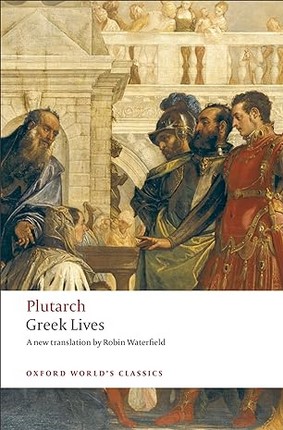
The primary source for most Greco-Roman ancient histories is Plutarch’s Lives, which are twenty-three paired histories of ancient Greek and Roman noble men. Plutarch, in turn, based his Lives on whatever ancient histories he could locate, many of which have since disappeared in the sands of history. Our favored translator, Robin Waterfield, renders fresh translations of the major Greek and Roman lives. We prefer the crispness of Waterfield’s translations, his thorough footnotes, and his preference to translate Plato’s Greek theme in the Republic as morality rather than justice in most instances, which makes Plato’s philosophy more personal. Unfortunately, Robin Waterfield has freshly translated fewer than half of Plutarch’s Greek Lives.
Plato’s Republic, Book 1, On Aging and Morality, a Better Word for Justice
https://youtu.be/JY1ILO3weZI
https://seekingvirtueandwisdom.com/platos-republic-book-1-on-aging-and-morality-a-better-word-for-justice/
The Modern Library compilation of Plutarch’s Lives was translated long ago by John Dryden, whose translation is often stilted, compelling me to reword awkward phrases. Because this translation has few footnotes, we cannot recommend it any higher than the free online translations excerpted from Loeb Classical Library, which have a few more footnotes than Dryden.
YouTube video for this blog: https://youtu.be/ICWujY0CViQ
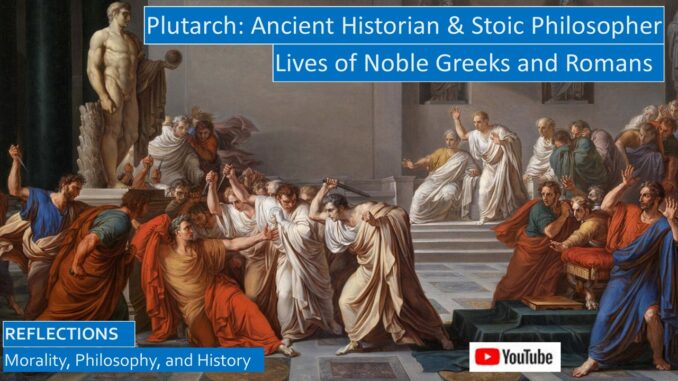
Over half of Plutarch’s Lives of Noble Romans influenced the history of the corrupt and violent last years of the Roman Republic, and the rise of the Roman Empire under Julius Caesar. Our YouTube thumbnail, the painting On the Death of Caesar, depicts the corruption and violence of the late Roman Republic, when Brutus and sixty other Roman senators conspired to assassinate Julius Caesar, hoping to reestablish the Roman Republic. The prominent statues in the background illustrate the ancient history of Rome. Even that history was poisoned, as Brutus’ distant relative centuries ago was celebrated for stabbing the last tyrannical Roman king to death. The many senatorial daggers stabbing Caesar to death in public show how violent the political struggles of the Roman Republic had become. The frightened or appalled citizens and back-wall senators foreshadow how this assassination would not be welcomed by both ordinary and prominent Romans, leading to the consolidation of power by the next Roman emperor, Caesar Augustus, aka Octavian.[1]
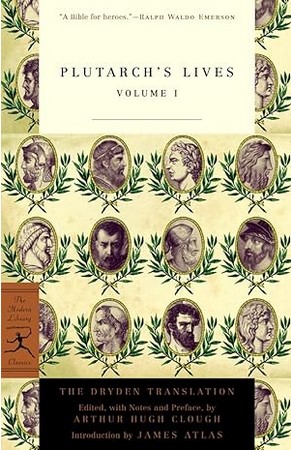
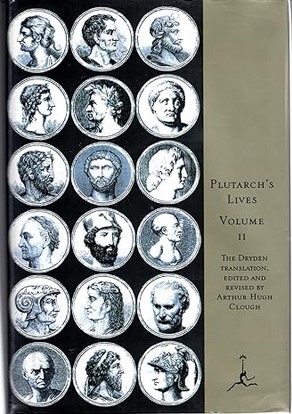
Plutarch paired Greek and Roman lives based on their personalities and accomplishments. For example, Julius Caesar is paired with Alexander the Great, and the Greek companion to Cicero is Demosthenes, the renowned Greek orator who opposed Alexander the Great’s conquest of Greece. Plutarch used Xenophon as one of his sources for his lives of the Spartan Kings Agis and Agesilaus, Alcibiades, the lost life of Epaminondas of Thebes, and possibly Lycurgus of Sparta.
The Life, Adventures, and Philosophy of Xenophon, General and Student of Socrates
https://youtu.be/lU59WBQu3bc
https://seekingvirtueandwisdom.com/the-life-adventures-and-philosophy-of-xenophon-general-and-student-of-socrates/
The majority of Plutarch’s Roman lives featured the strivings of great men during the breakdown of the Roman Republic, and the subsequent struggles and civil wars that culminated in the reign of the first two emperors of the Roman Empire, Julius Caesar and Caesar Augustus, or Octavian.
Plutarch is more interested in highlighting the moral and character strengths and weaknesses of the famous men of history than he is in revealing how these great men influenced historical events. For this reason, you cannot consult only Plutarch for a complete historical review.
In our reflections, we will first view the history of the fall of the Roman Republic and the rise of the Roman Empire through the eyes of these great men of history, as depicted by Plutarch.
- Incorruptible statesmen in the thoroughly corrupt Roman Republic: Cicero and Cato the Younger.
- Political turmoil and violence during the Agrarian Revolt and Social Wars, which weakened the Roman Republic: Gaius Marius, the brothers Tiberius and Gaius Grachus, General Lucullus, General Sulla, and General Sertorius.
- Civil wars and strife leading to the founding of the Roman Empire: Pompey, Mark Antony, Crassus, Brutus, and Julius Caesar, as well as Cleopatra. Plutarch did not include a life for Caesar Augustus, aka Octavian.
- Then we will reflect on the History of Rome by Livy, the Twelve Caesars by Seutonius, and the Roman History by Cassius Dio. We may also consult the histories of Polybius and Diodorus Siculus. Plutarch consulted many of these ancient historians when composing his Roman Lives.[2]
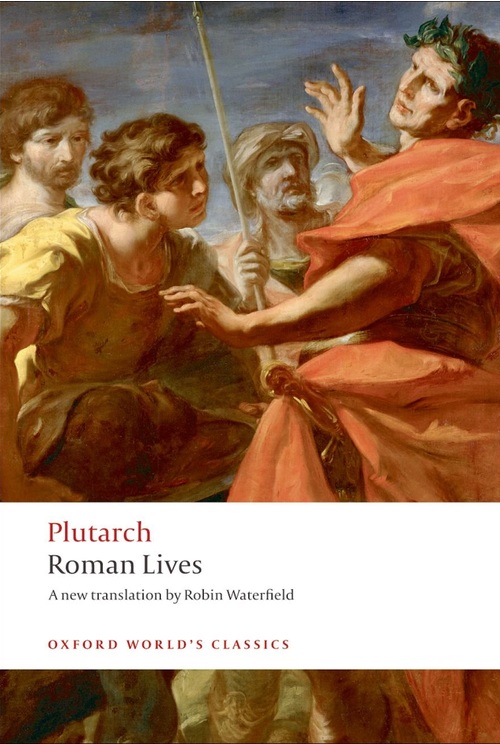
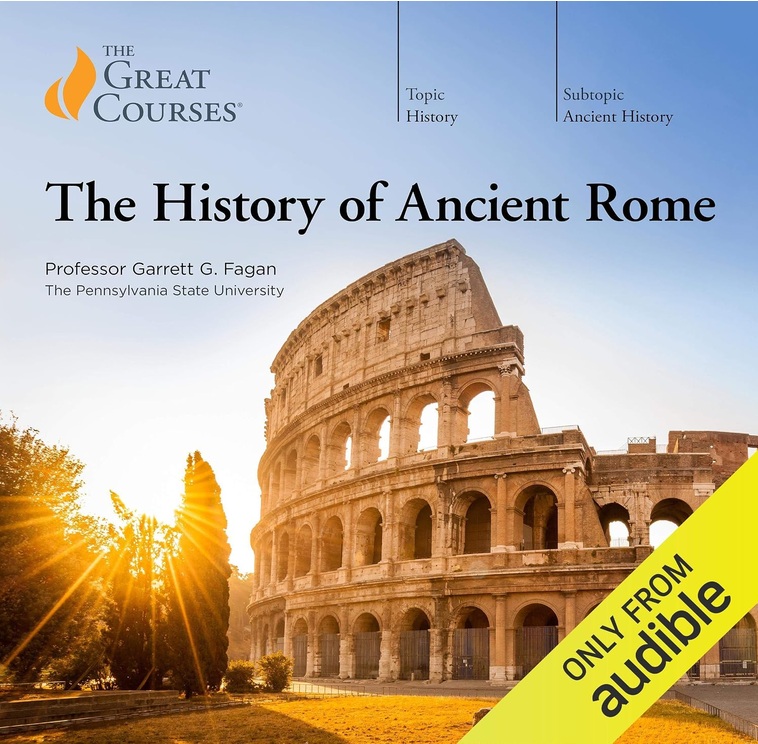
We will also consult the Great Courses lectures, including the History of Ancient Rome, The Rise of Rome, and Famous Romans, and the modern historian Will Durant’s Caesar and Christ, to update our ancient Roman historians. We may also consult Edward Gibbon, since his Decline and Fall of the Roman Empire begins with the reign of Octavian. Rufus Fears’ Famous Romans is the most entertaining of these sets of lectures, but occasional inaccuracies do creep into many of his lectures.
Like Plutarch, Will Durant is also a moral historian. Along with the ancient Roman historians, they are all eminently quotable.
BRIEF BIOGRAPHY OF PLUTARCH
The first volume of Plutarch’s Lives has both a preface and introduction by two scholars, which includes both a biography and his objectives in writing his Lives of Greeks and Romans.
Plutarch was born to a wealthy family in a small town in Beotia, Greece, near Thebes, in about 45 to 50 AD. He had a happy marriage, and his wife Timoxena bore him at least five children: four sons and a daughter. Infant mortality was high in the ancient world, and two sons and his daughter died in childhood. One of his essays was the Consolation to His Wife, written after the death of their daughter, giving the same advice that Marcus Aurelius would later give, that she should grieve only “within the reasonable limits,” instead recalling their good fortune.
Plutarch lived during the time of the Good Emperors at the height of the Roman Empire. One of our scholars says his later years were spent during the time of Hadrian, the other says Trajan, his predecessor. He founded a school of Stoic philosophy, served as a local official, or archon, and later served for many years as a priest in the Oracle at Delphi. He learned Latin late in life, which enabled him to do the research for his Roman Lives.
Roman Emperors Before Marcus Aurelius
https://youtu.be/6i–hVIpg1k
https://seekingvirtueandwisdom.com/roman-emperors-before-marcus-aurelius/
Plutarch declared: “My design is not to write Histories, but Lives.” “The most glorious exploits do not always furnish us with the clearest discoveries of virtue or vice in men; sometimes a matter of less moment, an expression or jest, informs us better of their character and inclinations, than the most famous sieges, the greatest armaments, or the bloodiest battles.”
Our scholars write: “Plutarch’s interest is less for politics and the changes of empires, and much more for personal character and individual actions and motives to action; duty performed and rewarded; arrogance chastised, hasty anger corrected; humanity, fair dealing, and generosity triumphing in the visible, or relying on the invisible world.”
Some of his observations on various Roman Lives reveal his moral character. Our scholars observe: “That Plutarch was a sensitive soul is evident from his attitude toward the elder Cato, whom he reproves for selling off his servants when they got old ‘like so many beasts of burden.’” Like Thucydides, Plutarch was critical of the Histories of Herodotus, and reported history as accurately as was possible in the ancient world.
Plutarch praised the great Roman general Sertorius “for his willingness to share power and negotiate fairly with his enemies, as well as for his equable disposition, which ‘enabled him to resist pleasure and fear alike: he was unmoved in the face of danger, nor did he become over-elated with success.’”
Plutarch also revealed his subjects’ weaknesses: “Caesar’s lust for distinction; Themistocles’ insomniac obsession with the triumphs of his rival Miltiades; and Mark Antony’s ‘insane desire to be the first and greatest man in the world.’ Time and again, the moral good that Plutarch wishes to put before his readers is blotted out by the schemes and machinations, the greed, envy, competitiveness, and lust that drives the world.”
We have previously reflected on many of Plutarch’s Greek Lives. In his life of Theseus, the mythical founding King of Athens, “Plutarch confesses his inability to disengage fact from fable.” Although his hero story on how Theseus defeated the half-man, half-bull Minotaur in the labyrinth beneath the Minoan palace was a central story, Plutarch dispatches the final struggle in just a few sentences.
Mighty Deeds of Theseus, First King of the Commonwealth of Athens, in Plutarch’s Lives
https://youtu.be/jOgNKSf9IT4
http://www.seekingvirtueandwisdom.com/mighty-deeds-of-theseus-first-king-of-the-commonwealth-of-athens-in-plutarchs-lives/
Plutarch tells us many moral anecdotes coined by Solon, the founding lawmaker and philosopher of Athens.
Draco, Solon, and Cleisthenes, Democracy and Justice in Ancient Greece
https://youtu.be/6sNSaOoQoJs
http://www.seekingvirtueandwisdom.com/draco-solon-and-cleisthenes-democracy-and-justice-in-ancient-greece/
Plutarch and Herodotus tell us the moral strengths and weaknesses, and accomplishments and failures of Themistocles, who led the Athenians in defeating the Persians, but who was later served as a Persian satrap in Asia Minor after he was banished from Athens because of his corruption.
Histories of Herodotus, The Greeks Defeat the Mighty Persians in the Greco-Persian Wars
https://youtu.be/JjNcyLo54ko
http://www.seekingvirtueandwisdom.com/histories-of-herodotus-the-greco-persian-wars/
Plutarch reflected on the lives of many Greeks in the Peloponnesian Wars between Athens and Sparta and their allies. These were the World Wars of the ancient world that spanned two generations. Perhaps a quarter of the male population of Greece were casualties.
Plutarch explored the lives of Aristides and Cimon, the Athenian generals who challenged the Persians in Asia Minor in the interregnum between the Greco-Persian Wars and the Peloponnesian Wars.
Plutarch: Lives of Aristides and Cimon, Formation of the Delian League After the Greco-Persian Wars
https://youtu.be/QabwtFANCDc
http://www.seekingvirtueandwisdom.com/plutarch-lives-of-aristides-and-cimon-formation-of-the-delian-league-after-the-greco-persian-wars/
Plutarch explained his approach in the opening pages of his life of Pericles, who started the Peloponnesian Wars. For Pericles, Plutarch sought “to arouse the spirit of emulation,” “to find in the deeds of heroes an illustration of moral good that inspires other men to follow.”
Thucydides and Plutarch: Pericles and the Radical Democracy Before the Peloponnesian Wars
https://youtu.be/uhtGzfxVdzk
http://www.seekingvirtueandwisdom.com/thucydides-and-plutarch-pericles-and-the-radical-democracy-before-the-peloponnesian-wars/
Thucydides and Plutarch: Pericles and the Beginning of the Peloponnesian War Between Athens and Sparta
https://youtu.be/1ra58mg33nM
http://www.seekingvirtueandwisdom.com/thucydides-and-plutarch-pericles-and-the-beginning-of-the-peloponnesian-war-between-athens-and-sparta/
From the Death of Pericles to the Peace of Nicias, Peloponnesian War, Thucydides and Plutarch
https://youtu.be/szi7-9QQWI0
https://seekingvirtueandwisdom.com/from-the-death-of-pericles-to-the-peace-of-nicias-peloponnesian-war-thucydides-and-plutarch/
Plutarch explains the mythical origins of Sparta and Spartan culture in his Life of Lycurgus, lawgiver of Sparta.
Unique Spartan Warrior Culture and History, Plutarch’s Life of Lycurgus, Lawgiver of Sparta
https://seekingvirtueandwisdom.com/unique-spartan-warrior-culture-and-history-plutarchs-life-of-lycurgus-lawgiver-of-sparta/
https://youtu.be/_hYwZsxmC3s
Spartan Women, Marriage, Family Life and Sayings, From Plutarch’s Life of Lycurgus
https://youtu.be/q8kgoaaeCLg
https://seekingvirtueandwisdom.com/spartan-women-marriage-family-life-and-sayings-from-plutarchs-life-of-lycurgus/
Plutarch “chided Alcibiades for his ‘drunkenness, debauchery, and insolence,’ his notorious flamboyance: ‘He was effeminate in his dress and would walk through the marketplace trailing his long purple robes.’ Alcibiades also borrowed vessels of gold and silver from the city for his own table,” which was a type of theft.
Comeback of Alcibiades in Peloponnesian War, according to Plutarch, Thucydides, and Xenophon
https://youtu.be/b7QLp1HrOMs
https://seekingvirtueandwisdom.com/comeback-of-alcibiades-in-peloponnesian-war-according-to-plutarch-thucydides-and-xenophon/
Plutarch explores the moral weaknesses of the Athenian general and admiral Nicias, whose timidity led to the complete loss of a large portion of the Athenian fleet, including hoplite soldiers, in his defeat in Syracuse.
Athens’ Disastrous Defeat at Syracuse in the Sicilian Expedition, the Peloponnesian Wars
https://youtu.be/SaIqQ35ysl4
https://seekingvirtueandwisdom.com/athens-disastrous-defeat-at-syracuse-in-the-sicilian-expedition-the-peloponnesian-wars/
In Plutarch’s life on the victorious Spartan general Lysander, he celebrates how he did not raze and enslave Athens after their defeat, remembering how their Athenian ancestors played major roles in defeating Persia in previous generations.
Spartan Lysander Shows Mercy on Athens, Ending the Peloponnesian Wars
https://seekingvirtueandwisdom.com/spartan-lysander-shows-mercy-on-athens-ending-the-peloponnesian-wars/
https://youtu.be/giNzqNoOH3Y
Plutarch’s Lives include the life of Alexander the Great, and other Greek and Roman lives before and after these major epochs in their histories.[3]
In addition to his Lives, Plutarch also penned around eighty Stoic essays collected in his Moralia. Some are a few paragraphs, but many are as long and thoughtful as Seneca’s essays, and cover similar moral and practical topics. You can buy some of these essays in print, including one compilation by Penguin. You can find the Loeb Classical Library translations which are free online, which is what I would recommend. Don’t search Google by the keyword Moralia, but by the titles of the individual essays, using the list in the Wikipedia article on the Moralia. The sayings in many of these essays were repeated in his Lives.
A sampling of the Moralia essays include:
- On Education.
- On Moral Virtues.
- On Controlling Anger.
- On Virtue and Vice.
- On Having Many Friends, which he advises against.
- How to Tell a Flatterer From a Friend.
- On Brotherly Love.
- On Being a Busybody.
And many others.[4]
We previously released Book Reviews of Greek History and Philosophy, which greatly influenced Roman philosophy and history.
Book and Lecture Reviews of Ancient Greek History and Philosophy
https://youtu.be/472aVKkPsk8
http://www.seekingvirtueandwisdom.com/book-and-lecture-reviews-of-ancient-greek-history-and-philosophy/
[1] https://en.wikipedia.org/wiki/The_Death_of_Julius_Caesar_(Camuccini) and https://oaklores.com/artwork/painting/the-death-of-julius-caesar/
[2] https://en.wikipedia.org/wiki/Parallel_Lives
[3] James Atlas, Introduction, and Arthur Hugh Clough, Preface, in Plutarch, Parallel Lives (New York: Modern Library, 1992, 2001, originally 100s AD), pp. v-xxxi, and https://en.wikipedia.org/wiki/Plutarch

Be the first to comment