Plutarch’s Life and Works, Including His Greek and Roman Lives, and Moralia, His Stoic Sayings
Book Reviews and Miscellaneous

Plutarch’s Life and Works, Including His Noble Greek and Roman Lives, and Moralia, His Stoic Sayings

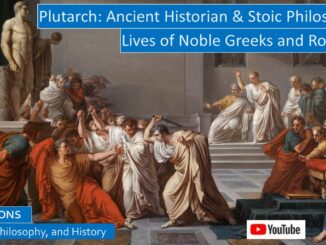
Over half of Plutarch’s Lives of Noble Romans influenced the history of the corrupt and violent last years of the Roman Republic, and the rise of the Roman Empire under Julius Caesar. Plutarch paired Greek and Roman lives based on their personalities and accomplishments. For example, Julius Caesar is paired with Alexander the Great, and the Greek companion to Cicero is Demosthenes, the renowned Greek orator who opposed Alexander the Great’s conquest of Greece. Plutarch used Xenophon as one of his sources for his lives of the Spartan Kings Agis and Agesilaus, Alcibiades, the lost life of Epaminondas of Thebes, and possibly Lycurgus of Sparta. The majority of Plutarch’s Roman lives featured the strivings of great men during the breakdown of the Roman Republic, and the subsequent struggles and civil wars that culminated in the reign of the first two emperors of the Roman Empire, Julius Caesar and Caesar Augustus, or Octavian.
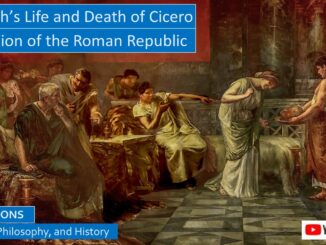
Plutarch is more interested in highlighting the moral and character strengths and weaknesses of the famous men of history than he is in revealing how these great men influenced historical events. For this reason, you cannot consult only Plutarch for a complete historical review. We also consulted Will Durant’s account in his Story of Civilization, Volume 3, Caesar and Christ. Will Durant often quotes Cicero directly, and Plutarch is his primary source out of necessity. We also consulted the Wikipedia article on Cicero to fill in some background and details. […]

Roman Emperors before Marcus Aurelius
Greek and Roman History

Roman Emperors Before Marcus Aurelius

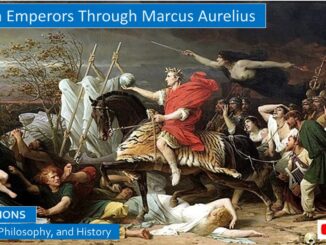
Hadrian’s peace policy was controversial, he abandoned Trajan’s conquests in Dacian Romania and Parthian Persia to concentrate on consolidating the Roman Empire. The problem was that the Roman Empire needed continual expansion, including war booty and slaves, to fund the empire and feed the growing populace of Rome. This policy certainly did not prevent future conflict with Parthian Persia.
Historians debate whether Hadrian’s defensive posture was wise. Were there prosperous provinces left to conquer on the frontiers? On the other hand, the successful expansion of the empire by the Byzantine Emperor Justinian several centuries later nearly bankrupted his Empire. […]

Ancient Warrior Culture - Ancient Greece, Rome, Israel
History

Ancient Warrior Societies, Blog 3, Warfare in the Old Testament

Warfare is mentioned over three hundred times in the Old Testament, swords four hundred times. Ancient Israel was caught in many of the ancient wars since it was in the cross-roads of trade routes between Mesopotamia and Egypt. Since Judah was mountainous, its armies relied heavily on infantry, but the Bible mentions that King Ahab of the Northern Kingdom had chariots, and that he was felled by arrow probably shot by a composite bow. Assyria and Babylon had cavalry archers on horseback, but not Egypt or Israel. An Israeli chariot had three horses pulling three men, a driver with a spear, an archer, and a shield bearer. We know from our Sunday School stores King David slew Goliath with a sling, but the ancient slings were not the puny toys we imagine, the sling in the ancient world was a deadly combat weapon. A skilled slinger could sling a rock over 120 miles per hour, faster than the fastest fast ball. […]

Ancient Warrior Culture - Ancient Greece, Rome, Israel
History

Ancient Warrior Societies, Blog 2, Ancient Greek and Roman Armies and Navies

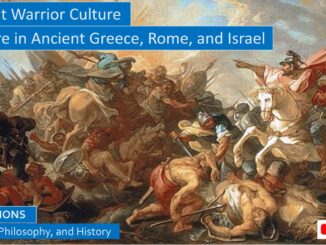
The Greek innovation to ancient warfare was their hoplite warrior phalanx, a formation eight to ten rows of a hundred or more warriors, sometimes extending a quarter of a mile. The shields of the front row would interlock, and the entire formation would press upon the enemy, the soldiers would first throw their spears then jab with their swords from behind their shields, strictly maintaining their position. This required training and practice, the Athenians expected their nobles to drill during the year, the Spartans had a year-round military the practiced year-round. […]