Plutarch’s Life of Cicero: Incorruptible Statesman and Stoic Philosopher in a Corrupt Roman Republic
Greek and Roman History

Plutarch’s Life of Cicero: Incorruptible Statesman and Stoic Philosopher in a Corrupt Roman Republic

COMPARING AND CONTRASTING CICERO AND CATO THE YOUNGER
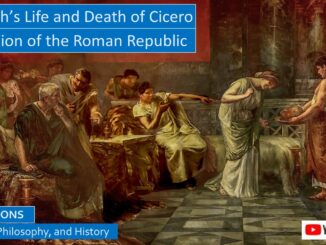
When Cicero served as consul, the top political office in Rome, for a year, he thwarted the Catiline Conspiracy that threatened to overthrow the government. Previously, he served in other important annual offices that often preceded holding the consulship. But like Cato the Younger, Cicero was not a leading figure in the Civil Wars that led to the breakdown of the Roman Republic and the founding of the Roman Empire.
Likewise, Cato the Younger was a prominent senator who also earned renown and a Plutarch biography. Both Cato and Cicero were unique: they were morally incorruptible when blatant, rampant corruption was increasing. As consul, Cicero succumbed to violence when he summarily executed the conspirators without a trial. Although he praised the moral qualities of both, Plutarch offered greater praise for Cato the Younger.
Cicero lived during a transition. Class tensions had resulted in the Agrarian Revolt and Social War when the politics in the Roman Republic became increasingly violent. In Cicero’s youth, General Sulla had marched on Rome with his army, and although his dictatorship was not permanent, he did execute many of his political rivals, setting dangerous precedents. […]

St John Climacus on Mad Pride and Vainglory : Ladder of Divine Ascent, Steps 22-23
Ladder of Divine Ascent

St John Climacus on Mad Pride and Vainglory: Ladder of Divine Ascent, Steps 22-23

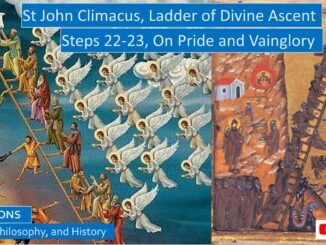
What is the difference between vainglory and pride? Today, vainglory is an archaic word that has not been replaced in common usage, so we usually consider them to be synonymous. Although St John Climacus concedes they are similar, except vainglory progresses to mad pride. He examines vainglory in Step 22, and mad pride in Step 23.
Let us compare the definitions:
Step 22.1. “Some like to distinguish vainglory from pride, and to give it a special place and chapter.” “The only difference between them” is like the difference “between a child and a man, between wheat and bread: for the one is the beginning and the other the end.”
Step 22.2. “With regard to its form, vainglory is a change of nature, a perversion of character, a note of blame. With regard to its quality, it is a dissipation of labors, a waste of sweat, a betrayal of treasure, a child of unbelief, the precursor of pride, shipwreck in harbor, an ant on the threshing floor which, though small, has designs upon all one’s labor and fruit. The ant waits for the gathering of the wheat, and vainglory for the gathering of the riches of virtue: for the one loves to steal and the other to squander.” […]

What Spiritual Advice Can Fathers Suggest at Their Daughter’s Wedding Reception
Marriage and Divorce

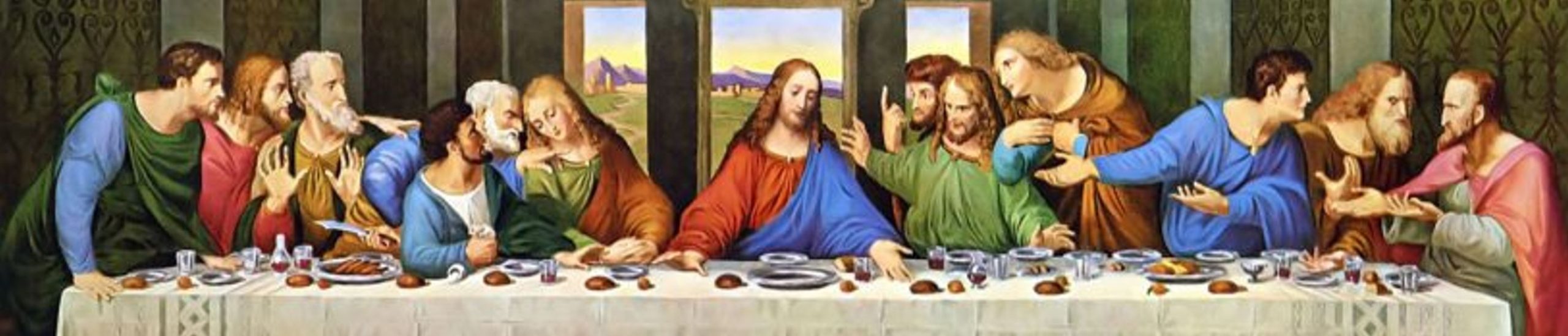
What Beneficial Advice Can Fathers Suggest in Their Speech at Their Daughter’s Wedding?

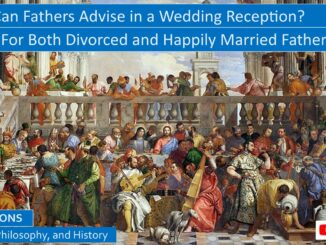
For all our close friendships, and our marriages, we need to ask ourselves: Do we bring out the best in each other? Or, do we bring out the worst in each other? Our marriage should be a monastic calling: our marriage should be for our children. The prospective bride should ask herself the key question: Will he be a good father? Will he be good with our children? We cannot love some and hate others, hatred infects all our relationships. […]

FDR’s Inaugural Address and St John Climacus, Ladder of Divine Ascent, on Fear & Cowardice, Step 21
Ladder of Divine Ascent

FDR’s First Inaugural Address and St John Climacus, Ladder of Divine Ascent, on Fear & Cowardice, Step 21

The chapter on fear is both one of the shortest and one of the most puzzling chapters of St John Climacus’ Ladder of Divine Ascent. In part, that is because there are many flavors of fears that spring from our most basal fears: the fear of the dark, the distressing, the dangerous.
More common are those fears that cause us to hesitate. Perhaps we fear what others think of us when we champion the good others do not see. Perhaps we fear rejection and failure. Perhaps we fear that past failures will rob us of future success. Perhaps we fear to do good when we are not encouraged. […]

Franklin Delano Roosevelt’s Prayer For Allied Soldiers Landing on the Beaches of Normandy
History

Franklin Delano Roosevelt’s Prayer For Allied Soldiers Landing on the Beaches of Normandy

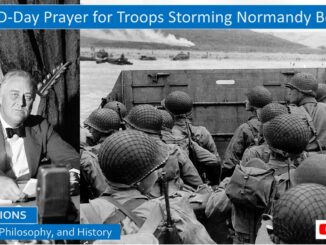
We now assume that our victory over the Nazis in this invasion of France was inevitable, but like many military battles, the battle could have gone either way. How were the Allies able to land enough troops and tanks, plus sufficient food, water, gasoline, and ammunition, on the Normandy beaches to overwhelm the German forces and push forward, first to Paris, and then to Germany itself? Why were the Allied forces not thrown back into the sea?
The historian William Manchester tells us that “Hitler’s intuition had told him from the first that the landings would come in Normandy. Then he listened to his advisors and changed his mind.” They advised him that the Allies would land in Calais in Northern France, which was a short distance from Dover in England. “The main force will land near Calais; Normandy was just a feint.” […]

Pope Francis on the Healthy Fear of God
Morality

Pope Francis on the Healthy Fear of God

Referring to the fear of the Lord as an “alarm” that awakens us “to the presence of sin in our lives” and reminds us that one day we will “be held accountable to the just Judge,” the pontiff stated that when we start to sin, this spiritual gift can help direct the faithful back on the right path.” “When a person is not on the right path, he settles himself in evil.” “When he distances himself from God, when he takes advantage of everyone, when he lives attached to money, to vanity, to power or pride, then the holy fear of God draws his attention: You will not be happy like this, this way you will end badly.” […]