
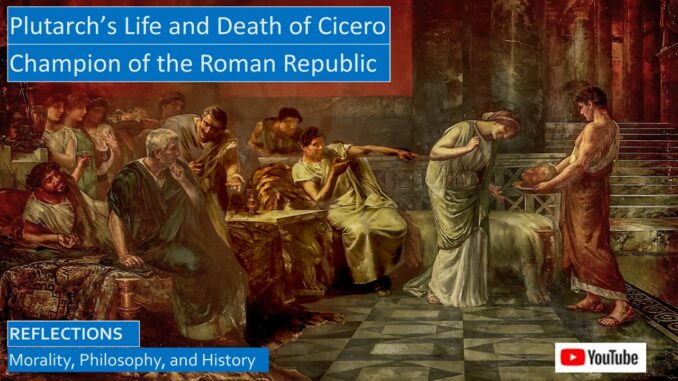
How was Cicero able to succeed in ancient Rome, holding the top political offices, despite his relatively humble birth?
Was the Roman Republic truly a democracy? Why was political violence tolerated in the late Roman Republic?
How did Cicero thwart the attempted overthrow of the Roman Republic by Catiline while serving as consul?
How did Cicero cope with the destruction of the Roman Republic during the Civil Wars of Julius Caesar and his successors?
YouTube video for this blog: https://youtu.be/k5iyHp_yhRo
COMPARING AND CONTRASTING CICERO AND CATO THE YOUNGER
When Cicero served as consul, the top political office in Rome, for a year, he thwarted the Catiline Conspiracy that threatened to overthrow the government. But unlike Cato the Younger, Cicero was not a leading figure in the Civil Wars that led to the breakdown of the Roman Republic and the founding of the Roman Empire.

Likewise, Cato the Younger was a prominent senator who also earned renown and a Plutarch biography. Both Cato and Cicero were unique: they were morally incorruptible when blatant, rampant corruption was increasing. As consul, Cicero succumbed to violence when he summarily executed the conspirators without a trial. Although he praised the moral qualities of both, Plutarch offered greater praise for Cato the Younger.
Cicero lived during a transition. Class tensions had resulted in the Agrarian Revolt and Social War when the politics in the Roman Republic became increasingly violent.
The political cultures of ancient Greece and Rome valued rhetoric, or the art of public speaking. In an age before mass entertainment, when works were read aloud at infrequent religious festivals, many of the citizens were captivated by public trials and long political speeches. Rhetoric was the entertainment of the ancient world.
PLUTARCH’S LIFE OF CICERO
Plutarch reports that although his mother was well born, his father may have been a fuller, who processes cloth. Plutarch notes: “’Cicer’ is the Latin name for chick-pea. An ancestor of Cicero had a faint dent in the end of his nose like the cleft of a chick-pea, from which he acquired his surname. Cicero himself, however,” “when he first entered public life and stood for office, his friends thought he ought to drop or change the name.” “He enthusiastically replied that he would strive to make the name of Cicero more illustrious than such names as Scaurus or Catulus.”[1]
Cicero was born into a Roman Republic that was beginning to destroy itself through demagoguery and violence. In his youth, the general Sulla had set dangerous precedents when he marched his army on Rome and executed some of his opposition. These precedents were repeated in the dying days of the Roman Republic. At the end of his life, Sulla resigned the dictatorship and served another year as consul. Sulla did introduce needed political reforms, some of which were reversed after his death.
From an early age, Cicero was eager to learn. Afterwards, not only was he the most renowned orator of Rome, he was also the most renowned poet. His Latin style was legendary. Early in his life, he studied both law and philosophy, learning rhetoric both from studying the classics and by observing public trials. “To succeed in the law,” Cicero said, “a man must renounce all pleasures, avoid all amusements, say farewell to recreation, games, entertainment, almost to intercourse with his friends.”
The historian Will Durant states: “Soon Cicero was practicing law himself and making speeches whose brilliance and courage won him the gratitude of the middle classes and the plebians. He prosecuted a favorite of Sulla,” the Roman general and dictator of Rome, “and denounced the proscriptions in the midst of the Sullan terror in 80 BC. Shortly afterward, perhaps to avoid the dictator’s revenge, he went to Greece, and continued there his studies of oratory and philosophy.”[2]
In Athens, he studied the works of all philosophers, especially the Stoics and the Platonic New Academy. Plutarch mentions that while in Greece he consulted the Oracle of Delphi. “The Pythian priestess enjoined upon him to make his own nature, and not the opinion of the multitude, his guide in life.”
Following the Oracle’s advice, Cicero gained renown in the early Republic by defending the rights of the underdog, often challenging the interests of the politically powerful. In ancient Rome, trials were public affairs, often held in public squares before large crowds. Cicero’s electrifying speeches during these public trials propelled his political career, leading to his selection as a Roman Senator. His political career was boosted not only by his memory of people’s names, but also where they were from and who their friends were.
Plutarch also notes his faults. When he ridiculed loud, shouting speakers, he said “that they were led by their weakness to resort to clamor as cripples mounting a horse. His readiness to indulge in jests and pleasantry was” “a pleasant characteristic of a pleader; but he carried it to excess and so annoyed many and got the reputation of being malicious.” Also, “Cicero’s excessive delight in the praise of others and his too passionate desire for glory remained with him until the very end, and very often confounded his saner reasonings.”
Plutarch notes that “Cicero was appointed quaestor of Sicily” for the year 75 BC “when grain was scarce, where he annoyed people at first by compelling them to send grain to Rome. But afterwards they found him careful, just, and mild, and honored him beyond any governor they had ever had. Moreover, when large numbers of young men from illustrious and noble Roman families were accused of lack of discipline and courage in the war, they were tried by the praetor of Sicily. Cicero pleaded their cause brilliantly and won the day.” He thought news of his success would reach Rome, but he was disappointed to learn that most of his associates were unaware that he was serving in Sicily.[3]
Many paintings of Cicero picture his rediscovery of the lost tomb of Archimedes when serving in Sicily, which he personally financed. After his quaestorship ended, Cicero lent his oratorical voice to prosecute the province’s governor for abuse of power and corruption. This post made him an ex officio member of the Roman Senate. In the late Roman Republic, the Senate consisted of three to five hundred patricians who served for life. Although the Senate had some administrative responsibilities, its decrees were called consultations, or advice, which had no legal force. However, they were usually followed in practice, and were often seen as interpretations of the law. Senators also served as administrators in the Roman bureaucracy.
Each office Cicero held was at or near the youngest possible age for that office. Cicero also served as:
- Aedile in 69 BC, where he administered the upkeep of Rome’s buildings and roads, distributed grain, and held games.
- Praetor in 66 BC, where he was a city magistrate and an army commander.[4]
CICERO SAVES THE REPUBLIC FROM THE CATILINE CONSPIRACY
The highest political offices during the Roman Republic were the two consuls who served for a year. Often the two consuls rotated their duties every month. They performed administrative, legislative, and judicial duties, and served as commanders of the army when Rome was at war. [5]
The event that dominated Cicero’s term as consul in 63 BC was his thwarting the Catiline Conspiracy to overthrow the Roman Republic with the help of foreign armed forces. One of Cicero’s finest political speeches were the four vehement Catiline Orations, some delivered to the people of Rome, some delivered to the Senate. Cicero was criticized by many, including Julius Caesar, for condemning conspirators to death rather than to life imprisonment.[6]
Both the common people and the patricians supported Cicero’s appointment as consul. It was widely held that many of Sulla’s changes to the constitution were unworkable and sometimes absurd, but many patricians, led by the “bold, enterprising, and versatile” Lucius Catiline, sought changes that would benefit them personally. Plutarch comments that, “in addition to other great crimes, he had once been accused of deflowering his own daughter and of killing his own brother. Fearing prosecution for this murder, he persuaded Sulla to put his brother’s name, as though he were still alive, in the list of those who were to be put to death under proscription.”
Plutarch continued: “Moreover, Catiline had corrupted a large part of the young men in the city, supplying them continually with amusements, banquets, and amours, and furnishing without stint the money to spend on these things.” Although Catiline, supported by his allies, sought the consulship, “Cicero and Caius Antonius were elected.” In his election speeches, Catiline resolved to assassinate Cicero.
Many of Sulla’s soldiers had settled in Etruria, the region north of Rome. Many formed into companies to serve under Catiline. Some of the principal citizens of Rome, including Marcus Crassus, Marcus Marcellus, and Scipio Metellus, knocked on Cicero’s door at midnight to inform him of the expected invasion and slaughter by Catiline’s forces, suggesting that he should flee the city. Cicero responded by summoning the Senate the next morning. They gave Cicero the military authority to deal with this crisis.
After Catiline’s emissaries were denied entrance to Cicero’s gates, Cicero again convened the Senate in the Temple of Jupiter. Plutarch recounts: “Catiline came” “to make his defense. No senator, however, would sit with him, but all moved away from his bench. When he began to speak, he was interrupted by outcries, and at last Cicero rose and ordered him to depart from the city, saying that, since one of them” trusted his “words and the other his arms, the city wall” should separate them.
Plutarch continued: “Catiline left the city at once with three-hundred-armed followers. He assumed the fasces and axes as though he were a magistrate, raised standards, and marched:” with “twenty-thousand men “ “to the various cities persuading them to revolt. This was now open war.”
“The creatures of Catiline who had been left behind in the city were brought together and encouraged by Cornelius Lentulus, surnamed Sura, a man of illustrious birth, but one who had led a low life and for his licentiousness had formerly been expelled from the senate, though now he was serving as praetor for the second time.”
Meanwhile, Lentulus and the other conspirators in Rome were stockpiling swords “to kill all the senators and as many of the other citizens as they could, to burn down the city, and to spare no one except the children of Pompey.” These children would be held as “hostages for their reconciliation with Pompey, when he returned from ‘his great expedition.’” “They had appointed a hundred men and assigned them by lot to many quarters of Rome” to ignite fires all over the city. “Others would stop up the aqueducts and kill those who tried to bring water.
The conspirators approached ambassadors who felt oppressed by the Romans to join the conspiracy. But Plutarch notes that “the conspirators were unbalanced men who seldom met together without wine and women, while Cicero was following their schemes industriously, with sober judgement and surpassing sagacity; he also had many men outside of their conspiracy” who monitored their scheming. Cicero also “conferred secretly and confidentially with many who” were spying on the conspiracy. Roman authorities seized correspondence between the conspirators and these ambassadors.
Plutarch recounts: “At the break of day, Cicero he assembled the Senate, read the letters aloud, and examined the informers.” One praetor “found many missiles and weapons, and a huge quantity of swords and knives, all newly sharpened,” at the house of a conspirator. The Senate convicted Lentulus, and he resigned both his office of praetor and “layed aside his purple-bordered toga in the senate.”
Plutarch continued: “It was now evening, and the people were waiting about the temple in throngs, when Cicero came forth and told his fellow-citizens what had been done.” Cicero deliberated on “what he should do with the men. He shrank from inflicting the extreme penalty befitting such great crimes.” Cicero had a “kindly nature,” and he was reluctant “to trample ruthlessly upon patricians who had powerful friends in the city. But if he treated them with less severity, he was afraid of the peril into which they would bring the state. If they suffered any milder penalty than death, they would not be satisfied, but would break out into every extreme of boldness, adding fresh rage to their old villainy.” Cicero feared that a lesser punishment would seem to be “unmanly, weak, and cowardly.”
“On the following day, the Senate discussed the punishment of the conspirators.” Most senators opined that they “ought to be imprisoned and suffer extreme punishment. All senators agreed, until they asked Caius Caesar, the future dictator, for his opinion. He opposed executing the conspirators, but favored confiscating their property and exiling them to distant Roman cities. After Cato spoke, the Senate decided to execute the conspirators, but Cicero declined to confiscate their property.”
That evening, when “Cicero left the forum to go to his house, the citizens no longer escorted him on his way with silent decorum, but received him with cries and clapping. They called him the savior and founder of his country. Many lights illuminated the streets, since people placed lamps and torches at their doors.”
But there were many who opposed repressing the conspiracy. Plutarch recounts that the leaders of the opposition included “the magistrates-elect, including Caesar as praetor, and Metellus and Bestia as tribunes. When they assumed office, Cicero had only a few days remaining as consul. They would not permit him to harangue the people.”
When Cicero swore the usual oath expected from consuls at the end of their term, he swore a new oath, that “truthfully he had saved his country and maintained her supremacy. And all the people confirmed his oath for him. At this Caesar and the tribunes” “contrived fresh troubles for Cicero.” “A law was introduced to call Pompey home with his army, so that he might put down the arbitrary power of Cicero. But Cato, who was tribune at this time, was a great help to Cicero and to the whole state, opposing the measures of the other tribunes with equal authority and a better reputation.” “Cato so highly extolled the ‘arbitrary power’ of Cicero in a speech to the people, that they voted him the greatest honors ever conferred and called him the father of his country.”[7]
Will Durant’s history concludes that the commoners “could not forgive Cicero for violating the laws of Rome by putting citizens to death without appeal; they felt that he had not made an effort to remove the causes of Catiline’s revolt, or to mitigate the poverty of the masses. They refused to let him address the Assembly on the last day” of his consulship, “and listened in anger when he swore that he had preserved the city. The revolution was not over. With Caesar’s consulate, it would begin again.”[8]
Plutarch observes: “At this time Cicero had the greatest power in the state, but he made himself generally odious, not by any base action, but by continually praising and magnifying himself, which made him hateful to many.” “But nevertheless, although he cherished so strong an ambition, he was free from envying others,” praising “his predecessors and contemporaries” in his speeches and his writings.
Plutarch observed that Cicero sometimes made enemies through his love of praise and when “he neglected decorum and dignity to make his orations more striking.” Plutarch has several amusing examples. When the greedy “Crassus expressed his admiration for the Stoic saying that the good man is always rich, Cicero countered: ‘Do you not mean that the Stoics believe that all things belong to the wise?’”
When Caesar proposed providing land for his soldiers, many Senators opposed him. Plutarch remembers: “Lucius Gellius, one of the oldest senators, said this should never pass while he lived. Cicero proposed: ‘Let us postpone it, as Gellius does not ask us to wait long.’” When a senator said he could not hear him, Cicero responded: “Yet there are holes in your ears.” Plutarch adds that Cicero caused “much ill-feeling by his readiness to attack anyone for the sake of a jest.”[9]
CLODIUS HAS HIS POLITICAL ENEMY CICERO EXILED
The sections in Plutarch’s Life of Cicero that mention Cicero’s corrupt archenemy Publius Clodius Pulcher are confusing. Although he supported Cicero’s prosecution of Catiline, he became his enemy when Cicero’s popularity declined. Clodius proclaimed Cicero’s exile while serving as the Plebian Tribune in 58 BC, seizing much of Cicero’s real estate for himself. After Clodius’ term was up, Cicero had his formal exile revoked and his property returned, returning to Rome. Clodius and Milo, his other political rival, controlled a rival set of urban mobs. Clodius was murdered in 52 BC when these two mobs clashed.[10]
Clodius plumbed new depths of blatant and unashamed financial and moral corruption in the late Roman Republic. Plutarch says he had a “bold and resolute temper,” followed by this tidbit: “Clodius, being in love with Pompeia, Caesar’s wife, snuck into his house secretly, by assuming the dress and guise of a lute-player; for the women of Rome were celebrating in Caesar’s house that mysterious rite which men were not allowed to witness.” A servant of Caesar’s mother asked him what he was doing wandering in the house. “Clodius was prosecuted for profaning the holy rites.” Cicero’s wife had a grudge against Clodius, and “many other good and honest citizens testified against him, for perjuries, disorders, bribes, and debauching women.”
Plutarch continues: “But Clodius, having escaped his peril, and having been chosen tribune, at once began to attack Cicero.” “He won the favor of the people by benevolent laws, got large provinces voted to each of the consul, brought many poorer citizens into politics, and kept armed slaves about his person.” His armed mob intimidated Cicero, and since Caesar and Pompey chose not to defend him, Cicero was compelled to flee into exile. But after Clodius burned Cicero’s house and farm, Pompey supported recalling Cicero from exile. After sixteen months, Cicero returned to Rome to a hero’s welcome, and even his enemy Crassus greeted him.[11]
JULIUS CAESAR AND THE CIVIL WARS DOOM THE REPUBLIC
In 60 BC, several years after Cicero’s consulship, Julius Caesar formed the First Triumvirate, where Caesar, Pompey, and Crassus shared power. Caesar invited Cicero to be a fourth member of this partnership, but Cicero declined, fearing it would undermine the Republic. Crassus was an incompetent general who died fighting an inferior Parthian force in 53 BC.
After spending a decade subduing the tribes in Gaul, or today’s France, Julius Caesar’s army crossed the Rubicon on the way to Rome in 49 BC. This violated Roman law: both Caesar and his soldiers could have been condemned to death for this act. But if Caesar had left his army behind on the banks of the River Rubicon, he likely would have been deposed, or possibly assassinated.
When Caesar invaded Italy, Cicero, Cato, and other senators fled to the Balkans to join Pompey’s staff. Although Pompey’s army outnumbered Caesar’s forces, Caesar triumphed in the decisive Battle of Pharsalus in Macedonia in 48 BC. Afterwards, Pompey fled to Egypt, where he was assassinated. Cato and his supporters offered the military command to Cicero. He refused. Unwilling to continue the war, Cicero returned to Italy. Caesar offered pardons to all who supported Pompey, but Cato refused, preferring suicide to living under the rule of a tyrant.[12]
CICERO, STOIC PHILOSOPHER AND RHETORICIAN
Plutarch comments that “after this, when the government had been changed to a monarchy, Cicero abstained from public affairs and devoted his time to those young men who wished to study philosophy,” and to his writings. Consequently, these intellectual endeavors increased his “influence in the state.” “He rarely went down to the city, and then only to pay court to Caesar. He was foremost among those who advocated Caesar’s honors.”[13]
Cicero is best known today for his Stoic philosophical works and political speeches, many of which have been preserved. Cicero’s works were eagerly read when rediscovered in the Renaissance, and he is known for his elegant Latin. Most of his philosophical works were written in 45 and 44 BC when he retired to his villas, withdrawing from active politics as Caesar became more authoritarian. We have reflected on Cicero’s works on friendship and old age, and we are planning several more reflections on his other works.
Roman Stoic Philosopher Cicero On Friendship and Virtue
https://wp.me/pachSU-1uY
https://seekingvirtueandwisdom.com/stoic-cicero-on-friendship-and-virtue/
Roman Stoic Philosopher and Politician Cicero on Aging and Death
https://youtu.be/ne9T2N2mvZY
https://seekingvirtueandwisdom.com/roman-stoic-philosophers-cicero-on-aging-and-death/
These are Cicero’s main philosophical works (bold face: past or planned reflections):
- (46 BC) Paradoxa Stoicorum (Stoic Paradoxes)
- (45 BC) Hortensius, a lost work.
- (45 BC) Consolatio (Consolation)
- (45 BC) De Finibus Bonorum et Malorum (About the Ends of Goods and Evils) – a book on ethics
- (45 BC) Tusculanae Quaestiones (Tusculanae Disputationes: Questions debated at Tusculum)
- (45 BC) De Natura Deorum (On the Nature of the Gods)
- (45 BC) De Divinatione (On Divination)
- (45 BC) De Fato (On Fate)
- (44 BC) Cato Maior de Senectute (Cato the Elder on Old Age)
- (44 BC) Laelius de Amicitia (Laelius on Friendship)
- (44 BC) De Officiis (On Duties)[14]
MORE CIVIL WARS AFTER BRUTUS STABS JULIUS CAESAR
Another round of civil wars erupted after Brutus and other senators stabbed Caesar to death during a senate session on the Ides of March, 44 BC. They thought this act would restore the Roman Republic, but instead it solidified a Roman Empire ruled by emperors. Since Cicero was sixty years old and a moderate, they did not approach him to join the conspiracy. But his opposition increased his popularity, and he became more politically active. Cicero attacked Antony in a series of speeches called the Philippics, named after the Greek orator Demosthenes’ denunciations of Philip II of Macedon, father of Alexander the Great.
The Second Triumvirate was formed by the Senate for Mark Antony, Lepidus, and Octavian to share power while combating the forces of Brutus and his allies. After Brutus’ army was vanquished, Octavian first removed Lepidus from power, and then defeated the combined naval forces of Mark Antony and Cleopatra.[15]
Cicero favored Caesar Augustus, aka Octavian, and detested Mark Antony. Once when “Antony convened the senate and summoned Cicero, “he pretended to be ill in bed,” fearing for his life. But “Antony showed great offense at the affront, and sent soldiers, commanding them to either bring him or burn down his house.”
In 43 BC, at his villa in Formia, halfway between Rome and Naples, Cicero’s servants carried him in a litter to the seashore, where they encountered a band of Antony’s soldiers. Cicero, recognizing them, “commanded his servants to set down the litter.” “He looked steadfastly at his slayers, his head all squalid and unkempt, and his face wasted with anxiety, so that most of those who stood by covered their faces while Herennius was slaying him.” “Herennius cut off his head, by Antony’s command, and his hands: the hands with which he wrote the Philippics.”
When Cicero’s remains were brought to Rome, “Antony ordered the head and hands to be fastened over the rostra, where the orators spoke; a sight that made the Romans shudder.”
Plutarch concludes this life: “Caesar, a long time after this, paid a visit to one of his daughter’s sons; and the boy, since he had in his hands a book of Cicero’s, was terrified and sought to hide it in his gown; but Caesar saw it, and took the book, and read a great part of it as he stood, and then gave it back to the youth, saying: ‘He was a learned man and a lover of his country.’ Moreover, as soon as he had finally defeated Antony, and when he was himself consul, he chose Cicero’s son as his colleague in the office.”[16]
In a prior reflection, we briefly reviewed the Roman Emperors from Julius Caesar and Octavian, the intervening emperors and the five good emperors, stopping at Marcus Aurelius, who has an extended series of reflections.
Roman Emperors Before Marcus Aurelius
https://youtu.be/6i–hVIpg1k
https://seekingvirtueandwisdom.com/roman-emperors-before-marcus-aurelius/
DISCUSSING THE SOURCES
We prefer Robin Waterfield’s translations of Plutarch’s Roman Noble Lives, but he did not translate his life of Cicero. So, we consulted the translation in Harvard’s Loeb Classical Library and John Dryden’s translation, which we often condensed for clarity. We also relied on the very quotable modern history of Will Durant to supplant Plutarch, and we consulted Dr Wikipedia for quick summaries of the broad-brush events that frame Cicero’s interesting life.
We plan to first reflect on Plutarch’s many lives of Romans during the late Roman Republic, the civil wars, and the early Roman Empire, and then we will reflect on the histories written by the ancient Roman historians, supplemented by Will Durant and other modern historians.
We reflected on Plutarch’s life, and both his Lives of Noble Greeks and Romans, and his Moralia, a collection of his philosophical works, and the ancient histories which were his sources. We reflected on the moral lessons that Plutarch draws from his Roman and Greek lives. Many, but not all, of his sources have disappeared into the sands of history, which makes his Parallel Lives all the more precious. Above all, they are a joy to read.
Plutarch’s Life and Works, Including His Noble Greek and Roman Lives, and Moralia, His Stoic Sayings
https://youtu.be/ICWujY0CViQ
https://seekingvirtueandwisdom.com/plutarchs-life-and-works-including-his-greek-and-roman-lives-and-moralia-his-stoic-sayings/
[1] Plutarch, Parallel Lives, translated by Bernadotte Perrin (Harvard University Press: Loeb Classical Library, 1919, originally 100s AD), https://penelope.uchicago.edu/Thayer/E/Roman/Texts/Plutarch/Lives/Cicero*.html, 1.1-1.5. I will quote mostly from this translation.
[2] Will Durant, Caesar and Christ (New York: Simon and Schuster, 1944, 1971), The Oligarchic Reaction: Cicero and Catiline, pp. 140-141.
[3] Plutarch, Cicero, in Parallel Lives, Volume 2, translation by John Dryden, updated by Arthur Hugh Clough (New York: The Modern Library, 1992, 1979, originally 100s AD), Chapters 1-7, pp. 408-413 and webpage in Footnote 1.
[4] https://en.wikipedia.org/wiki/Cicero and https://en.wikipedia.org/wiki/Roman_Senate
[5] https://en.wikipedia.org/wiki/Roman_consul
[6] https://en.wikipedia.org/wiki/Cicero
[7] Plutarch, Cicero, in Parallel Lives, Volume 2, Chapters 10-23, pp. 415 – 423 and webpage in Footnote 1.
[8] Will Durant, Caesar and Christ, The Oligarchic Reaction: Cicero and Catiline, pp. 142-145.
[9] Plutarch, Cicero, in Parallel Lives, Volume 2, Chapters 24-27, pp. 424 – 426 and webpage in Footnote 1.
[10] https://en.wikipedia.org/wiki/Publius_Clodius_Pulcher
[11] Plutarch, Cicero, in Parallel Lives, Volume 2, Chapters 28-36, pp. 426 – 433 and webpage in Footnote 1.
[12] https://en.wikipedia.org/wiki/Cicero and https://en.wikipedia.org/wiki/Crossing_the_Rubicon and https://en.wikipedia.org/wiki/Battle_of_Pharsalus and https://en.wikipedia.org/wiki/Marcus_Licinius_Crassus
[13] Plutarch, Cicero, in Parallel Lives, Volume 2, Chapters 37-40, pp. 433 – 435 and webpage in Footnote 1.
[14] https://en.wikipedia.org/wiki/Writings_of_Cicero
[15] https://en.wikipedia.org/wiki/Assassination_of_Julius_Caesar and https://en.wikipedia.org/wiki/Second_Triumvirate
[16] Plutarch, Cicero, in Parallel Lives, Volume 2, Chapters 42-49, pp. 436 – 441 and webpage in Footnote 1.



Be the first to comment