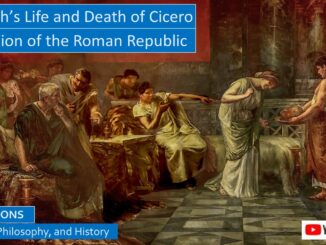
Plutarch’s Life and Works, Including His Greek and Roman Lives, and Moralia, His Stoic Sayings
Book Reviews and Miscellaneous

Plutarch’s Life and Works, Including His Noble Greek and Roman Lives, and Moralia, His Stoic Sayings

Over half of Plutarch’s Lives of Noble Romans influenced the history of the corrupt and violent last years of the Roman Republic, and the rise of the Roman Empire under Julius Caesar. Plutarch paired Greek and Roman lives based on their personalities and accomplishments. For example, Julius Caesar is paired with Alexander the Great, and the Greek companion to Cicero is Demosthenes, the renowned Greek orator who opposed Alexander the Great’s conquest of Greece. Plutarch used Xenophon as one of his sources for his lives of the Spartan Kings Agis and Agesilaus, Alcibiades, the lost life of Epaminondas of Thebes, and possibly Lycurgus of Sparta. The majority of Plutarch’s Roman lives featured the strivings of great men during the breakdown of the Roman Republic, and the subsequent struggles and civil wars that culminated in the reign of the first two emperors of the Roman Empire, Julius Caesar and Caesar Augustus, or Octavian.
Plutarch is more interested in highlighting the moral and character strengths and weaknesses of the famous men of history than he is in revealing how these great men influenced historical events. For this reason, you cannot consult only Plutarch for a complete historical review. We also consulted Will Durant’s account in his Story of Civilization, Volume 3, Caesar and Christ. Will Durant often quotes Cicero directly, and Plutarch is his primary source out of necessity. We also consulted the Wikipedia article on Cicero to fill in some background and details. […]

States' Rights v Federal Power From the Nation's Founding to Civil War, Jim Crow, and Civil Rights Movement
Civil Rights

States’ Rights v Federal Power From the Nation’s Founding to Civil War, Jim Crow, and Civil Rights Movement

The Constitution was drafted to correct the many weaknesses of the Articles of Confederation. Congressmen now swear allegiance to the United States rather than to their native states, as was done under the Articles. The Constitution grants the Federal government not only the power to levy taxes, but also to collect them, as well as sole control over trade and commerce. The Constitution establishes a Federal court system that can override state court decisions if there is a conflict. The US Congress, unlike the Confederation Congress, can pass routine legislation with a simple majority vote. […]

The Life, Adventures, and Philosophy of Xenophon, General and Student of Socrates
Greek and Roman History

The Life, Adventures, and Philosophy of Xenophon, General and Student of Socrates

Was Xenophon a warrior, a historian, or a philosopher? Xenophon is one of the rare ancient authors whose entire corpus of major works have survived, putting him in the company of Plato and St Augustine, he was highly regarded among ancient and medieval scholars, though hyper-critical modern scholars tend to deprecate him. He was a student of Socrates and wrote several works featuring Socrates, including a fascinating collections of his Stoic-like sayings in the Memorabilia. […]

Xenophon’s Anabasis: The Persian Expedition, an Ancient Adventure Story
Greek and Roman History

Xenophon’s Anabasis: The Persian Expedition, an Ancient Adventure Story

The historian Will Durant summarizes this March of the Ten Thousand, led by Xenophon, “was one of the greatest adventures in human history. We are amazed at the inexhaustible courage of these Greeks, fighting their way on foot, day by day for five months, thorough two thousand miles of enemy country, across hot and foodless plains, and over perilous mountain passes covered with eight feet of snow, while armies and guerrilla bands attacked them in the rear and in front and on either flank, and hostile natives used every device to kill them, or mislead them, or bar their way.” […]

Summary of Greco-Persian Wars, Herodotus, Plutarch and Aeschylus Celebrate Greek Victory
Greek and Roman History

Summary of Greco-Persian Wars, Ancient Historians Herodotus, Plutarch and Aeschylus Celebrate Greek Victory

The wars between Greek city-states, and Persian influence in these wars, continued after a short peace, and lasted another generation, exhausting the Greek city-states, leading to their subjection of Philip of Macedon and Alexander the Great. The lesson that Alexander learned from of all these wars, starting with the Greco-Persian Wars, and from Xenophon’s leading the Greek mercenary armies from the heart of the Persian Empire, Babylon, back to Greek territory, was that the Greek hoplite armies were vastly superior to the Persian fighting forces. This meant for Alexander the Great that the Persian Empire was ripe for the taking. […]

Greek and Roman History

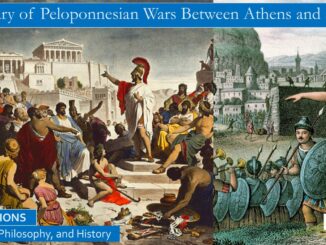
Summary of the Peloponnesian Wars Between Athens and Sparta

Why study the Peloponnesian wars? One main reason is: You cannot understand the Platonic dialogues without first understanding the history of the Peloponnesian Wars, because so many of the leading figures of this period are referenced in the Platonic dialogues, and we can learn many moral lessons from the war, which changed the Greek city-states forever.
The history of the war includes many interesting personalities, including Pericles, the founder of the radical democracy of Athens who died in the first years of the war, and Alcibiades, the ladies’ man and charismatic personality who was a leader of all three sides of the antagonists of the war, and we have the Spartan general Lysander who spared Athens from destruction when she lost the war. […]

Greek and Roman History

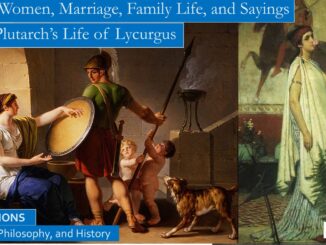
Spartan Women, Marriage, Family Life and Sayings, From Plutarch’s Life of Lycurgus

Seizing women for marriage was part of many ancient cultures. When in war a particularly hated city-state was conquered, it was common practice to slaughter the military age men and enslave the women and children, and many of the women would be enslaved as concubines. Early in the Peloponnesian Wars, Thucydides tells us the dramatic of how first the Athenian Assembly condemned the city-state of Mytilene to this fate, then changed their mind the next day, and how a furiously rowed trireme bearing this good news beat the previous day’s trireme just in the nick of time, saving the city of Mytilene!

Thucydides also tells of the siege of the Melians, whose men were executed, and her women and children sold into slavery at the hands of the Athenians late in the war, and how the Athenians worried they would suffer the same fate when they lost the war to Sparta. […]

Greek and Roman History

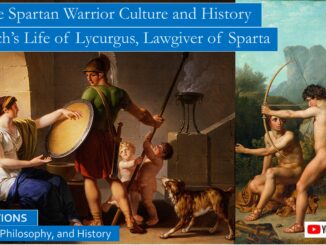
Unique Spartan Warrior Culture and History, Plutarch’s Life of Lycurgus, Lawgiver of Sparta

Sparta was the city-state that dominated the Peloponnese, the region that is separated from Athens and the rest of Greece by the narrow Isthmus at Corinth, and without that isthmus it would be an island to itself. Sparta was a traditional and conservative agricultural society that was not welcoming to foreigners, other than aristocratic guest-friends. […]

Philosophy

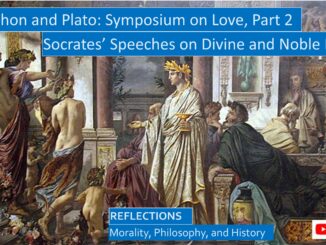
Xenophon and Plato, Socratic Dialogue, Symposium, Divine and Noble Love, Part 2

Both of these commandments are the Divine Love that Plato describes in the Symposium. Like the country song suggests, If you don’t love your neighbor, you don’t Love God. As we learned from St John of the Cross, if our love for our neighbor or our love does not increase in us our Love of God, then it is not love at all. Which means that you cannot talk about two types of love, one mortal, one divine, as do the speakers like Agathon in the Symposium, though you could talk about love and lust, love being unselfish, and lust being selfish, caring only about yourself, not caring about the well-being of your partner or friend. […]

History

Thirty Tyrants Ruling Athens After Spartan Victory in the Peloponnesian Wars

After the end of the Peloponnesian Wars, the victorious Spartan commander Lysander insisted that, as part of the terms of peace, the Athenians set up an aristocracy under the rule of the Thirty Tyrants. Although the previous tyrants in the sixth century BC were benevolent tyrants, the Thirty were Tyrants of the worst kind, dominated by the vicious Critias, a tyranny that quickly descended into an orgy of bloodshed directed first against their enemies, and then against their fellow aristocrats so they could seize their property. This misrule preceded the reestablishment of the Radical Democracy of Athens, and the events of the Thirty Tyrants cast a long shadow over Athenian history and the Platonic dialogues. […]