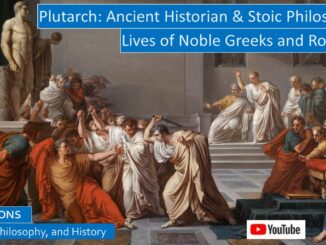
Plutarch’s Life and Works, Including His Greek and Roman Lives, and Moralia, His Stoic Sayings
Book Reviews and Miscellaneous

Plutarch’s Life and Works, Including His Noble Greek and Roman Lives, and Moralia, His Stoic Sayings

Over half of Plutarch’s Lives of Noble Romans influenced the history of the corrupt and violent last years of the Roman Republic, and the rise of the Roman Empire under Julius Caesar. Plutarch paired Greek and Roman lives based on their personalities and accomplishments. For example, Julius Caesar is paired with Alexander the Great, and the Greek companion to Cicero is Demosthenes, the renowned Greek orator who opposed Alexander the Great’s conquest of Greece. Plutarch used Xenophon as one of his sources for his lives of the Spartan Kings Agis and Agesilaus, Alcibiades, the lost life of Epaminondas of Thebes, and possibly Lycurgus of Sparta. The majority of Plutarch’s Roman lives featured the strivings of great men during the breakdown of the Roman Republic, and the subsequent struggles and civil wars that culminated in the reign of the first two emperors of the Roman Empire, Julius Caesar and Caesar Augustus, or Octavian.
Plutarch is more interested in highlighting the moral and character strengths and weaknesses of the famous men of history than he is in revealing how these great men influenced historical events. For this reason, you cannot consult only Plutarch for a complete historical review. We also consulted Will Durant’s account in his Story of Civilization, Volume 3, Caesar and Christ. Will Durant often quotes Cicero directly, and Plutarch is his primary source out of necessity. We also consulted the Wikipedia article on Cicero to fill in some background and details. […]
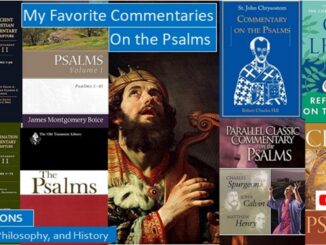
My Favorite Commentaries on the Psalms
Book Reviews and Miscellaneous

My Favorite Commentaries on the Psalms

One excellent example of reading the Bible allegorically is the verse in Psalm 137 where the Jews are encouraged to bash the brains of Babylonian babies against the rocks. The Church Fathers equate these babies with our small sins, that we should strive to be perfect, even as our Heavenly Father is perfect, bashing both our large and small sins.
We must remember that the Psalms are poetry, and Hebrew poets are like poets in any language, they sometimes use obscure words for better rhythm. This means the Psalms pose more translation problems than most of the books in the Bible. If you cannot make sense of a passage, it may be that scholars are not quite sure what the original passage meant. […]

Book Reviews and Miscellaneous

My Favorite Reflections on Morality, Philosophy, and History

Scholars, like most everyone else, are social creatures, and are eager to please their teachers. This means they usually repeat the narratives they have been taught. Additionally, professors are often so hyper-specialized that they overlook connections to other fields. And, as Professor Steven Pinker noted, back in the day, professors dared not study consciousness until they attained tenure.
Is there anything new under the sun? What I hope to find is someone from the past who confirms my insights, because original insights are most valuable when they are old truths long forgotten, or connections are overlooked because prior generations were blind to how current events affected their views. Even when there is no direct confirmation, I sometimes find reflections from past generations that indirectly confirm, or at least do not disprove my perspectives.
For me, creativity is not a problem, so I prefer to include quotes from ancient and modern authors, to encourage my listeners to read them on their own. Why restate aphorisms in my own words when they are so inspiring when originally uttered? The eastern Church Fathers did not see a need to reword inherited ancient teachings, so why should I? […]

Book Reviews: Golden Legend, Butler’s, OCA, and Pope Benedict XVI’s Lives of Saints
Book Reviews and Miscellaneous

Book Reviews: Golden Legend, Butler’s, OCA, and Pope Benedict XVI’s Lives of Saints

The compiler of the Golden Legend was the Dominican friar Jacobus de Voragine. The Dominicans historically have been concerned about historical accuracy to guard the faith against heresy. He lists as his three primary sources the lives from Ecclesiastical History by Eusebius, bishop and advisor to Emperor Constantine; the Tripartite History by Cassiodorus; and the Scholastic History by Peter Comestor. In addition, he refers to more than 120 other sources. He was also influenced by earlier collections of lives of the saints by two other Dominican scholars. When his sources were apocryphal and not trustworthy, he points this out. When possible, he tries to reconcile dates and details, but is more concerned with the spiritual lessons than historical accuracy. […]

Book Reviews and Miscellaneous

Book and DVD Reviews on the Ten Commandments, or Decalogue

These are book reviews on the Decalogue, or Ten Commandments. Our first sources are the Lutheran and Catholic Catechisms, they discuss each of the Ten Commandments. Pope Benedict, aka Cardinal Ratzinger when footnotes for the sources used in the Catechism between the eastern and western church fathers, which means that this is an excellent study program for the writings of the Church Fathers for both the Catholic and Orthodox religious traditions. […]

Book Reviews and Miscellaneous

Book Reviews on Apostolic and Early Church Fathers

These quick book reviews include links to our YouTube videos and blogs on the Apostolic and Early Church Fathers, plus related topics. We will also discuss how to read ancient works, and the problems scholars face when translating ancient works, and the 38-volume set of the writings of the Ante-Nicene, ante meaning before, Nicene, and Post-Nicene Church Fathers, translated into English. […]

Book Reviews and Miscellaneous

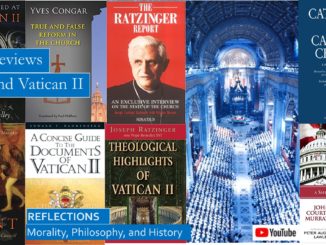
Book Reviews, Reform Councils of Trent and Vatican II, and Vatican I

IMHO, you cannot truly understand the modern Catholic Church without reading William O’Malley’s histories of Trent and Vatican II. O’Malley argues that Vatican II restated the theology of Trent, countering the notion that Trent was a reactionary rather than a reforming council. This polemic view of Trent was influenced by the fact that the Vatican had closed the archives of the Trent Council until early in the twentieth century. […]

Book Reviews and Miscellaneous

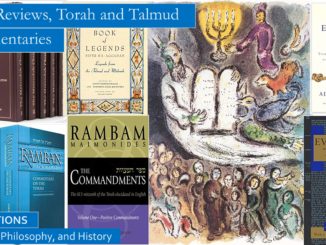
Book Reviews, Commentaries of Torah and Talmud, Medieval Rabbis and Modern Rabbis and Scholars

We encourage Christians to study the moral lessons of the Torah, we do not hold to the dual-covenant belief that the laws in the Torah have been superseded. St Irenaeus in his influential work, On Heresies, teaches us that the moral laws of the Torah are still binding on Christians, and that the dietary and festival laws that have been superseded can be read as teaching moral lessons allegorically. […]

Book Reviews and Miscellaneous

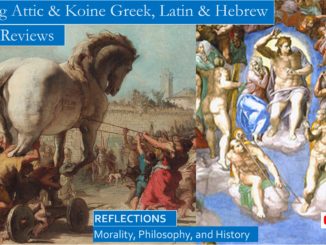
On Learning Attic and Koine Greek, Classical Latin, and Biblical Hebrew

You would only want to learn these ancient languages if you are truly a serious student, and want to read the Scriptures and classics in their original language, and so you will not miss the word plays and puns that you can only catch in the original language. When reading epic poems of Homer and the Greek playwrights, or the Psalms in Old Testament, or the elegant works of Cicero, you can experience the rhymes and rhythms of the original language, as poetry can be incredibly difficult to translate. When we cut the video for a play by Aeschylus on the Battle of Salamis in the Persian Wars, the various translations we encountered were RADICALLY different. Personally, I am tempted not to read any more Greek plays until I learn how to read Attic Greek. […]