
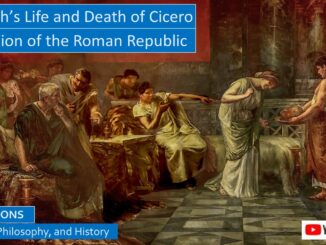
Plutarch’s Life and Works, Including His Greek and Roman Lives, and Moralia, His Stoic Sayings
Book Reviews and Miscellaneous

Plutarch’s Life and Works, Including His Noble Greek and Roman Lives, and Moralia, His Stoic Sayings

Over half of Plutarch’s Lives of Noble Romans influenced the history of the corrupt and violent last years of the Roman Republic, and the rise of the Roman Empire under Julius Caesar. Plutarch paired Greek and Roman lives based on their personalities and accomplishments. For example, Julius Caesar is paired with Alexander the Great, and the Greek companion to Cicero is Demosthenes, the renowned Greek orator who opposed Alexander the Great’s conquest of Greece. Plutarch used Xenophon as one of his sources for his lives of the Spartan Kings Agis and Agesilaus, Alcibiades, the lost life of Epaminondas of Thebes, and possibly Lycurgus of Sparta. The majority of Plutarch’s Roman lives featured the strivings of great men during the breakdown of the Roman Republic, and the subsequent struggles and civil wars that culminated in the reign of the first two emperors of the Roman Empire, Julius Caesar and Caesar Augustus, or Octavian.
Plutarch is more interested in highlighting the moral and character strengths and weaknesses of the famous men of history than he is in revealing how these great men influenced historical events. For this reason, you cannot consult only Plutarch for a complete historical review. We also consulted Will Durant’s account in his Story of Civilization, Volume 3, Caesar and Christ. Will Durant often quotes Cicero directly, and Plutarch is his primary source out of necessity. We also consulted the Wikipedia article on Cicero to fill in some background and details. […]

Cicero on Friendship and Virtue
Philosophy

Roman Stoic Philosopher Cicero On Friendship and Virtue

Cicero advises us: “The first and sacred law of friendship: Seek only good from friends, do only good for the sake of friends, and don’t wait to be asked! Be always attentive! Banish hesitation! Be ready to give advice freely! Take seriously the good advice of friends. Be ready to offer it openly, even forcefully, if the occasion demands, and also be ready to follow when it has been offered.”
In contrast, Antisthenes, the first Cynic philosopher who studied under Socrates, advises us: “Pay attention to your enemies, for they are the first to notice your faults.” Often, friends are reluctant to tell us what we need to know, preferring to tell us what they think we want to hear. […]

Roman Stoic Philosopher Cicero on Aging and Death
Philosophy

Roman Stoic Philosopher and Politician Cicero on Aging and Death

Cicero advises us: “Enjoy the blessing of strength while you have it, and have no regrets when it has gone, any more than young men should regret the end of boyhood, or those approaching middle age lament the passing of youth. Life’s course is invariable: nature has one path only, and you cannot travel along it more than once. Every stage of life has its own characteristics: boys are feeble, youths in their prime are aggressive, middle-aged men are dignified, while the elderly are mature. Each of these qualities is ordained by nature for harvesting in due season.”
Cicero continues: “Age must be overcome; its faults need vigilant resistance. We must combat them as we should fight a disease: following a fixed regime, exercising in moderation, and consuming enough food and drink to strengthen” but not too much. “The mind and spirit need even more attention than the body, for old age easily extinguishes them, like lamps” with too little oil. […]