Plutarch’s Life and Works, Including His Greek and Roman Lives, and Moralia, His Stoic Sayings
Book Reviews and Miscellaneous

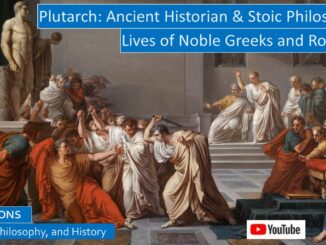
Plutarch’s Life and Works, Including His Noble Greek and Roman Lives, and Moralia, His Stoic Sayings

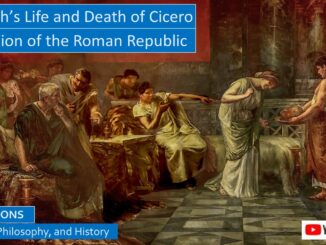
Over half of Plutarch’s Lives of Noble Romans influenced the history of the corrupt and violent last years of the Roman Republic, and the rise of the Roman Empire under Julius Caesar. Plutarch paired Greek and Roman lives based on their personalities and accomplishments. For example, Julius Caesar is paired with Alexander the Great, and the Greek companion to Cicero is Demosthenes, the renowned Greek orator who opposed Alexander the Great’s conquest of Greece. Plutarch used Xenophon as one of his sources for his lives of the Spartan Kings Agis and Agesilaus, Alcibiades, the lost life of Epaminondas of Thebes, and possibly Lycurgus of Sparta. The majority of Plutarch’s Roman lives featured the strivings of great men during the breakdown of the Roman Republic, and the subsequent struggles and civil wars that culminated in the reign of the first two emperors of the Roman Empire, Julius Caesar and Caesar Augustus, or Octavian.
Plutarch is more interested in highlighting the moral and character strengths and weaknesses of the famous men of history than he is in revealing how these great men influenced historical events. For this reason, you cannot consult only Plutarch for a complete historical review. We also consulted Will Durant’s account in his Story of Civilization, Volume 3, Caesar and Christ. Will Durant often quotes Cicero directly, and Plutarch is his primary source out of necessity. We also consulted the Wikipedia article on Cicero to fill in some background and details. […]

Pope Leo the Great, Confronting Attila the Hun, and His Role in Fourth Ecumenical Council of Chalcedon
Catholic Middle Ages and Beyond

Pope Leo the Great, Confronting Attila the Hun, and His Role in the Fourth Ecumenical Council of Chalcedon

As Pope Benedict XVI writes: “The times in which Pope Leo lived were very difficult: constant barbarian invasions, the gradual weakening of imperial authority in the West, and the long, drawn-out social crisis forced the Bishop of Rome” “to play an important role in both civil and political events.”
“In a period of profound crisis, Leo the Great knew how to make himself close to the people and the faithful with his pastoral action and his preaching. He enlivened charity in a Rome tried by famines, an influx of refugees, injustice, and poverty. He opposed pagan superstitions and actions of Manichaean groups. He associated the liturgy with the daily life of Christians.” […]

Did Rome Fall, or Evolve to Barbarian Kingdoms? Sack of Rome, and Attila the Hun’s Invasions
Greek and Roman History

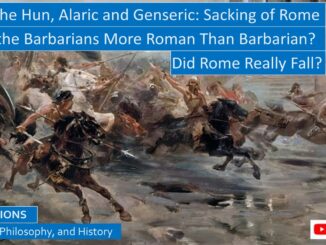
Did Rome Fall, or Evolve Into the Barbarian Kingdoms? Sacks of Rome, and Attila the Hun’s Invasions

Peter Brown contends: “The Roman Empire was not violently breached by barbarian “invasions.” Rather, between AD 200 and 400, the frontier itself changed. From being a defensive region, which kept Romans and barbarians apart, it had become, instead, an extensive middle ground, in which roman and barbarian societies were drawn together. And after AD 400, it was the barbarians and no longer the Romans who became the dominant partners in the middle ground.” Indeed, after AD 400 barbarian tribes served in the army of the Huns, and barbarians from most of the tribes, including the Huns, served in the Roman armies. […]

The Cruel Roman Emperor Commodus, Son of the Good Stoic Emperor Marcus Aurelius
Greek and Roman History

The Cruel Roman Emperor Commodus, Son of the Good Stoic Emperor Marcus Aurelius

The wise stoic reign of Marcus Aurelius, beloved by all, was followed by the murderous reign of Commodus, hated and feared by all, who would be assassinated by his closest companions. The disastrously reckless cruelty of Commodus, and his neglectful reign, which nearly caused the disintegration of the Roman Empire, colors the opinion of both ancient and modern historians. What historians mention, but do not emphasize, are the similarities between the soldier Hadrian and Commodus. Both liked to fight in the ring as gladiators. Both decided to halt the Roman policy of expansion, seeking strategic withdrawal. And Marcus Aurelius was as wary of his adoptive grandfather Hadrian as he was of his wayward son Commodus. […]

Were the Christians Actively Persecuted by Marcus Aurelius, Stoic Philosopher and Good Roman Emperor?
Greek and Roman History

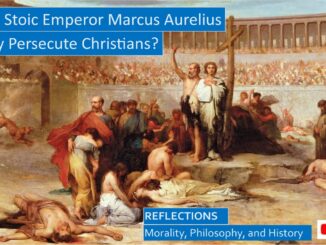
Were the Christians Actively Persecuted by Marcus Aurelius, Stoic Philosopher and Good Roman Emperor?

Today we will reflect on this question: Did the good Roman Emperor and Stoic Philosopher Marcus Aurelius actively persecute Christians? Why wasn’t Marcus Aurelius and other stoics impressed by the martyrdom of Christians in the arena? How could Marcus Aurelius espouse Christian values in his Stoic Meditations, while also including […]

History of Christian Persecutions, New Testament Through Marcus Aurelius
Greek and Roman History

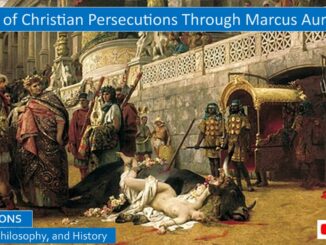
History of Christian Persecutions, New Testament Through Marcus Aurelius

How widespread was the Christian persecution under the Roman Empire? Usually, it was a local affair, not until the reign of Diocletian was an empire-wide systematic persecution of Christians undertaken. The persecution under Nero was limited to Rome itself. The extent of the local persecution depended on the enthusiasm or cruelty of the local officials, many local officials had no enthusiasm for persecuting the local Christians, turning a blind eye. Overall, the number of persecutions was not huge, rarely were the Christian persecutions systematic, targeting all Christians. Indeed, the Christian martyrs in the twentieth century alone, mostly in Russia, dwarfed the number of Christian martyrs from the preceding nineteen centuries combined. […]

Marcus Aurelius Biography
Greek and Roman History

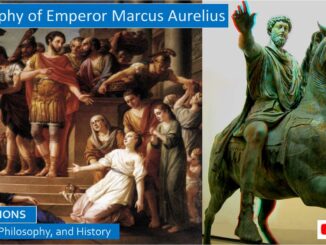
Biography of Marcus Aurelius, Stoic Philosopher and Roman Emperor

Summarizing his life, Cassius Dio tells us that Marcus Aurelius “did not display many feats of physical prowess; yet he had developed his body from a very weak one to one capable of the greatest endurance. Most of his life he devoted to beneficence, and that was the reason, perhaps, for his erecting a temple to Beneficence on the Capitol.” […]

Roman Emperors before Marcus Aurelius
Greek and Roman History

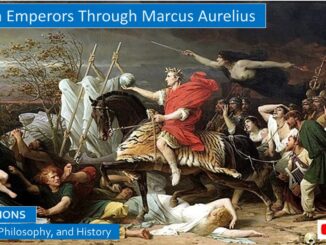
Roman Emperors Before Marcus Aurelius

Hadrian’s peace policy was controversial, he abandoned Trajan’s conquests in Dacian Romania and Parthian Persia to concentrate on consolidating the Roman Empire. The problem was that the Roman Empire needed continual expansion, including war booty and slaves, to fund the empire and feed the growing populace of Rome. This policy certainly did not prevent future conflict with Parthian Persia.
Historians debate whether Hadrian’s defensive posture was wise. Were there prosperous provinces left to conquer on the frontiers? On the other hand, the successful expansion of the empire by the Byzantine Emperor Justinian several centuries later nearly bankrupted his Empire. […]

Ordinary Life for Romans Under Stoic Emperor Marcus Aurelius
History

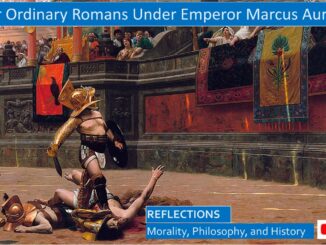
Ordinary Life for Romans Under Stoic Emperor Marcus Aurelius

Professor Aldrete in his Wondrium lecture on the History of the Ancient World points out that the ancient historians and sources are silent on what life was like for the many farmers who labored in obscurity, that these ancient histories are really histories of political leaders and city dwellers. For every person who lived in the city in much of the ancient world, eight or nine lived on a family farm. The ratio differed around Rome, about a quarter of the people nearby lived in the city. Most people never traveled more than twenty miles from home, never saw a king, never read a book, or heard a philosopher speak. Most people living on farms did not even know the name of the Roman Emperor, and life went on as before no matter who was emperor. […]

Ancient Warrior Culture - Ancient Greece, Rome, Israel
History

Ancient Warrior Societies, Blog 3, Warfare in the Old Testament

Warfare is mentioned over three hundred times in the Old Testament, swords four hundred times. Ancient Israel was caught in many of the ancient wars since it was in the cross-roads of trade routes between Mesopotamia and Egypt. Since Judah was mountainous, its armies relied heavily on infantry, but the Bible mentions that King Ahab of the Northern Kingdom had chariots, and that he was felled by arrow probably shot by a composite bow. Assyria and Babylon had cavalry archers on horseback, but not Egypt or Israel. An Israeli chariot had three horses pulling three men, a driver with a spear, an archer, and a shield bearer. We know from our Sunday School stores King David slew Goliath with a sling, but the ancient slings were not the puny toys we imagine, the sling in the ancient world was a deadly combat weapon. A skilled slinger could sling a rock over 120 miles per hour, faster than the fastest fast ball. […]