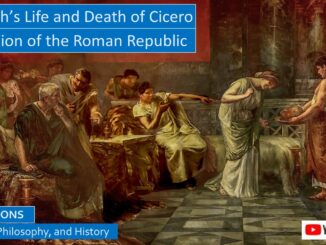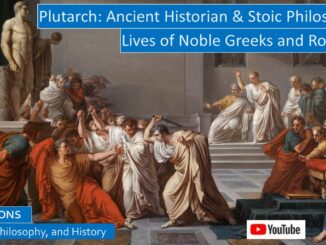

Plutarch’s Life of Cicero: Incorruptible Statesman and Stoic Philosopher in a Corrupt Roman Republic
Greek and Roman History

Plutarch’s Life of Cicero: Incorruptible Statesman and Stoic Philosopher in a Corrupt Roman Republic

COMPARING AND CONTRASTING CICERO AND CATO THE YOUNGER
When Cicero served as consul, the top political office in Rome, for a year, he thwarted the Catiline Conspiracy that threatened to overthrow the government. Previously, he served in other important annual offices that often preceded holding the consulship. But like Cato the Younger, Cicero was not a leading figure in the Civil Wars that led to the breakdown of the Roman Republic and the founding of the Roman Empire.
Likewise, Cato the Younger was a prominent senator who also earned renown and a Plutarch biography. Both Cato and Cicero were unique: they were morally incorruptible when blatant, rampant corruption was increasing. As consul, Cicero succumbed to violence when he summarily executed the conspirators without a trial. Although he praised the moral qualities of both, Plutarch offered greater praise for Cato the Younger.
Cicero lived during a transition. Class tensions had resulted in the Agrarian Revolt and Social War when the politics in the Roman Republic became increasingly violent. In Cicero’s youth, General Sulla had marched on Rome with his army, and although his dictatorship was not permanent, he did execute many of his political rivals, setting dangerous precedents. […]

Plutarch’s Life and Works, Including His Greek and Roman Lives, and Moralia, His Stoic Sayings
Book Reviews and Miscellaneous

Plutarch’s Life and Works, Including His Noble Greek and Roman Lives, and Moralia, His Stoic Sayings

Over half of Plutarch’s Lives of Noble Romans influenced the history of the corrupt and violent last years of the Roman Republic, and the rise of the Roman Empire under Julius Caesar. Plutarch paired Greek and Roman lives based on their personalities and accomplishments. For example, Julius Caesar is paired with Alexander the Great, and the Greek companion to Cicero is Demosthenes, the renowned Greek orator who opposed Alexander the Great’s conquest of Greece. Plutarch used Xenophon as one of his sources for his lives of the Spartan Kings Agis and Agesilaus, Alcibiades, the lost life of Epaminondas of Thebes, and possibly Lycurgus of Sparta. The majority of Plutarch’s Roman lives featured the strivings of great men during the breakdown of the Roman Republic, and the subsequent struggles and civil wars that culminated in the reign of the first two emperors of the Roman Empire, Julius Caesar and Caesar Augustus, or Octavian.
Plutarch is more interested in highlighting the moral and character strengths and weaknesses of the famous men of history than he is in revealing how these great men influenced historical events. For this reason, you cannot consult only Plutarch for a complete historical review. We also consulted Will Durant’s account in his Story of Civilization, Volume 3, Caesar and Christ. Will Durant often quotes Cicero directly, and Plutarch is his primary source out of necessity. We also consulted the Wikipedia article on Cicero to fill in some background and details. […]

Stoic Quotes from Paul Harris, Founder of Rotary International
Philosophy

Stoic Quotes from Paul Harris, Founder of Rotary International

Early in its history, the Rotary Clubs adopted the Four-Way Test. The Rotary website states that “the Four-Way Test is a nonpartisan and nonsectarian ethical guide for Rotarians to use for their personal and professional relationships.
Of the things we think, say, or do:
Is it the TRUTH?
Is it FAIR to all concerned?
Will it build GOODWILL and BETTER FRIENDSHIPS?
Will it be BENEFICIAL to all concerned?”
The Four-Way Test is a restatement of the Golden Rule that is the core teaching of all Judeo-Christian traditions, encouraging fellowship among Rotarians.[3] The Four Way Test is a restatement of the Golden Rule that is the core teaching of all Judeo-Christian traditions, with an emphasis on developing fellowship with fellow Rotarians. […]

Book Reviews and Miscellaneous

My Favorite Reflections on Morality, Philosophy, and History

Scholars, like most everyone else, are social creatures, and are eager to please their teachers. This means they usually repeat the narratives they have been taught. Additionally, professors are often so hyper-specialized that they overlook connections to other fields. And, as Professor Steven Pinker noted, back in the day, professors dared not study consciousness until they attained tenure.
Is there anything new under the sun? What I hope to find is someone from the past who confirms my insights, because original insights are most valuable when they are old truths long forgotten, or connections are overlooked because prior generations were blind to how current events affected their views. Even when there is no direct confirmation, I sometimes find reflections from past generations that indirectly confirm, or at least do not disprove my perspectives.
For me, creativity is not a problem, so I prefer to include quotes from ancient and modern authors, to encourage my listeners to read them on their own. Why restate aphorisms in my own words when they are so inspiring when originally uttered? The eastern Church Fathers did not see a need to reword inherited ancient teachings, so why should I? […]

Cicero on Friendship and Virtue
Philosophy

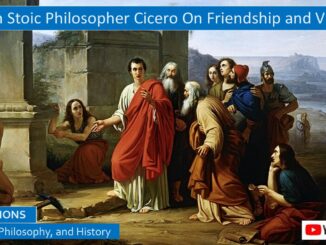
Roman Stoic Philosopher Cicero On Friendship and Virtue

Cicero advises us: “The first and sacred law of friendship: Seek only good from friends, do only good for the sake of friends, and don’t wait to be asked! Be always attentive! Banish hesitation! Be ready to give advice freely! Take seriously the good advice of friends. Be ready to offer it openly, even forcefully, if the occasion demands, and also be ready to follow when it has been offered.”
In contrast, Antisthenes, the first Cynic philosopher who studied under Socrates, advises us: “Pay attention to your enemies, for they are the first to notice your faults.” Often, friends are reluctant to tell us what we need to know, preferring to tell us what they think we want to hear. […]

Plato’s Republic, Book 1, Reflecting on Old Age, Morality, and Justice
Aging

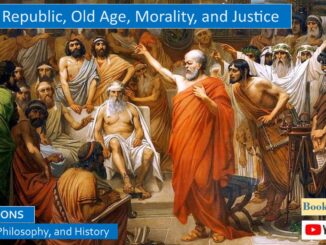
Plato’s Republic, Book 1, On Aging and Morality, a Better Word for Justice

Reading Robin Waterfield’s translation was like breathing fresh alpine air. When I thought that Plato’s Republic was about justice, I reasoned that this was because Socrates sought to train Athenians to be better citizens in a direct democracy, a skill that would not be needed in the later totalitarian Roman Empire. But Robin Waterfield’s translation of the Republic makes more sense and is more in line with Stoic and Christian moral values. I demur from the conventional scholarly opinion that who the translator is does not matter. […]

Paul Tournier, Christian Psychologist on Marriage and Widows in Old Age and Retirement
Aging

Paul Tournier, Christian Psychologist on Marriage and Widows in Old Age and Retirement

What is the ideal, according to Paul Tournier? “Growing old together, husband and wife can come to know a love which is, in a way, a prefiguration of heaven, for it is less tumultuous than the love of youth, being less directed towards selfish pleasure-seeking, and because a slow advance in mutual comprehension permits more authentic communication.” […]

Joys of Successful Aging, by Evangelical George Sweeting, Moody Bible Institute
Aging

Joys of Successful Aging, by Evangelical George Sweeting, Moody Bible Institute

George Sweeting writes: “Age adds maturity and richness to life. Age smooths the rough edges of life and adds gentleness and compassion. They say: ‘The older the violin, the sweeter the music.’ Some speak of seniors as ancient, faded, frail, shriveled, senile, withered, wrinkled, and worthless!” I prefer to say seniors are “experienced, dependable, mature, patient, seasoned, steady, wise, tested, survivor, and veteran!” […]

Opposing Suicide: According to the Bible, Catholic Catechism, and St Augustine’s City of God
Command 6 Do Not Murder

Opposing Suicide: Biblical Exhortations, Catholic Catechism, and St Augustine’s City of God

CCC 2281. “Suicide contradicts the natural inclination of the human being to preserve and perpetuate his life. It is gravely contrary to the just love of self. It likewise offends love of neighbor because it unjustly breaks the ties of solidarity with family, nation, and other human societies to which we continue to have obligations. Suicide is contrary to love for the living God.” […]

Epictetus, Eminent Roman Stoic Philosopher, on Living Well, Dying Well, and Opposing Suicide
Aging

Epictetus, Eminent Roman Stoic Philosopher, on Living Well, Dying Well, and Opposing Suicide

Is it wise to complain? Epictetus observes: “If someone dies young, he blames the gods because he is being taken before his time. If someone lingers on into extreme old age, he too blames the gods.” “Despite this, at the approach of death, he wants to stay alive; he sends for the doctors and begs him to do all he can.” “It is quite remarkable to see how people want neither to live nor to die.”
“Is health good and illness bad? No, man. What, then? Health managed well is good, but when badly managed, it is bad.”
Epictetus points out: “If you look at yourself in isolation, it is natural for you to live to an old age, to be rich, to be healthy. But if you look at yourself as a human being and as part of some whole, for the sake of that whole, it may be appropriate for you to be ill, or risk your life at sea, or be poor, or die young. Why get angry then?” “What is a human being? A part of a city made up of gods and human beings,” “a small copy of the universal city.” […]