Plutarch’s Life and Works, Including His Greek and Roman Lives, and Moralia, His Stoic Sayings
Book Reviews and Miscellaneous

Plutarch’s Life and Works, Including His Noble Greek and Roman Lives, and Moralia, His Stoic Sayings

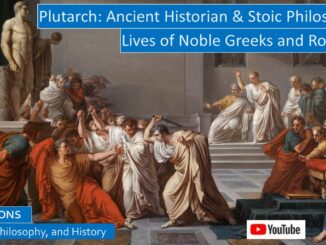
Over half of Plutarch’s Lives of Noble Romans influenced the history of the corrupt and violent last years of the Roman Republic, and the rise of the Roman Empire under Julius Caesar. Plutarch paired Greek and Roman lives based on their personalities and accomplishments. For example, Julius Caesar is paired with Alexander the Great, and the Greek companion to Cicero is Demosthenes, the renowned Greek orator who opposed Alexander the Great’s conquest of Greece. Plutarch used Xenophon as one of his sources for his lives of the Spartan Kings Agis and Agesilaus, Alcibiades, the lost life of Epaminondas of Thebes, and possibly Lycurgus of Sparta. The majority of Plutarch’s Roman lives featured the strivings of great men during the breakdown of the Roman Republic, and the subsequent struggles and civil wars that culminated in the reign of the first two emperors of the Roman Empire, Julius Caesar and Caesar Augustus, or Octavian.
Plutarch is more interested in highlighting the moral and character strengths and weaknesses of the famous men of history than he is in revealing how these great men influenced historical events. For this reason, you cannot consult only Plutarch for a complete historical review. We also consulted Will Durant’s account in his Story of Civilization, Volume 3, Caesar and Christ. Will Durant often quotes Cicero directly, and Plutarch is his primary source out of necessity. We also consulted the Wikipedia article on Cicero to fill in some background and details. […]
Plato’s Republic, Book 1, Reflecting on Old Age, Morality, and Justice
Aging

Plato’s Republic, Book 1, On Aging and Morality, a Better Word for Justice

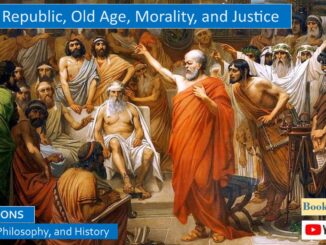
Reading Robin Waterfield’s translation was like breathing fresh alpine air. When I thought that Plato’s Republic was about justice, I reasoned that this was because Socrates sought to train Athenians to be better citizens in a direct democracy, a skill that would not be needed in the later totalitarian Roman Empire. But Robin Waterfield’s translation of the Republic makes more sense and is more in line with Stoic and Christian moral values. I demur from the conventional scholarly opinion that who the translator is does not matter. […]

Seneca on Aging Death and Suicide
Aging

Roman Stoic Philosopher Seneca on Aging, Death, and Suicide

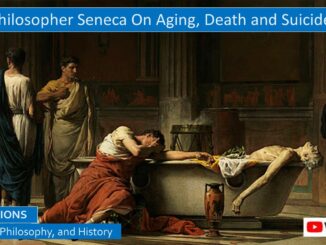
Seneca reminds us: “There is indeed a limit fixed to us,” “but none of us knows how near he is to this limit. Therefore, let us so order our minds as if we had come to the very end. Let us postpone nothing. Let us balance life’s account every day.” “Let us begin at once to live and count each separate day as a separate life.” What is important is “not how long you live, but how nobly you live. And often living nobly means that you cannot live long.” […]

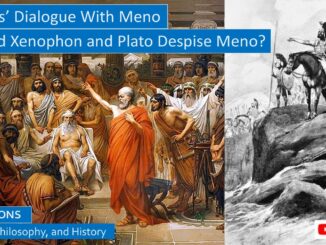
Meno, a Platonic Dialogue. Why did Xenophon Despise Meno?
Philosophy

Meno, a Socratic Dialogue. Why Did Xenophon and Plato Despise Meno? How Did Meno Die?

Xenophon, in Robin Waterfield’s translation, remembers:
“It was obvious that Meno longed to be rich; he wanted military command because it would bring him a greater share of the spoils, he wanted prestige because it would help him increase his wealth, and he wanted to be on good terms with the most powerful men because then he could avoid being punished for his crimes.”
Xenophon continues, “Meno thought that the quickest way for him to achieve his goals was to use perjury, lies, and deceit. In his opinion, openness and truthfulness were synonyms for stupidity. He evidently felt no affection for anyone, and if he claimed to be somebody’s friend it soon became clear that he was trying to sabotage him.”
Xenophon said that “Meno was frightened of people he found breaking promises and committing crimes, because he regarded them as well protected, and he tried to exploit people who were moral and honest because he regarded them as weak.” […]

Summary Platonic Dialogues on Love and Friendship
Philosophy

Summary of Platonic Dialogues on Love, With Commentary by Copleston and Anders Nygren

How can we benefit by reflecting on Four Platonic Dialogues on Love: Lysis, Alcibiades, Symposium, and Phaedrus? How similar are they? Was it possible for men and women, and husbands and wives, to be friends in ancient Greece and Rome? Did the Platonic dialogues on love condone or encourage homosexuality […]

Robin Waterfield Reflects on Xenophon’s Anabasis in Persia, and Other Greco-Persian Conflicts
Greek and Roman History

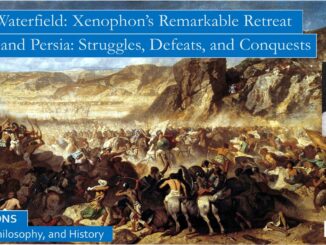
The Historian Robin Waterfield Reflects on Xenophon’s Anabasis in Persia, and Other Greco-Persian Conflicts

The Greek hoplite infantry forces were the best warriors of their time, they were eagerly employed as mercenaries in the ancient world. The Greeks won the Battle of Cunaxa, and although Artaxerxes was wounded in the battle, his younger brother Cyrus died fighting. The Greek forces were stuck thousands of miles from home, but the Persian forces of Artaxerxes were fearful of directly attacking them. At first, the Persians guided them north towards the Greek colonies of the Black Sea, but then they double-crossed them, killing many of their generals. The Greeks simply elected new generals, with Xenophon now leading their forces, as they first fought the Persians, then mountain tribesmen, fighting for provisions, as they retreated to the Greek colonies on the shores of the Black Sea. […]

Platonic Dialogue: Protagoras and Socrates Debate: Can Virtue Be Taught?
Philosophy

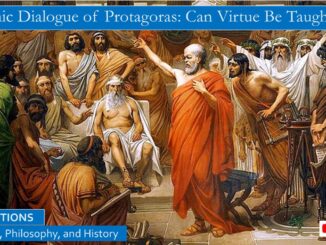
Platonic Dialogue: Protagoras and Socrates Debate: Can Virtue Be Taught?

Socrates wants his students to think for themselves, so we cannot assume that Socrates really believes that virtue cannot be taught. After all, at the end of the dialogue, Socrates asserts that true knowledge leads to virtue. Perhaps he seeks to dissuade the youths in Athens from studying under the Sophists, who claim to be able to teach anything, for a fee, a generous fee, of course.
What example comes to mind if we assert that virtue can be taught? We need to go no further than the Book of Judges, which is filled with horrible stories that atheists love to parade as proof that God is not a loving god. We must keep in mind the constant theme of the Book of Judges: Everyone in Israel did what was right IN HIS OWN EYES. Which is the slogan of the Sophists. […]

The Life, Adventures, and Philosophy of Xenophon, General and Student of Socrates
Greek and Roman History

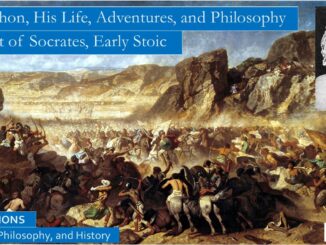
The Life, Adventures, and Philosophy of Xenophon, General and Student of Socrates

Was Xenophon a warrior, a historian, or a philosopher? Xenophon is one of the rare ancient authors whose entire corpus of major works have survived, putting him in the company of Plato and St Augustine, he was highly regarded among ancient and medieval scholars, though hyper-critical modern scholars tend to deprecate him. He was a student of Socrates and wrote several works featuring Socrates, including a fascinating collections of his Stoic-like sayings in the Memorabilia. […]

Platonic Dialogue Alcibiades 1, On Friendship, :Leadership, and Love
Philosophy

Platonic Dialogue Alcibiades 1, On Friendship, Leadership, and Love

In antiquity through the Renaissance, Alcibiades I was a highly regarded Platonic dialogue, and was often the first dialogue serious students of philosophy studied. However, many modern scholars deprecate this dialogue, arguing that it was not written by Plato. We demur, we tend to side with the ancient, medieval, and Renaissance scholars in such judgments, who tend to be inclusive, whereas modern scholars tend to be exclusive, demanding absolute certainty of proof. Our translator agrees with us, he says that the German scholar Schleiermacher first doubted its authenticity based on scholarly taste and a superficial reading. IMHO, although it does appear to differ from his other earlier dialogues, Alcibiades I was likely either written by Plato, or maybe by one of his brightest students, with his input. […]

Xenophon’s Anabasis: The Persian Expedition, an Ancient Adventure Story
Greek and Roman History

Xenophon’s Anabasis: The Persian Expedition, an Ancient Adventure Story

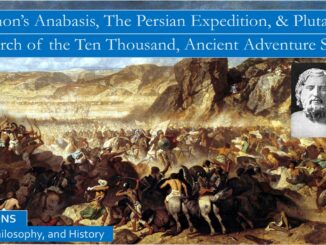
The historian Will Durant summarizes this March of the Ten Thousand, led by Xenophon, “was one of the greatest adventures in human history. We are amazed at the inexhaustible courage of these Greeks, fighting their way on foot, day by day for five months, thorough two thousand miles of enemy country, across hot and foodless plains, and over perilous mountain passes covered with eight feet of snow, while armies and guerrilla bands attacked them in the rear and in front and on either flank, and hostile natives used every device to kill them, or mislead them, or bar their way.” […]