How can you conquer pride by humility? Will you then become proud of your humility? Who then can be saved?
Is St John Climacus urging you to sleep less so you can pray more?
How should we pray? With whom should we pray? What does it mean to pray without ceasing?
Can you take a break from church when on vacation?
What if this day were your last? What if tomorrow morning is your last chance to pray and repent and prepare your soul for death?
YouTube video for this blog: https://youtu.be/BDojtLhnPOY
RUNG 18: INSENSIBILITY: OUR INABILITY TO ESCAPE HYPOCRISY
How many parents witlessly tell their children, Do as I say, but do not do as I do? This is witless insensibility, doing wrong when you know better.
St John Climacus opens his discussion with a warning:
Step 18.1 “Insensibility both in the body and in the spirit is deadened feeling, which, from long sickness and negligence, lapses into loss of feeling.”
He is speaking of spiritual sickness, like the flu that develops from spending many hours in the cold. Father John Mack remembers how awestruck he felt when he held the blessed loaf of bread, the body of Christ, on the day he was ordained, but after serving for many years as a priest, the Divine Liturgy has become routine.
Our saint defines it thus:
Step 18.2. “Insensibility is negligence that has become habit, benumbed thought, the child of predispositions, a snare for zeal, the noose of courage, ignorance of compunction, a door to despair, the mother of forgetfulness which gives birth to loss of the fear of God.”
In another translation, the Greek is rendered as insensitivity. Father Vassilios Papavassiliou notes that this insensitivity has a spiritual meaning that differs from our common definition, where “someone who is insensitive does not consider other people’s feelings.” But to St John Climacus, insensitivity is a “deep-rooted hypocrisy that is almost impossible to recognize in ourselves, though we are quick to condemn it in others.”
In his Screwtape Letters, CS Lewis imagined how the demons strategize to keep us from our Christian walk. The demons would rather we not pray, that we not attend the Divine Liturgy, but if we do, they by no means give up. They then tempt us to trivialize both holy things and sinful thoughts, words, and deeds. Shut the front church door tight and the demons will find their way in through the back door. When we advance in our Christian life, we are by no means without sin; our sins just become more subtle and harder to detect.
St John Climacus teaches us:
Step 18.3. “He who has lost sensibility is a witless philosopher, a self-contradictory windbag, a blind man who teaches others to see.”
“‘I am doing wrong,’ he cries, and eagerly continues to do so.”
“He praises prayer, but runs from it as from the plague.”
“He blesses obedience, but he is the first to disobey.”
“He blesses silence, and praises it with a spate of words.”
“He teaches meekness, and during the actual teaching frequently gets angry.”
St John Climacus admits:
Step 18.4 “I am not ashamed to admit my own powerlessness, since I am sorely afflicted with this sickness.”
This reminds me of the short Parable of the Pharisee and the Publican:
“Two men went up into the temple to pray, one a Pharisee and the other a tax collector. The Pharisee stood and prayed thus with himself, ‘God, I thank thee that I am not like other men, extortioners, unjust, adulterers, or even like this tax collector. I fast twice a week, I give tithes of all that I get.’ But the tax collector, standing far off, would not even lift up his eyes to heaven, but beat his breast, saying, ‘God, be merciful to me a sinner!’ I tell you: the tax collector went down to his house justified rather than the other; for everyone who exalts himself will be humbled, but he who humbles himself will be exalted.”[1]
Every church-goer, when he hears this parable, pictures himself as the Publican. But the church-goer is more likely to be like the Pharisee. How can it be otherwise? That is what St John Climacus is telling us.
Father Vassilios recalls how King David’s insensitive lustful pursuit of the beautiful, bathing Bathsheba led him to break every one of the Ten Commandments, including adultery, theft, lying, envy, and murder, leading to his repentance when challenged by the brave prophet Nathan.
But there is hope, for afterwards penned the penitential Psalm 51, which includes these verses:
“Create in me a clean heart, O God,
and put a new and right spirit within me.
Cast me not away from thy presence,
and take not thy holy Spirit from me.
Restore to me the joy of thy salvation,
and uphold me with a willing spirit.
Then I will teach transgressors thy ways,
and sinners will return to thee.”[2]
Father Vassilios rues: “This insensitivity appears to have no means of defeat. If a hypocrite seeks to overcome his passions by fasting, he becomes proud and judgmental. If a proud man tries to be humble, he becomes proud of his humility. If he prays, he thinks he has accomplished something. If he reads, he thinks he has become an expert on what he has read. If he acknowledges his hypocrisy, he thinks he has mastered humility; for insensitivity is the ally of Fake Piety. Every cure for insensitivity seems to become absorbed in the very sin it is supposed to remedy. There seems to be no escape.”
Father Vassilios concludes: “All of this may sound hopeless, and in a way it is. Because for as long as we think we can overcome hypocrisy by our own works, there is no hope.” In Luke is the query: “Who then can be saved?” “If we can recognize that hopelessness in ourselves, if we cry to God with all sincerity and desperation, then we can turn hopelessness into hope.” As we read in Luke: “The things that are impossible with men are possible with God.”
RUNG 19: SLEEP, PRAYER, AND CHURCH
When reflecting on the Ladder of Divine Ascent, we need to allegorize the teachings originally given to fifth-century monks in the Egyptian desert to apply them to laymen today. St John Climacus is obsessed with the role of sleep in the holy life. Did the ancient Egyptian abbots urge their monks to sleep less, so they could pray more?
St John Climacus begins:
Step 19.1. “Sleep is a particular state of nature, an image of death, inactivity of the senses. Sleep is one, but, like desire, its sources and occasions are many. It comes from nature, from food, from demons, or perhaps, from extreme and prolonged fasting.”
The problem is that if you sleep too little, you will fall asleep during prayers. Our saint recognizes this when he proclaims:
Step 19.3. Some demons “plunge those standing in prayer into sleep.” “Others make us lean against the wall from fatigue.”
The monastic rules for the desert Church Fathers focused on attitude and spirituality, while the medieval monastic rules place a greater emphasis on rules such as those governing the cycles of prayer. In Medieval monasteries, monks spent much of the day and night praying, with only about a five or six-hour chunk of time to sleep.
- Matins (during the night, at about 2 a.m.); also called Vigil and perhaps composed of two or three Nocturns
- Lauds or Dawn Prayer (at dawn, about 5 a.m., but earlier in summer, later in winter)
- Prime or Early Morning Prayer (First Hour = approximately 6 a.m.)
- Terce or Mid-Morning Prayer (Third Hour = approximately 9 a.m.)
- Sext or Midday Prayer (Sixth Hour = approximately 12 noon)
- None or Mid-Afternoon Prayer (Ninth Hour = approximately 3 p.m.)
- Vespers or Evening Prayer (“at the lighting of the lamps”, about 6 p.m.)
- Compline or Night Prayer (before retiring, about 7 p.m.)[3]
We discussed the role of medieval monasteries in medieval culture and town life in our reflection on St John of the Cross’ Dark Night of the Soul.
St John of the Cross, Dark Night of the Soul, Seven Capital Sins and Best Type of Close Friend
https://youtu.be/DgL7Y5pIFAU
https://seekingvirtueandwisdom.com/st-john-of-the-cross-dark-night-of-the-soul-seven-capital-sins-and-best-type-of-close-friend/
The prayer rule for the ancient Egyptian monasteries varied by community. One Upper Egyptian monastery notes that their prayer cycle consists of five prayers rather than eight: the morning and evening prayer, plus prayers in the first, third, and ninth hour, leaving more time for sleep.[4]
We learn from modern medicine that most people should aim for eight hours of sleep a night, although this can vary from six to nine hours among individuals. Getting a good night’s sleep is critical, as well as establishing a consistent sleep schedule, waking up early,[5] as diet, exercise, and sleep are the magical cures for most ailments.
Those suffering from depression often sleep far too long, or sometimes for not long enough, while those who are anxious about their life may wake up in the middle of the night.[6] If you are having trouble sleeping, consult your physician; he can prescribe a sleep study. Some people need a CPAP machine to regulate their breathing to improve their sleep.[7]
We discussed diet, sleep, and exercise in a prior reflection on Gluttony and Fasting, Step 14, plus we reflected on the healthy DASH and Mediterranean diets for healthy eating. Proper sleep and proper dietary habits will not only help your prayer life, but will also help your entire life.
St John Climacus states that:
Step 19.1. Sleep sometimes is caused by “extreme and prolonged fasting, through which the flesh is weakened and at last longs for the consolation of sleep.”
In our reflection on Step 14 we discuss how the modern Orthodox Church teaches us to fast moderately as we are able, according to our medical condition, never completely abstaining from food all day long. This same moderate attitude should be taken towards sleep.
St John Climacus on Gluttony and Fasting, Ladder of Divine Ascent, Step 14, and Eating for Health: DASH diet
https://youtu.be/KM0eMjE1fXc
https://seekingvirtueandwisdom.com/eating-for-health-dash-diet-st-john-climacus-on-gluttony-and-fasting-in-ladder-of-divine-ascent/
However, Father Vassilios Papavassiliou enjoys all-night prayer vigils. He proclaims: “The saints live for prayer and worship. If they could, they would not sleep at all so they could keep praying. Indeed, this is the purpose of vigils. I have been fortunate to experience all-night vigils on several occasions, both in monasteries and in parish churches. Strangely enough, they are more invigorating than they are grueling.”
DEVELOPING BETTER HABITS OF PRAYER
How should we pray? St John Climacus teaches us:
Step 19.4. “The really obedient man often suddenly becomes radiant and exultant during prayer: for this wrestler was prepared and fired by his sincere service.”
With whom should we pray?
Step 19.5. “It is possible for all to pray with a congregation; for many it is more suitable to pray with a single kindred spirit; solitary prayer is for the very few.”
Sometimes I have attended the morning weekday masses of a nearby Catholic Church. But if they are held after 8 AM, check to see if the church is attached to an elementary school. If you are a man and a stranger, it may not be appropriate for you to attend. But if the morning mass is before 8 AM, you know both that some people pray before work, and that likely the priest encourages morning prayer.
St John Climacus teaches us:
Step 19.6 “When chanting with many,” “contemplate the words being chanted or read.”
Step 19.7. “It is not proper for anyone to engage in any accessory work, or rather distraction, during the time of prayer.”
Before Vatican II, when the Catholic Mass was chanted in Latin, many parishioners prayed the Rosary since they could not follow the service. That was the primary reason for the Catholic liturgical reform.
What Happened at Vatican II, Embracing Democracy and Modernity
http://www.seekingvirtueandwisdom.com/what-happened-at-vatican-ii-embracing-democracy-and-modernity/
https://youtu.be/vHtYu6UtiuE
Rather, Father Vassilios wonders why we are so eager to wake up early for work and play, but we “do not apply the same urgency to prayer and worship.” If your church has Saturday evening services, you really have no excuse.
Father Vassilios observes: When “Christ in the Garden of Gethsemane awaited His pending arrest, torture, and death, He commanded His disciples to stay awake and pray, but they kept falling asleep. Christ asks us to do the same, but we too keep failing, for ‘the spirit is willing, but the flesh is weak.’”
He asks: “Why is it that the spirit, which is strong, is overpowered by the flesh, which is weak? Because we are not sensitive to the presence of God. We give the flesh what it wants and starve the spirit of what it needs. If only we could sense and perceive His presence every morning, every night, every day!”
Father John Mack remembers how “St John of Kronstadt points out that if we go to bed without prayer, we leave our minds and imaginations open for demonic assault all night!”
St John Climacus concludes:
Step 19.8. “Just as a furnace tests gold, so the practice of prayer tests the monk’s zeal and Love for God.”
RUNG 20: ON ALERTNESS
Father John Mack teaches us: “The labor of prayer is a labor with the thoughts. Our minds are far too lazy and undisciplined. Instead of directing our thoughts and controlling them, we allow them to run free, here and there, wherever they wish to go. So, during prayer, we find ourselves thinking about all kinds of other things.”
All-night vigils were held in the monasteries in the desert, where the monks would pray all night long. Layman rarely have this experience. Today monasteries often celebrate Liturgy often, but rarely all night long. I once prayed for an hour at a retreat, but without my prayer book, my mind would have drifted aimlessly through my thoughts.
Few of us will be called to pray all night long, particularly if we have kids who will wake up in the morning. How can we keep vigil? How should we be vigilant in our Christian walk? How should we live?
But we are called to prayer during Divine Liturgy. Do we complain that the service is over an hour? Do we watch our watch rather than our soul? Are we attentive in prayer, are we attentive during Divine Liturgy, paying attention to our prayers, not letting our mind wander, trying not to let our mind wander? We are bidden by Jesus in his Agony of the Garden of Gethsemane to stay awake and pray.
Indeed, the Divine Liturgy is itself a vigil for those of us who lead busy lives in the world, so let us follow the advice of St John Climacus:
Step 20.5. “Vigil is a quenching of lust, deliverance from dream phantoms, a tearful eye, a softened heart, the guarding of thoughts, the smelting furnace of food, the subduing of passions, the taming of spirits, the chastisement of the tongue, the banishment of fantasies.”
Step 20.6. “A vigilant monk is a fisher of thoughts, and in the serenity of night he can easily observe and catch them.”
Do we attend the Divine Liturgy every week that we can? Do we skip the Divine Liturgy during vacation? Do we take a break from God after rewarding Him with our attendance during Pascha?
Are we attentive in Bible study? Do we study the Bible and the Church Fathers and the Philokalia regularly? Do we ponder God’s word until it is burnt into our heart? St John Climacus really does not talk about Bible study, simply because in the fifth century books were rare and expensive, and few monks could read, and the monks listened to the Scripture during the Divine Liturgy, but if he were writing today, certainly he would encourage this discipline.
Father Vassilios concludes: “What if this day were your last? What if tomorrow morning is your last chance to pray and repent and prepare your soul for death? When we perceive our sins and remember our coming judgment, when we become sensitive to the presence of God, we are snapped out of our slumber and become alert.”
Father Vassilios asks: “Do you see now why Remembrance of Death is so important in spiritual life? Remembrance of Death leads to alertness, alertness fosters prayer, and prayer prepares us to meet God.”[8]
Ladder of Divine Ascent, Remembrance of Death, Joy Making Mourning, and Despondency, Steps 6,7, & 13
https://youtu.be/pFwC2nDf1CQ
https://seekingvirtueandwisdom.com/ladder-of-divine-ascent-remembrance-of-death-joy-making-mourning-and-despondency-steps-67-13/
PAST AND FUTURE RUNGS OF THE LADDER
Each step of the Ladder of Divine Ascent builds on the prior steps, beginning with the first step, the renunciation of the world, which includes wise advice to laymen on how to live a godly life. This is followed by Detachment and Exile from the values of this sinful world, followed by the need for Obedience to the Law and the Gospel, and how we should be persistent in our Repentance, which we compared this struggle to the struggle of the Allies in fighting the Axis of Evil Fascism during World War II.
John Climacus: First Step of the Ladder of Divine Ascent
http://www.seekingvirtueandwisdom.com/st-john-climacus-first-step-on-the-ladder-of-divine-ascent/
https://youtu.be/Fco0W3bt5GA
St John Climacus, Ladder of Divine Ascent, On Detachment, Exile, and Pilgrimage, Steps 2 and 3
https://seekingvirtueandwisdom.com/st-john-climacus-ladder-of-divine-ascent-on-detachment-exile-and-pilgrimage-steps-2-and-3/
https://youtu.be/qDtrgYmaAQU
Ladder of Divine Ascent, St John Climacus, Rung 4 on Obedience
https://seekingvirtueandwisdom.com/ladder-of-divine-ascent-st-john-climacus-rung-4-on-obedience/
https://youtu.be/_bjQcNvzb-c
St John Climacus: Ladder of Divine Ascent, Step 5, Repentance, and Perseverance of Winston Churchill
http://www.seekingvirtueandwisdom.com/st-john-climacus-ladder-of-divine-ascent-step-5-repentance-and-perseverance-of-winston-churchill/
https://youtu.be/NiuWNsy4x4Q
This is followed by the steps on remembrance of death, joy-making mourning, and why we should battle despondency. We are then reminded that we should be free from anger, not holding grudges for the wrongs we suffer, and the strength of meekness. In the next step, we combat slander, lying, and gossip. In the step we reflect on gluttony and fasting, and also eating a healthy diet, which is a modern asceticism unknown to the ancient monks of Egypt.
Ladder of Divine Ascent, Remembrance of Death, Joy Making Mourning, and Despondency, Steps 6,7, & 13
https://seekingvirtueandwisdom.com/ladder-of-divine-ascent-remembrance-of-death-joy-making-mourning-and-despondency-steps-67-13/
https://youtu.be/pFwC2nDf1CQ
St John Climacus, Ladder of Divine Ascent, Freedom from Anger, Meekness, Remembrance of Wrongs, Steps 8 and 9
https://seekingvirtueandwisdom.com/st-john-climacus-ladder-of-divine-ascent-freedom-from-anger-meekness-remembrance-of-wrongs-steps-8-and-9/
https://youtu.be/2mEjh425sJk
St John Climacus in Ladder of Divine Ascent on Lying, Talkativeness, and Slander, Steps 10, 11 and 12
http://www.seekingvirtueandwisdom.com/st-john-climacus-in-ladder-of-divine-ascent-on-lying-talkativeness-and-slander-steps-10-11-and-12/
https://youtu.be/SLBIdDHRy3A
St John Climacus on Gluttony and Fasting, Ladder of Divine Ascent, Step 14, and Eating for Health: DASH diet
https://seekingvirtueandwisdom.com/eating-for-health-dash-diet-st-john-climacus-on-gluttony-and-fasting-in-ladder-of-divine-ascent/
https://youtu.be/KM0eMjE1fXc
This is followed by the steps on purity and chastity, and next on avarice and poverty.
St John Climacus on Love, Lust, and Marriage: Ladder of Divine Ascent, Step 15, on Purity and Chastity
https://seekingvirtueandwisdom.com/st-john-climacus-on-love-lust-and-marriage-ladder-of-divine-ascent-step-15-on-purity-and-chastity/
https://youtu.be/YOlrP6-6YP0
St John Climacus, Ladder of Divine Ascent, On Avarice and Non-Possessiveness, Steps 16 & 17
https://seekingvirtueandwisdom.com/st-john-climacus-ladder-of-divine-ascent-on-avarice-and-non-possessiveness-steps-16-17/
https://youtu.be/8viBLzhjMrI
In the near future, we will reflect on cowardice, pride, and vainglory, and speculate on whether Step 23 ½ is really about mental illness, which was not well understood by ancient monks. And next we will reflect on meekness and humility.
DISCUSSING THE SOURCES
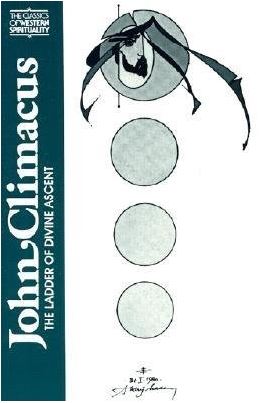
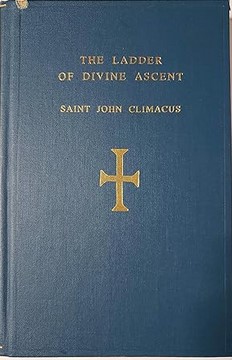
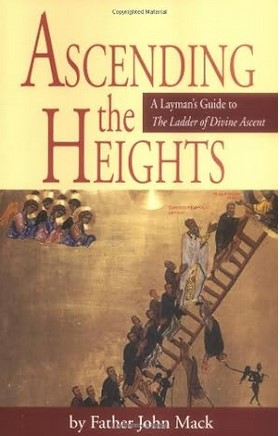
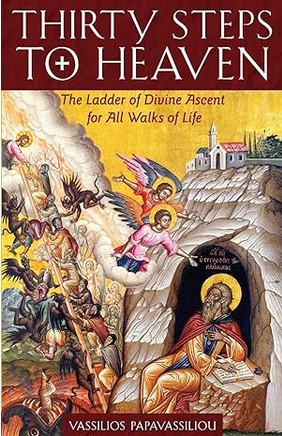
Both of these editions of the Ladder of Divine Ascent use the same translation, but each has its own thoughtful introduction, the introduction in the Classics of Western Spirituality is by Bishop Kallistos Ware. We find this work as easy to read as the works of the Stoic Philosophers that influenced Christianity and the monastic tradition, but we also have the commentaries by Father John Mack and Father Vassilios Papavassiliou, which are valuable because they reflect their experience as priests hearing confessions.
[1] https://www.biblegateway.com/passage/?search=luke%2018%3A9-14&version=RSVCE
[2] https://www.biblegateway.com/passage/?search=psalm%2051%3A10-13&version=RSVCE
[3] https://en.wikipedia.org/wiki/Liturgy_of_the_Hours
[4]https://www.academia.edu/37170843/On_Early_Egyptian_Monastic_Prayer_and_the_Islamic_%E1%B9%A2al%C4%81t
[5] https://www.youtube.com/watch?v=Vlu9GRSJF5g and https://www.youtube.com/watch?v=YFeIRVueNRM
[6] https://pmc.ncbi.nlm.nih.gov/articles/PMC6700255/ and https://elevationbehavioralhealth.com/sleeping-too-much/ and https://med.stanford.edu/news/insights/2025/08/sleep-mental-health-connection-what-science-says.html
[7] https://my.clevelandclinic.org/health/treatments/22043-cpap-machine
[8] St John Climacus, The Ladder of Divine Ascent, translated by Lazarus Moore, updated by others (Boston: Holy Transfiguration Monastery, 1991), Steps 18-20, pp. 124-130, and Father Vassilios Papavassiliou, Thirty Steps to Heaven, The Ladder of Divine Ascent for All Walks of Life (Chesterton, Indiana: Ancient Faith Publishing, 2103), Steps 18-20, pp. 145-158, and Father John Mack, Ascending the Heights, Laymen’s Guide to the Ladder of Divine Ascent (Ben Lamond, California: Conciliar Press, 1999), Steps 18-20, pp. 93-105.

1 Trackback / Pingback