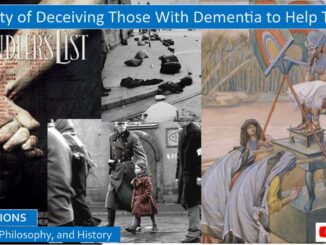
Biblical Morality of Deceiving Those Who Suffer From Dementia In Order to Help Them
Biblical Interpretation

Biblical Morality of Deceiving Those Who Suffer From Dementia In Order to Help Them

Often adult children just do not want to lie to their parents. They want to empower them and involve them in the decisions about their care. They expect their parents suffering from dementia to reason with them, and that is impossible.

On rare occasions, you are compelled to tell a white lie for their own good. The commandment is not worded: Do not lie. Rather, it is worded: Do not bear false witness against your neighbor. In part, this reflects the reality that ancient jurisprudence relied heavily on eyewitness testimony, unlike modern jurisprudence that relies more on forensic evidence. […]
Mental Illness, Demons, and Free Will in the Bible and Ancient Israel, Greece, and Rome
Dementia and Alzheimers Disease

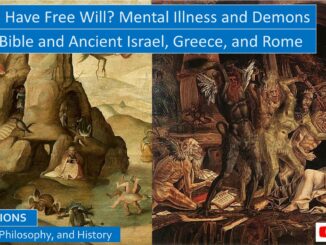
Do We Have Free Will? Mental Illness and Demons in the Bible, Church Fathers, and the Ancient World

Did the early Christians believe in free will? Or could demons rob them of their free will; just as dementia and mental illness rob modern patients today? The New Testament does not discuss whether we have free will, it simply accepts that we are subject to forces in the divine realm. Jesus often heals those who have lost their minds, driving out their demons. Also, St Paul in his epistles argues for divine determination, which St Augustine later develops into his doctrine of predestination. […]

St John Climacus on Demons, Blasphemy, and Mental Illness: Ladder of Divine Ascent, Step 23 ½
Ladder of Divine Ascent

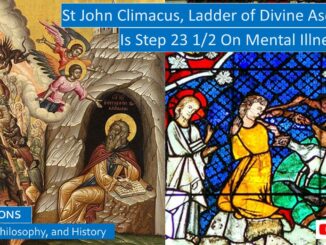
St John Climacus on Demons, Blasphemy, and Mental Illness: Ladder of Divine Ascent, Step 23 ½

We reflected on a puzzling section of St John Climacus’ step on his Ladder of Divine Ascent on first vainglory, then mad pride. He ponders how highly arrogant pride can lead to a type of madness that can lead to strange behavior. He wondered: Was this caused by demons? He recounts a puzzling situation where a monk starts cursing loudly in the middle of the Divine Liturgy.
However, our saint is reluctant to make a full-throated attack, as he likely sensed that his formerly devout monk was not in his right mind. When modern readers study this, they may wonder: Could this monk be suffering from Tourette’s syndrome, which involves involuntary cursing? Could this be symptomatic of dementia, or another mental illness or condition? These are the questions we will ponder in today’s reflection. […]

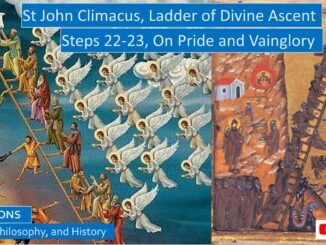
St John Climacus on Mad Pride and Vainglory : Ladder of Divine Ascent, Steps 22-23
Ladder of Divine Ascent

St John Climacus on Mad Pride and Vainglory: Ladder of Divine Ascent, Steps 22-23

What is the difference between vainglory and pride? Today, vainglory is an archaic word that has not been replaced in common usage, so we usually consider them to be synonymous. Although St John Climacus concedes they are similar, except vainglory progresses to mad pride. He examines vainglory in Step 22, and mad pride in Step 23.
Let us compare the definitions:
Step 22.1. “Some like to distinguish vainglory from pride, and to give it a special place and chapter.” “The only difference between them” is like the difference “between a child and a man, between wheat and bread: for the one is the beginning and the other the end.”
Step 22.2. “With regard to its form, vainglory is a change of nature, a perversion of character, a note of blame. With regard to its quality, it is a dissipation of labors, a waste of sweat, a betrayal of treasure, a child of unbelief, the precursor of pride, shipwreck in harbor, an ant on the threshing floor which, though small, has designs upon all one’s labor and fruit. The ant waits for the gathering of the wheat, and vainglory for the gathering of the riches of virtue: for the one loves to steal and the other to squander.” […]

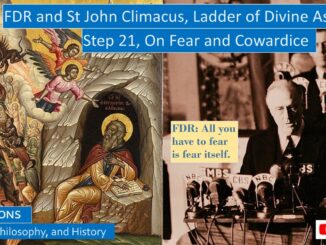
FDR’s Inaugural Address and St John Climacus, Ladder of Divine Ascent, on Fear & Cowardice, Step 21
Ladder of Divine Ascent

FDR’s First Inaugural Address and St John Climacus, Ladder of Divine Ascent, on Fear & Cowardice, Step 21

The chapter on fear is both one of the shortest and one of the most puzzling chapters of St John Climacus’ Ladder of Divine Ascent. In part, that is because there are many flavors of fears that spring from our most basal fears: the fear of the dark, the distressing, the dangerous.
More common are those fears that cause us to hesitate. Perhaps we fear what others think of us when we champion the good others do not see. Perhaps we fear rejection and failure. Perhaps we fear that past failures will rob us of future success. Perhaps we fear to do good when we are not encouraged. […]

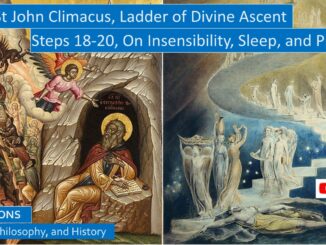
St John Climacus on Insensibility, Sleep, Prayer, and Vigil: Ladder of Divine Ascent, Steps 18-20
Ladder of Divine Ascent

St John Climacus on Insensibility, Sleep, Prayer, and Vigil: Ladder of Divine Ascent, Steps 18-20

Father John Mack teaches us: “The labor of prayer is a labor with the thoughts. Our minds are far too lazy and undisciplined. Instead of directing our thoughts and controlling them, we allow them to run free, here and there, wherever they wish to go. So, during prayer, we find ourselves thinking about all kinds of other things.”
We are called to prayer during Divine Liturgy. Do we complain that the service is over an hour? Do we watch our watch rather than our soul? Are we attentive in prayer, are we attentive during Divine Liturgy, paying attention to our prayers, not letting our mind wander, trying not to let our mind wander? We are bidden by Jesus in his Agony of the Garden of Gethsemane to stay awake and pray. […]

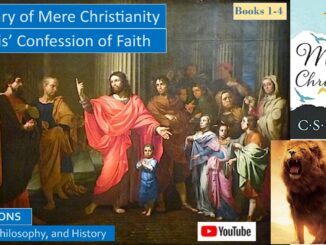
Summary of Mere Christianity, WWII Ecumenical Broadcast: Morality, Not Polemics
CS Lewis

Summary of CS Lewis’ Mere Christianity, WWII Ecumenical Broadcast: Morality Not Polemics

Many scholars speculate on whether CS Lewis was inspired by the writings of Richard Baxter, a Puritan and prolific author who first coined the phrase “Mere Christianity.” Baxter lived during the intense religious struggle in the late 1600’s, a century after Henry VIII split from the Catholic Church to form the Anglican Church. Baxter was appointed to the royal chaplaincy, but he left his post after the passage of the Act of Uniformity in 1662, which required that all pastors exclusively use the Book of Common Prayer and be ordained as Anglican ministers. Baxter was reluctant to adopt a denomination, proclaiming that “I am a Christian, a MEER CHRISTIAN, of no other religion,” and “I am against all sects and dividing parties.” He did not want to identify either with Catholics, or Anglicans, or Presbyterians. […]

CS Lewis’ Mere Christianity: Forgiveness, Pride, and Envy. Can Pride Ever Be Good?
CS Lewis

CS Lewis’ Mere Christianity: Forgiveness, Pride, and Envy. Can Pride Ever Be Good?

CS Lewis notes that in the middle of the Lord’s Prayer we pray: “Forgive us our sins as we forgive those who sin against us.” He observes: “There is no slightest suggestion that we are offered forgiveness on any other terms. It is made perfectly clear that if we do not forgive, we shall not be forgiven.”
Indeed, immediately after the Lord’s Prayer in Matthew, Jesus exhorts us: “For if you forgive men their trespasses, your heavenly Father also will forgive you; but if you do not forgive men their trespasses, neither will your Father forgive your trespasses.” […]

Hesiod Works and Days
Philosophy

Hesiod: Works and Days, Early Greek Moral Philosophy

Hesiod is a grouchy old farmer who mistrusts ‘lords’” but does not advocate changing the society. “He believes in justice, honesty, conventional piety, self-reliance, self-denial, foresight, and above all, WORK. He dislikes city folk, the sea, women, gossip and LAZINESS. He delivers a maxim like ‘Don’t urinate where the Sun can see you’ with the same earnest convict that he advises judges not to take bribes, his brother to avoid pride, and the farmer to get two nine-year-old oxen and a forty-year-old hired hand. […]

Catholic Middle Ages and Beyond

St John of the Cross, Dark Night of the Soul, Seven Capital Sins and Best Type of Close Friend

Before you can truly deepen your interior life of prayer and communion with God, you must first purify your soul by combating your spiritual capital vices, strengthening your inner virtues, which are revealed by how you think of your neighbor, what you say about your neighbor, how you act towards your neighbor, and how eagerly you seek to forgive and overlook the shortcomings of your neighbor. […]