Do the Scriptures forbid us from telling white lies when our motives are pure, especially when those white lies improve the lives of others?
YouTube video for this blog: https://youtu.be/uukJRpH7k64
In a situation we described in a prior reflection: After we halted the foreclosure of the condominium unit belonging to Robert, an otherwise destitute owner with advanced dementia, after the court approved the appointment of a guardian, after the guardian found a lockdown memory care facility for him after putting his unit up for sale, moving day arrived. But Robert was not only unaware of the halted foreclosure; he was also unaware of why he needed to move. He refused to leave. We called the police, and although they sympathized, they did not want to risk hurting him by forcing him to leave, especially since he was so frail.
The next day, Mercy, his guardian, tried again by herself. She told a little white lie. She told Robert that she had arranged for him to receive a COVID vaccine, and he agreed! So, she took him to his lockdown facility to get his vaccination. But once Robert walked through that door, he could not leave, this was his new home. We will reflect on the morality of this situation.
How I Halted the Foreclosure on a Destitute Owner with Advanced Dementia! We Discuss Dementia
https://seekingvirtueandwisdom.com/how-i-halted-foreclosure-on-owner-with-advanced-dementia-reflecting-on-dementia/
https://youtu.be/_uAJPCCRNQ8
Rotary https://youtu.be/FrW0fJbk-vg
We have situations where owners with dementia live by themselves in our over-55 condominium complex. Their children are reluctant to compel them to move into a facility because they refuse to leave. The problem is that someone with dementia will likely never want to move. They have lost not only their memories, but also their reasoning ability. Their emotions rule: you cannot reason with them.
The problem is that their children are risking their lives by allowing their parents with dementia to continue living alone. They could turn on the stove and start a fire. Or worse, they could wander off. If they are not found in a few days, the odds are good that they would drown in a ditch or a canal.
Why Are Dementia Patients Who Wander So Drawn to Water? Why Do They Drown?
https://seekingvirtueandwisdom.com/why-are-dementia-patients-who-wander-so-drawn-to-water-why-do-they-drown/
https://youtu.be/aZMgG1YzpD0
Rotary https://youtu.be/FrW0fJbk-vg
Ordinary Life and Justice in Ancient Athens, Rome, and Israel
https://youtu.be/vl8KGL5Yx2w
http://www.seekingvirtueandwisdom.com/ordinary-life-and-justice-in-the-ancient-world/
The positive form of the commandment is to protect the reputation of your neighbor, which is why malicious gossip is sinful. Even if gossip is true, it is sinful to repeat it when revealing the truth would be harmful. There is no sin in acting in your parent’s best interests.
We have many reflections on this commandment.
Martin Luther, Do Not Slander, Lutheran Catechisms
https://youtu.be/jM2FrvyKsbk
https://seekingvirtueandwisdom.com/luther-on-do-not-bear-false-witness-against-your-neighbor/
Do Not SLANDER: Teachings from the Medieval Rabbis, Rashi, Rambam, Ramban, the Torah and Talmud
https://youtu.be/KvKOCyREmQA
http://www.seekingvirtueandwisdom.com/the-decalogue-in-the-torah-blog-6-do-not-bear-false-witness-against-your-neighbor/
Do Not Slander: Dr Laura and Her Rabbi Stewart Vogel on Ten Commandments
https://youtu.be/tlTymS2Bxxo
http://www.seekingvirtueandwisdom.com/dr-laura-and-her-rabbi-on-not-bearing-false-witness-against-your-neighbor/
St Nicodemus the Hagiorite, Do Not Bear False Witness, Do Not Slander
https://youtu.be/N7GmAMl0sDg
https://seekingvirtueandwisdom.com/st-nicodemus-the-hagiorite-do-not-bear-false-witness-do-not-slander/
Do Not Slander, Church Fathers, Preachers, and Catholic Catechism, CCC 2464
https://youtu.be/CZADtl6Yz74
http://www.seekingvirtueandwisdom.com/do-not-slander-church-fathers-and-preachers-and-catholic-catechism-introduction-ccc-2464/
Decalogue: Do Not Slander, Catholic Catechism 2465-2503, and St Thomas Aquinas
https://youtu.be/9RqsWvRZpWw
https://seekingvirtueandwisdom.com/decalogue-do-not-slander-catholic-catechism-2465-2503-and-st-thomas-aquinas/
St John Climacus in Ladder of Divine Ascent on Lying, Talkativeness, and Slander, Steps 10, 11 and 12
https://youtu.be/SLBIdDHRy3A
http://www.seekingvirtueandwisdom.com/st-john-climacus-in-ladder-of-divine-ascent-on-lying-talkativeness-and-slander-steps-10-11-and-12/
St Augustine: On Lying
https://youtu.be/PuY5KAyeDXc
http://www.seekingvirtueandwisdom.com/st-augustine-on-lying/
THE LORD TELLS A SLIGHT WHITE LIE TO ABRAHAM
We have three examples, two of them biblical, of godly men telling white lies to benefit their neighbor.
In Genesis, three angels visited Abraham and Sarah, who were both over ninety years old. Many, many years ago, the Lord had promised Abraham that his descendants would be as numerous as the stars in the sky; yet he and Sarah were childless.
During the visit, “the Lord said to Abraham, ‘I will surely return to you in the spring, and Sarah your wife shall have a son.’ And Sarah was listening at the tent door behind him. Now Abraham and Sarah were old, advanced in age.” “So Sarah laughed to herself, saying, ‘After I have grown old, and my husband is old, shall I have pleasure?’ The Lord said to Abraham, ‘Why did Sarah laugh, and say: Shall I indeed bear a child, now that I am old?’”[1]
The rabbis point out that the Lord himself is telling an inconsequential white lie that causes no harm. Note that the Lord did not repeat to Abraham exactly what Sarah thought, as he did not want to tell Abraham that she said that both he and Sarah were old, just herself. This means that we can morally modify our story to protect not only our neighbor’s reputation, but also his dignity and his feelings.
This may be the only Bible passage where the Lord himself tells a white lie. This suggests that we must be judicious in telling white lies.
This also demonstrates the maxim that whenever you read an Old Testament story with heavy dialogue, you should always carefully compare the retelling of a message to the original message. They often differ.
HEBREW MIDWIVES LIE TO PHARAOH TO SAVE JEWISH BABIES
The story of the Hebrew midwives can justify lying when the purpose is benevolent: to save lives or reputations, to show your unselfish love for your neighbor. In Exodus, just before Moses was born, the Pharaoh commanded the midwives that all male Hebrew babies be killed. They refused, telling the Pharaoh that the Hebrew ladies’ labor was short because of their liveliness and vigor.[2]
St Augustine puzzles over these verses. “It is usual to ask whether such lies have been approved by divine authority. Scripture says that God favored the midwives. It is unclear whether God, in his mercy, pardoned the lie or judged that the lie itself deserved a reward.”
“For the midwives, on one hand, let the infant boys live, but on the other hand, they lied to Pharaoh. In letting them live, they performed a work of mercy; but they used that lie for their own ends, to keep Pharaoh from harming the infants.” The rest of his commentary is confusing and unclear.[3]
How did the midwives use the lie for their own ends? In addition to protecting the infants, they likely risked death if Pharaoh discovered their lie, a lie that could be easily discovered. St Augustine’s reluctance to bless this lie means that we should never be eager to lie. Instead, we should be judicious.
St Augustine also mentions the Hebrew midwives in his book On Lying. In his Retractions, St Augustine says he wrote this book to “inculcate the love of speaking the truth.” The Catholic Catechism quotes On Lying to say that a “lie consists of speaking a falsehood with the intention of deceiving,” which in our translation is rendered, “a lie is any utterance whatever with will to deceive.”[4] But we do know that the Hebrew wives intended to deceive Pharaoh, so we must ponder further.
St Augustine teaches us in On Lying, “there is a difference between lying and being a liar. A man may tell a lie unwittingly; but a liar loves to lie, and inhabits in his mind the delight of lying.”[5]
St Augustine continues: “God dealt well with the Hebrew midwives not because they lied, but because they were merciful to the men of God. It was not their benevolence that was rewarded, but their benevolence; the benignity of their intention, not the iniquity of their invention.”[6]
St Augustine: On Lying
https://youtu.be/PuY5KAyeDXc
http://www.seekingvirtueandwisdom.com/st-augustine-on-lying/
Brevard Childs, in his Westminster commentary on Exodus, summarizes the main Protestant exegesis. “Calvin argued” “that the lying of the midwives was reprehensible and displeasing to God. However, since no action is free of sin, God rewarded their good works even if mixed with impurity.” Luther was less critical: he saw in the example of the midwives “a model for Christian living under the pressures of persecution. He tended to justify the midwives’ lying which sought to aid rather than injure.”[7]
Although the Scriptures suggest that no evil befell the Hebrew midwives, “Pharaoh then commanded all his people, ‘Every son that is born to the Hebrews you shall cast into the Nile, but you shall let every daughter live.’”[8] Since the Egyptians feared the Pharaoh but not God, they did as they were bid.
Rabbi Joseph Telushkin observes: “That fear of God can liberate people from fear of others explains why a disproportionate percentage of political dissenters in totalitarian societies such as Nazi Germany and the former Soviet Union were God-fearers. Such people presumably feared their country’s rulers, as they did not want to die, but they believed that obedience to God’s will was more important than anything, including life. On the other hand, people who do not believe in or fear God are far less likely to risk their lives, the most valuable possession they have, to defy a country’s rulers, no matter how immoral his edicts.”[9]
OSKAR SCHINDLER LIES REPEATEDLY TO SAVE OVER A THOUSAND JEWS
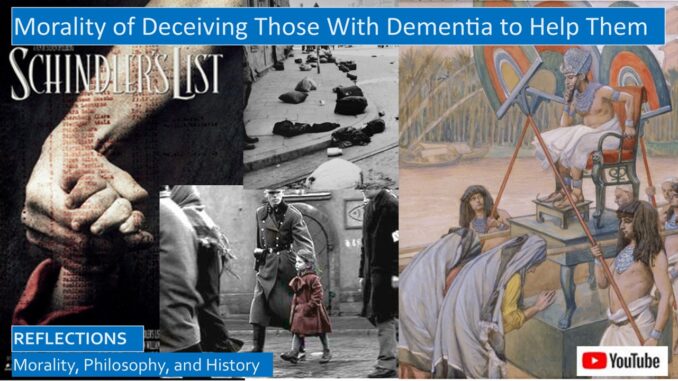
Another example is when, during World War II, Oskar Schindler of Schindler’s List constantly lied to the Nazis to save the lives of as many Jews under his care as possible. He constantly bribed the SS officials to protect his Jews, buying a ceramic factory that had been seized from Jewish owners. He lied, saying that the women, children, and elderly Jews had skills essential for his business. Near the end of the war, he organized an armaments factory that produced a small amount of mostly duds, which was another lie. Schindler spent his entire fortune on bribes, food, and supplies to keep his Jewish workers as safe and as healthy as possible.[10]
If it was moral for Oskar Schindler to lie to save the lives of twelve hundred Jews, why would it not be moral to tell a white lie to your loved one who is suffering from dementia so they can have the care they need in a compassionate lockdown facility you selected?
We recently reflected on whether the demons in the Old and New Testaments are the same as mental illness, and whether demons could cause or worsen mental illness, although even if that were true, it would be impossible to prove.
Mental Illness, Demons, and Free Will in the Bible and Ancient Israel, Greece, and Rome
https://youtu.be/ZdgWzU-sJds
https://seekingvirtueandwisdom.com/do-we-have-free-will-mental-illness-and-demons-in-the-bible-church-fathers-and-the-ancient-world/
We also reflected on whether what St John Climacus credits to demons are really due to mental illness, and whether the blasphemy he describes could have been caused by Tourette’s Syndrome or other mental conditions.
St John Climacus on Demons, Blasphemy, and Mental Illness: Ladder of Divine Ascent, Step 23 ½
DISCUSSING THE SOURCES
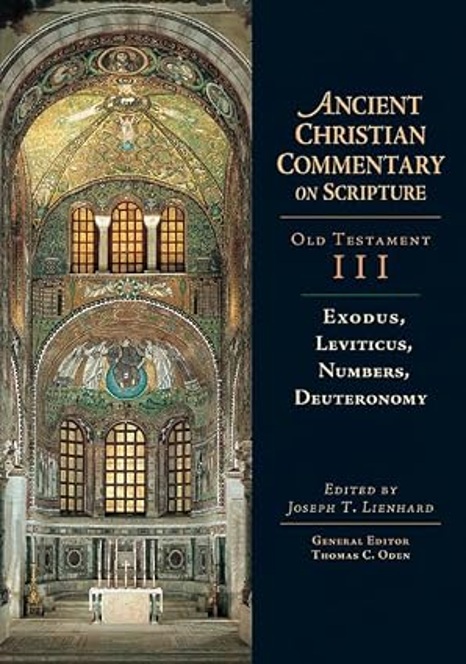
We consulted the Ancient Christian Commentary on Scripture for Exodus. St Augustine’s book On Lying was quoted in this commentary and in the Catholic Catechism, and the full version in included in the Nicene and Post-Nicene Fathers.
Unfortunately, the Reformation Commentary is not planning to publish the Exodus Commentary in the next few years. But in one of our favorite commentaries, the Exodus Westminster Commentary by Brevard Childs, he explains how Luther and Calvin interpretted these passages. We also treasure the interpretations of Rabbi Joseph Telushkin; we have consulted his various books for several reflections, including his discussion of Hillel’s commentary on the Love of God and neighbor.
Hillel and Jesus, Reflections on Rabbi Telushkin’s Observations
http://www.seekingvirtueandwisdom.com/hillel-and-jesus-reflections/
Comparing Hillel and Shammai to Jesus
http://www.seekingvirtueandwisdom.com/comparing-hillel-and-shammai-to-jesus/
More Stories and Sayings of Hillel and Shammai
http://www.seekingvirtueandwisdom.com/more-stories-and-sayings-of-hillel-and-shammai/
Jesus, Hillel, and Shammai, Loving God and Neighbor
https://youtu.be/ygxn2qqGnOI
We also have a reflection on how to read the early Church Fathers.
Book Review: Early Church Fathers Library – 38 Volumes in 3 Series
http://www.seekingvirtueandwisdom.com/early-church-fathers-library-38-volumes-in-3-series/
Book Reviews on Apostolic and Early Church Fathers
http://www.seekingvirtueandwisdom.com/book-reviews-on-apostolic-and-early-church-fathers/
How To Read Ancient Works, and Book Reviews on the Apostolic Church Fathers
https://youtu.be/I_2q4BiRBlU
[1] https://www.biblegateway.com/passage/?search=Genesis%2018%3A10-13&version=RSVCE
[2] https://en.wikipedia.org/wiki/Shiphrah_and_Puah and https://www.biblegateway.com/passage/?search=exodus%201%3A15-21&version=RSVCE
[3] St Augustine, Questions on Exodus 1, included in Exodus, Ancient Christian Commentary on Scripture, Old Testament Volume III (Downers Grove, IL: Intervarsity Press, 2001), p. 4.
[4] Catechism of the Catholic Church, 2nd Edition (Washington, DC: US Catholic Conference, 1997), Part 3, Section 2, Article 8, Eighth Commandment, paragraphs 2482, p. 595.
[5] St Augustine, On Lying, in the Nicene and Post-Nicene Fathers, First Series, Volume 3, translated by Rev H Brown (Boston: Hendrickson Publishers, 1994, first published 1887), Section 18, p. 466.
[6] St Augustine, On Lying, included in Exodus, Ancient Christian Commentary on Scripture, Old Testament Volume III, p. 5.
[7] Brevard Childs, The Book of Exodus, a Critical, Theological Commentary (Philadelphia: The Westminster Press, 1974), p. 23.
[8] https://www.biblegateway.com/passage/?search=exodus%201%3A22&version=RSVCE
[9] Joseph Telushkin, A Code of Jewish Ethics, Volume 1, You Shall Be Holy (New York: Bell Tower, 2006), p. 488.
[10] https://en.wikipedia.org/wiki/Schindler%27s_List and https://en.wikipedia.org/wiki/Oskar_Schindler

Be the first to comment