Biblical Morality of Deceiving Those Who Suffer From Dementia In Order to Help Them
Biblical Interpretation

Biblical Morality of Deceiving Those Who Suffer From Dementia In Order to Help Them

Often adult children just do not want to lie to their parents. They want to empower them and involve them in the decisions about their care. They expect their parents suffering from dementia to reason with them, and that is impossible.

On rare occasions, you are compelled to tell a white lie for their own good. The commandment is not worded: Do not lie. Rather, it is worded: Do not bear false witness against your neighbor. In part, this reflects the reality that ancient jurisprudence relied heavily on eyewitness testimony, unlike modern jurisprudence that relies more on forensic evidence. […]
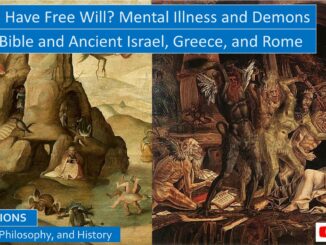
Mental Illness, Demons, and Free Will in the Bible and Ancient Israel, Greece, and Rome
Dementia and Alzheimers Disease

Do We Have Free Will? Mental Illness and Demons in the Bible, Church Fathers, and the Ancient World

Did the early Christians believe in free will? Or could demons rob them of their free will; just as dementia and mental illness rob modern patients today? The New Testament does not discuss whether we have free will, it simply accepts that we are subject to forces in the divine realm. Jesus often heals those who have lost their minds, driving out their demons. Also, St Paul in his epistles argues for divine determination, which St Augustine later develops into his doctrine of predestination. […]

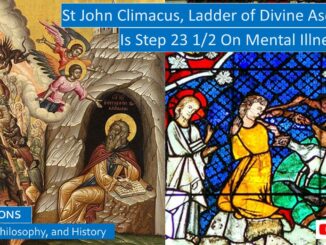
St John Climacus on Demons, Blasphemy, and Mental Illness: Ladder of Divine Ascent, Step 23 ½
Ladder of Divine Ascent

St John Climacus on Demons, Blasphemy, and Mental Illness: Ladder of Divine Ascent, Step 23 ½

We reflected on a puzzling section of St John Climacus’ step on his Ladder of Divine Ascent on first vainglory, then mad pride. He ponders how highly arrogant pride can lead to a type of madness that can lead to strange behavior. He wondered: Was this caused by demons? He recounts a puzzling situation where a monk starts cursing loudly in the middle of the Divine Liturgy.
However, our saint is reluctant to make a full-throated attack, as he likely sensed that his formerly devout monk was not in his right mind. When modern readers study this, they may wonder: Could this monk be suffering from Tourette’s syndrome, which involves involuntary cursing? Could this be symptomatic of dementia, or another mental illness or condition? These are the questions we will ponder in today’s reflection. […]

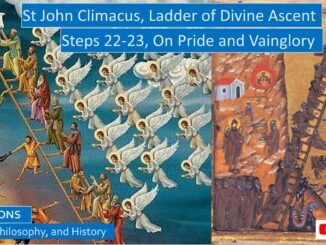
St John Climacus on Mad Pride and Vainglory : Ladder of Divine Ascent, Steps 22-23
Ladder of Divine Ascent

St John Climacus on Mad Pride and Vainglory: Ladder of Divine Ascent, Steps 22-23

What is the difference between vainglory and pride? Today, vainglory is an archaic word that has not been replaced in common usage, so we usually consider them to be synonymous. Although St John Climacus concedes they are similar, except vainglory progresses to mad pride. He examines vainglory in Step 22, and mad pride in Step 23.
Let us compare the definitions:
Step 22.1. “Some like to distinguish vainglory from pride, and to give it a special place and chapter.” “The only difference between them” is like the difference “between a child and a man, between wheat and bread: for the one is the beginning and the other the end.”
Step 22.2. “With regard to its form, vainglory is a change of nature, a perversion of character, a note of blame. With regard to its quality, it is a dissipation of labors, a waste of sweat, a betrayal of treasure, a child of unbelief, the precursor of pride, shipwreck in harbor, an ant on the threshing floor which, though small, has designs upon all one’s labor and fruit. The ant waits for the gathering of the wheat, and vainglory for the gathering of the riches of virtue: for the one loves to steal and the other to squander.” […]

Morality

St Isaiah the Solitary on Guarding the Intellect

St Isaiah the Solitary “On Guarding the Intellect” gives us this advice, “If you find yourself hating your fellow man and resist the hatred, and you see that it grows weak and withdraws, do not rejoice in your heart; for this withdrawal is trick of the evil spirits. They are preparing a second attack worse than the first; they have left behind their troops behind the city and ordered them to remain there. If you go out to attack them, they will flee before you in weakness.” […]