Psalm 137: Should We Bash the Babylonian Babies? Spiritual and Historical Interpretations
Biblical Interpretation

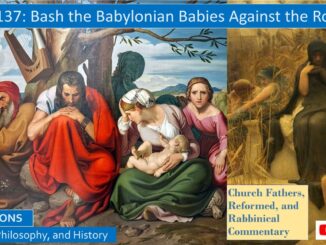
Psalm 137: Should We Bash the Babylonian Babies Against the Rocks? Spiritual and Historical Interpretations

Happy shall they be who take your little ones
and dash them against the rock!
Origen was one of the first Church Fathers who interpreted this troublesome verse allegorically, as did St Ambrose, who catechized and baptized the young St Augustine. Origen teaches us that “the little ones of Babylon, which signifies confusion, are those troublesome sinful thoughts that arise in the soul, and one who subdues them by striking their heads against the firm and solid strength of reason and truth, is the person who ‘dashes the little ones against the stones;’ and he is therefore truly blessed.”[2] Likewise, St Ambrose comments that we should “dash all corrupt and filthy thoughts against Christ.” […]

Psalm 71: Encouraging Us In Our Old Age
Biblical Interpretation

Psalm 71: Encouraging Us In Our Old Age

John Calvin speculates that David composed Psalm 71 after experiencing the trauma of losing the life of his son Absalom during his rebellion against him, which was sparked by the favoritism Davis showed towards his newly resented wife, Bathsheba. “The particular reference which David makes to his old age renders this conjecture not improbable.”
If so, this psalm should be a comfort to those who old age is lonelier due to mistakes, miscalculations or misfortunes occurring many years earlier. […]

Psalms 40 and 70: Deliver Both Young and Old from Suffering and Trials
Biblical Interpretation

Psalms 40 and 70: Deliver Both Young and Old from Suffering and Trials

St Ambrose rejoices: “Christ has heard the prayer of his own servants and has brought us out from the pit of misery and from the mire of dregs. We were drowning there; our whole flesh was clinging to the mire, trapped in the whirlpool of our sins. Our soul was powerless to save itself; fallen and ruined as it was by the multiplicity and dreadfulness of our offenses.”
St Ambrose continues: “Christ came to save us from the pit and slime of this world, from the mud and mire of this earth, from this body doomed to death.” “May that rock, which follows those who thirst, confirm the weak and unsteady; may that water never be lacking to those who long for it; and may that firm foundation never be wanting to those in danger of falling.” […]

St Augustine’s On Christian Teaching and JD Vance, Order of Love
Politics

St Augustine’s On Christian Teaching and JD Vance, Order of Love

St Augustine clearly teaches us: “All people should be loved equally. But you cannot do good to all people equally, so you should take particular thought for those who, as if by lot, happen to be particularly close to you in terms of place, time, or any other circumstances.”
St Augustine explains further: “Suppose you have plenty of something which had to be given to someone in need but could not be given to two people, and you met two people,” you could flip a coin for who would receive it. But if one of them was a relative, Jesus would not object if you benefited him. In other words, if your children are starving, you need not share what little food you have with strangers.
Should we love everyone, even our enemies? Definitely, Christians are exhorted to love their enemies. As St Augustine teaches us: “We do not fear our enemies, for they do not take away from us what we love, but we pity them, for they hate us all the more because they are separated from the one we love,” since they are separated from God. […]

St John Climacus, Ladder of Divine Ascent Steps 16&17 Avarice and NonPossessiveness
Ladder of Divine Ascent

St John Climacus, Ladder of Divine Ascent, On Avarice and Non-Possessiveness, Steps 16 & 17

Avarice is the worst kind of drought and famine, for it is drought and famine in the midst of plenty. A Jewish story tells of a man taken on a tour of Hell, where he sees a huge banquet hall, with long tables lined with souls, each one ogling their plate heaped with roast beef, sausage, breads, fruits and pies. This sumptuous meal tormented each one, all were starving, for they had no elbows to feed themselves. Then he was shown the banquet hall in Heaven, same type of banquet hall, same meats, breads, fruits and pies, but here the mood was joyous. Like those souls in Hell, they had no elbows, but they were joyous because they were feeding each other. […]

St John Chrysostom On Reading Scriptures, Preaching, and Chariot Races
Eastern Church Fathers

St John Chrysostom On Reading Scriptures, Preaching, and Chariot Races

“What are you saying, man? That attending to the Scriptures is not for you, since you are surrounded by a multitude of cares? Rather it is for you more than them. Monks do not need the help of the divine Scriptures as much as those who are involved in many occupations. The monks, who are released from the clamor of the marketplace and have fixed their huts in the wilderness, who own nothing in common with anyone, but practice wisdom in the calm of that quiet life, as if resting in a harbor, enjoy great security; but we, as if tossing in the midst of the sea, driven by a multitude of sins the continuous aid of the Scriptures.” […]

Moral Lessons Learned From Historical Black Leaders, Guest on BMK Podcast
Civil Rights

What Moral Lessons Can We Learn From Black Civil Rights Leaders? From the Brahim Kellon Podcast

Will the Civil Rights movement ever be fulfilled? It has not yet been fulfilled. But I can tell you when it’ll be fulfilled. It will be fulfilled when you make that last trip across the river, and you go to that place where everybody’s kind to you, and everybody’s nice to you, and where there is no discrimination. But once you go to that place, you’re not coming back. It’s a one-way trip, because when you are singing with Elvis, you know, you can’t come back.
Civil Rights is just an eternal struggle, the struggle for encouraging everyone to love their neighbor, and to be kind to their neighbor, which is really what the Civil Rights movement is all about. From the minute that President Nixon got elected, the Republicans have been trying to rollback civil rights, and the Republican Supreme Court justices have been pushing back against civil rights ever since. So, it is a never-ending, eternal struggle. It just never ends. […]

St Basil On Social Justice To the Rich SMALL
Cappodocian Church Fathers

St Basil the Great, On Social Justice, His Homily to the Rich

St Basil speaks to the Rich Young Man: “It is thus evident that you are far from fulfilling the commandment, and that you bear false witness within your own soul that you have loved your neighbor as yourself. Look, the Lord’s offer shows just how distant you are from true love! For it what you say is true, that you have kept from your youth the commandment of love and have given to everyone the same as to yourself, then how did you come by this abundance of wealth?”
“The more you abound in wealth, the more you lack in love. If you had truly loved your neighbor, it would have occurred to you long ago to divest yourself of this wealth. But now your possessions are more a part of you than the members of your own body, and separation from them is as painful as the amputation of one of your limbs.”
St Basis warns the wealthy: If you have “sound judgment, you should should recognize that you have received wealth as a stewardship, and not for your own enjoyment; thus, when you are parted from it, you rejoice as those who relinquish what is not really theirs, instead of becoming downcast like those who are stripped of their own.” […]

Summary of Mere Christianity, WWII Ecumenical Broadcast: Morality, Not Polemics
CS Lewis

Summary of CS Lewis’ Mere Christianity, WWII Ecumenical Broadcast: Morality Not Polemics

Many scholars speculate on whether CS Lewis was inspired by the writings of Richard Baxter, a Puritan and prolific author who first coined the phrase “Mere Christianity.” Baxter lived during the intense religious struggle in the late 1600’s, a century after Henry VIII split from the Catholic Church to form the Anglican Church. Baxter was appointed to the royal chaplaincy, but he left his post after the passage of the Act of Uniformity in 1662, which required that all pastors exclusively use the Book of Common Prayer and be ordained as Anglican ministers. Baxter was reluctant to adopt a denomination, proclaiming that “I am a Christian, a MEER CHRISTIAN, of no other religion,” and “I am against all sects and dividing parties.” He did not want to identify either with Catholics, or Anglicans, or Presbyterians. […]