Aging

Humorous Yet Serious Reflections on Facing Aging, Retirement, and Death

Epictetus advises us: “When the doctor pays you a visit, don’t be afraid of what he might say, and don’t be overjoyed if he says, ‘You are doing splendidly!’” Keep in mind that ancient doctors were not nearly as effective as doctors are today, who study and are supervised for over a decade before practicing medicine.
Epictetus continues: “Don’t be depressed if your doctor says, ‘You are doing badly.’” What does that mean? “It means that you are close to the separation of the soul from the body. What is there to fear in that? If you are not close now, you are going to be close later, aren’t you? Is the world going to come to an end when you die?”
His students asked him: “What if friends of mine in Rome die?” Epictetus answered, “Well, that is just the death of some mortal beings. Do you really expect to reach old age without seeing the death of any of those you love along the way?” […]

Biblical Morality of Deceiving Those Who Suffer From Dementia In Order to Help Them
Biblical Interpretation

Biblical Morality of Deceiving Those Who Suffer From Dementia In Order to Help Them

Often adult children just do not want to lie to their parents. They want to empower them and involve them in the decisions about their care. They expect their parents suffering from dementia to reason with them, and that is impossible.

On rare occasions, you are compelled to tell a white lie for their own good. The commandment is not worded: Do not lie. Rather, it is worded: Do not bear false witness against your neighbor. In part, this reflects the reality that ancient jurisprudence relied heavily on eyewitness testimony, unlike modern jurisprudence that relies more on forensic evidence. […]

Mental Illness, Demons, and Free Will in the Bible and Ancient Israel, Greece, and Rome
Dementia and Alzheimers Disease

Do We Have Free Will? Mental Illness and Demons in the Bible, Church Fathers, and the Ancient World

Did the early Christians believe in free will? Or could demons rob them of their free will; just as dementia and mental illness rob modern patients today? The New Testament does not discuss whether we have free will, it simply accepts that we are subject to forces in the divine realm. Jesus often heals those who have lost their minds, driving out their demons. Also, St Paul in his epistles argues for divine determination, which St Augustine later develops into his doctrine of predestination. […]

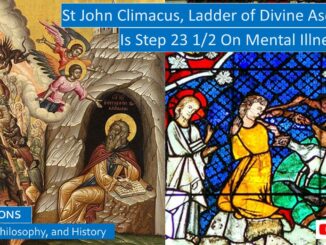
St John Climacus on Demons, Blasphemy, and Mental Illness: Ladder of Divine Ascent, Step 23 ½
Ladder of Divine Ascent

St John Climacus on Demons, Blasphemy, and Mental Illness: Ladder of Divine Ascent, Step 23 ½

We reflected on a puzzling section of St John Climacus’ step on his Ladder of Divine Ascent on first vainglory, then mad pride. He ponders how highly arrogant pride can lead to a type of madness that can lead to strange behavior. He wondered: Was this caused by demons? He recounts a puzzling situation where a monk starts cursing loudly in the middle of the Divine Liturgy.
However, our saint is reluctant to make a full-throated attack, as he likely sensed that his formerly devout monk was not in his right mind. When modern readers study this, they may wonder: Could this monk be suffering from Tourette’s syndrome, which involves involuntary cursing? Could this be symptomatic of dementia, or another mental illness or condition? These are the questions we will ponder in today’s reflection. […]

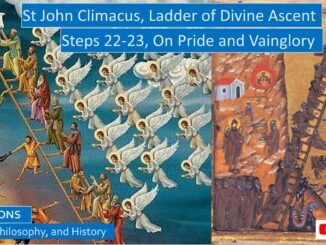
St John Climacus on Mad Pride and Vainglory : Ladder of Divine Ascent, Steps 22-23
Ladder of Divine Ascent

St John Climacus on Mad Pride and Vainglory: Ladder of Divine Ascent, Steps 22-23

What is the difference between vainglory and pride? Today, vainglory is an archaic word that has not been replaced in common usage, so we usually consider them to be synonymous. Although St John Climacus concedes they are similar, except vainglory progresses to mad pride. He examines vainglory in Step 22, and mad pride in Step 23.
Let us compare the definitions:
Step 22.1. “Some like to distinguish vainglory from pride, and to give it a special place and chapter.” “The only difference between them” is like the difference “between a child and a man, between wheat and bread: for the one is the beginning and the other the end.”
Step 22.2. “With regard to its form, vainglory is a change of nature, a perversion of character, a note of blame. With regard to its quality, it is a dissipation of labors, a waste of sweat, a betrayal of treasure, a child of unbelief, the precursor of pride, shipwreck in harbor, an ant on the threshing floor which, though small, has designs upon all one’s labor and fruit. The ant waits for the gathering of the wheat, and vainglory for the gathering of the riches of virtue: for the one loves to steal and the other to squander.” […]

Psalm 137: Should We Bash the Babylonian Babies? Spiritual and Historical Interpretations
Biblical Interpretation

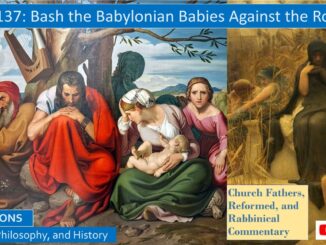
Psalm 137: Should We Bash the Babylonian Babies Against the Rocks? Spiritual and Historical Interpretations

Happy shall they be who take your little ones
and dash them against the rock!
Origen was one of the first Church Fathers who interpreted this troublesome verse allegorically, as did St Ambrose, who catechized and baptized the young St Augustine. Origen teaches us that “the little ones of Babylon, which signifies confusion, are those troublesome sinful thoughts that arise in the soul, and one who subdues them by striking their heads against the firm and solid strength of reason and truth, is the person who ‘dashes the little ones against the stones;’ and he is therefore truly blessed.”[2] Likewise, St Ambrose comments that we should “dash all corrupt and filthy thoughts against Christ.” […]

Psalm 71: Encouraging Us In Our Old Age
Biblical Interpretation

Psalm 71: Encouraging Us In Our Old Age

John Calvin speculates that David composed Psalm 71 after experiencing the trauma of losing the life of his son Absalom during his rebellion against him, which was sparked by the favoritism Davis showed towards his newly resented wife, Bathsheba. “The particular reference which David makes to his old age renders this conjecture not improbable.”
If so, this psalm should be a comfort to those who old age is lonelier due to mistakes, miscalculations or misfortunes occurring many years earlier. […]

Psalms 40 and 70: Deliver Both Young and Old from Suffering and Trials
Biblical Interpretation

Psalms 40 and 70: Deliver Both Young and Old from Suffering and Trials

St Ambrose rejoices: “Christ has heard the prayer of his own servants and has brought us out from the pit of misery and from the mire of dregs. We were drowning there; our whole flesh was clinging to the mire, trapped in the whirlpool of our sins. Our soul was powerless to save itself; fallen and ruined as it was by the multiplicity and dreadfulness of our offenses.”
St Ambrose continues: “Christ came to save us from the pit and slime of this world, from the mud and mire of this earth, from this body doomed to death.” “May that rock, which follows those who thirst, confirm the weak and unsteady; may that water never be lacking to those who long for it; and may that firm foundation never be wanting to those in danger of falling.” […]

Protestantism, Catholicism, Orthodoxy, and Judaism: Which Is True
christianity

Protestantism, Catholicism, Orthodoxy, and Judaism: Which Is True?

We agree with CS Lewis when, in his Preface to Mere Christianity, he states that “the reader should be warned that I offer no help to anyone who is hesitating between two Christian denominations. You will not learn from me whether you ought to become an Anglican, a Methodist, a Presbyterian, or a Roman Catholic.” CS Lewis compares his Mere Christianity to a central hall opening up to many rooms, representative of the various denominations, saying that this hall is a place to wait while you try the different doors.
CS Lewis continues: “There is no mystery of my own position. I am a very ordinary layman of the Church of England, not especially high, nor especially low, nor especially anything else.” […]

Paul Tournier on Aging and Retirement
Aging

Classical Christian Psychologist Paul Tournier on Old Age and Retirement

Paul Tournier notes: “Freud defined psychological health under the double heading of aptitude for love and for work.” But Paul Tournier cautions that “the superficial relationships of working life and of sexual attraction must lead to a deeper personal commitment. And I believe that no commitment can be truly personal unless it takes on a transcendent dimension and become love, in the biblical meaning of the word.”
Paul Tournier is grateful: “As an intellectual, I am specially privileged. It is true that the better educated people are, the more chance they have to enjoy their retirement. First, intellectual work” is not physically taxing. “Second, the capacity for intellectual work is retained longer than physical ability. It can even increase in old age as long as disease does not affect the mental faculties. But most of all, the more one exercises one’s mind, the more pleasure it gives to exercise it. The more one learns, the more one wants to learn, and the easier study becomes.” […]