
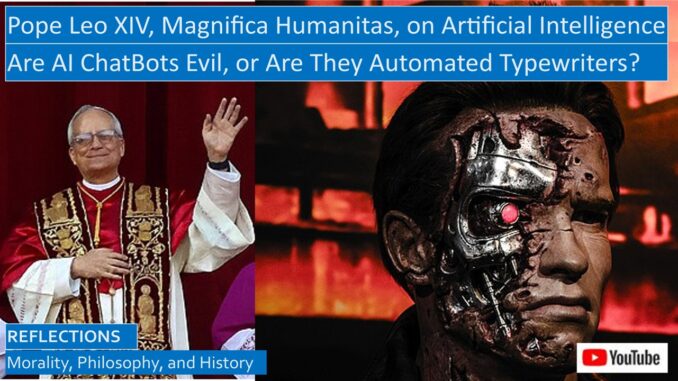
When I hear the debates about artificial intelligence, and in particular, Pope Leo’s recent encyclical, Magnifica Humanitas, I ask myself: Has the entire world gone mad? I have written on the topic previously: My main point is that artificial intelligence is nothing new, automating intellectual tasks is why computers were invented.
What is new are the chatbots like Claude and ChatGPT that can automate the generation of boring, bland high school essays and equally bland marketing prose. But even proponents of AI admit that chatbots are prone to hallucinating, seemingly making stuff up at random intervals.
YouTube video for this blog: https://youtu.be/YwnErQ-1Z_A
As a writer, I have used grammar checkers for decades, which flag words, phrases, or punctuation that do not match expected patterns. Grammar checkers were truly AI programs decades before programs were labeled as AI. They are USUALLY, but not always, accurate when they correct spelling, spot errors in person (she say instead of she says) and tense, and correct punctuation. Quite often, when a whole phrase is marked, I will choose to rewrite it rather than correct it. For the rest of the suggestions, it is wrong a third to half the time. I don’t think grammar checkers will improve much further.
However, I am unimpressed with the AI programs that summarize my essays. IMHO, a third of the time they are okay, a third have to be reworded, and another third of the summary is as acceptable as it is bland.
I love to learn. When I simply read or hear a text, often I soon forget it. But I learn most when I write about a subject. Why should I delegate to a robot that which I enjoy, that which makes me fully human? If I come to fully rely on AI to do my thinking, how can I tell when it is mistaken? Won’t its errors sometimes be difficult to detect?
Local newspapers were destroyed by CraigsList decades ago. Elon Musk has declared that “Wikipedia won’t die, but it will dwindle into irrelevance over time.”[1] Which is odd since Wikipedia is a major source for the common chatbots. Won’t they degrade if Wikipedia dwindles and disappears?
What is amazing about AI is how I could feed my recollection of what Elon Musk said into Google and have it return the exact reference. I often do that with my vague recollection of Bible verses.
John Searle’s famous thought experiment features the Chinese room. “Suppose that artificial intelligence research has succeeded in programming a computer to behave as if it understands Chinese. The machine accepts Chinese characters as input, carries out each instruction of the program step by step, and then produces Chinese characters as output. The machine does this so perfectly that no one can tell that they are communicating with a machine and not a hidden Chinese speaker.”
“The questions at issue are these: does the machine actually understand the conversation, or is it just simulating the ability to understand the conversation? Does the machine have a mind in exactly the same sense that people do, or is it just acting as if it had a mind?”
“Now suppose that Searle is in a room with an English version of the program, along with sufficient pencils, paper, erasers, and filing cabinets. Chinese characters are slipped in under the door, and he follows the program step-by-step, which eventually instructs him to slide other Chinese characters back out under the door.”[2]
What is puzzling is the absurdity of debating the moral agency of artificial intelligence in general, and chatbots in particular. Chatbots are simply tools, they are highly capable typewriters. Artificial intelligence is a misnomer: AI programs are simply pattern-matching and prediction programs. The simplest pattern-matching program guesses your next letters as you type.
Thus, these chatbots are really automated typewriters. Let us replace the phrase artificial intelligence with automated typewriters to test the logic or absurdity of these following statements:
“Pope Leo XIV has written an encyclical letter on safeguarding the human person in the time of ‘automated typewriters.’”
Title of Atlantic Magazine article:
“There Is Already a Word for the Deep Moral Failures of ‘Automated Typewriters.’”
In Christianity Today: “Leo contends that ‘automated typewriters’ are not just a technological development or a foreseeable economic crisis but a spiritual and civilizational test that forces us to face what it means to be human.”
Likewise, from the encyclical itself: “We cannot consider ‘automated typewriters’ to be morally neutral.” “For ‘automated typewriters’ to respect human dignity and truly serve the common good, responsibility must be clearly defined at every stage.”[3]
Artificial intelligence is not just chatbots. But how do you define artificial intelligence? Turing’s definition is not precise, but it is the most satisfying: A program is considered to be artificially intelligent when it fools humans into thinking that it is not a computer, but is a real person.[4]
But unlike Data, and unlike the computer robot David in the AI movie by Steven Spielberg, and unlike Pinocchio, no robot will ever desire to be transformed into a real boy.
The Original Pinocchio, Deeply Repentant, Unlike the Disney and Jordan Peterson Pinocchio
https://youtu.be/SsnZamvvhdw
https://seekingvirtueandwisdom.com/the-original-pinocchio-deeply-repentant-unlike-the-disney-and-jordan-peterson-pinocchio/
What must we do before we can answer the question: What is artificial intelligence? We must first answer these questions: What is intelligence?[5] What is consciousness?[6] What is creativity?[7] We do not know precise answers to these questions, which means we cannot understand how the brain truly works. However, John Searle famously cautioned that whatever consciousness is, professors should not publish their speculations before they have earned tenure.[8]
The ancient world had a similar technological crisis. After the ancient Greeks employed the written word, such as written Iliad and Odyssey, Socrates complained that letters “create forgetfulness in students’ souls, because they will not use their memories.”[9] Reading would weaken students’ memory, making them too lazy to memorize their lessons. Which is ironic, because Socrates’ wisdom would be lost in the sands of history had Plato not recorded them in the letters of his dialogues.
In our previous reflection on artificial intelligence, we reflected on:
- Whether we will ever face a Terminator problem, where AI tries to take over the world, or automates destruction of the enemy.
- Whether programming can be totally automated, Alexa and Siri privacy issues, and factory robots.
- Facial recognition, and whether there are false positives.
- The problem of deep-fakes, and how to detect AI images.
- How computerization has affected the job market for the past hundred years.
- Which is preferable for education: AI chatbots or Wikipedia?
- Which professions are most endangered by AI? Why lawyers, programmers, doctors, and possibly hamburger flippers may never be replaced.
- The positive aspects of artificial intelligence.
Artificial Intelligence: Friend or Foe of Mankind? Are AI Chat-bots Better Than Wikipedia?
https://youtu.be/8qNbGOtDp4w
https://seekingvirtueandwisdom.com/artificial-intelligence-friend-or-foe-of-mankind/
And in our reflections on our experiences in our local Community Police Academy, we ponder how AI and modern technology, especially cameras, have drastically affected policing for the better:
POPE LEO XIV’S ENCYCLICAL PONDERS ARTIFICIAL INTELLIGENCE
Pope Leo XIV’s encyclical agrees in part: “It is not possible to provide a single, comprehensive definition of AI. What can be stated, however, is that we must avoid the misconception of equating this type of ‘intelligence’ with that of human beings. These systems merely imitate certain functions of human intelligence. In doing so, they often surpass human intelligence in speed and computational capacity, offering tangible benefits across many fields. Yet this power remains entirely tied to data processing.”
“So-called artificial intelligences do not undergo experiences, do not possess a body, do not feel joy or pain, do not mature through relationships, and do not know from within what love, work, friendship, or responsibility mean.” These unusual “do not” constructions tripped the Word grammar checker.
“Nor do they have a moral conscience, since they do not judge good and evil, grasp the ultimate meaning of situations, or bear responsibility for consequences. They may imitate language, behavior, and analytical skills, or even simulate empathy and understanding, but they do not understand what they produce, for they lack the affective, relational, and spiritual perspective through which human beings grow in wisdom. Even when these tools are described as capable of ‘learning,’ their way of doing so is different from that of a human person.” The last unusual phrase tripped up Grammarly.
“It is not the experience of those who allow themselves to be shaped by life and grow over time through choices, mistakes, forgiveness, and fidelity. Rather, it is a form of statistical adaptation based on data and feedback, which can be very effective, but does not imply inner growth.”[10]
However, some of the concerns were difficult for me to parse, and some of the fears were simply misplaced. There is an odd comment that, if access to credit were controlled by an inflexible algorithm, its lack of “compassion, mercy, forgiveness, and hope” would “give rise to new forms of exclusion.”
For example, home mortgages have been awarded using inflexible algorithms for many decades, because that is the only way to avoid red-lining, or racial discrimination. Once you permit bankers to factor in personal judgments of character, the numbers favor whites, regardless of the stated intentions. However, one study claims that racial discrimination creeps into the algorithm when factors other than race are considered.[11] But AI is useful for searches: once again, I found the source for the third sentence when I fed the first two sentences into the Google prompt.
There is no doubt that one reason why Ukraine is winning the war in mid-2026 is how some of its drones are powered by artificial intelligence, which enables them to navigate to their target. Thus, drones costing thousands of dollars can destroy military assets worth hundreds of thousands, or millions, of dollars. This contradicts Pope Leo XIV’s concern that artificial intelligence should not power weapons on the battlefield, since now, with artificial intelligence, smaller countries can protect themselves against much larger opponents.[12]
WHEN ARTIFICIAL INTELLIGENCE LEADS TO THEFT
Artificial intelligence both causes and enables varying types of theft. Surprisingly, when you do a word search on the encyclical, the words PLAGIARISM and THEFT are not found at all, while the word STEAL is used once. In a few sections, there are some euphemistic phrases that hint at theft, but it does not explicitly name the sin.
Winding through the courts are many lawsuits alleging plagiarism filed against the companies who created the various chatbots. Should these companies copy text into their databases without permission, and without paying royalties? Why can’t these companies always list their sources, with the option to show the original content?
Previously, I had generated several types of text using ChatGPT and Bard, and found that if I added WITH SOURCES, though the high school essay did not change, the more complex essay did change! This suggests that it was assigning the sources after the AI chatbot engine generated the text.
Artificial Intelligence, Comparing ChatGPT vs Bard, With and Without Footnotes and Sources
https://seekingvirtueandwisdom.com/artificial-intelligence-comparing-chatgpt-vs-bard-with-and-without-footnotes-and-sources/
https://wp.me/pachSU-TN
These chatbots may be black boxes to the user, but they are not to the programmers. They could not debug the program without comparing the original sources to the output, and they should be able to turn that switch back on. If they cannot, then perhaps they need to regenerate the databases, keeping the source tags. Probably, they want to claim they cannot do this because if they did, they know that this would generate lawsuits from those they stole the data from.
How else can companies use artificial intelligence to steal from consumers? Simple, by replacing real, live customer support representatives with chatbots! Because they can program chatbots so they never need to refund contested charges! Microsoft has mistakenly charged me several times, and if I cannot talk to a real live human being, there is nobody to appeal to.
On the other hand, there are specialized chatbots that automate the waiving of late fees, which is a simple arithmetic algorithm. That is a good use of artificial intelligence.
These huge companies are also fooling themselves when they think they always save money by eliminating all clerical positions. One reform is needed: That humans should always supervise and be able to override automated processes.
Pope Leo XIV had some interesting quotes from unexpected sources. Why has he and so many others forgotten FDR and his Four Freedoms, formulated during the dark days of World War II?
The first two of the Four Freedoms are:
- Freedom of speech and expression.
- Freedom of worship.
But we have forgotten the last two freedoms:
- Freedom from want.
- Freedom from fear.
The New Deal urges that when someone works a forty-hour week, he is ENTITLED to a wage sufficient to feed, clothe, and house his family with dignity. Back during the Cold War days, this was true even if only the husband worked.
St John Chrysostom warns us: “Since you have not given the accustomed offerings, God says, you have stolen the goods of the poor. He says this to show the rich that they hold the goods of the poor even if they have inherited them from their fathers, or no matter how they have gathered their wealth.”[13]
If this is true for the poor, it is doubly true for poorly paid employees. Employees’ wages should not be limited by the market rate, but should always be a living wage. Anything less is theft, where employers steal from their employees.
St John Chrysostom: Lazarus and the Rich Man: When Are the Poor Unworthy? On Wealth and Poverty
https://youtu.be/jOi6SNDlo74
https://seekingvirtueandwisdom.com/st-john-chrysostom-lazarus-and-the-rich-man-when-are-the-poor-unworthy-on-wealth-and-poverty/
To his credit, Pope Leo XIV does decry the payment of low wages to those workers who train the chatbots. [14] Ironically, these low-paid workers are often not the ideal workers to train the chatbots, but those who are truly qualified can never be coaxed to do this tedious work.
WHEN ARTIFICIAL INTELLIGENCE VALUES PROFIT OVER SAFETY
We also cannot find the word SAFETY in the encyclical. The government should forbid the unsafe implementation of artificial intelligence, and the false savings from reducing your workforce to increase profits, while endangering safety.
For example, flying is now the safest form of transportation by far, and the number of plane crashes has plummeted in recent years. Artificial intelligence has been flying planes for decades, long before most people were aware of artificial intelligence.
Why shouldn’t the government insist on human supervision when driving semi-trucks and cars? Artificially-intelligent warnings can assist the drivers, but they should not be allowed to drive them. Why? Both for safety reasons, and because a computer program cannot practically assume responsibility for what happens.
Years ago, I had a potential near-death experience. I was driving on a lonely stretch of interstate in the forests of Florida with no streetlights on a moonless night when waterfalls of heavy rain cascaded out of the pitch-black sky. I could barely see the dark asphalt road, but I eventually spotted a brightly illuminated exit sign. I carefully exited, parking next to a closed gas station with dozens of other cars seeking safety.
What would an artificially intelligent robotic car have done when its sensors were blinded? Quite likely a robot would have pulled over and stopped until the storm cleared. Then the robot would decide: Should I turn off the lights? Turn the lights off and people will run into the robot car they cannot see. Or leave the taillights on, so when the people in cars behind choose to follow the lights, they run into the stupid robot car anyway.
This dilemma with the proper use of artificial intelligence has been solved for commercial airlines. Artificial intelligence has been deeply embedded in air traffic control systems and airplanes themselves for decades, both on the ground and the air. Pilots are only in-charge, by default, when their planes takeoff and land, but once they reach cruising altitude, their planes go on autopilot, because that is safer. But the artificially intelligent systems are constantly supervised by competent and hopefully alert human beings. There must always be a pilot in the cockpit to monitor the sensors, ready to take over when necessary. One or more air traffic controllers, sometimes in several airports simultaneously, track every plane in the sky. Critical fly-by-wire systems flying the plane often have manual backup systems if they go haywire. And in the classroom, there are incredibly impressive AI flight simulators that train pilots on how to respond to emergency situations.[15]
The declining rate of plane accidents and crashes is mainly due to smart SUPERVISION of artificially intelligent systems deeply embedded in the airline industry. Why is there not more public discussion of adopting this technology in the trucking industry as they seek greater automation? If pilots are considered necessary to fly planes, why shouldn’t drivers be necessary to drive these huge semitrucks with their heavy cargo loads?
Should we permit driverless cars on fixed routes in cities? Even then, they encounter unique situations they were not trained for. One example is the Waymo driverless car that drove over KitKat, a beloved bodega cat in San Francisco. After KitKat ran under the car, many panicked onlookers tried to get the attention of the robocar, yelling at the car: BE CAREFUL. Don’t run over KitKat!
But the stupid robocar was not programmed to accept verbal commands in plain English, so it didn’t hear the warnings at all. It was truly deaf. So, after the robocar went bumpity-bump, there was no more life left in KitKat.[16]
In January 2026, CNN reported that Waymo robotaxis have been seen running red lights, stopping on railroad tracks, driving into flooded streets, and impeding first responders. They tend to just stop in the middle of traffic when befuddled.[17]
VATICAN SPEECH OF CHRIS OLAH, CO-FOUNDER OF ANTHROPIC
Anthropic co-founder Chris Olah was invited to speak at the presentation of the encyclical in the Vatican City, doing so as part of Anthropic’s initiative to widen the conversation on the important questions raised by Artificial Intelligence.
“AI systems are not engineered the way a bridge or an airplane is engineered. We understand an airplane because we designed every part of it and we understand the physics that act on it. AI models are not like that. They are grown on a structure roughly modeled after the brain, on an enormous inheritance of human thought and speech.”
How can AI be modeled after the brain when we don’t understand how the brain really works? All we have are hints of how it functions. We can record brain waves, but we cannot associate them with thoughts like we associate sound waves with words in a song.
Chris Olah continues: “And what has grown is far more subtle, odd, and beautiful than science fiction prepared us for. They are not the cold, calculating robots we were promised. They are made from us, from our words, and, as the Holy Father observes, they remain in important ways mysterious even to those of us who train them.”
Of course, AI works by pattern matching against the vast amounts of text in its database. Chatbots may appear mysterious, and may appear intelligent, but they required debugging just like any other computer program. Which means output was compared to input to verify the program was operating correctly. This is on-going, thus the need to ‘train’ AI chatbots.
Chris Olah continues: “If it helps, one way I sometimes describe it is as being a little like bringing a fictional character to life. And now we’re entering an extraordinary world where those fictional characters speak to us, do work, have jobs.”
“This clearly raises questions beyond computer science. The machinery that makes this possible is the work of math and programming and science. But what character we choose, how it interacts with the world, how it ought to interact with the world: these are more clearly questions for the humanities, for religion, for philosophy, for society at large.”[18]
CAN WE DELEGATE PRAYER AND PREACHING TO CHATBOTS?
When Jesus bids us to pray without ceasing, what does he mean? Clearly, this suggests we can pray more. Today’s question is: Can we simply fulfill this requirement by automatically running a chatbot to pray on our behalf all day long?
You may think this is absurd, but if so, it is just as absurd as the answer to the question: Can priests fulfill their evangelical obligation by employing chatbots to generate their homilies, copying the best homilies the chatbot has previously digested? If the answer is yes, does this mean that a homily can live forever if digested by a chatbot engine, benefitting all future priests who use AI to write their homilies?
This is just as absurd, because the priest benefits when he studies the Word of God when preparing his homily. Will God bless those priests too lazy to write their own homilies? Although I think Jesus would be okay if he reads a homily written by the saints, such as is done by Orthodox Priests, when they read the homily by St John Chrysostom during the Pascha service.
St John Climacus on Gluttony and Fasting, Ladder of Divine Ascent, Step 14, and Eating for Health: DASH diet
https://youtu.be/KM0eMjE1fXc
https://seekingvirtueandwisdom.com/eating-for-health-dash-diet-st-john-climacus-on-gluttony-and-fasting-in-ladder-of-divine-ascent/
Can priests compose their own homilies using a chatbot? A recent article in the Jesuit America magazine assures us: “Pope Leo does not think so.” “At the beginning of Lent this past year, Pope Leo met with the priests of Rome and told them to resist the temptation to prepare homilies with AI. A true homily, he indicated, is about sharing faith, and AI cannot share faith.”
“At its heart, that communication is the sharing of Jesus Christ, the Word. As we sort through the many and sometimes bewildering ways and means of communication in our technological age, I hold to the necessary and irreplaceable human mediation needed to proclaim the word.”[19]
The Holy Spirit can inspire a living, breathing priest, or layman, and in the past, the Virgin Mary, but he cannot inspire a lifeless robot who blindly plagiarizes the homilies of past priests. If he could, he wouldn’t.
SOCIAL JUSTICE, RERUM NOVAREM FROM 1891 TO TODAY
The Magnifica Humanitas encyclical is in three parts:
- Sections 1-89: History of social justice starting with Pope Leo XIII’s groundbreaking 1891 encyclical on the rights of both Capital and Labor, Rerum Novarum, which has been amplified several times in encyclicals by succeeding popes.
- Sections 90-228: Effects of Artificial Intelligence and Technology.
- Sections 229-245: Conclusion, with a lesser emphasis on artificial intelligence.
IMHO, the connection between the opening sections and the critiques on the Effects of Artificial Intelligence and Technology is weak. Pope Leo XIV desired to reflect on the social justice doctrine, beginning with Pope Leo XIII’s Rerum Novarum, again emphasizing that he plans to assume the mantle of the previous Leo. Perhaps he was planning to release the Rerum Novarum social justice update anyway, and realized that more people would read it if it preceded a discussion of AI. Unlike other encyclicals I have read, I had trouble parsing many of the sections on AI, as they seemed illogical to me. Jargonizing sometimes obscures tech and academic writing in general.
Pope Leo XIII: Catholic Social Justice and Rerum Novarum, Confronting the Modern World
https://youtu.be/YojqhGBJtOY
https://seekingvirtueandwisdom.com/pope-leo-xiii-catholic-social-justice-and-rerum-novarum-confronting-the-modern-world/
Pope Leo XIV reminds us: “Leo XIII’s Encyclical Rerum Novarum constitutes a milestone in the development of the Church’s social teaching. The document places the dignity of work and of workers at the forefront of its reflection; affirms the right to a fair wage for oneself and one’s family; recognizes that persons have a fundamental value that takes precedence over capital and profit; defends private property along with its indispensable societal role; esteems workers’ associations;” i.e., Labor Unions, “and proposes forms of cooperation between the different components of society as an alternative to the mentality of class struggle.”
Pope Leo continues: “While many of the historical conditions described by Leo XIII have changed, at least two insights remain highly relevant today:
- The primacy of human labor over any mindset focused solely on finance or productivity, with the consequent attention to the people and families most susceptible to exploitation, and
- The inseparable link between proclaiming the Gospel and pursuing a more just social order.
Rerum Novarum thereby continues to remind us that there is no authentic evangelization that does not also affect the structures of human society.”[20]
Likewise, Pope Leo XIV declares that Pope Pius XI’s Encyclical Quadragesima Anno, “published in 1931 on the fortieth anniversary of Rerum Novarum at the height of a major global economic crisis,” the Great Depression, “marks a further step in the Church’s social teaching. Rather than limiting itself to addressing the ‘workforce question,’ it broadened its focus to encompass the overall structure of the economic and political order. The Encyclical denounces the concentration of economic power in the hands of a few; criticizes both unlimited competition and collectivist projects that undermine the freedom and responsibility of the individual; strongly affirms the workers’ right to association; and reiterates the requirement that wages be proportionate not only to performance, but also to the needs of workers and their families.”
“At least three insights of his social teaching remain particularly relevant today: the awareness that injustice concerns not only individual behavior but also economic and institutional structures; the importance of the principle of subsidiarity, which calls for the strengthening of the fabric of associations and communities while avoiding further centralization of power; and the link between the dignity of work, fair remuneration and the genuine possibility for families to lead a dignified life.”[21]
Pope John XXIII reiterated the ideals of Rerum Novarum in Pacem in Terris, as did Pope Paul VI and Pope John Paul II in their encyclicals celebrating the eightieth and hundredth anniversary of Rerum Novarum.[22] Many encyclicals by Pope Benedict XVI and Pope Francis reiterated these ideals, including several encyclicals in our reflections.
Pope Leo XIV cites Pope Francis’ encyclical Fratelli Tutti, On Fraternity and Social Friendship, several times. “He proposed a culture of encounter, a ‘better politics’ capable of seeking the common good, paths of reconciliation, and a world that ensures ‘land, housing, and work for all.’”[23]
Pope Francis Encyclical, Fratelli Tutti, On Fraternity and Social Friendship
https://youtu.be/WmT12-PFrt8
https://seekingvirtueandwisdom.com/pope-francis-encyclical-fratelli-tutti-on-fraternity-and-social-friendship/
We previously reflected on how Pope Leo XIV extols the ideals of his predecessor, Pope Francis, in his pursuit of social justice, caring for the working poor, ensuring their greater prosperity, by adopting the name of Pope Leo XIII, and his Twitter battles with JD Vance, and his first encyclical, Dilexi Te. We are planning a series of reflections on Rerum Novarum and Catholic Social Justice.
Pope Leo XIV, First American Pope, Successor to Pope Francis and Social Justice of Pope Leo XIII
https://youtu.be/wSns5VGhtRk
https://seekingvirtueandwisdom.com/pope-leo-xiv-first-american-pope-successor-to-pope-francis-and-social-justice-of-pope-leo-xiii/
Pope Leo XIV, Dilexi Te, On Love for the Poor. Is Leo a Woke Pope?
https://youtu.be/0XraD2JatsI
https://seekingvirtueandwisdom.com/pope-leo-xiv-dilexi-te-on-love-for-the-poor-is-leo-a-woke-pope/
We also reflected on the fascinating story of the first Pope Leo, Pope Leo the Great, who bravely entered the armed camp of Atilla the Hun unarmed, ensuring that he would not sack and terrorize Rome.
Pope Leo the Great, Confronting Attila the Hun, and the Fourth Ecumenical Council of Chalcedon
https://youtu.be/4XwZYxDWAtA
https://seekingvirtueandwisdom.com/pope-leo-the-great-confronting-attila-the-hun-and-his-role-in-fourth-ecumenical-council-of-chalcedon/
Did Rome Fall, or Evolve Into the Barbarian Kingdoms? Sacks of Rome, and Attila the Hun’s Invasions
https://youtu.be/0pVNIggTbnM
https://seekingvirtueandwisdom.com/did-rome-fall-or-evolve-to-barbarian-kingdoms-sack-of-rome-and-attila-the-huns-invasions/
We reflected on JD Vance and his comments on St Thomas Aquinas, and on whether he and St Augustine taught that we should love our neighbor as ourselves, or whether we should love our family more than our neighbor.
St Augustine’s On Christian Teaching and JD Vance, Order of Love
https://youtu.be/v7H684y9phs
https://seekingvirtueandwisdom.com/st-augustines-on-christian-teaching-and-jd-vance-order-of-love/
CONCLUSION
In conclusion, Pope Leo XIV warns that “in the promises of transhumanism and some posthumanist currents of thought, which seek an enhanced and almost disembodied humanity, we recognize a yearning that is of concern to us, namely the need for a fuller life, less exposed to limitations and suffering. Yet the Incarnation opens a different pathway. On the one hand, old and new ideologies alike urge humanity to overcome limitations through technology, and to rise above others by asserting dominance. Contrary to this, the mystery of the Son of God entering into our human condition promises something quite different. The living God descends into our history in order to free us from all forms of slavery.”[24]
[1] https://creators.yahoo.com/lifestyle/story/wikipedia-wont-die-but-it-will-dwindle-into-irrelevance-over-time-says-elon-musk-191943901.html
[2] https://en.wikipedia.org/wiki/Chinese_room, footnote refers to Searle, John (1980), “Minds, Brains and Programs”, Behavioral and Brain Sciences, 3 (3): 417–457, doi:10.1017/S0140525X00005756, p. 11.
[3] Pope Leo XIV, Magnifica Humanitas, On Safeguarding the Human Person in the Time of Artificial Intelligence, May 15, 2026, https://www.vatican.va/content/leo-xiv/en/encyclicals/documents/20260515-magnifica-humanitas.html , Sections 104-105.
[4] https://en.wikipedia.org/wiki/Turing_test
[5] https://en.wikipedia.org/wiki/Intelligence
[6] https://en.wikipedia.org/wiki/Consciousness
[7] https://en.wikipedia.org/wiki/Creativity Plus, there are many Great Courses and YouTube Yale lectures on creativity, consciousness, and intelligence.
[8] https://youtu.be/ot4z1UrPvZY?si=8T_aKVENvZMl4Bl1
[9] Plato, Phaedrus, included in Essential Dialogues of Plato, translated by Benjamin Jowett (New York: Barnes and Nobles Classics, 2005), Section 275a-b, p. 249 and https://www.historyofinformation.com/detail.php?id=3439
[10] Pope Leo XIV, Magnifica Humanitas, Section 99.
[11] https://pmc.ncbi.nlm.nih.gov/articles/PMC11731762/
[12] Pope Leo XIV, Magnifica Humanitas, Sections 197-198.
[13] John Chrysostom, On Wealth and Poverty, translated by Catharine P Roth (Crestwood, NY: St Vladimir’s Seminary Press, 1999, originally 300s AD), Second Sermon on Lazarus and the Rich Man, pp. 48-49.
[14] Pope Leo XIV, Magnifica Humanitas, Section 109.
[15] https://en.wikipedia.org/wiki/Aviation_safety
[16] https://en.wikipedia.org/wiki/KitKat_(cat)
[17] https://www.youtube.com/watch?v=yRb2Lk_uxDA
[18] https://www.anthropic.com/news/chris-olah-pope-leo-encyclical
[19]Louis Cameli, Priests: Please, Don’t Let AI Write Your Homilies For You, America Magazine, June 10, 2026, https://www.americamagazine.org/faith-and-reason/2026/06/10/priests-please-dont-let-a-i-write-your-homilies-for-you/
[20] Pope Leo XIV, Magnifica Humanitas, Section 30.
[21] Pope Leo XIV, Magnifica Humanitas, Section 31.
[22] Pope Leo XIV, Magnifica Humanitas, Sections 33-39.
[23] Pope Leo XIV, Magnifica Humanitas, Section 44.
[24] Pope Leo XIV, Magnifica Humanitas, Section 232.

Be the first to comment