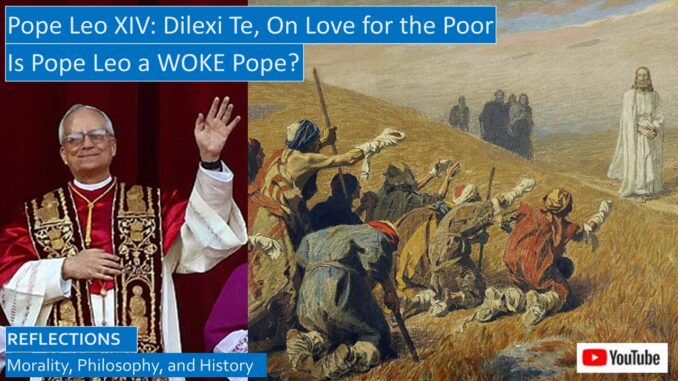
Is Pope Leo XIV an American pope, or is he a Latin American pope who was only born in Chicago? Does he plan to continue Pope Francis’ policies towards the poor and disadvantaged, and the immigrants?
Does he admire the Catholic Social Justice legacy of Pope Leo XIII?
Can we see Jesus in the eyes of the poor? Does Christian love for our neighbor include loving the poor and disadvantaged? Does that include the poor who are unemployed, uneducated, and lazy?
What is the preferential option for the poor? Is love for the poor a central tenet of Christianity? Was Jesus poor? Must we also care for the undeserving poor?
Is it true that the Lucan Beatitudes say, Blessed are the poor? Woe to the rich?
When we withhold alms from the poor, are we stealing from them?
YouTube video for this blog: https://youtu.be/0XraD2JatsI
POPE LEO XIV, DILEXI TE, ON LOVE FOR THE POOR
Many traditional American Catholics were hopeful when the Chicago-born Pope Leo XIV was elected pope, hoping that he would break away from the perceived liberal woke policies of Pope Francis. But it was Pope Francis who made him to cardinal and the prefect of the Dicastery of Bishops in Rome. Pope Francis conferred with him often when elevating bishops and cardinals. Pope Leo XIV’s first words confirmed that he was an admirer of both his predecessor, Pope Francis, as well as Pope Leo XIII, who championed the rights of the working poor in the late nineteenth century.
Pope Leo XIV, First American Pope, Successor to Pope Francis and Social Justice of Pope Leo XIII
https://seekingvirtueandwisdom.com/pope-leo-xiv-first-american-pope-successor-to-pope-francis-and-social-justice-of-pope-leo-xiii/
https://youtu.be/wSns5VGhtRk
We reflected on Pope Francis’ short Autobiography, which encourages us to be compassionate to the poor and marginalized. We learn about the fascinating life he led before he was pope, but with few details of his papacy. Instead, Pope Francis describes his ideas on how the church should care for the poor and marginalized. He saw his main job as pope as spreading the Good News, encouraging Catholics to minister to the poor and marginalized.
Pope Francis’ Autobiography: Be Compassionate to the Poor and Marginalized
https://seekingvirtueandwisdom.com/pope-francis-autobiography/
https://youtu.be/6QDyiu3wwbc
The Jesuit America Magazine notes that “Pope Leo XIV’s apostolic exhortation Dilexi Te begins with this simple declaration of love from the Book of Revelation: ‘I have loved you.’” “Pope Leo XIV places this exhortation in continuity with the meditation on the divine love expressed in the Sacred Heart of Jesus in Dilexit Nos, Pope Francis’ final encyclical. As has become common practice, Pope Leo chose to continue the work begun by his predecessor. ‘I am happy to make this document my own,’ he wrote, affirming his desire ‘that all Christians come to appreciate the close connection between Christ’s love and his summons to care for the poor.’” Pope Leo XIV has the “voice of a patient teacher reminding us of an inescapable truth at the very heart of Christianity: Christ’s radical love for and identification with the poor.”
The America Magazine observes: “The language of Dilexi Te is incarnational and personal. It is in the ‘wounded faces of the poor’ that we encounter or reject the face of Christ. As with Pope Francis, for Pope Leo XIV the question of encounter is not abstract or ideological: it is physical and human. As the good Samaritan meets the wounded man on the side of the road, so too we are called to recognize Christ in the face of our neighbor.”[1]
Pope Leo XIV teaches us: “Love for the Lord, then, is one with love for the poor” “This is not a matter of mere human kindness but a revelation: contact with those who are lowly and powerless is a fundamental way of encountering the Lord of history. In the poor, he continues to speak to us.”[2] “Care for the poor was also a great concern of St Francis of Assisi: in the person of a leper, Christ himself embraced Francis and changed his life.”[3]
Pop Leo XIV teaches us: “By embracing poverty, St Francis wanted to imitate Christ, who was poor, naked, and crucified. In his Rule, he asks that “the brothers should not appropriate anything, neither house, nor place, nor anything else. And as pilgrims and strangers in this world, serving the Lord in poverty and humility, they should go about begging with confidence, and should not be ashamed, because the Lord made himself poor for us in this world.”[4]
Who Was the Author of the Prayer of St Francis? Sayings of Brother Giles
https://seekingvirtueandwisdom.com/who-was-the-author-of-the-prayer-of-st-francis-sayings-of-brother-giles/
https://youtu.be/TJh72jknklE
Pope Leo XIV teaches us: “On the wounded faces of the poor, we see the suffering of the innocent and, therefore, the suffering of Christ himself.” “There are many forms of poverty: the poverty of those who lack material means of subsistence, the poverty of those who are socially marginalized and lack the means to give voice to their dignity and abilities, moral and spiritual poverty, cultural poverty, the poverty of those who find themselves in a condition of personal or social weakness or fragility, the poverty of those who have no rights, no space, no freedom.”[5]
Pope Leo XIV teaches us: “The illusion of happiness derived from a comfortable life pushes many people towards a vision of life centered on the accumulation of wealth and social success at all costs, even at the expense of others and by taking advantage of unjust social ideals and political-economic systems that favor the strongest. Thus, in a world where the poor are increasingly numerous, we paradoxically see the growth of a wealthy elite, living in a bubble of comfort and luxury, almost in another world compared to ordinary people. This means that a culture still persists, sometimes well disguised, that discards others without even realizing it and tolerates with indifference that millions of people die of hunger or survive in conditions unfit for human beings.”[6]
Pope Leo XIV continues: “The poor are not there by chance or by blind and cruel fate. Nor, for most of them, is poverty a choice. Yet, there are those who still presume to make this claim, thus revealing their own blindness and cruelty. Of course, among the poor, there are also those who do not want to work, perhaps because their ancestors, who worked all their lives, died poor. However, there are so many others, men and women, who nonetheless work from dawn to dusk, perhaps collecting scraps or the like, even though they know that their hard work will only help them to scrape by, but never really improve their lives.”[7]
The Psychologist Jordan Peterson seconds this perception, when he states that our society has very few job options open to decent paying jobs for those citizens in the bottom quartile of intelligence and intellectual ability.[8]
What does the preferential option for the poor mean? “Precisely in order to share the limitations and fragility of our human nature, Jesus himself became poor and was born in the flesh like us. We came to know him in the smallness of a child laid in a manger and in the extreme humiliation of the cross, where he shared our radical poverty, which is death. It is easy to understand, then, why we can also speak theologically of a preferential option on the part of God for the poor, an expression that arose in the context of Latin America.”
Pope Leo XIV continues: “This preference never indicates exclusivity or discrimination towards other groups, which would be impossible for God. It is meant to emphasize God’s actions, which are moved by compassion toward the poverty and weakness of all humanity. Wanting to inaugurate a kingdom of justice, fraternity and solidarity, God has a special place in his heart for those who are discriminated against and oppressed, and he asks us, his Church, to make a decisive and radical choice in favor of the weakest.”[9]
“God, the refuge of the poor, denounces through the prophets, in particular Amos and Isaiah, the injustices committed against the weakest, and exhorts Israel to renew its worship from within, because one cannot pray and offer sacrifice while oppressing the weakest and poorest.”[10]
Pope Leo XIV observes how Jesus and his family were poor: “There are some clues about Jesus’ social status. First of all, he worked as a craftsman or carpenter, téktōn (cf. Mk 6:3). These were people who earned their living by manual labor. Not owning land, they were considered inferior to farmers. When the baby Jesus was presented in the Temple by Joseph and Mary, his parents offered a pair of turtledoves or pigeons (cf. Lk 2:22-24), which according to the prescriptions of the Book of Leviticus (cf. 12:8) was the offering of the poor. A fairly significant episode in the Gospel tells us how Jesus, together with his disciples, gathered heads of grain to eat as they passed through the fields (cf. Mk 2:23-28). Only the poor were allowed to do this gleaning in the fields.”
In the genealogy of King David, and of Jesus, is Ruth, who gleaned in the fields to gather wheat for herself and her mother-in-law. They emigrated from Moab to survive; they became destitute when Ruth’s father and her and her sister’s Moabite husbands passed away.
Book of Ruth: Historical-Critical, Patristic, and Rabbinical Commentaries. Was Ruth an Old Testament Illegal Alien?
https://seekingvirtueandwisdom.com/book-of-ruth-historical-critical-commentaries-was-ruth-an-old-testament-illegal-alien/
https://youtu.be/IgVDLGw9ZCY
Pope Leo XIV continues: “The signs that accompany Jesus’ preaching are manifestations of the love and compassion with which God looks upon the sick, the poor and sinners who, because of their condition, were marginalized by society and even people of faith. He opens the eyes of the blind, heals lepers, raises the dead and proclaims the good news to the poor: God is near, God loves you (cf. Lk 7:22).”
Pope Leo notes that the beatitudes in Luke differ from those in Matthew: “This explains why he proclaims: “Blessed are you poor, for yours is the kingdom of God” (Lk 6:20). God shows a preference for the poor: the Lord’s words of hope and liberation are addressed first of all to them.” [11]
Blessed Are the Poor, Woe to the Rich, and Other Woke Compassionate Bible Verses
https://seekingvirtueandwisdom.com/blessed-are-the-poor-woe-to-the-rich-and-other-woke-bible-verses/
https://youtu.be/576TYemgA8o
Pope Leo XIV continues: “Jesus’ teaching on the primacy of love for God is clearly complemented by his insistence that one cannot love God without extending one’s love to the poor.” “The Lord himself teaches that every act of love for one’s neighbor is in some way a reflection of divine charity: ‘Truly I tell you, just as you did it to one of the least of these my brethren, you did it to me.’” (Mt 25:40)[12]
Pope Leo XIV notes that “the Letter of James deals at length with the problem of relations between rich and poor, and asks the faithful two questions in order to examine the authenticity of their faith: “What good is it, my brothers and sisters, if you say you have faith but do not have works? Can faith save you? If a brother or sister is naked and lacks daily food, and one of you says to them, ‘Go in peace; keep warm and eat your fill,’ and yet you do not supply their bodily needs, what is the good of that? So, faith by itself, if it has no works, is dead” (2:14-17).”[13]
“Among the Eastern Church Fathers, perhaps the most ardent preacher on social justice was St John Chrysostom, Archbishop of Constantinople from the late 300s to the early 400s. In his homilies, he exhorted the faithful to recognize Christ in the needy: ‘Do you wish to honor the body of Christ? Do not allow it to be despised in its members, that is, in the poor, who have no clothes to cover themselves. Do not honor Christ’s body here in church with silk fabrics, while outside you neglect it when it suffers from cold and nakedness.”[14]
Pope Leo XIV teaches us: “Charity is not optional but a requirement of true worship. St John Chrysostom vehemently denounced excessive wealth connected with indifference for the poor. The attention due to them, rather than a mere social requirement, is a condition for salvation, which gives unjust wealth a condemnatory weight.”
St John Chrysostom scolds us: ‘It is very cold and the poor man lies in rags, dying, freezing, shivering, with an appearance and clothing that should move you. You, however, red in the face and drunk, pass by. And how do you expect God to deliver you from misfortune?’ You often adorn an unfeeling corpse, which no longer understands honor, with many varied and gilded garments. Yet you despise the one who feels pain, who is torn apart, tortured, tormented by hunger and cold.’ This profound sense of social justice leads him to affirm that ‘not giving to the poor is stealing from them, defrauding them of their lives, because what we have belongs to them.’”[15]
St John Chrysostom: Lazarus and the Rich Man: When Are the Poor Unworthy? On Wealth and Poverty
https://seekingvirtueandwisdom.com/st-john-chrysostom-lazarus-and-the-rich-man-when-are-the-poor-unworthy-on-wealth-and-poverty/
https://youtu.be/jOi6SNDlo74
St John Chrysostom asks: When are the poor considered unworthy? We also reflected on the commentaries by both the ancient Church Fathers and the Protestant Reformers, and modern commentators, including a Jewish scholar, on the Parable of Lazarus and the Rich Man.
Parable of Lazarus and the Rich Man: Church Fathers, Reformers, and Commentators
https://seekingvirtueandwisdom.com/parable-of-lazarus-and-the-rich-man-church-fathers-reformers-and-commentators/
https://youtu.be/zI-7IGuctkg
“St Augustine’s spiritual guide was St Ambrose, who insisted on the ethical requirement to share material goods: ‘What you give to the poor is not your property, but theirs. Why have you appropriated what was given for common use?’” “For Augustine, the poor are not just people to be helped, but the sacramental presence of the Lord.”[16]
“During a plague in the city of Carthage, where he was Bishop, St Cyprian reminded Christians of the importance of caring for the sick: “This pestilence and plague, which seems so horrible and deadly, searches out the righteousness of each one, and examines the minds of the human race, to see whether the healthy serve the sick; whether relatives love each other with sincerity; whether masters have pity on their sick servants; whether doctors do not abandon the sick who beg for help.”[17]
St Basil the Great, in his Rule, saw no contradiction between the monks’ life of prayer and contemplation and their work on behalf of the poor. For him, hospitality and care for the needy were an integral part of monastic spirituality, and monks, even after having left everything to embrace poverty, had to help the poorest with their work, because “in order to have enough to help the needy,” “it is clear that we must work diligently.” “This way of life is profitable not only for subduing the body, but also for charity towards our neighbor, so that through us God may provide enough for our weaker brothers and sisters.”[18]
We have many reflections on St Basil the Great and his teachings on social justice, including his take on the Parable of the Rich Fool, and what to do in times of famine and drought. He also reflected on the sin of envy, which is a gateway to all other sins.
St Basil on Social Justice: Assisting the Poor During a Famine in a Roman Province
https://seekingvirtueandwisdom.com/st-basil-on-social-justice-assisting-the-poor-during-a-famine-in-a-roman-province/
https://youtu.be/c8YXs7y4RrU
Was St Basil WOKE? St Basil the Great On Social Justice, Parable of the Rich Fool
https://seekingvirtueandwisdom.com/was-st-basil-woke-st-basil-the-great-on-social-justice-parable-of-the-rich-fool/
https://youtu.be/UDQIZ81VfsY
Was St Basil Woke? Basil the Great On Social Justice, Homily To the Rich
https://seekingvirtueandwisdom.com/st-basil-the-great-on-social-justice/
https://youtu.be/PT_I5IrZGzY
St Basil the Great On Envy
http://www.seekingvirtueandwisdom.com/st-basil-on-envy/
https://youtu.be/XnFUrFKoF7s
Pope Leo XIV remembers: “In the West, St Benedict of Nursia formulated a Rule that would become the backbone of European monastic spirituality. Welcoming the poor and pilgrims occupies a prominent place in the document: ‘The poor and pilgrims are to be received with all care and hospitality, for it is in them that Christ is received.’”
THE BIBLE, THE POPES, AND CHURCH FATHERS ON IMMIGRANTS
Pope Leo XIV teaches us: “The experience of migration accompanies the history of the People of God. Abraham sets out without knowing where he is going; Moses leads the pilgrim people through the desert; Mary and Joseph flee with the child Jesus to Egypt. Christ himself, who “came to what was his own, and his own people did not accept him” (Jn 1:11), lived among us as a stranger. For this reason, the Church has always recognized in migrants a living presence of the Lord who, on the day of judgment, will say to those on his right: “I was a stranger and you welcomed me” (Mt 25:35).[19]
“Pope Francis has recalled that the Church’s mission to migrants and refugees is even broader, insisting that “our response to the challenges posed by contemporary migration can be summed up in four verbs: welcome, protect, promote and integrate. Yet these verbs do not apply only to migrants and refugees. They describe the Church’s mission to all those living in the existential peripheries, who need to be welcomed, protected, promoted, and integrated.” “He also said: “Every human being is a child of God! He or she bears the image of Christ! We ourselves need to see, and then to enable others to see, that migrants and refugees do not only represent a problem to be solved, but are brothers and sisters to be welcomed, respected, and loved.”[20]
Pope Leo XIV reminds us: “St Teresa of Calcutta, canonized in 2016, has become a universal icon of charity lived to the fullest extent in favor of the most destitute, those discarded by society. Foundress of the Missionaries of Charity, she dedicated her life to the dying abandoned on the streets of India. She gathered the rejected, washed their wounds, and accompanied them to the moment of death with the tenderness of prayer. Her love for the poorest of the poor meant that she did not only take care of their material needs, but also proclaimed the good news of the Gospel to them.”[21]
CENTURY OF CATHOLIC SOCIAL DOCTRINE
Pope Leo XIV teaches us: “The various movements of workers, women, and young people, and the fight against racial discrimination, gave rise to a new appreciation of the dignity of those on the margins of society. The Church’s social doctrine also emerged from this matrix. Its analysis of Christian revelation in the context of modern social, labor, economic, and cultural issues would not have been possible without the contribution of the laity, men and women alike, who grappled with the great issues of their time. At their side were those men and women religious who embodied a Church forging ahead in new directions.”
Historically, his predecessor, Pope Leo XIII, encouraged the Catholic Social Justice Movement when he issued the papal encyclical Rerum Novarum supporting workers’ rights in 1891.
Pope Leo XIII: Catholic Social Justice and Rerum Novarum, Confronting the Modern World
https://seekingvirtueandwisdom.com/pope-leo-xiii-catholic-social-justice-and-rerum-novarum-confronting-the-modern-world/
https://youtu.be/YojqhGBJtOY
Pope Leo XIV explains: “The epochal change we are now undergoing makes even more necessary a constant interaction between the faithful and the Church’s Magisterium, between ordinary citizens and experts, between individuals and institutions. Here too, it needs to be acknowledged once more that reality is best viewed from the sidelines, and that the poor are possessed of unique insights indispensable to the Church and to humanity as a whole.”[22]
“Pope John XXIII, in his Radio Message of September 11, 1962, a month before the opening of the Council, called attention to the issue. In his memorable words, “the Church presents herself as she is and as she wishes to be: the Church of all and in particular the Church of the poor.” “Many Council Fathers supported this approach, as eloquently expressed by Cardinal Lercaro in his 1962 intervention: ‘The mystery of Christ in the Church has always been and today is, in a particular way, the mystery of Christ in the poor.’”[23]
Pope John XXIII Opening Address to Vatican II, and Yves Congar, True and False Reform, Conclusion
https://seekingvirtueandwisdom.com/pope-john-xxiii-opening-address-to-vatican-ii-and-yves-congar-true-and-false-reform-conclusion/
https://youtu.be/ALZozpbSrM4
At the opening of the second session of the Council, Pope Paul VI took up this concern voiced by his predecessor, namely that the Church looks with particular attention “to the poor, the needy, the afflicted, the hungry, the suffering, the imprisoned, that is, she looks to all humanity that suffers and weeps: she is part of them by evangelical right.” He affirmed this truth with these words: “The representation of Christ in the poor is universal; every poor person reflects Christ; that of the Pope is personal.” “The poor man and Peter can be one in the same person, clothed in a double representation; that of poverty and that of authority.”[24]
“Pope Francis recognized that in recent decades, alongside the teachings of the Bishops of Rome, national and regional Bishops’ Conferences have increasingly spoken out. He could personally attest, for example, to the particular commitment of the Latin American episcopate to rethinking the Church’s relationship with the poor. In the immediate post-conciliar period, in almost all Latin American countries, there was a strong sense of the Church’s need to identify with the poor and to participate actively in securing their freedom. The Church was moved by the masses of the poor suffering from unemployment, underemployment, unjust wages and sub-standard living conditions. The martyrdom of St Oscar Romero, the Archbishop of San Salvador, was a powerful witness and an inspiration for the Church. He had made his own the plight of the vast majority of his flock and made them the center of his pastoral vision.”[25]
St Oscar Romero, during the bloody civil war in El Salvador, spoke out against social injustice and violence. He was assassinated while celebrating Mass by a right-wing military group. He was initially a conservative but was deeply affected by the murder of a fellow priest, and he came to support the tenets of liberation theology. First Pope John Paul II, then Pope Benedict XVI, proposed him for beatification. Pope Francis declared him a martyr and a Saint.[26]
Pope Leo XIV remembers: “At Medellín, the bishops declared themselves in favor of a preferential option for the poor: “Christ our Savior not only loved the poor, but, ‘being rich, he became poor.’ He lived a life of poverty, focused his mission on preaching their liberation, and founded his Church as a sign of this poverty in our midst.” “The poverty endured by so many of our brothers and sisters cries out for justice, solidarity, witness, commitment, and efforts directed to ending it, so that the saving mission entrusted by Christ may be fully accomplished.”[27]
“Charity has the power to change reality; it is a genuine force for change in history. Pope Francis said that ‘it is the source that must inspire and guide every effort to resolve the structural causes of poverty,” and to do so with urgency.’”[28] In the Bible, charity and love are interchangeable.
Pope Francis teaches us: “It often becomes normal to ignore the poor and live as if they do not exist. It then likewise seems reasonable to organize the economy in such a way that sacrifices are demanded of the masses to serve the needs of the powerful. Meanwhile, the poor are promised only a few ‘drops’ that trickle down, until the next global crisis brings things back to where they were.”[29]
In the final Message of the Latin American Conference of Aparecida, the bishops wrote: “The stark differences between rich and poor invite us to work with greater commitment to being disciples capable of sharing the table of life, the table of all the sons and daughters of the Father, a table that is open and inclusive, from which no one is excluded. We therefore reaffirm our preferential and evangelical option for the poor.”[30] Although Pope Benedict XVI was wary of liberation theology, he conferred with the future Pope Francis on the plight of the poor at this conference.
Pope Francis Mentions Abortion in Gaudete et Exsultate, On the Call to Holiness in Today’s World, With a Prayer From Pope Benedict
http://www.seekingvirtueandwisdom.com/pope-francis-mentions-abortion-in-gaudete-et-exsultate-with-a-prayer-from-pope-benedict/
https://youtu.be/jF-fsMvYsak
When, as Cardinal Ratzinger, he chaired the 1994 Pontifical Biblical Commission on Biblical Interpretation, Pope Benedict XVI expressed reservations about Liberation Theology, based on his and his predecessor, Pope John Paul II’s, experiences with and under communism in the post-war period, he did not expressly condemn Liberation Theology.
Vatican Decree on Biblical Interpretation, Cardinal Ratzinger and the 1994 Pontifical Biblical Commission
http://www.seekingvirtueandwisdom.com/interpretation-of-the-bible-in-the-church/
https://youtu.be/6jwUNScn_sM
Pope Leo XIV notes: “I have chosen to recall the age-old history of the Church’s care for the poor and with the poor in order to make clear that it has always been a central part of her life. Indeed, caring for the poor is part of the Church’s great Tradition, a beacon of evangelical light to illumine the hearts and guide the decisions of Christians in every age. That is why we must feel bound to invite everyone to share in the light and life born of recognizing Christ in the faces of the suffering and those in need.”
Pope Leo XIV continues: “Love for the poor is an essential element of the history of God’s dealings with us; it rises up from the heart of the Church as a constant appeal to the hearts of the faithful, both individually and in our communities. As the Body of Christ, the Church experiences the lives of the poor as her very flesh, for theirs is a privileged place within the pilgrim people of God. Consequently, love for the poor, whatever the form their poverty may take, is the evangelical hallmark of a Church faithful to the heart of God.”
Pope Leo XIV concludes: “Indeed, one of the priorities of every movement of renewal within the Church has always been a preferential concern for the poor. In this sense, her work with the poor differs in its inspiration and method from the work carried out by any other humanitarian organization.” “No Christian can regard the poor simply as a societal problem; they are part of our family.” They are “one of us.”[31]
Pope Leo continues: “The dominant culture at the beginning of this millennium would have us abandon the poor to their fate and consider them unworthy of attention, much less our respect. Pope Francis, in his Encyclical Fratelli Tutti, challenged us to reflect on the Parable of the Good Samaritan (cf. Lk 10:25-37), which presents the different reactions of those confronted by the sight of a wounded man lying on the road. Only the Good Samaritan stops and cares for him.”
“Pope Francis went on to ask each of us: ‘Which of these persons do you identify with?’ This question, blunt as it is, is direct and incisive. Which of these characters do you resemble? We need to acknowledge that we are constantly tempted to ignore others, especially the weak. Let us admit that, for all the progress we have made, we are still ‘illiterate’ when it comes to accompanying, caring for and supporting the most frail and vulnerable members of our developed societies. We have become accustomed to looking the other way, passing by, and ignoring situations until they affect us directly.”[32]
Pope Francis Encyclical, Fratelli Tutti, On Fraternity and Social Friendship
https://seekingvirtueandwisdom.com/pope-francis-encyclical-fratelli-tutti-on-fraternity-and-social-friendship/
https://youtu.be/WmT12-PFrt8
Pope Leo XIV reminds us that the Parable of the Good Samaritan remains ever timely. “If I encounter a person sleeping outdoors on a cold night, I can view him or her as an annoyance, an idler, an obstacle in my path, a troubling sight, a problem for politicians to sort out, or even a piece of refuse cluttering a public space. Or I can respond with faith and charity, and see in this person a human being with a dignity identical to my own, a creature infinitely loved by the Father, an image of God, a brother or sister redeemed by Jesus Christ. That is what it is to be a Christian! Can holiness somehow be understood apart from this lively recognition of the dignity of each human being?” What did the Good Samaritan do?[33]
These questions become all the more urgent in light of a serious flaw present not only in the life of our societies, but also in our Christian communities. The many forms of indifference we see all around us are in fact “signs of an approach to life that is spreading in various and subtle ways. What is more, caught up as we are with our own needs, the sight of a person who is suffering disturbs us. It makes us uneasy, since we have no time to waste on other people’s problems. These are symptoms of an unhealthy society. A society that seeks prosperity but turns its back on suffering. May we not sink to such depths! Let us look to the example of the Good Samaritan.”[34]
At a particularly critical time in the history of the Church in Rome, when the imperial institutions were collapsing under the pressure of the barbarian invasions, Pope St Gregory the Great felt it necessary to remind the faithful: “Every minute we can find a Lazarus if we seek him, and every day, even without seeking, we find one at our door. Now beggars besiege us, imploring alms; later they will be our advocates.” “Therefore do not waste the opportunity of doing works of mercy; do not store unused the good things you possess.”
St Gregory courageously denounced contemporary forms of prejudice against the poor, including the belief that they were responsible for their plight: “Whenever you see the poor doing something reprehensible, do not despise or discredit them, for the fire of poverty is perhaps purifying their sinful actions, however slight they be.”[35]
Pope Leo XIV reminds us: “Indeed, “any Church community, if it thinks it can comfortably go its own way without creative concern and effective cooperation in helping the poor to live with dignity and reaching out to everyone, will also risk breaking down, however much it may talk about social issues or criticize governments. It will easily drift into a spiritual worldliness camouflaged by religious practices, unproductive meetings, and empty talk.”
Pope Leo XIV continues: “Nor is it a question merely of providing for welfare assistance and working to ensure social justice. Christians should also be aware of another form of inconsistency in the way they treat the poor.” In reality, “the worst discrimination which the poor suffer is the lack of spiritual care.” “Our preferential option for the poor must mainly translate into a privileged and preferential religious care.” Yet, this spiritual attentiveness to the poor is called into question, even among Christians, by certain prejudices arising from the fact that we find it easier to turn a blind eye to the poor.”
Pope Leo XIV warns us: “There are those who say: ‘Our task is to pray and teach sound doctrine.’ Separating this religious aspect from integral development, they even say that it is the government’s job to care for them, or that it would be better not to lift them out of their poverty but simply to teach them to work. At times, pseudo-scientific data are invoked to support the claim that a free-market economy will automatically solve the problem of poverty. Or even that we should opt for pastoral work with the so-called elite; since, rather than wasting time on the poor, it would be better to care for the rich, the influential, and professionals, so that with their help, real solutions can be found, and the Church can feel protected. It is easy to perceive the worldliness behind these positions, which would lead us to view reality through superficial lenses, lacking any light from above, and to cultivate relationships that bring us security and a position of privilege.”[36]
Pope Leo XIV emphasizes: “Let me state once again that the most important way to help the disadvantaged is to assist them in finding a good job, so that they can lead a more dignified life by developing their abilities and contributing their fair share. In this sense, “lack of work means far more than simply not having a steady source of income. Work is also this, but it is much, much more. By working, we become a fuller person, our humanity flourishes, young people become adults only by working.”[37] The problem is that many of the poor are poor because they are unemployable because of lack of education, lack of employment history, or because they lack the ability to function in most jobs.
St John Chrysostom teaches us: “Almsgiving is the wing of prayer. If you do not provide your prayer with wings, it will hardly fly.” In the same vein, St Gregory of Nazianzus concluded one of his celebrated orations with these words: “If you think that I have something to say, servants of Christ, his brethren and co-heirs, let us visit Christ whenever we may; let us care for him, feed him, clothe him, welcome him, honor him, not only at a meal, as some have done, or by anointing him, as Mary did, or only by lending him a tomb, like Joseph of Arimathea, or by arranging for his burial, like Nicodemus, who loved Christ half-heartedly, or by giving him gold, frankincense and myrrh, like the Magi before all these others. The Lord of all asks for mercy, not sacrifice.” “Let us then show him mercy in the persons of the poor and those who today are lying on the ground, so that when we come to leave this world, they may receive us into everlasting dwelling places.”[38]
Pope Leo XIV concludes: “Our love and our deepest convictions need to be continually cultivated, and we do so through our concrete actions. Remaining in the realm of ideas and theories, while failing to give them expression through frequent and practical acts of charity, will eventually cause even our most cherished hopes and aspirations to weaken and fade away. For this very reason, we Christians must not abandon almsgiving. It can be done in different ways, and surely more effectively, but it must continue to be done. It is always better to do something rather than nothing. Whatever form it may take, almsgiving will touch and soften our hardened hearts. It will not solve the problem of world poverty, yet it must still be carried out, with intelligence, diligence, and social responsibility. For our part, we need to give alms as a way of reaching out and touching the suffering flesh of the poor.”[39]
A Franciscan monk once exclaimed: “We want to eliminate world hunger, but we do not want to feed the poor.” A reflection of this modern detached attitude is JD Vance’s claim that St Augustine says that we should love our family and associates before we love our poorer neighbors, especially those whom we do not know. Pope Leo XIV pushed back against this, reminding Christians that we should love all our neighbors as ourselves.
St Augustine’s On Christian Teaching and JD Vance, Order of Love
https://seekingvirtueandwisdom.com/st-augustines-on-christian-teaching-and-jd-vance-order-of-love/
https://youtu.be/v7H684y9phs
One of our more popular reflections is on the history of the Jesuit Order through the life of Pope Francis, the First Jesuit Pope.
History of the Jesuits From Ignatius Loyola Through Pope Francis, the First Jesuit Pope
http://www.seekingvirtueandwisdom.com/history-of-the-jesuits/
https://youtu.be/16HRnyenOVc
DISCUSSING THE SOURCES
Moreso than most Papal Encyclicals, Dilexi Te is easy reading, so we will mostly quote directly from the document. We also include the Vatican footnotes in most sections we quote in our blog. America Magazine takes a similar approach.[40]
We just picked our favorite sections, concentrating on the well-known sources. Dilexi Te includes more examples of how the Bible shows that Jesus himself was poor, and includes more Old Testament and early Church Father stories and admonitions to be kind and caring to the poor. The encyclical has section on caring for the sick, caring for immigrants, the ransoming of hostages, and educating poor children.
[1] https://www.americamagazine.org/faith-and-reason/2025/10/14/pope-leo-dilexi-te-church-poor-identify/
[2] Pope Leo XIV, Dilexi Te, On Love For the Poor, paragraph 5.
[3] Pope Leo XIV, Dilexi Te, On Love For the Poor, paragraph 6.
[4] Pope Leo XIV, Dilexi Te, On Love For the Poor, paragraph 64 and Honorius III, Bull Solet annuere – Regula bullata (29 November 1223), chap. VI: SC 285, Paris 1981, 192.
[5] Pope Leo XIV, Dilexi Te, On Love For the Poor, paragraph 9.
[6] Pope Leo XIV, Dilexi Te, On Love For the Poor, paragraph 11.
[7] Pope Leo XIV, Dilexi Te, On Love For the Poor, paragraph 14.
[8] https://www.youtube.com/watch?v=fjs2gPa5sD0
[9] Pope Leo XIV, Dilexi Te, On Love For the Poor, paragraph 16.
[10] Pope Leo XIV, Dilexi Te, On Love For the Poor, paragraph 17 and Francis, Apostolic Exhortation Evangelii Gaudium (24 November 2013), 197: AAS 105 (2013), 1102.
[11] Pope Leo XIV, Dilexi Te, On Love For the Poor, paragraphs 20-21.
[12] Pope Leo XIV, Dilexi Te, On Love For the Poor, paragraph 26.
[13] Pope Leo XIV, Dilexi Te, On Love For the Poor, paragraph 29.
[14] Pope Leo XIV, Dilexi Te, On Love For the Poor, paragraph 41 and John Chrysostom, Homiliae in Matthaeum, 50, 3: PG 58, Paris 1862, 508, 509.
[15] Pope Leo XIV, Dilexi Te, On Love For the Poor, paragraph 42 and John Chrysostom, Homilia in Epistula ad Hebraeos, 11, 3 : PG 63, Paris 1862, 94 and John Chrysostom, Homilia II De Lazaro, 6: PG 48, Paris 1862, 992.
[16] Pope Leo XIV, Dilexi Te, On Love For the Poor, paragraphs 33-34 and Ambrose, De Nabuthae, 12, 53: CSEL 32/2, Prague-Vienna-Leipzig 1897, 498 and Augustine, Enarrationes in Psalmos, 125, 12: CSEL 95/3, Vienna 2001, 181.
[17] Pope Leo XIV, Dilexi Te, On Love For the Poor, paragraph 49 and Cyprian, De mortalitate, 16: CCSL 3A, Turnhout 1976, 25.
[18] Pope Leo XIV, Dilexi Te, On Love For the Poor, paragraph 53 and Basil the Great, Regulae fusius tractatae, 37, 1: PG 31, Paris 1857, 1009 C-D.
[19] Pope Leo XIV, Dilexi Te, On Love For the Poor, paragraph 73.
[20] Pope Leo XIV, Dilexi Te, On Love For the Poor, paragraph 75 and Francis, Message for the 105th World Day of Migrants and Refugees (27 May 2019): AAS 111 (2019), 911.
[21] Pope Leo XIV, Dilexi Te, On Love For the Poor, paragraph 77 and Teresa of Calcutta, Speech on the occasion of the awarding of the Nobel Peace Prize (Oslo, 10 December 1979): Aimer jusqu’à en avoir mal, Lyon 2017, 19-20 and John Paul II, Address to the Pilgrims who had come to Rome for the Beatification of Mother Teresa (20 October 2003), 3: L’Osservatore Romano, 20-21 October 2003, 10.
[22] Pope Leo XIV, Dilexi Te, On Love For the Poor, paragraph 82 and https://www.vatican.va/roman_curia/pontifical_councils/justpeace/documents/rc_pc_justpeace_doc_20060526_compendio-dott-soc_en.html .
[23] Pope Leo XIV, Dilexi Te, On Love For the Poor, paragraph 84 and John XXIII, Radio Message to all the Christian faithful one month before the opening of the Second Vatican Ecumenical Council (11 September 1962): AAS 54 (1962), 682.
[24] Pope Leo XIV, Dilexi Te, On Love For the Poor, paragraph 85 and Paul VI, Catechesis (11 November 1964): Insegnamenti di Paolo VI, II (1964), 984.
[25] Pope Leo XIV, Dilexi Te, On Love For the Poor, paragraph 89.
[26] https://en.wikipedia.org/wiki/%C3%93scar_Romero
[27] Pope Leo XIV, Dilexi Te, On Love For the Poor, paragraph 90 and Second General Conference of the Latin American Bishops, Medellín Document (24 October 1968), 14, n. 7: Celam, Medellín. Conclusiones, Lima 2005, 131-132.
[28] Pope Leo XIV, Dilexi Te, On Love For the Poor, paragraph 91 and Francis, Apostolic Exhortation Evangelii Gaudium (24 November 2013), 202: AAS 105 (2013), 1105.
[29] Pope Leo XIV, Dilexi Te, On Love For the Poor, paragraph 93 and Francis, Encyclical Letter Dilexit Nos (24 October 2024), 183: AAS 116 (2024), 1427 and John Paul II, Encyclical Letter Centesimus Annus (1 May 1991), 41: AAS 83 (1991), 844-845.
[30] Pope Leo XIV, Dilexi Te, On Love For the Poor, paragraph 99 and Fifth General Conference of the Latin American and Caribbean Bishops, Final Message (29 May 2007), n. 4, Bogotá 2007, p. 275.
[31] Pope Leo XIV, Dilexi Te, On Love For the Poor, paragraphs 103, 104 and Fifth General Conference of the Bishops of Latin America and the Caribbean, Aparecida Document (29 June 2007), n. 397, p. 182.
[32] Pope Leo XIV, Dilexi Te, On Love For the Poor, paragraph 105 and Francis, Encyclical Letter Fratelli Tutti (3 October 2020), 64: AAS 112 (2020), 992.
[33] Pope Leo XIV, Dilexi Te, On Love For the Poor, paragraph 106 and Francis, Apostolic Exhortation Gaudete et Exsultate (19 March 2018), 98: AAS 110 (2018), 1137.
[34] Pope Leo XIV, Dilexi Te, On Love For the Poor, paragraph 107 and Francis, Encyclical Letter Fratelli Tutti (3 October 2020), 65-66: AAS 112 (2020), 992.
[35] Pope Leo XIV, Dilexi Te, On Love For the Poor, paragraph 107 and Gregory the Great, Homilia 40, 10: SC 522, Paris 2008, 552-554.
[36] Pope Leo XIV, Dilexi Te, On Love For the Poor, paragraph 113-114 and Francis, Apostolic Exhortation Evangelii Gaudium (24 November 2013), 186: AAS 105 (2013), 1098.
[37] Pope Leo XIV, Dilexi Te, On Love For the Poor, paragraph 115 and Francis, Address at the Meeting with Representatives of the World of Labor at the Ilva Factory in Genoa (27 May 2017): AAS 109 (2017), 613.
[38] Pope Leo XIV, Dilexi Te, On Love For the Poor, paragraph 118 and Pseudo-Chrysostom, Homilia de Jejunio et Eleemosyna: PG 48, 1060 and Gregory Nazianzus, Oratio XIV, 40: PG 35, Paris 1886, 910.
[39] Pope Leo XIV, Dilexi Te, On Love For the Poor, paragraph 119.
[40] https://www.americamagazine.org/faith-and-reason/2025/10/14/pope-leo-dilexi-te-church-poor-identify/

Be the first to comment