
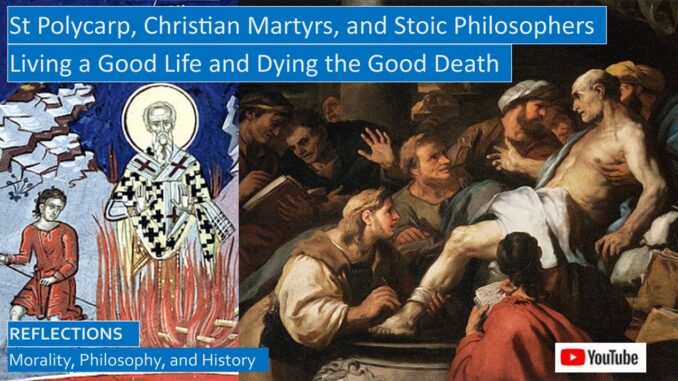
What were the Christian and Stoic attitudes toward martyrdom, and how did they evolve in the early centuries of the Church?
What were the early Christian and Stoic attitudes towards suicide?
Why were both the Stoic philosophers and early Christians concerned about dying the good death?
Why were the accounts of the martyrdom stories of St Polycarp, St Ignatius, and St Peter so revered by early Christians?
YouTube video for this blog: https://youtu.be/o0Y0NGMfYrs
CHRISTIAN ATTITUDES TOWARD MARTYRDOM
Did the Christian martyrdoms and the Stoic view towards suicide both reflect the ancient Greek and Roman concern that the virtuous person should die the good death, facing death with courage, not fearing death?
What we are not concerned with is whether the Christian views towards martyrdom affected the Stoic views of suicide, or the reverse, or vice versa. How one influenced the other is both impractical to conjecture and impossible to prove.
We cannot assume that all Stoic philosophers enthusiastically condoned suicide. In the City of God, St Augustine opposed suicide in all cases. The Stoic Seneca obsessed about suicide because he spent his last few retirement years wondering when the evil Emperor Nero would send his sword-wielding soldiers to his estate to insist that he commit suicide. Like St Augustine, the Stoic philosopher Epictetus opposed suicide in most circumstances.
Opposing Suicide: According to the Bible, Catholic Catechism, and St Augustine’s City of God
https://seekingvirtueandwisdom.com/opposing-suicide-biblical-exhortations-catholic-catechism-and-church-father-teachings/
https://youtu.be/G0e0uVCDIwg
Michael Holmes’ Introduction agrees that the account of the Martyrdom of Polycarp seeks to show how our saint showed Stoic calm and courage in the face of death. “A martyrdom in accordance with the gospel” not only “imitates events of the passion of Jesus,” but also:
- “It is a matter of divine calling rather than human accomplishment or initiative.
- It demonstrates a concern for the salvation or well-being of others.
- It displays endurance in the midst of suffering.”
Not only does the scribe Evarestus “establish the character of Polycarp as a charismatic and prophetic bishop,” but also demonstrates how Polycarp embodies the heroic and athletic virtues and characteristics idealized by Greco-Roman culture,”[1] in spite of his advanced eighty-six years of age.
Christian tradition holds that each of the original twelve disciples, except for John, the beloved apostle, and Judas the traitor, became martyrs for the faith. Tradition holds that St Peter and St Paul were martyrs in the persecutions under Emperor Nero. The apocryphal Acts of Peter reflected the Christian tradition that St Peter was crucified head down in Rome, while St Paul was beheaded, since as a Roman citizen he could not be crucified.[2]
The early Christians were not encouraged to avoid persecution. The apocryphal Acts of Peter, reflecting early Christian tradition, recounts how the brethren of Rome encouraged Peter to flee the city so he could “go on serving the Lord.”
The Acts of Peter continues: “As Peter went out of the city gate, he saw our Lord entering Rome. When he saw him, he asked: ‘Lord, where are you going?’ And the Lord said to him, ‘I am coming to Rome to be crucified.’ Peter asked: ‘Lord, are you being crucified again?’ Jesus said to him, ‘Yes, Peter, I am being crucified again.’ And Peter came to himself, and he saw the Lord ascending into Heaven. He returned to Rome, rejoicing and giving praise to the Lord, because he said, ‘I am being crucified,’ since this was to happen to Peter.”[3]
St Ignatius teaches us that we live as martyrs every day when we live selflessly in faith and love for Jesus Christ, “for life begins and ends with faith and love. Faith is the beginning, and love is the end, and their union is God, perfecting our soul. Nobody who professes faith can commit sin, nobody who possesses love can feel hatred.”[4]
Like St Paul in the prior generation, St Ignatius traveled to Rome for his trial and crucifixion as a professing Christian, hurriedly writing epistles and visiting with officials from the local churches on his journey. St Ignatius writes of his enthusiasm for his impending martyrdom in his Epistle to the Romans: “in the fullness of life I am yearning for death with all the passion of a lover. Earthly longings have been crucified; in me there is left no spark of desire for mundane things, but only a murmur of living water that whispers within me, ‘Come to the Father.’” “I am His wheat, ground fine by the lion’s teeth to be made purest bread for Christ.”
St Ignatius likens his upcoming martyrdom to a eucharist, as a sacramental offering, urging us to live our lives as a sacrament to the Lord, praying without ceasing, ever keeping the Word of God alert in our mind, guarding our tongues, loving our neighbor as ourselves, encouraging rather than discouraging our neighbor.
We should pray that we long for Christ as does St Ignatius. “To die in Jesus Christ is better than to be monarch of earth’s widest bounds. He who died for us is all that I seek; He who rose again for us is my whole desire.”[5]
Epistles of St Ignatius to the Romans and Polycarp
http://www.seekingvirtueandwisdom.com/epistles-of-st-ignatius-to-the-romans-and-polycarp/
St Ignatius Epistles to the Ephesians, Magnesians, and Smyrnaeans
http://www.seekingvirtueandwisdom.com/st-ignatius-epistles-to-the-ephesians-magnesians-and-smyrnaeans/
Epistles of St Ignatius of Antioch, Early Church Martyr
https://youtu.be/CM31T6J4bXo
However, in subsequent centuries, Christian church leaders wanted to temper this enthusiasm for martyrdom. They discouraged their more devout members from eagerly seeking martyrdom, especially since some enthusiasts would lose their nerve and deny the faith, discrediting the faith. When these deniers of the faith changed their mind, they were no longer striving for the good death.
For example, St Clement of Alexandria teaches us: “When Jesus says, ‘When they persecute you in this city, flee to another.’ He does not advise flight, as if persecution were an evil thing; nor does encourage them to avoid death by flight,” “but wishes us neither to be authors or abettors of any evil to anyone, either to ourselves or the persecutor and murderer.”
St Clement continues: “Jesus bids us to take care of ourselves. But he who disobeys is rash and foolhardy. If he who kills a man of God sins against God, he also who presents himself before the judgment-seat becomes guilty of his death. And such is also true for those who do not avoid persecution, but out of daring presents himself for capture.” Such a Christian “becomes an accomplice in the crime of the persecutor.” Why should we tempt further our persecutors?[6]
In contrast to St Clement, and writing in the same timeframe, the rigorous Church Father Tertullian counseled that Christians facing persecution should never flee persecution. He argues that “persecution is just the judgement of the Lord,” “separating the grain of the martyrs from the chaff of the deniers.” He proclaims: “Nothing happens without God’s will.” Like St Paul, Tertullian uses military metaphors to depict the Christian as fighting a spiritual battle. “More glorious is the soldier pierced with a javelin in battle, than he who has a safe skin as a fugitive.”
Tertullian criticizes those who fear that if they do not flee, that they might be pressured to deny Christ. “Are you sure that you will deny Christ if you do not flee, or are you not sure? For if you are sure, you have denied already, because by presupposing that you will deny, you have denied already.” Rather, “he who fears to suffer cannot belong to Christ who suffered. “Perfect love casts out fear.” “He who fears is not perfect in love, the Love of God.”
However, even Tertullian does not seem to encourage Christians to voluntarily turn themselves over for persecution. I did not see where he discusses this in the twelve small font pages of the Ante-Nicene Fathers.[7]
CHRISTIAN CHURCHES ASK FOR ACCOUNT OF MARTYRDOM OF POLYCARP
Upon the martyrdom of Polycarp, bishop of Smyrna, many Christian communities asked for an account of his suffering and death. The scribe Evarestus composed this most famous epistle recounting his martyrdom. Eusebius quotes extensively from this epistle in his ancient History of the Church.
Evarestus, the scribe, recounts: “Polycarp, like the Lord, had patiently awaited the hour of his betrayal,” so that by his example, we “might think of others before ourselves. This is surely the sign of a true and steadfast love, when a man is not bent on saving himself alone, but his brethren as well.”
Speaking of the other martyrs, “No one could fail to admire their high-hearted endurance, and the love they showed for their Master. Some were so cut to pieces by the scourges that their very vitals were plainly exposed to view, down to the inmost veins and arteries; and yet they still bore up, until even the bystanders were moved to tears of pity for them.”
Our scribe continues: “Others displayed such heroism that not a cry or a groan escaped from any of them, which seemed a clear proof to us all that in that hour of anguish those martyr-heroes of Christ were not present in the body at all, perhaps the Lord was standing at their side and holding them in talk.”
“So it was that, with all their thoughts absorbed in the grace of Christ, they made light of the cruelties of this world, and at the cost of a single hour purchased for themselves life everlasting. For them, the fires of their barbarous tormentors had a grateful coolness, for they held ever before their eyes their escape from the quenchless flames of eternity; and looking up, they beheld with inward vision the good things in store for those who persevere.”
Our scribe agrees that Christians should not eagerly volunteer for crucifixion, a stance that later ancient Christians likened to suicide. Likewise, we remember how the mother of the Church Father Origen hid his clothes so he could not volunteer to be a martyr, enabling him to continue his work as a preacher, teacher, and author of innumerable Christian commentaries and theological essays.
Our scribe remembers: “There was a man” “whose courage failed him at the sight of the beasts. It was he who had compelled himself and some others to surrender themselves voluntarily, and after much persuasion, he was induced by the Governor to take the oath and offer incense.”
“And that is the reason why we do not approve of men offering themselves spontaneously. We are not taught anything of that kind in the Gospel.”[8]
We reflect on the Christian persecutions from the time of Christ through when Marcus Aurelius and his son Commodus were emperors.
History of Christian Persecutions, New Testament Through Marcus Aurelius
https://seekingvirtueandwisdom.com/history-of-christian-persecutions-new-testament-through-marcus-aurelius/
https://youtu.be/9THdbyx-jHU
DID GOOD EMPEROR MARCUS AURELIUS ACTIVELY PERSECUTE THE CHRISTIANS?
Did the Good Emperor Marcus Aurelius actively persecute the Christians? This is an interesting question since in his Meditations, many of his Stoic observations seemingly reflect Christian teachings.
We do know Marcus Aurelius knew something about Christians, for in Book XI are these two observations:
“Love of one’s neighbor and truth and modesty are properties of the rational soul.”
“What a great soul is that which is ready to be separated from the body and then to be extinguished or dispersed or continue to exist. But this readiness must come from a man’s own judgment, not from mere obstinacy, as with the Christians, but considerately and with dignity and in a way to persuade another, without tragic show.”[9]
Unfortunately, we can conclude that the good Emperor witnessed Christian persecutions in the Coliseum. Here Marcus Aurelius criticizes the more fanatical Christians who actively sought martyrdom by pestering and loudly objecting to local magistrates that they would not sacrifice to the gods, behavior which was also discouraged by many bishops.
Marcus Aurelius expresses a critical view of the resurrection of the soul and body in Book IV. “If souls continue to exist, how does the air contain them from eternity?” He then speculates that souls eventually diffuse to make room for other souls. Then he adds, “we must not only think of the bodies that are buried, but also the animals that are eaten by us and the other animals. For these animals that are consumed are also buried in the bodies of those who feed on them!”[10] Interestingly, when St. Paul preaches to the Athenians in Acts 17, it is the doctrine of the resurrection of the dead that the Greeks have trouble accepting.
The historian Henry Chadwick notes that “Marcus Aurelius regarded suicide as ethically unobjectionable, but felt that it must be done in good style, ‘not, like the Christians in a spirit of theatricality.’”[11]
Did the Stoic Roman Emperor Marcus Aurelius Actively Persecute the Christians?
https://seekingvirtueandwisdom.com/did-the-stoic-roman-emperor-marcus-aurelius-actively-persecute-the-christians
https://youtu.be/7xEeggL9wKs
Marcus Aurelius, Blog 1, Friend, or Foe, or Both, of Christianity?
http://www.seekingvirtueandwisdom.com/marcus-aurelius-blog-1-friend-or-foe-or-both-of-christianity/
Marcus Aurelius and Christian Persecutions: Friend or Foe?
https://youtu.be/-uQxq1O9xSY
Marcus Aurelius Blog 2, Others will be irritating, but not I!
http://www.seekingvirtueandwisdom.com/marcus-aurelius-blog-2-others-will-be-irritating-but-not-i/
Marcus Aurelius Blog 3 Genuine Friends Don’t Keep Scorecards
http://www.seekingvirtueandwisdom.com/marcus-aurelius-blog-3-genuine-friendships-have-no-scorecards/
Marcus Aurelius Blog 4 Be critical of yourself, be gracious towards your neighbor
http://www.seekingvirtueandwisdom.com/marcus-aurelius-blog-4-be-critical-of-yourself-be-gracious-towards-your-neighbor/
Marcus Aurelius Blog 5 Seeing life’s misfortunes through the eyes of our neighbor
http://www.seekingvirtueandwisdom.com/marcus-aurelius-blog-5-seeing-lifes-misfortunes-through-the-eyes-of-our-neighbor/
Marcus Aurelius: Meditations: Stoic View of Life
https://youtu.be/0qHpReZYhv4
Polycarp also wrote an epistle to the Philippians, and likely penned many more that have not survived antiquity.
Epistle of Polycarp to the Philippians
http://www.seekingvirtueandwisdom.com/epistle-of-polycarp-to-the-philippians/
https://youtu.be/wmZ8A9R0ngE
ROMAN AUTHORITIES ARREST BISHOP POLYCARP
Unlike St Peter, when the persecutions started, the blessed Bishop Polycarp was not faulted from withdrawing from the city to one farm, and then another, with a few friends, “doing nothing but praying for us all, and for churches all over the world, as it was his usual custom. During his prayers, three days before his arrest, he had a vision in which he saw flames reducing his pillow to ashes; whereupon he turned to his companions and said, ‘I must be going to be burnt alive.’”
The authorities had tortured a houseboy who led them to Polycarp. When our saint heard the group arrive, “he went down to chat with them. Everyone there was struck by his age and his calmness. They were surprised that the arrest of such an old man could be so urgent. Despite the lateness of the hour, Polycarp at once ordered that they be given all the food and drink they desired.”
“Polycarp then asked if he might be allowed an hour to pray undisturbed. When they consented, he got to his feet and prayed. He was so full of the grace of God that two whole hours went by before he could bring himself to be silent again. All who heard him were struck with awe, and many of them began to regret this expedition against a man so old and saintly.”
Like Christ at Pentecost, the authorities mounted Polycarp on an ass, taking him to the city. They implored him: “What harm is there in saying, ‘Caesar is Lord’ and offering some incense, when it will save your life?” Polycarp refused, and when he was brought into the arena, the crowd erupted into an uproar.
The Governor pressed him, “Take the oath to Caesar, and I will let you go.” Polycarp replied: “Eighty and six years have I served Him, and He has done me no wrong. How then can I blaspheme my King and my Savior?”
Polycarp offered to share the Good News of Christ, but the Governor refused to hear his testimony, suggesting that he share it with the crowd. Polycarp responded that he hoped to share his testimony with him, since Christians “pay proper respect to powers and authorities of God’s appointment, so long as it does not compromise us. To defend myself before the crowd would only be a waste of time.”
The Governor threatened Polycarp with the wild beasts, and when he showed no fear, he threatened him: “If you do not recant, I will have you burnt to death, since you think so lightly of wild beasts.”
Polycarp rejoined, “The fire you threaten me with cannot go on burning for very long; after a while it goes out. But what you are unaware of are the flames of future judgment and everlasting torment which are in store for the ungodly. Why do you go on wasting time? Bring out whatever you have a mind to.”
While saying this, Polycarp “was overflowing with courage and joy, and his whole countenance was beaming with grace.” The Governor was beside himself, completely flummoxed. He proclaimed to the crowd that Polycarp admitted to being a Christian. The crowds insisted he feed him to the lions, but the Governor said the beast-fighting was done, so they cried out to have him burnt alive instead.
“In a moment, the crowd had collected faggots and kindling from the workshops and baths; the Jews, as usual, eager to help.”
WERE THE EARLY CHURCH FATHERS GUILTY OF ANTI-SEMITISM?
With the trauma of the industrialized murder of millions of Jews in the Holocaust, modern historians and theologians are sensitive as to when anti-Semitism developed in the early Christian Church. Was the infamous screed by St John Chrysostom aimed at the Jews in particular, or was it aimed at those Christians who were accused of being Judaizers? And why were the ancient Church Fathers so concerned about Judaism? Today, long after the invention of the printing press, Christians can independently purchase the writings of the Jewish rabbis for their personal study. This was not true in the ancient world. If the ancient Christians were curious about the teachings of the Jewish rabbis, they had to attend the synagogue to study them.
The early Church Fathers could not have foreseen what the creeping anti-Semitism among Christians would lead to. Regarding the early Christians, the persecutions were likely one factor that drove a wedge between ancient Christians and ancient Jews, as it would not be unreasonable for ancient Jewish ruffians to be among the crowds shouting for the crucifixion of Christians. We cannot imagine that a sizable percentage of Jews attended these pagan celebrations, let alone cheer for Christian persecutions, since the slaughter of the Jews in the latest revolt was still a recent memory.
John Chrysostom, Justin Martyr, and the Church Fathers Preach Against the Judaizers and the Jews
https://www.seekingvirtueandwisdom.com/the-church-fathers-preach-against-the-judaizers/
https://youtu.be/fVVyupNwydw
Epistle of Barnabas, Beginnings of Anti-Semitism?
http://www.seekingvirtueandwisdom.com/epistle-of-barnabas-blog-1/
https://youtu.be/J8cxz5uUvdw
Viktor Frankl, Man’s Search For Meaning, His Life in a Nazi Concentration Camp in WWII
http://www.seekingvirtueandwisdom.com/viktor-frankl-mans-search-for-meaning-his-life-in-a-nazi-concentration-camp-in-wwii/
https://youtu.be/O-YtC9qGWPI
What is haunting is that Hitler quoted Martin Luther’s anti-Semitic works to justify the persecution and murder of the Jews, and his quotes were not taken out of context.
Martin Luther’s Catechisms on Do Not Envy, and Confronting Luther’s Anti-Semitism
http://www.seekingvirtueandwisdom.com/martin-luther-large-catechism-on-decalogue-do-not-envy-and-anti-semitism/
https://youtu.be/FQmBggJAhKg
REMARKABLE MARTYRDOM OF BISHOP POLYCARP
Returning to the martyrdom of Polycarp: After he took off his outer garment, the crowd fastened him with irons to the pyre and were going to nail him as well. Polycarp protested: “Let me be! He who gives me strength to endure the flames will give me strength not to flinch at the stake,” without the need for nails.
Our scribe reflects: “So they left out the nailing and tied him instead. Bound like that, with his hands behind him, he was like a noble ram taken out of some great flock for sacrifice: a goodly burnt offering all ready for God.”
This is an obvious comparison to the crucifixion of Jesus, perhaps signifying that as he was not nailed to the wood, he was not as worthy as Christ. It is also a comparison to when the Patriarch Abraham was commanded by God to offer his only son Isaac as a sacrifice, substituting a ram at the very last moment.
“Then Polycarp cast his eyes up to heaven and prayed:”
“O Lord God Almighty, Father of thy blessed and beloved Son Jesus Christ:” “I bless thee for granting me this day and hour, that I may be numbered amongst the martyrs, to share the cup of thine Anointed and to rise again unto life everlasting, both in body and soul, in the immortality of the Holy Spirit. May I be received among them this day in thy presence, a sacrifice rich and acceptable, even as thou didst appoint and foreshow, and dost now bring it to pass, for thou art the God of truth and in thee is no falsehood.”
“As the amen soared up and the prayer ended,” the men lit the carefully stacked wood, “and a great sheet of flame blazed out. And then we who were privileged to see it saw a wondrous sight.” “The fire took on the shape of a hollow chamber, like a ship’s sail when the winds fills it, and formed a wall round about the martyr’s figure; and there he was in the center of it, not like a human being in flames but like a loaf baking in the oven, or like a gold or silver ingot being refined in the furnace. And we became aware of a delicious fragrance, like the odor of incense or other precious gems.”
We are also reminded of the story in the Book of Daniel of the three youths, Shadrach, Meshach, and Abednego, who were thrown into the furnace by the evil king of Babylon, but they did not perish, because there was an angel sent to protect them from the flames.[12]
“Finally, when they realized that his body could not be destroyed by fire, the ruffians ordered one of the dagger-men to stab Polycarp. As he did so, there flew out a dove, together with such a copious rush of blood that the flames were extinguished; and this filled all the spectators with awe, to see the greatness of the difference that separates unbelievers from the elect of God.”[13]
This is another obvious comparison to the crucifixion of Jesus. When the soldiers spear the side of the dead body of Jesus, out come a copious amount of water and blood.[14]
CAN WE COMPARE CHRISTIAN MARTYRDOMS TO STOIC SUICIDES?
Other than Marcus Aurelius’ Meditations, there are scant references to Christians in the works by other Roman Stoic philosophers. Likewise, there are scant references in the New Testament on suicide. Although there are scant condemnations of suicide in the Old Testament, many Bible characters, including Samson and Saul, die by suicide. None of these suicides are worthy of emulation.
But the great majority of the suicides in both the Old Testament and the writings of the Roman Stoics have this in common: They are a consequence of armed or political conflicts. King Saul committed suicide when his army lost their battle with the Philistines, and Samson’s suicide happened when he was held captive by the Philistines, likely facing eventual death.
In contrast to the Old Testament suicides, most of the Stoic and Roman examples of suicides were considered to be good deaths accompanied by Stoic calm and courage.
For example, for the last few years of his life, Seneca was compelled to live with the threat that, any day, Nero’s soldiers would come to his villa demanding his death. Because of this sword perpetually hanging over him, Seneca obsesses over death by suicide more than any other Stoic Philosopher.
Seneca obsesses: “Rehearse this thought every day, that you may be able to depart from life contentedly; for many men clutch and cling to life, even as those who are carried down a rushing stream clutch and cling to briars and sharp rocks.” “Make life as a whole agreeable to yourself by banishing all worry about it.”[15]
The Roman historian Tacitus details how Nero’s soldiers patiently allowed him a good and noble death by suicide. When slitting his veins in his bath was ineffective, his demise was hastened by poison. But when his wife, Paulina, attempted to follow him in suicide, the soldiers, according to Nero’s instructions, bound her arms and stopped her bleeding, preventing her suicide.[16]
Roman Stoic Philosopher Seneca on Aging, Death, and Suicide
https://seekingvirtueandwisdom.com/roman-stoic-philosopher-seneca-on-aging-death-and-suicide/
https://youtu.be/c9JXjqRKgBE
Like Seneca, Cicero likewise expected to be executed by one of the tyrants who overthrew the Roman Republic. Unlike Seneca, he did not dwell on suicide.
Cicero summarizes the ancient Stoic view of death:
“When a man is old, there is no doubt that death is near. Yet if, during his long life, he has failed to grasp that death is of no account, he is unfortunate indeed.”
“When the end comes, all that is gone before has vanished. All that remains is the credit you have gained by your good and right actions. Hours, days, months, and years go by. Once they have passed, they never come back again. What the future will be, we cannot tell. So, we ought to be content with whatever life has allotted to us.”[17]
Cicero holds up as a noble example the life and death of Cato, who committed suicide rather than live his life under the tyrant, Emperor Augustus, although he was willing to pardon him and allow him to continue his civic life as a senator serving the Empire.
Roman Stoic Philosopher and Politician Cicero on Aging and Death
https://seekingvirtueandwisdom.com/roman-stoic-philosophers-cicero-on-aging-and-death/
https://youtu.be/ne9T2N2mvZY
Unlike Seneca and Cicero, the Stoic philosopher Epictetus had a different audience: younger students learning rhetoric and Stoic philosophy to prepare for a career in public service.
Epictetus urged his students: “My friends, wait for God. You are free to return to him only when he gives the signal and releases you from your service here on earth. For the time being, resign yourselves to residing here, at the post to which he has assigned you. The time of your stay is short, and easy to endure for people with your convictions. What tyrant or thief or law court can strike fear in those who regard the body and its possessions as of no importance? Don’t leave for no good reason.”[18]
Epictetus did not condemn suicide under all circumstances. Although he does not provide a reason, the ancients could have tolerated suicide when people faced unending severe pain, with no possibility of a cure or relief. The ancients did not have access to the hospital care or drugs that we in the modern world use routinely to manage pain.
Epictetus, Eminent Stoic Philosopher, on Living Well, Dying Well, and Opposing Suicide
https://seekingvirtueandwisdom.com/epictetus-eminent-stoic-philosopher-on-living-well-dying-well-and-opposing-suicide/
https://youtu.be/MDRCc8Gu4y8
Although St Augustine was clearly influenced by the Roman moral philosophers, he corrected their teachings when they conflicted with the Christian ethos and Scriptures. St Augustine staunchly opposes suicide in the opening chapters of his magnus opus, the City of God. He explicitly discusses why Cato did not set a good example in his suicide.
St Augustine composed the City of God to respond to the challenges faced by the Christian Church and Roman Empire in the face of the barbarian invasions. What shook the Romans to the core was the Sack of Rome, which had not happened in the previous eight centuries. He reassured Roman maidens that if they were sexually assaulted by the barbarians, they would remain virgins spiritually if they did not consent. Many of these Roman maidens were tempted to commit suicide, but St Augustine sought to dissuade them from this drastic act.[19]
Opposing Suicide: According to the Bible, Catholic Catechism, and St Augustine’s City of God
https://seekingvirtueandwisdom.com/opposing-suicide-biblical-exhortations-catholic-catechism-and-church-father-teachings/
https://youtu.be/G0e0uVCDIwg
Why were ancient Christians and Romans so concerned about dying the good death? This question is impossible to answer, but we can speculate based on how the ancient world differs from our modern world.
Death was common and was a part of everyday life in the ancient world, unlike the modern world. In the ancient world, the high infant mortality rate meant that most people did not live past childhood, and women commonly died during childbirth. The lack of aspirin meant many people died from fever, and it was not uncommon to die of food poisoning. Today we pass in hospice or hospitals, but in the ancient world, the elderly more often died at home.
Ordinary Life for Romans Under Stoic Emperor Marcus Aurelius
https://seekingvirtueandwisdom.com/ordinary-life-for-romans-under-stoic-emperor-marcus-aurelius/
https://youtu.be/9hgSbcgbCJw
Ordinary Life and Justice in Ancient Athens, Rome, and Israel
http://www.seekingvirtueandwisdom.com/ordinary-life-and-justice-in-the-ancient-world/
https://youtu.be/vl8KGL5Yx2w
Ancient Warrior Societies, Blog 1, The Warrior Ethos of Ancient Greece, Rome, and Israel
https://seekingvirtueandwisdom.com/ancient-warrior-societies-blog-1-the-warrior-ethos-of-ancient-greece/
https://youtu.be/7QAZ_s6zw4E
Ancient Warrior Societies, Blog 2, Greek and Roman Armies and Navies
https://seekingvirtueandwisdom.com/ancient-warrior-societies-blog-2-greek-and-roman-armies-and-navies/
Ancient Warrior Societies, Blog 3, World of the Old Testament
https://seekingvirtueandwisdom.com/ancient-warrior-societies-blog-3-world-of-the-old-testament/
Ancient Warfare in Ancient Greece, Rome, and Israel. Did Joshua Massacre Pagans in Promised Land?
https://youtu.be/9xKxqAbJ2qY
Since death was so ever present to the ancients, they were concerned that they face death calmly, courageously, and with Stoic resolve. Likewise, Christians sought to present a positive example by facing a martyr’s death martyrdom calmly, and courageously, and with Stoic resolve.
The Bible gives little advice on how to confront old age, except for Psalm 71, and possibly Psalms 70 and 40.
Psalm 71: Encouraging Us In Our Old Age
https://seekingvirtueandwisdom.com/psalm-71-encouraging-us-in-our-old-age/
https://youtu.be/NrzVItznE1E
Psalms 40 and 70: Deliver Both Young and Old from Suffering and Trials
https://seekingvirtueandwisdom.com/psalms-40-and-70-deliver-both-young-and-old-from-suffering-and-trials/
https://youtu.be/JbKQd6vP5qo
DISCUSSING THE SOURCES
We have quoted large portions of the Martyrdom of Polycarp. There are seven Greek and one Latin manuscripts from the tenth to the thirteenth centuries, plus the many Greek, Latin, Syriac, and Armenian manuscripts of Eusebius’ History of the Church which quotes a large portion of it.[20] Like most patristic writings, you can find public domain copies on the internet. Michael Holmes has also compiled an excellent collection of these writings in both the original Greek and an English translation. Polycarp’s saintly biography is included in the medieval Golden Legends collection, but is not included in our modern compilations.[21]
Book Reviews: Golden Legend, Butler’s, OCA, and Pope Benedict XVI’s Lives of Saints
https://seekingvirtueandwisdom.com/book-reviews-golden-legend-oca-and-butlers-lives-of-the-saints/
https://youtu.be/RFUeBLPMyqI
Bart Ehrman also has an excellent series of Great Books Plus lectures on the Apostolic Fathers. In general, I agree with all the evidence he cites in his lecture, but disagree with most of his conclusions. I discuss these lectures in the Epistles of Ignatius reflection.[22]
The Other Bible includes the Acts of Peter, and other interesting Jewish and early Christian apocryphal texts.
We have become totally disenchanted with the Stoic Six Pack listed on Amazon. We could not decipher the translation of several of Seneca’s letters from the Latin originals, so we purchased the Penguin or Oxford translations, which also have more and better footnotes. We now prefer Robin Waterfield’s translations from the Greek, including those of the works of Epictetus and Marcus Aurelius. Most notably, he translated a key Greek word in the Republic as morality rather than Benjamin Jowett’s classical translation as justice, which accentuates the moral lessons that Plato provides.
Plato’s Republic, Book 1, On Aging and Morality, a Better Word for Justice
https://seekingvirtueandwisdom.com/platos-republic-book-1-on-aging-and-morality-a-better-word-for-justice/
https://youtu.be/JY1ILO3weZI
Bart Ehrman also has an excellent series of Great Books Plus lectures on the Apostolic Fathers. In general, I agree with all the evidence he cites in his lecture, but disagree with most of his conclusions. I discuss these lectures in the Epistles of Ignatius reflection.[23]
We have also reviewed several works by the Apostolic Fathers included in the Ante-Nicene Church Fathers volumes. You might find these volumes in a used book store, and one publisher has reprinted these volumes recently. We recommend that you purchase the online eBooks for each volume from Christian Book Distributors, as they will preserve the footnotes and introductions.
Book Review: Early Church Fathers Library – 38 Volumes in 3 Series
http://www.seekingvirtueandwisdom.com/early-church-fathers-library-38-volumes-in-3-series/
Book Reviews on Apostolic and Early Church Fathers
http://www.seekingvirtueandwisdom.com/book-reviews-on-apostolic-and-early-church-fathers/
How To Read Ancient Works, and Book Reviews on the Apostolic Church Fathers
https://youtu.be/I_2q4BiRBlU
The Mystagogy website was a source for many of our icons, and they have many additional interesting saints’ stories about St Polycarp.[24]
[1] Michael Holmes, Introduction to Martyrdom of Polycarp, included in The Apostolic Fathers, Greek Texts and English Translations, Third Edition (Grand Rapids, MI, Baker Academic Press, 2007, 1992, originally 200s AD), pp. 299-300.
[2] https://en.wikipedia.org/wiki/Paul_the_Apostle#Death
[3] The Acts of Peter, translated by GC Stead, included in The Other Bible edited with Introductions by Willis Barnstone (San Francisco: Harper Collins Publishers, 1984), Martyrdom of the Holy Apostle Peter, Chapters 30-41, p. 442. The Other Bible excerpts are from New Testament Apocrypha, Volume 2 (Philadelphia, Westminster Press, 1963.)
[4] Ignatius of Antioch, “Epistle to the Ephesians,” in Early Christian Writings, the Apostolic Fathers, translated by Maxwell Staniforth (New York: Dorset Press, 1968, originally 300s AD), pp. 79-80.
[5] Ignatius of Antioch, “Epistle to the Romans,” in Early Christian Writings, the Apostolic Fathers, pp. 104-106.
[6] St Clement of Alexandria, The Stomata, In the Ante-Nicene Fathers, Volume 2, translated by WL Alexander (Boston: Hendrickson Publishers, 1994, first published 1885), Chapter X, p. 423.
[7] Tertullian, De Fuga in Persecutione, In the Ante-Nicene Fathers, Volume 4, translated by Rev S Thelwall (Boston: Hendrickson Publishers, 1994, first published 1885), pp. 116-125.
[8] The scribe Evarestus, The Martyrdom of Polycarp, included in Early Chrisitan Writings, the Apostolic Fathers, pp. 155-156 and https://en.wikipedia.org/wiki/Origen#Early_years
[9] Marcus Aurelius, “Meditations,” translated by George Long, revised and updated (Dover Publications, 1997), Book XI, 85-86.
[10] Marcus Aurelius, “Meditations,” Book IV, 22-23.
[11] Henry Chadwick, “The Early Church,” p. 31.
[12] https://en.wikipedia.org/wiki/Shadrach,_Meshach,_and_Abednego
[13] The scribe Evarestus, The Martyrdom of Polycarp, included in Early Chrisitan Writings, the Apostolic Fathers, pp. 156-161.
[14] https://en.wikipedia.org/wiki/Holy_Lance and https://www.biblegateway.com/passage/?search=john%2019%3A31-37&version=NRSVCE
[15] Seneca, Moral Discourses, Letter IV, On the Terrors of Death, p. 222.
[16] Tacitus, The Annals, translated by Cynthia Damon (New York: Penguin Classics, 2012, originally AD 116), Book 15, Chapters 60-64, pp. 333-335.
[17] Cicero, On Old Age, included in Selected Works, translated Michael Grant (New York: Penguin Classics, 1971, 1960, originally about 50 BC), Chapter 7, Death Has No Sting, pp. 240-242.
[18] Epictetus, Discourses, included in Epictetus, The Complete Works, translated by Robin Waterfield (University of Chicago Press, 2022, originally AD 100+), Discourse 1.9.12-17, pp. 91-92.
[19] St Augustine, City of God, translated by Henry Bettenson (New York: Penguin Classics, 2003, 1972, originally early 400s), Book 1, Chapter 12, pp. 21-49.
[20] Edgard Goodspeed, A History of Early Christian Literature (University of Chicago Press, Midway Reprint, 1983, 1942), p. p. 26 and https://en.wikipedia.org/wiki/Martyrdom_of_Polycarp and https://en.wikipedia.org/wiki/Ecclesiastical_History_(Eusebius) and
[21] https://www.liturgies.net/saints/polycarp/goldenlegend.htm
[22] Bart Ehrman, “After the New Testament: The Writings of the Apostolic Fathers,” lectures recorded by The Great Courses, (www.thegreatcourses.com, 2005).
[23] https://www.thegreatcourses.com/courses/after-the-new-testament-the-writings-of-the-apostolic-fathers and https://amzn.to/3qRiYMQ

Be the first to comment