
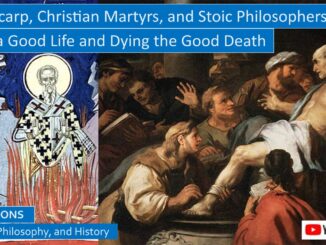
Polycarp, Christian Martyrs, and Stoic Philosophers: Dying the Good Death
Epictetus and Rufus

Polycarp, Christian Martyrs, and Stoic Philosophers: Dying the Good Death

Did the Christian martyrdoms and the Stoic view towards suicide both reflect the ancient Greek and Roman concern that the virtuous person should die the good death, facing death with courage, not fearing death?
What we are not concerned with is whether the Christian views towards martyrdom affected the Stoic views of suicide, or the reverse, or vice versa. How one influenced the other is both impractical to conjecture and impossible to prove.
We cannot assume that all Stoic philosophers enthusiastically condoned suicide. In the City of God, St Augustine opposed suicide in all cases. The Stoic Seneca obsessed about suicide because he spent his last few retirement years wondering when the evil Emperor Nero would send his sword-wielding soldiers to his estate to insist that he commit suicide. Like St Augustine, the Stoic philosopher Epictetus opposed suicide in most circumstances. […]

States' Rights v Federal Power From the Nation's Founding to Civil War, Jim Crow, and Civil Rights Movement
Civil Rights

States’ Rights v Federal Power From the Nation’s Founding to Civil War, Jim Crow, and Civil Rights Movement

The Constitution was drafted to correct the many weaknesses of the Articles of Confederation. Congressmen now swear allegiance to the United States rather than to their native states, as was done under the Articles. The Constitution grants the Federal government not only the power to levy taxes, but also to collect them, as well as sole control over trade and commerce. The Constitution establishes a Federal court system that can override state court decisions if there is a conflict. The US Congress, unlike the Confederation Congress, can pass routine legislation with a simple majority vote. […]

History of Christian Persecutions, New Testament Through Marcus Aurelius
Greek and Roman History

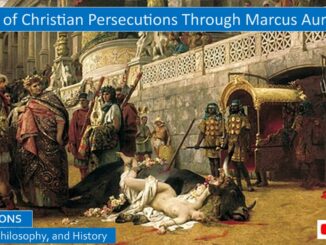
History of Christian Persecutions, New Testament Through Marcus Aurelius

How widespread was the Christian persecution under the Roman Empire? Usually, it was a local affair, not until the reign of Diocletian was an empire-wide systematic persecution of Christians undertaken. The persecution under Nero was limited to Rome itself. The extent of the local persecution depended on the enthusiasm or cruelty of the local officials, many local officials had no enthusiasm for persecuting the local Christians, turning a blind eye. Overall, the number of persecutions was not huge, rarely were the Christian persecutions systematic, targeting all Christians. Indeed, the Christian martyrs in the twentieth century alone, mostly in Russia, dwarfed the number of Christian martyrs from the preceding nineteen centuries combined. […]