
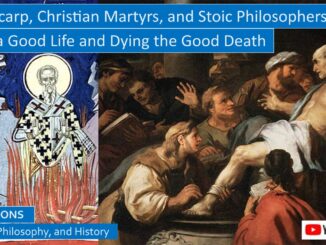
Polycarp, Christian Martyrs, and Stoic Philosophers: Dying the Good Death
Epictetus and Rufus

Polycarp, Christian Martyrs, and Stoic Philosophers: Dying the Good Death

Did the Christian martyrdoms and the Stoic view towards suicide both reflect the ancient Greek and Roman concern that the virtuous person should die the good death, facing death with courage, not fearing death?
What we are not concerned with is whether the Christian views towards martyrdom affected the Stoic views of suicide, or the reverse, or vice versa. How one influenced the other is both impractical to conjecture and impossible to prove.
We cannot assume that all Stoic philosophers enthusiastically condoned suicide. In the City of God, St Augustine opposed suicide in all cases. The Stoic Seneca obsessed about suicide because he spent his last few retirement years wondering when the evil Emperor Nero would send his sword-wielding soldiers to his estate to insist that he commit suicide. Like St Augustine, the Stoic philosopher Epictetus opposed suicide in most circumstances. […]

Pope Leo the Great, Confronting Attila the Hun, and His Role in Fourth Ecumenical Council of Chalcedon
Catholic Middle Ages and Beyond

Pope Leo the Great, Confronting Attila the Hun, and His Role in the Fourth Ecumenical Council of Chalcedon

As Pope Benedict XVI writes: “The times in which Pope Leo lived were very difficult: constant barbarian invasions, the gradual weakening of imperial authority in the West, and the long, drawn-out social crisis forced the Bishop of Rome” “to play an important role in both civil and political events.”
“In a period of profound crisis, Leo the Great knew how to make himself close to the people and the faithful with his pastoral action and his preaching. He enlivened charity in a Rome tried by famines, an influx of refugees, injustice, and poverty. He opposed pagan superstitions and actions of Manichaean groups. He associated the liturgy with the daily life of Christians.” […]

History of Christian Persecutions, New Testament Through Marcus Aurelius
Greek and Roman History

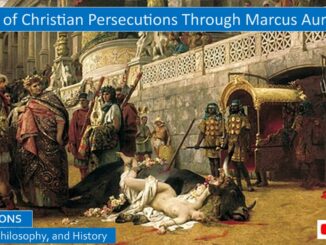
History of Christian Persecutions, New Testament Through Marcus Aurelius

How widespread was the Christian persecution under the Roman Empire? Usually, it was a local affair, not until the reign of Diocletian was an empire-wide systematic persecution of Christians undertaken. The persecution under Nero was limited to Rome itself. The extent of the local persecution depended on the enthusiasm or cruelty of the local officials, many local officials had no enthusiasm for persecuting the local Christians, turning a blind eye. Overall, the number of persecutions was not huge, rarely were the Christian persecutions systematic, targeting all Christians. Indeed, the Christian martyrs in the twentieth century alone, mostly in Russia, dwarfed the number of Christian martyrs from the preceding nineteen centuries combined. […]