Polycarp, Christian Martyrs, and Stoic Philosophers: Dying the Good Death
Epictetus and Rufus

Polycarp, Christian Martyrs, and Stoic Philosophers: Dying the Good Death

Did the Christian martyrdoms and the Stoic view towards suicide both reflect the ancient Greek and Roman concern that the virtuous person should die the good death, facing death with courage, not fearing death?
What we are not concerned with is whether the Christian views towards martyrdom affected the Stoic views of suicide, or the reverse, or vice versa. How one influenced the other is both impractical to conjecture and impossible to prove.
We cannot assume that all Stoic philosophers enthusiastically condoned suicide. In the City of God, St Augustine opposed suicide in all cases. The Stoic Seneca obsessed about suicide because he spent his last few retirement years wondering when the evil Emperor Nero would send his sword-wielding soldiers to his estate to insist that he commit suicide. Like St Augustine, the Stoic philosopher Epictetus opposed suicide in most circumstances. […]

Psalms 40 and 70: Deliver Both Young and Old from Suffering and Trials
Biblical Interpretation

Psalms 40 and 70: Deliver Both Young and Old from Suffering and Trials

St Ambrose rejoices: “Christ has heard the prayer of his own servants and has brought us out from the pit of misery and from the mire of dregs. We were drowning there; our whole flesh was clinging to the mire, trapped in the whirlpool of our sins. Our soul was powerless to save itself; fallen and ruined as it was by the multiplicity and dreadfulness of our offenses.”
St Ambrose continues: “Christ came to save us from the pit and slime of this world, from the mud and mire of this earth, from this body doomed to death.” “May that rock, which follows those who thirst, confirm the weak and unsteady; may that water never be lacking to those who long for it; and may that firm foundation never be wanting to those in danger of falling.” […]

Paul Tournier, Christian Psychologist on Marriage and Widows in Old Age and Retirement
Aging

Paul Tournier, Christian Psychologist on Marriage and Widows in Old Age and Retirement

What is the ideal, according to Paul Tournier? “Growing old together, husband and wife can come to know a love which is, in a way, a prefiguration of heaven, for it is less tumultuous than the love of youth, being less directed towards selfish pleasure-seeking, and because a slow advance in mutual comprehension permits more authentic communication.” […]

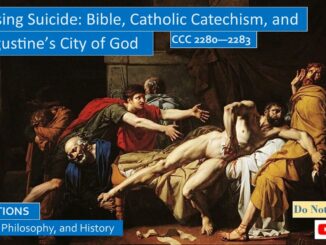
Opposing Suicide: According to the Bible, Catholic Catechism, and St Augustine’s City of God
Command 6 Do Not Murder

Opposing Suicide: Biblical Exhortations, Catholic Catechism, and St Augustine’s City of God

CCC 2281. “Suicide contradicts the natural inclination of the human being to preserve and perpetuate his life. It is gravely contrary to the just love of self. It likewise offends love of neighbor because it unjustly breaks the ties of solidarity with family, nation, and other human societies to which we continue to have obligations. Suicide is contrary to love for the living God.” […]

Brutalities Suffered By Slaves on the Plantations of the Antebellum South
Civil War Memories

Brutalities Suffered By Slaves on the Plantations of the Antebellum South

In most systems of slavery, in both the ancient world and the Antebellum South, masters could beat, maim, and even murder their slaves, since slaves were property. However, abuse of slaves eased somewhat under the influence of the Stoic Philosophers and early Church Fathers. But it was common, in the Antebellum South, for masters to abuse their slaves, though they rarely killed them, since they were valuable property. But no mercy was shown to slaves who were brutally whipped by their masters, which Frederick Douglass often witnessed. No mercy was shown to suffering slaves in the Antebellum South. […]

Greek Stoic and Cynic Philosophers: My Favorite Sayings
Greek Philosophy

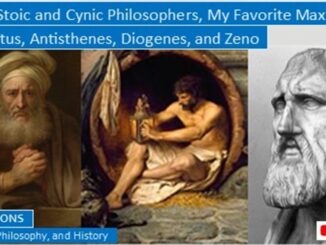
Greek Stoic and Cynic Philosophers: My Favorite Maxims: Heraclitus, Antisthenes, Diogenes, and Zeno

Diogenes was an exile in Athens who wanted to study under Antisthenes. Although Antisthenes threatened him with his staff, Diogenes was obstinate, he wanted to be his student, he shouted, “Strike, for you’ll not find wood hard enough to keep me away from you, as long as I think you have something to say.”
Diogenes noticed a mouse scurrying about in Athens, and he decided that, like the mouse, he would not be concerned about where he lived, so he lived in a tub, a large earthenware pot in the marketplace. When he saw a boy drinking water with his hands, he threw away the cup he owned, and later he threw away his bowl. He went barefoot even in the winter, his possessions consisted of a cloak and what he could carry in a knapsack.
Once, when traveling, he was captured by pirates and sold to a man who employed him to raise his sons to follow Cynic Philosophy. When his friends offered to ransom him from slavery, he refused, saying that “lions are not the slaves of those who feed them; it is the feeders, rather, who are the lions’ slaves. For fear is the mark of a slave, and wild beasts make men fearful.” […]

Major Roman Stoic Philosophers, My Favorite Maxims: Epictetus, Rufus, Seneca & Marcus Aurelius
Philosophy

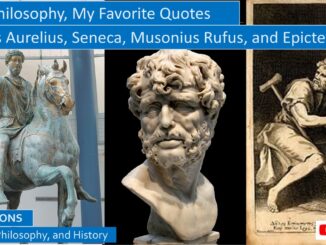
Major Roman Stoic Philosophers, My Favorite Maxims: Epictetus, Rufus, Seneca & Marcus Aurelius

Many of the writings of the Stoics sound like passages from the Pauline Epistles. Indeed, Seneca was a contemporary of St Paul. There are epistles written between them, though nearly all scholars think they are spurious. Was St Paul inspired by the Stoic writings of Seneca? Although the Jewish rabbinic tradition was the primary source of inspiration for the Epistles and the Gospels, stoicism was an important secondary influence. In particular, stoicism deeply influenced the desert monastic tradition, which in turn influenced medieval monasticism. […]