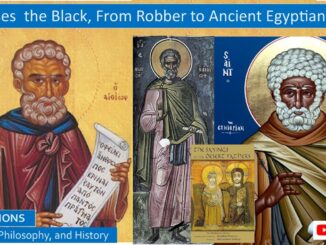
St Moses the Black, Desert Church Father, Former Ancient Gang Leader
Early Church Writing

St Moses the Black, Desert Church Father, Former Ancient Gang Leader

The old man said: ‘If we are on the watch to see our own faults, we shall not see those of our neighbor. It is folly for a man who has a dead person in his house to leave him there and go to weep over his neighbor’s dead. To die to one’s neighbor is this: To bear you won faults and not to pay attention to anyone else wondering whether they are good or bad.
Do no harm to anyone, do not think anything bad in your heart to anyone, do not scorn the man who does evil, do not put confidence in him who does wrong to his neighbor, do not rejoice with him who injures his neighbor.” […]

The Hymn Inspired by John I AM the Bread of Life
Bible Stories and Parables

The Hymn inspired by John, I Am the Bread of Life, with Commentary by Church Fathers and Reformed Preachers

John Chrysostom teaches us: “Jesus calls this the true bread, not because the miracle of the manna was false, but because it was a type and not the very truth itself.” “After Jesus says, ‘Moses did not give,’ he does not say, ‘I give,’ but says that the Father, and not Moses, gives.”
“When they heard this, the people replied: ‘Give us this bread to eat.’ They still thought it was something material, and they yet expected to satisfy their appetites, and so they quickly ran to him. What does Christ do? Leading them on little by little, he says, ‘The bread of God is he who comes down from heaven and gives life to the world.’” […]

Psalm 137: Should We Bash the Babylonian Babies? Spiritual and Historical Interpretations
Biblical Interpretation

Psalm 137: Should We Bash the Babylonian Babies Against the Rocks? Spiritual and Historical Interpretations

Happy shall they be who take your little ones
and dash them against the rock!
Origen was one of the first Church Fathers who interpreted this troublesome verse allegorically, as did St Ambrose, who catechized and baptized the young St Augustine. Origen teaches us that “the little ones of Babylon, which signifies confusion, are those troublesome sinful thoughts that arise in the soul, and one who subdues them by striking their heads against the firm and solid strength of reason and truth, is the person who ‘dashes the little ones against the stones;’ and he is therefore truly blessed.”[2] Likewise, St Ambrose comments that we should “dash all corrupt and filthy thoughts against Christ.” […]

Polycarp, Christian Martyrs, and Stoic Philosophers: Dying the Good Death
Epictetus and Rufus

Polycarp, Christian Martyrs, and Stoic Philosophers: Dying the Good Death

Did the Christian martyrdoms and the Stoic view towards suicide both reflect the ancient Greek and Roman concern that the virtuous person should die the good death, facing death with courage, not fearing death?
What we are not concerned with is whether the Christian views towards martyrdom affected the Stoic views of suicide, or the reverse, or vice versa. How one influenced the other is both impractical to conjecture and impossible to prove.
We cannot assume that all Stoic philosophers enthusiastically condoned suicide. In the City of God, St Augustine opposed suicide in all cases. The Stoic Seneca obsessed about suicide because he spent his last few retirement years wondering when the evil Emperor Nero would send his sword-wielding soldiers to his estate to insist that he commit suicide. Like St Augustine, the Stoic philosopher Epictetus opposed suicide in most circumstances. […]

Psalm 71: Encouraging Us In Our Old Age
Biblical Interpretation

Psalm 71: Encouraging Us In Our Old Age

John Calvin speculates that David composed Psalm 71 after experiencing the trauma of losing the life of his son Absalom during his rebellion against him, which was sparked by the favoritism Davis showed towards his newly resented wife, Bathsheba. “The particular reference which David makes to his old age renders this conjecture not improbable.”
If so, this psalm should be a comfort to those who old age is lonelier due to mistakes, miscalculations or misfortunes occurring many years earlier. […]

Psalms 40 and 70: Deliver Both Young and Old from Suffering and Trials
Biblical Interpretation

Psalms 40 and 70: Deliver Both Young and Old from Suffering and Trials

St Ambrose rejoices: “Christ has heard the prayer of his own servants and has brought us out from the pit of misery and from the mire of dregs. We were drowning there; our whole flesh was clinging to the mire, trapped in the whirlpool of our sins. Our soul was powerless to save itself; fallen and ruined as it was by the multiplicity and dreadfulness of our offenses.”
St Ambrose continues: “Christ came to save us from the pit and slime of this world, from the mud and mire of this earth, from this body doomed to death.” “May that rock, which follows those who thirst, confirm the weak and unsteady; may that water never be lacking to those who long for it; and may that firm foundation never be wanting to those in danger of falling.” […]

Epictetus, Eminent Roman Stoic Philosopher, on Living Well, Dying Well, and Opposing Suicide
Aging

Epictetus, Eminent Roman Stoic Philosopher, on Living Well, Dying Well, and Opposing Suicide

Is it wise to complain? Epictetus observes: “If someone dies young, he blames the gods because he is being taken before his time. If someone lingers on into extreme old age, he too blames the gods.” “Despite this, at the approach of death, he wants to stay alive; he sends for the doctors and begs him to do all he can.” “It is quite remarkable to see how people want neither to live nor to die.”
“Is health good and illness bad? No, man. What, then? Health managed well is good, but when badly managed, it is bad.”
Epictetus points out: “If you look at yourself in isolation, it is natural for you to live to an old age, to be rich, to be healthy. But if you look at yourself as a human being and as part of some whole, for the sake of that whole, it may be appropriate for you to be ill, or risk your life at sea, or be poor, or die young. Why get angry then?” “What is a human being? A part of a city made up of gods and human beings,” “a small copy of the universal city.” […]

St John Climacus, Ladder of Divine Ascent Steps 16&17 Avarice and NonPossessiveness
Ladder of Divine Ascent

St John Climacus, Ladder of Divine Ascent, On Avarice and Non-Possessiveness, Steps 16 & 17

Avarice is the worst kind of drought and famine, for it is drought and famine in the midst of plenty. A Jewish story tells of a man taken on a tour of Hell, where he sees a huge banquet hall, with long tables lined with souls, each one ogling their plate heaped with roast beef, sausage, breads, fruits and pies. This sumptuous meal tormented each one, all were starving, for they had no elbows to feed themselves. Then he was shown the banquet hall in Heaven, same type of banquet hall, same meats, breads, fruits and pies, but here the mood was joyous. Like those souls in Hell, they had no elbows, but they were joyous because they were feeding each other. […]

St John Climacus on Love, Lust, and Marriage: Ladder of Divine Ascent, Step 15, on Purity & Chastity
Ladder of Divine Ascent

St John Climacus on Love, Lust, and Marriage: Ladder of Divine Ascent, Step 15, on Purity and Chastity

Laymen often wonder: How can those who are married be chaste? In his commentary on the Ladder of Divine Ascent, Father Vassilios Papavassiliou teaches us that “people tend to think of chastity in purely sexual terms as the virtue opposed to sexual depravity.” But just as the word concupiscence has a deeper meaning for Catholics, chastity has a deeper meaning for Orthodox Christians. “In the Orthodox marriage service, we pray that the newlyweds may live in chastity. But yet in the same service, we pray numerous times that they may have honorable children. How can a couple live in” “sexual purity, and yet have children?”
The simple answer is that chastity and sexual purity are not exactly the same. He points out that “a fuller, more accurate translation of the Greek term sphrosini is whole-mindedness, or harmony between the flesh and the spirit.” Father Vassilios teaches us that in the Church “the intimate union between husband and wife is a living symbol of the union between Christ, the Bridegroom, and the Church, His Bride,” which is why intimacy should be experienced by a man and his wife. […]

Summary of Mere Christianity, WWII Ecumenical Broadcast: Morality, Not Polemics
CS Lewis

Summary of CS Lewis’ Mere Christianity, WWII Ecumenical Broadcast: Morality Not Polemics

Many scholars speculate on whether CS Lewis was inspired by the writings of Richard Baxter, a Puritan and prolific author who first coined the phrase “Mere Christianity.” Baxter lived during the intense religious struggle in the late 1600’s, a century after Henry VIII split from the Catholic Church to form the Anglican Church. Baxter was appointed to the royal chaplaincy, but he left his post after the passage of the Act of Uniformity in 1662, which required that all pastors exclusively use the Book of Common Prayer and be ordained as Anglican ministers. Baxter was reluctant to adopt a denomination, proclaiming that “I am a Christian, a MEER CHRISTIAN, of no other religion,” and “I am against all sects and dividing parties.” He did not want to identify either with Catholics, or Anglicans, or Presbyterians. […]