
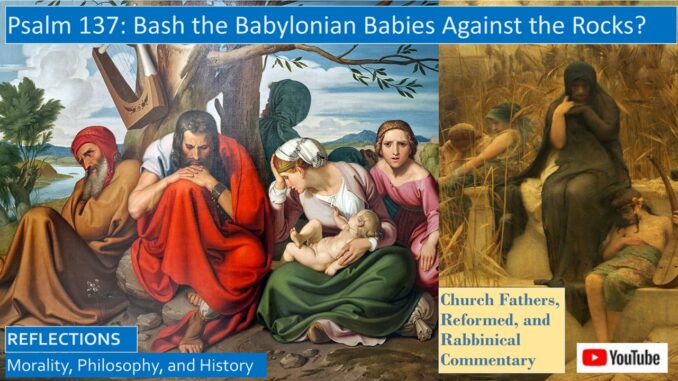
Did Psalm 137 really encourage the Jews to bash the Babylonian babies against the rocks? How can a loving God encourage this behavior?
How should Christians and Jews interpret this troublesome verse? How did the Church Fathers and Reformed Preachers, and rabbis, interpret this verse?
Can this verse be excused by the fact that the ancient world was a violent world?
How did the Babylonian Captivity of Judah differ from the Assyrian Conquest of the Ten Lost Tribes of Israel?
Book Links are in these blogs:
My Favorite Commentaries on the Psalms
https://youtu.be/kyJRf_JoGsI
https://seekingvirtueandwisdom.com/my-favorite-commentaries-on-the-psalms/
HOW SHOULD WE INTERPRET THE PSALMS?
Atheists and critics of Christianity focus on a handful of verses to prove that Christianity is a violent and cruel religion rather than a religion of love and compassion. One of the most violent verses in the Bible is the last verse of Psalm 137, where the Jews in the Babylonian Exile, in their pain, celebrate the thought that the Babylonian babies be bashed on the rocks. Sometimes these critics are evangelical Christians. Evangelicals often lift verses totally out of context to memorize and memorialize them individually. Likewise, if they become disillusioned with their Evangelical faith, they often lift problematic verses out of context to cudgel the faith they choose to abandon.
What these critics forget is that these hard verses have been pondered for millennia by Church Fathers, Reformed Preachers, and Rabbis. Why not ponder what these wise men reveal?
Timothy exhorts us: “All Scripture is God-breathed and is useful for teaching, rebuking, correcting and training in righteousness.”[1] Does this prevent us from stepping into the shoes of those ancient Jews who originally prayed this prayer? Are we allowed to vent our emotions into our prayers, or are we bound to throttle our emotions so God does not reject our prayers? Many psalms have imperfect pleadings in the middle of the psalms that are resolved by the end. But there are a few psalms, including Psalm 137, where the uncomfortable pleading is not worked out, especially when it is the last verse.
How should we interpret the Scriptures in general, and the Psalms in particular? We must first start with the core exhortation of the Judeo-Christian tradition, that we should Love God with all of our heart and soul and mind and all, and that we should love our neighbor as ourselves. All else is commentary.
Hillel and Jesus, Reflections on Rabbi Telushkin’s Observations
http://www.seekingvirtueandwisdom.com/hillel-and-jesus-reflections/
Comparing Hillel and Shammai to Jesus
http://www.seekingvirtueandwisdom.com/comparing-hillel-and-shammai-to-jesus/
More Stories and Sayings of Hillel and Shammai
http://www.seekingvirtueandwisdom.com/more-stories-and-sayings-of-hillel-and-shammai/
Jesus, Hillel, and Shammai, Loving God and Neighbor
https://youtu.be/ygxn2qqGnOI
St Augustine applies the two-fold Love of God and neighbor to interpreting the Scriptures. In his classic book On Christian Teaching, St Augustine teaches us that if the literal reading of any verse in the Old Testament appears to conflict with this two-fold Love of God and neighbor, then that verse has a deeper spiritual meaning, and must be read allegorically.
St Augustine: On Christian Teaching, aka On Christian Doctrine, How To Read Scripture
http://www.seekingvirtueandwisdom.com/st-augustine-on-christian-teaching-how-to-read-scripture/
https://youtu.be/uQCnAJMPoos
The ending verse of Psalm 137, referring to what should be done to Babylonian babies, is often interpreted spiritually and allegorically by the Church Fathers:
9 Happy shall they be who take your little ones
and dash them against the rock![2]
Origen was one of the first Church Fathers who interpreted this troublesome verse allegorically, as did St Ambrose, who catechized and baptized the young St Augustine. Origen teaches us that “the little ones of Babylon, which signifies confusion, are those troublesome sinful thoughts that arise in the soul, and one who subdues them by striking their heads against the firm and solid strength of reason and truth, is the person who ‘dashes the little ones against the stones;’ and he is therefore truly blessed.”[3] Likewise, St Ambrose comments that we should “dash all corrupt and filthy thoughts against Christ.”[4]
This is a favorite verse of the many Eastern Monastic Church Fathers who interpret it allegorically and spiritually. St John Cassian teaches us: “While the children of Babylon – by which I mean our wicked thoughts – are still young, we should dash them to the ground and crush them against the rock, which is Christ. If these thoughts grow stronger because we assent to them, we will not be able to overcome them without much pain and labor.”[5]
St Neilos teaches us: “The Psalms praise those who do not wait for the passions to grow to full strength but kill them in infancy.”[6] St Theodorus the Great Ascetic teaches us that “when assent persists, it stimulates the passion in question. Then, little by little, it leads to the actual committing of the sin. This is why the prophet calls blessed those who dash the children of Babylon against the stones.”[7] The Jewish rabbis likewise refrain from a literal interpretation.[8]
Bible verses often cannot be divorced from their context, and we must also interpret this verse in the context of the entire psalm, keeping in mind what we know about the history and archaeology of the Babylonian Exile.
Many commentators presume that this psalm was sung by the Jews after they returned from exile, but some presume that it was sung during the exile. The Baptist Broadman commentary speculates that the intensity of the emotions expressed means it must have been sung in exile in Babylon, soon after the destruction of Jerusalem,[9] as does the Orthodox Study Bible, which comments that “it is prayed by the Christian community as being in exile in this world.”[10]
Artur Weiser, who wrote the Westminster commentary, says it best: “Psalm 137 reveals the sufferings and sentiments of people who perhaps experienced at first hand the grievous days of the conquest and destruction of Jerusalem in the year 587 BC, who shared the burden of the Babylonian captivity and after their return to their homeland now, at the sight of the city still lying in ruins, give vent with passionate intensity to the feelings lying dormant in their hearts.”
Weiser continues: “The poet begins with the melancholy recollection of the time of mourning in Babylon. He once more experiences the indignation he had then felt in all its fullness as he recalls how the Babylonian rulers had hurt his most sacred religious and patriotic feelings and those of his fellow countrymen by their arrogant mockery. And, finally, he gives full rein to the wrath against his enemies which he has restrained for so long, and works himself up to a blind hate and a rage which he is no longer able to master.”[11]
HOW HARSH WAS THE ASSYRIAN CONQUEST AND CAPTIVITY?
The books of the Old Testament were compiled in a very different world. The ancient Jews and Greeks lived in a warrior culture with anxieties that differ wildly from our modern world. In the modern world, we look forward to retirement, worrying about whether Social Security will be enough to provide a comfortable retirement.
The ancient Jews and Greeks had a very different set of anxieties. They worried about whether a hostile enemy will some day capture their city-state, burn and plunder all their possessions, slaughter their military-age men, and enslave the women and children. These anxieties are explored in the Greek classic work, the Iliad, which depicts what life was like for the Greeks and Trojans during the siege of Troy during the Trojan War.
The Warrior Cultures of the Iliad and the American Indian, Bravely Visiting the Enemy Camp
http://www.seekingvirtueandwisdom.com/iliad-blog-3-visiting-the-enemy-camp-greeks-vs-indians/
https://youtu.be/ynIx-AVI2f8
Ancient Warrior Societies, Blog 1, The Warrior Ethos of Ancient Greece, Rome, and Israel
https://seekingvirtueandwisdom.com/ancient-warrior-societies-blog-1-the-warrior-ethos-of-ancient-greece/
https://youtu.be/7QAZ_s6zw4E
Ancient Warrior Societies, Blog 2, Greek and Roman Armies and Navies
https://seekingvirtueandwisdom.com/ancient-warrior-societies-blog-2-greek-and-roman-armies-and-navies/
Ancient Warrior Societies, Blog 3, World of the Old Testament
https://seekingvirtueandwisdom.com/ancient-warrior-societies-blog-3-world-of-the-old-testament/
Ancient Warfare in Ancient Greece, Rome, and Israel. Did Joshua Massacre Pagans in Promised Land?
https://youtu.be/9xKxqAbJ2qY
Ordinary Life and Justice in Ancient Athens, Rome, and Israel
http://www.seekingvirtueandwisdom.com/ordinary-life-and-justice-in-the-ancient-world/
https://youtu.be/vl8KGL5Yx2w
As background, under David and Solomon, the twelve tribes of Israel were united. After the death of Solomon, the Ten Northern Tribes of Israel rebelled against the foolish and abusive rule of his son Rehoboam, founding a competing kingdom, separating from the two Southern tribes of Judah and Benjamin.[12] These two Southern Tribes of Judah are the ancestors of today’s Jews.
What were the nitty-gritty details of the Assyrian conquest when they carried off the Ten Lost Tribes of Israel? How about the Babylonian conquest? Not only do we not know these details, we know little about how the over ninety percent of the ancient people who lived outside the city walls of any ancient city lived, as ancient writers saw no reason to compile the demographic data we have for the past millennium, especially after the invention of the printing press. All we have is archaeology, what we can dig out of the ground.
We can surmise that the Assyrians likely enslaved the members of the Ten Lost Tribes of Israel, and that they likely did not massacre a large portion of the military-age men, because if they had, surely the Old Testament would have mentioned it. The oral history speculates about the fate of the Ten Lost Tribes, but likely these Jewish slaves were distributed among households, or worked in the fields and mines in huge workcamps with horrendous mortality rates, as happened in ancient Rome. The sources I consulted do not speculate on whether there was mass enslavement, but enslavement would explain why the Ten Lost Tribes quickly faded into the sands of history. There is archaeological evidence that some Jews were settled in agricultural communities.[13] Were these settled Jews treated more like serfs, like the Helot population that supported Sparta?[14] Archaeology alone cannot answer many questions.
Unique Spartan Warrior Culture and History, Plutarch’s Life of Lycurgus, Lawgiver of Sparta
https://seekingvirtueandwisdom.com/unique-spartan-warrior-culture-and-history-plutarchs-life-of-lycurgus-lawgiver-of-sparta/
https://youtu.be/_hYwZsxmC3s
Hosea recounts that the Assyrian conquest of Israel was quite brutal, as the Assyrian army had a reputation for cruelty:[15]
Samaria shall bear her guilt,
because she has rebelled against her God;
they (the Assyrians) shall fall by the sword,
their little ones shall be dashed in pieces,
and their pregnant women ripped open.[16]
Did the Babylonian army also commit brutalities? Warfare in general, and ancient warfare in particular, is always brutal, and there are always those soldiers who relish in killing and cruelty. We also know that ancient soldiers were compensated largely by the booty that they could strip from their conquests, and often by kidnapped concubines. But we know for certain that the Babylonian armies were not nearly as brutal as were the cruel Assyrian armies.
Iliad Blog 2, Captured Concubines in the Iliad and the Torah
http://www.seekingvirtueandwisdom.com/iliad_blog02/
The Iliad, blog 4, Briseis, Chryseis, Aren’t all Concubines the Same?
http://www.seekingvirtueandwisdom.com/the-iliad-blog-4-briseis-chryseis-arent-all-concubines-the-same/
Concubines in the Iliad, Old Testament and Christian Tradition
https://youtu.be/bGHHD7XTvr0
HOW HARSH WAS THE BABYLONIAN CONQUEST AND EXILE?
The Babylonian conquest was in phases. When King Nebuchadnezzar conquered Judah in 597 BC, he only exiled seven thousand of the ruling class to Babylon. Nebuchadnezzar permitted the Judean King Jehoiakim to remain on the throne as a vassal ruler, but after he and the populace rebelled, a more thorough conquest completely subjugated the Judeans by 587 BC. Although Jerusalem was left in ruins, many other cities were left somewhat intact. During 587 – 582 BC, archaeologists estimate that a quarter of the population was exiled to Babylon. As before, primarily the ruling and religious classes, and prosperous city dwellers, were exiled.
History and archaeology agree that most, if not all, Judean exiles were settled in their own agricultural communities. Although many of the Judeans, including members of the former ruling class, were compelled to work in the fields, there is no evidence they were enslaved or enserfed, or grossly mistreated, though likely they were heavily taxed. Evidently, many Judeans eventually became merchants and tradesmen. There is not even a hint that Judeans were enslaved in the Book of Ezekiel, which was written during the period of Exile.
After the Persian King, Cyrus the Great, defeated the Babylonians, he allowed the citizens of the captive nations to return to their homelands. Many Jews returned to Judah in in four migrations from 538 – 444 BC. Many poorer Jews migrated, but many wealthier Jews remained in Babylon.[17]
Herodotus has many stories of Cyrus the Great from his youth to his career and death on the battlefield. He describes how he assembled the mighty Persian Empire though both conquest and diplomacy. In his biography of Cyrus the Great, Xenophon has an alternative account of his death. Xenophon authored the adventure story of how he led the Greek Army of Ten Thousand from the heart of the hostile Persian Empire to the Greek colonies on the shores of the Black Sea, which inspired Alexander the Great’s later conquest of Persia. The Greeks won the battle but lost the war when the rebellious Cyrus the Younger was killed in battle. Xenophon likely identified Cyrus the Younger with Cyrus the Great, and his many moral sayings of Cyrus were likely coined by Xenophon as what would correspond to their character. The final battle could have turned out differently had Cyrus the Younger had more military experience.
Herodotus, Histories of Persia, Egypt and Scythia Before the Greco-Persian Wars
http://www.seekingvirtueandwisdom.com/herodotus-histories-of-persia-egypt-and-scythia-before-the-greco-persian-wars/
https://youtu.be/YwUojwMIQEw
Xenophon’s Cyropaedia, Biography of Cyrus the Great, King of Persia
https://seekingvirtueandwisdom.com/xenophons-cyropaedia-biography-of-cyrus-the-great-king-of-persia/
https://youtu.be/E4BFSIpHHGk
Xenophon’s Cyropaedia, Moral Sayings of Cyrus the Great, King of Persia
https://seekingvirtueandwisdom.com/xenophons-cyropaedia-moral-sayings-of-cyrus-the-great-king-of-persia/
https://youtu.be/Y3ULbvPEmik
Xenophon’s Anabasis: The Persian Expedition, an Ancient Adventure Story
https://seekingvirtueandwisdom.com/xenophons-anabasis-the-persian-expedition-an-ancient-adventure-story/
https://youtu.be/DBG3JvyLP1E
COMMENTARIES ON PSALM 137
CS Lewis reminds us that the “Psalms are poems intended to be sung: they are neither doctrinal treatises, nor are they sermons.” “The Psalms must be read as poems, with all the licenses and all the formalities, the hyperboles, the emotional rather than logical connections, which are proper to lyric poetry.”[18]
Psalm 137 is titled: Lament over the Destruction of Jerusalem
1 By the rivers of Babylon
there we sat down and there we wept
when we remembered Zion.
2 On the willows there
we hung up our harps.
3 For there our captors
asked us for songs,
and our tormentors asked for mirth, saying,
“Sing us one of the songs of Zion!”[19]
The Presbyterian Pastor James Boice notes that the “Bible is filled with contrasts that lend substance and life to its teaching, and one of these is between Babylon, which stands for the world and its culture, and Jerusalem, which stands for God’s Kingdom.” This dichotomy is also seen in St Augustine’s masterpiece, the City of God.[20] St Augustine wrote: “Two cities have been formed by two loves; the earthly by the love of self, even to the contempt of God; the heavenly by the Love of God, even to the contempt of self.”[21]
Artur Weiser speculates that the Judeans “were tormented by the uncertainty whether they had been rejected by God forever, or whether they still had access to him. What the prophets of Israel had continually foretold had now come true; they felt that the hand of the living God was upon them in punishment.”[22]
Bishop Methodius interprets this verse allegorically: “We hanged our harps on the willows.” This “clearly gave the name of harps to the bodies” of the Judeans, “which they hung on the branches of chastity, hastening them to the wood that they might not be snatched away and dragged along again by the stream of incontinence. For Babylon, which is interpreted as disturbance or confusion, signifies this life around which the water flows, while we sit in the midst of the water that flows around us, as long as we are in the world, the rivers of evil always beating on us.”[23]
The Protestant Preacher Charles Spurgeon comments: “The rivers were well enough, but, alas, they were the rivers of Babylon, and the ground whereon the sons of Israel sat was foreign soil, and therefore they wept.” And for the second verse: “Better to hang their harps up than to dash them down: it is better to hang them on willows than profane them to the service of idols.”[24]
John Calvin notes: “When willows are mentioned, this denotes the pleasantness of the banks, and their coolness. But the Psalmist says that these shades, however delightful, could not dispel a grief which was too deeply seated to be consoled or refreshed.”
Calvin continues: “The worst affliction of all was that their conquerors reproachfully insulted them, and even mocked them.” Although the Babylonians meant to “wound their hearts,” they especially sought “to cast blasphemies upon their God.”[25]
Artur Weiser notes that “not every place and hour,” “not every human environment, is suitable for sounding forth God’s praise.” “The holiness of God is affected when the Lord’s song is degraded to a means of entertainment for a heathen audience.”[26]
St John Chrysostom observes how many Judeans found religion during the Babylonian Exile, which reminds us of how we often find Jesus after experiencing hardships in our lives. In summary, he teaches us that “when we are spoiled and fail to appreciate his good things, he reduces us to a state of deprivation so that we may come to our senses through the loss.”
Chrysostom continues: The Judeans, “after taking liberties and abandoning their worship, and trampling on provisions of the Law in every possible fashion, in a foreign land they adopted such observance that, despite the presence of savages threatening and hemming them in on every side and desiring to hear their songs, they did not accede to their desire, and instead gave priority to the Law and observing it diligently.”[27]
Psalm 137
4 How could we sing the Lord’s song
in a foreign land?
5 If I forget you, O Jerusalem,
let my right-hand wither!
6 Let my tongue cling to the roof of my mouth,
if I do not remember you,
if I do not set Jerusalem
above my highest joy.[28]
Rabbi Joseph Telushkin says that these verses inspired the “well-known custom of shattering a glass at the conclusion of a Jewish wedding ceremony. Since marriage is one of the happiest hours in a couple’s life, Jewish tradition mandates that a glass be shattered to remind the celebrants that the Jerusalem Temple has still not been rebuilt.”[29]
James Boice observes that in this stanza the pronouns shift “from the plural to the singular, from ‘we’ to ‘I.’ Thus, in these verses, each individual pledges his own personal loyalty to Jerusalem. Suffering may be shared; it often is. But determination to remember God and walk in his ways is something each of us must do individually. You must do it, and so must I!”[30]
Psalm 137
7 Remember, O Lord, against the Edomites
the day of Jerusalem’s fall,
how they said, “Tear it down! Tear it down!
Down to its foundations!”
8 O daughter Babylon, you devastator!
Happy shall they be who pay you back
what you have done to us!
9 Happy shall they be who take your little ones
and dash them against the rock![31]
Rabbi Joseph Telushkin observes that “the psalm’s conclusion is jolting. In the next-to-last verse, a curse is called down on ‘Babylon, you predator,’ and a ‘blessing on him who repays you in kind for what you have inflicted on us.’” Had the psalm simply ended with this call for revenge, “it would have shocked no one. But the Psalmist then adds the specific act” he desires to see, “a blessing on him who seizes your babies and dashes them against the rocks.”
Telushkin continues: “Since Jewish law forbids punishing children for their parents’ sins (Deuteronomy 24:16), this final verse violates the Torah’s ethical norms. Rather, one should regard it as the anguished, rageful cry of an impotent victim who is powerless to hurt his oppressor with deeds, and therefore discharges his rage with words. Unlike the rest of the psalm, the last verse is rarely, if ever, cited. It is the earlier verse, ‘If I forget you, O Jerusalem,’ that has made this psalm so memorable and often quoted.”[32]
Indeed, after the Second Vatican Council, these last three condemning verses were deleted from the liturgy since they were, without commentary, seemingly at odds with the Gospel message.[33]
Artur Weiser speculates that “the reason why the Psalmist calls down God’s punishment on the enemy is to show with whom the final decision rests, whether with men who blaspheme in their arrogant mockery or with God who is not mocked.”[34]
Who would be bashing the Babylonian babies against the rocks? Johannes Bugenhagen does not believe this verse refers to the Judeans. “Not long after the captivity in which Jerusalem was laid waste, Babylon was laid waste by the Medes and Persians, so that even the very young children were dashed before the eyes of the Babylonians.”[35] John Calvin agrees with this interpretation.[36]
Regarding the last verse, St John Chrysostom notes that “even if these words indicate intense anger and heavy punishment and retribution, nevertheless they are the expression of the captives’ feelings in demanding heavy retribution.” In the heat of their emotions, the “Jews let their anger extend to even such a young age.”
But “the teaching of the New Testament is not like that. Instead, we are bidden to give food and drink to our enemies, and to pray for those who abuse us.”[37]
James Boice cautions that we should not “get too self-righteous in reading this last verse.” “None of us has experienced anything like the cruelties that were inflicted on Jerusalem at the time of its fall.”[38]
The Jews are often criticized because they were not bidden to be generous with their enemies. But they lived in a brutal warrior culture: they worried whether their enemies would massacre them. But the Jews in Jesus’ time lived in a very different world: their province had been conquered by the Romans decades ago. No longer did the Jews in Jesus’ time have to worry whether conquering hostile armies would pillage, rape, murder, and enslave them and their neighbors. When Jesus exhorted them to love their enemies, the message was more readily received.
Previously, we reflected on Psalms 40, 70, and 71 for our series reflecting on aging and retirement.
Psalms 40 and 70: Deliver Both Young and Old from Suffering and Trials
https://seekingvirtueandwisdom.com/psalms-40-and-70-deliver-both-young-and-old-from-suffering-and-trials/
https://youtu.be/JbKQd6vP5qo
Psalm 71: Encouraging Us In Our Old Age
https://seekingvirtueandwisdom.com/psalm-71-encouraging-us-in-our-old-age/
https://youtu.be/NrzVItznE1E
We also have a series of reflections on the works included in the Philokalia, including St John Cassian and St Neilos, whom we quoted from.
The Philokalia, Classics by the Eastern Church Fathers, the Love of the Beautiful
https://seekingvirtueandwisdom.com/introduction-to-the-philokalia-the-love-of-the-beautiful/
https://youtu.be/rKVBhdHWHGI
The Stoic Philosopher “St Anthony” in the Appendix of the Philokalia
On the Character of Men and the Virtuous Life
http://www.seekingvirtueandwisdom.com/philokalia-on-the-character-of-men-and-the-virtuous-life/
https://youtu.be/UWqhOMkieqQ
John Cassian and the Vice of Gluttony, Blog 1
http://www.seekingvirtueandwisdom.com/john-cassian-and-the-vice-of-gluttony-blog-1/
St John Cassian on the Other Seven Vices, Blog 2
http://www.seekingvirtueandwisdom.com/st-john-cassian-on-the-other-seven-vices-blog-2/
St John Cassian, Philokalia, Link Between East and West
https://youtu.be/BDzxATWWdyY
St Neilos on Ascetic Discourses in the Philokalia
https://seekingvirtueandwisdom.com/st-neilos-on-ascetic-discourses/
https://youtu.be/-CoyNNgfza0
DISCUSSING THE SOURCES
In our quick review of the Assyrian and Babylonian conquests, we consulted Life in Biblical Israel and the updated Jesuit book on Reading the Old Testament, which are both excellent sources, though we did complement them with various Wikipedia articles. Not only do they provide more historical details, but they also have many clues on what life was like for ordinary ancient Jews.
We consulted the first two volumes of the Philokalia for commentary. We found an online resource with the complete text in a PDF file, which we used to quickly search for those Eastern Church Fathers who quoted from this psalm. Finally, last year Volume 5 of the Philokalia has been published after decades of anticipation.[39]
Psalm 137 is one of only five Psalms Rabbi Joseph Telushkin discusses in his book on Biblical Literacy. We plan more reflections on his Jewish perspective of the moral teachings of the Old Testament.
We have previously commented on my favorite commentaries on the Psalms. CS Lewis, in his Reflections on the Psalms, rephrases the teachings of the Church Fathers and commentators on Psalm 137, we highly recommend this summary. He reminds us that there are many of what he calls cursing psalms, of which Psalm 137 is the most infamous.
My Favorite Commentaries on the Psalms
https://seekingvirtueandwisdom.com/my-favorite-commentaries-on-the-psalms/
https://youtu.be/kyJRf_JoGsI
[1] https://www.biblegateway.com/passage/?search=2%20Timothy%203%3A16&version=NIV
[2] https://www.biblegateway.com/passage/?search=psalm%20137%3A9&version=NRSVCE
[3] Origen, Against Celsus 7.22, included in Psalm 137, Ancient Christian Commentary on Scripture, Old Testament Volume VII (Downers Grove, IL: Intervarsity Press, 2008), p. 380.
[4] St Ambrose, Concerning Repentance 2.11.106, included in Psalm 137, Ancient Christian Commentary on Scripture, Old Testament Volume VII, p. 380.
[5] St John Cassian, “On the Eight Vices,” In the Philokalia, The Complete Text, compiled by St Nikodimos of the Holy Mountain and St Makarios of Corinth, Vol. 1, translated and edited by GEH Palmer, Phillip Sherrard, and Kallistos Ware (London: Faber and Faber, 1979), pp. 77.
[6] St Nelios the Ascetic, “Ascetic Discourse,” in the Philokalia, The Complete Text, compiled by St Nikodimos of the Holy Mountain and St Makarios of Corinth, Volume 1, translated and edited by GEH Palmer, Phillip Sherrard, and Kallistos Ware, p 233.
[7] St Theodoros the Great Ascetic, “A Century of Spiritual Texts,” in the Philokalia, The Complete Text, compiled by St Nikodimos of the Holy Mountain and St Makarios of Corinth, Volume 2, translated and edited by GEH Palmer, Phillip Sherrard, and Kallistos Ware (London: Faber and Faber, 1981, 1984), p 18.
[8] https://www.thetorah.com/article/psalm-137-9-the-talmudic-inverse
[9] Broadman Commentary, Volume 4, Esther and Psalms (Nashville: Broadman Press, 1971), Psalm 137, p. 442.
[10] Orthodox Study Bible, Psalm 136 (137) (Dallas: Thomas Nelson, 2008), p.770.
[11] Artur Weiser, The Psalms, A Commentary, Old Testament Library, translated by Herbert Hartwell (Philadelphia, West Minister Press, 1962, 1955), Psalm 137, p. 794.
[12] https://en.wikipedia.org/wiki/Rehoboam
[13] https://en.wikipedia.org/wiki/Assyrian_captivity and Lawrence Boadt, Reading the Old Testament (New York: Paulist Press, 2012) and Phillip King and Lawrence Stager, Life in Biblical Israel (Louisville, Westminster John Knox Press, 2001).
[14] https://en.wikipedia.org/wiki/Helots
[15] https://en.wikipedia.org/wiki/Military_history_of_the_Neo-Assyrian_Empire and https://medium.com/lessons-from-history/assyrians-torture-60fabb7a9642 and Phillip King and Lawrence Stager, Life in Biblical Israel and Lawrence Boadt, Reading the Old Testament.
[16] https://www.biblegateway.com/passage/?search=hosea%2013%3A16&version=NRSVCE
[17] https://en.wikipedia.org/wiki/Nebuchadnezzar_II and https://en.wikipedia.org/wiki/Babylonian_captivity and
[18] CS Lewis, Reflections on the Psalms, included in the Beloved Works of CS Lewis (New York: Inspirational Press, 2004, 1955), Introductory, p. 134.
[19] https://www.biblegateway.com/passage/?search=psalm%20137%3A1-3&version=NRSVCE
[20] James Boice, Psalms Volume 3, Psalms 107-150 (Grand Rapids: Baker Books, 1998), Psalm 137, pp. 1186-1187.
[21] St Augustine, City of God, translated by Henry Bettenson (New York: Penguin Classics, 2003, 1972, originally early 400s), Book XIV, Chapter 28, p. 593.
[22] Artur Weiser, The Psalms, A Commentary, Old Testament Library, Psalm 137, p. 795.
[23] Methodius, Symposium or Banquet of the Ten Virgins 4.3, Psalm 137, Ancient Christian Commentary on Scripture, Old Testament Volume VII, p. 379.
[24] Charles Spurgeon, in Parallel Classic Commentary on the Psalms (Chattanooga, TN: AMG Publishers, 2005), Psalm 137, p. 728.
[25] John Calvin, in Parallel Classic Commentary on the Psalms, Psalm 137, pp. 729-731.
[26] Artur Weiser, The Psalms, A Commentary, Old Testament Library, Psalm 137, p. 795.
[27] St John Chrysostom, Commentary on the Psalms, Volume II, translated by Robert Charles Hill (Brookline, Massachusetts: Holy Cross Orthodox Press, 1998, originally late 300s AD), Psalm 137, p. 242.
[28] https://www.biblegateway.com/passage/?search=psalm%20137%3A4-6&version=NRSVCE
[29] Joseph Telushkin, Biblical Literacy (New York: William Morrow and Company, Inc., 1997), Section 125, p. 341.
[30] James Boice, Psalms Volume 3, Psalms 107-150, Psalm 137, p. 1190.
[31] https://www.biblegateway.com/passage/?search=psalm%20137%3A7-9&version=NRSVCE
[32] Joseph Telushkin, Biblical Literacy (New York: William Morrow and Company, Inc., 1997), Section 125, pp. 341-324.
[33] https://en.wikipedia.org/wiki/Psalm_137#Western_Christianity
[34] Artur Weiser, The Psalms, A Commentary, Old Testament Library, Psalm 137, p. 796.
[35] Johannes Bugenhagen, Interpretation of the Psalms, Psalm 137, Reformation Commentary on Scripture, Old Testament Volume VII (Downers Grove, IL: Intervarsity Press, 2015), p. 344.
[36] John Calvin, Interpretation of Psalm 137:9, Psalm 137, Reformation Commentary on Scripture, Old Testament Volume VII, p. 346.
[37] St John Chrysostom, Commentary on the Psalms, Volume II, Psalm 137, pp. 244-245.
[38] James Boice, Psalms Volume 3, Psalms 107-150 (Grand Rapids: Baker Books, 1998), Psalm 137, pp. 1186-1191.
[39] http://www.prudencetrue.com/images/Philokalia-Complete-Text.pdf


1 Trackback / Pingback