Psalm 137: Should We Bash the Babylonian Babies? Spiritual and Historical Interpretations
Biblical Interpretation

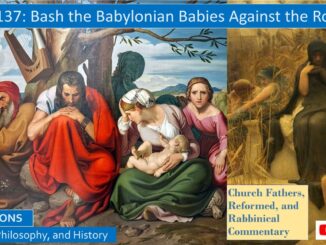
Psalm 137: Should We Bash the Babylonian Babies Against the Rocks? Spiritual and Historical Interpretations

Happy shall they be who take your little ones
and dash them against the rock!
Origen was one of the first Church Fathers who interpreted this troublesome verse allegorically, as did St Ambrose, who catechized and baptized the young St Augustine. Origen teaches us that “the little ones of Babylon, which signifies confusion, are those troublesome sinful thoughts that arise in the soul, and one who subdues them by striking their heads against the firm and solid strength of reason and truth, is the person who ‘dashes the little ones against the stones;’ and he is therefore truly blessed.”[2] Likewise, St Ambrose comments that we should “dash all corrupt and filthy thoughts against Christ.” […]

Psalm 71: Encouraging Us In Our Old Age
Biblical Interpretation

Psalm 71: Encouraging Us In Our Old Age

John Calvin speculates that David composed Psalm 71 after experiencing the trauma of losing the life of his son Absalom during his rebellion against him, which was sparked by the favoritism Davis showed towards his newly resented wife, Bathsheba. “The particular reference which David makes to his old age renders this conjecture not improbable.”
If so, this psalm should be a comfort to those who old age is lonelier due to mistakes, miscalculations or misfortunes occurring many years earlier. […]

Psalms 40 and 70: Deliver Both Young and Old from Suffering and Trials
Biblical Interpretation

Psalms 40 and 70: Deliver Both Young and Old from Suffering and Trials

St Ambrose rejoices: “Christ has heard the prayer of his own servants and has brought us out from the pit of misery and from the mire of dregs. We were drowning there; our whole flesh was clinging to the mire, trapped in the whirlpool of our sins. Our soul was powerless to save itself; fallen and ruined as it was by the multiplicity and dreadfulness of our offenses.”
St Ambrose continues: “Christ came to save us from the pit and slime of this world, from the mud and mire of this earth, from this body doomed to death.” “May that rock, which follows those who thirst, confirm the weak and unsteady; may that water never be lacking to those who long for it; and may that firm foundation never be wanting to those in danger of falling.” […]

Summary of St Augustine’s Confessions of Faith and Repentance
Morality

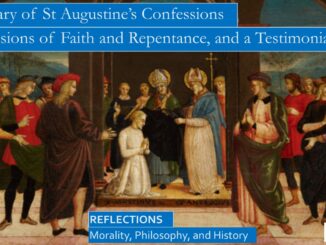
Summary of St Augustine’s Confessions of Faith and Repentance

The Confessions are both a testimonial and a prayer. St Augustine tells us how he embraced Christianity after he was active in the Manichean sect, a New Age dualistic system where good and evil competed more or less evenly, and where Jesus was totally divine without a trace of mortality. St Augustine had many of the same questions that we hear atheists and agnostics raise today, such as: How can intelligent and sophisticated men believe in superstitions about an Almighty God? How can God be Almighty when sin has such a hold in the world? What is the nature of evil? […]

St Augustine Confessions Book 10
Morality

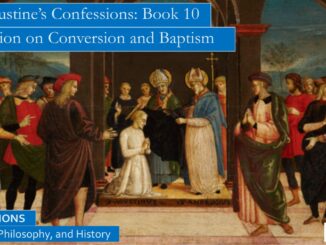
St Augustine’s Confessions: On Soul, Mind, Memory, Stoicism, Salvation, and True Happiness, Book 10

St Augustine is my favorite Catholic saint because in every major work he explicitly states that the foundation of the Christian faith is the two-fold Love of God, and love of neighbor, where we love our neighbors as ourselves. In Book 10 St Augustine prays to God that “you want us not only to Love you, but also to love our neighbor,” and he repeats this in other books of the Confessions. St Augustine prays to God: “Give me the grace to do as you command, and command me to do as you will!” […]

St Augustine’s Confessions, His Conversion, Baptism, St Monica’s Death, and Philosophy, Books 8 & 9
Morality

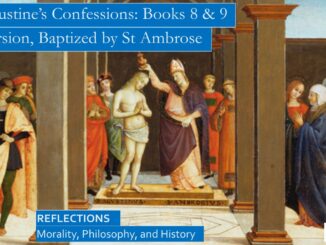
St Augustine’s Confessions, His Conversion, Baptism, St Monica’s Death, and Philosophy, Books 8 & 9

Baptism and confession in ancient Rome were very viewed much more seriously in the ancient world than they are today, as the Christian persecutions were in living memory. St Augustine was baptized in the year 387 while the former Emperor Constantine the Great started favoring Christianity in the year 312, putting to an end the vicious persecution of Christians under the preceding Emperor Diocletian, which was only seventy-five years ago.

Although the severe Diocletian persecutions were fading into history, many Christians had parents or grandparents who suffered and martyred for their Christian faith. There was a strong feeling among the Christians that they needed to be serious about baptism, that committing mortal sins after baptism could endanger their immortal soul. Constantine was baptized on his deathbed since he feared damnation for those enemies that were killed on the battlefield. Monica had delayed her son’s baptism because she was not sure he could repent of the inevitable sins teenagers with raging hormones would commit, and he declined to be baptized until he left the Manichean heresy in his middle age. Many Christians in the time of St Augustine desired to be as serious about their faith as the martyrs were about the faith that they sacrificed their life for.

This explains Augustine’s anxieties as he prepares himself for the challenge of living as perfect a Christian life as possible after his baptism. His anxiety was that he could not control his passions, a common concern in a Roman world so deeply influenced by Stoic philosophy. St Augustine tells us several conversion stories that were shared with him before his own conversion story. […]

Morality

St Augustine’s Confessions: Mother Monica, Concubine, Marriage, and Philosophy, Books 6 & 7

The Confessions were written soon after St Augustine was drafted to be the co-bishop of Hippo, near Carthage. The Confessions are not only a confession of faith and a confession of sin and sinful longings, but also a mirror into his soul, exploring his innermost motivations. The style is unique, Bishop Augustine addresses his Confessions as a prayer to God, addressing God directly, imbedding verses of Scripture and the Psalms directly into his Confessions as he writes these words on his soul. […]

Biblical Interpretation

Blessed Are the Poor, Woe to the Rich, and Other Woke Compassionate Bible Verses

Among the Church Fathers, St Ambrose teaches us,
“Blessed are the poor. Not all the poor are blessed, for poverty is neutral. The poor can be either good or evil,” unless he is the blessed pauper described by Proverbs 19:22, “’A righteous poor man is better than a rich liar.’ Blessed is the poor man in whom the prince of this world finds nothing. Blessed is the poor man who is like that poor Man who, although he was rich, became poor for our sake,” […]

History

Yves Congar, True and False Reform, Part 1, Finding Common Ground

When Archbishop Angelo Roncalli, the future Pope John XXIII, reflected on this book, he asked, “A reform of the church? Is such a thing really possible?” Yves Congar reflects, What is the role of the church? Is the church the hierarchy in the Curia; or is the church the parishioners in the pews? What are the sacraments? What is the church’s definition of commonly misunderstood concepts, such as infallibility?
This book, along with help by the Holy Spirit, encouraged the pope to call for a church council, and helped set the tone for Vatican II. As Yves Congar teaches us, spiritual reform cannot be a revolution, false reform divides rather than unites. […]