Psalm 137: Should We Bash the Babylonian Babies? Spiritual and Historical Interpretations
Biblical Interpretation

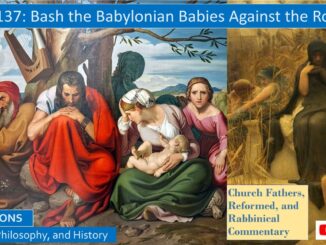
Psalm 137: Should We Bash the Babylonian Babies Against the Rocks? Spiritual and Historical Interpretations

Happy shall they be who take your little ones
and dash them against the rock!
Origen was one of the first Church Fathers who interpreted this troublesome verse allegorically, as did St Ambrose, who catechized and baptized the young St Augustine. Origen teaches us that “the little ones of Babylon, which signifies confusion, are those troublesome sinful thoughts that arise in the soul, and one who subdues them by striking their heads against the firm and solid strength of reason and truth, is the person who ‘dashes the little ones against the stones;’ and he is therefore truly blessed.”[2] Likewise, St Ambrose comments that we should “dash all corrupt and filthy thoughts against Christ.” […]

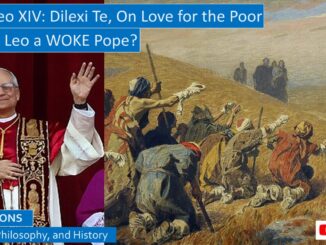
Pope Leo XIV, Dilexi Te, On Love for the Poor. Is Leo a Woke Pope?
Vatican II

Pope Leo XIV, Dilexi Te, On Love for the Poor. Is Leo a Woke Pope?

Pope Leo XIV teaches us: “Love for the Lord, then, is one with love for the poor” ““This is not a matter of mere human kindness but a revelation: contact with those who are lowly and powerless is a fundamental way of encountering the Lord of history. In the poor, he continues to speak to us.” “Care for the poor was also a great concern of St Francis of Assisi: in the person of a leper, Christ himself embraced Francis and changed his life.”
Pop Leo XIV teaches us: “By embracing poverty, he wanted to imitate Christ, who was poor, naked, and crucified. In his Rule, he asks that “the brothers should not appropriate anything, neither house, nor place, nor anything else. And as pilgrims and strangers in this world, serving the Lord in poverty and humility, they should go about begging with confidence, and should not be ashamed, because the Lord made himself poor for us in this world.” […]

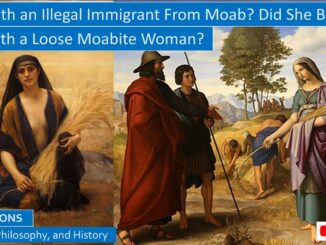
Book of Ruth: Historical-Critical Commentaries. Was Ruth an Old Testament Illegal Alien?
Bible Stories and Parables

Book of Ruth: Historical-Critical, Patristic, and Rabbinical Commentaries. Was Ruth an Old Testament Illegal Alien?

Was Ruth an Old Testament version of an illegal alien? Marriages between Jews and Moabites were definitely illegal under Jewish law, and Ruth was seen as a sojourner, which is the Biblical term for immigrant, or alien. Ancient Jews were just as suspicious of Moabites just as many Americans are suspicious of Mexicans. Ruth emigrates to Judah because of economic hardship, just as hardship drives many Mexicans to seek to enter the United States.
Is the term illegal alien a misnomer? Are illegal aliens criminals because they are doing illegal things? We can all agree that someone who robs a bank or steals a car or shoots or beats his neighbor is a criminal, but is someone who is fleeing gangs who threaten their lives a criminal? Is someone who flees grinding poverty to take his chances swimming the Rio Grande truly a criminal? […]

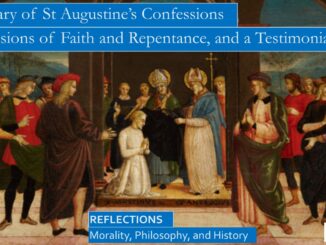
Summary of St Augustine’s Confessions of Faith and Repentance
Morality

Summary of St Augustine’s Confessions of Faith and Repentance

The Confessions are both a testimonial and a prayer. St Augustine tells us how he embraced Christianity after he was active in the Manichean sect, a New Age dualistic system where good and evil competed more or less evenly, and where Jesus was totally divine without a trace of mortality. St Augustine had many of the same questions that we hear atheists and agnostics raise today, such as: How can intelligent and sophisticated men believe in superstitions about an Almighty God? How can God be Almighty when sin has such a hold in the world? What is the nature of evil? […]

St Augustine Confessions Book 10
Morality

St Augustine’s Confessions: On Soul, Mind, Memory, Stoicism, Salvation, and True Happiness, Book 10

St Augustine is my favorite Catholic saint because in every major work he explicitly states that the foundation of the Christian faith is the two-fold Love of God, and love of neighbor, where we love our neighbors as ourselves. In Book 10 St Augustine prays to God that “you want us not only to Love you, but also to love our neighbor,” and he repeats this in other books of the Confessions. St Augustine prays to God: “Give me the grace to do as you command, and command me to do as you will!” […]

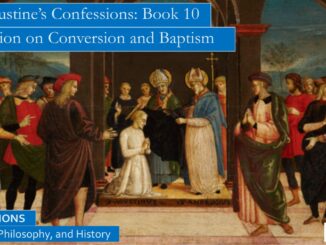
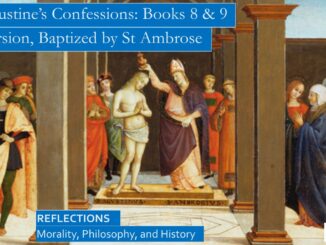
St Augustine’s Confessions, His Conversion, Baptism, St Monica’s Death, and Philosophy, Books 8 & 9
Morality

St Augustine’s Confessions, His Conversion, Baptism, St Monica’s Death, and Philosophy, Books 8 & 9

Baptism and confession in ancient Rome were very viewed much more seriously in the ancient world than they are today, as the Christian persecutions were in living memory. St Augustine was baptized in the year 387 while the former Emperor Constantine the Great started favoring Christianity in the year 312, putting to an end the vicious persecution of Christians under the preceding Emperor Diocletian, which was only seventy-five years ago.

Although the severe Diocletian persecutions were fading into history, many Christians had parents or grandparents who suffered and martyred for their Christian faith. There was a strong feeling among the Christians that they needed to be serious about baptism, that committing mortal sins after baptism could endanger their immortal soul. Constantine was baptized on his deathbed since he feared damnation for those enemies that were killed on the battlefield. Monica had delayed her son’s baptism because she was not sure he could repent of the inevitable sins teenagers with raging hormones would commit, and he declined to be baptized until he left the Manichean heresy in his middle age. Many Christians in the time of St Augustine desired to be as serious about their faith as the martyrs were about the faith that they sacrificed their life for.

This explains Augustine’s anxieties as he prepares himself for the challenge of living as perfect a Christian life as possible after his baptism. His anxiety was that he could not control his passions, a common concern in a Roman world so deeply influenced by Stoic philosophy. St Augustine tells us several conversion stories that were shared with him before his own conversion story. […]

Morality

St Augustine’s Confessions: Mother Monica, Concubine, Marriage, and Philosophy, Books 6 & 7

The Confessions were written soon after St Augustine was drafted to be the co-bishop of Hippo, near Carthage. The Confessions are not only a confession of faith and a confession of sin and sinful longings, but also a mirror into his soul, exploring his innermost motivations. The style is unique, Bishop Augustine addresses his Confessions as a prayer to God, addressing God directly, imbedding verses of Scripture and the Psalms directly into his Confessions as he writes these words on his soul. […]