Literature and Myths

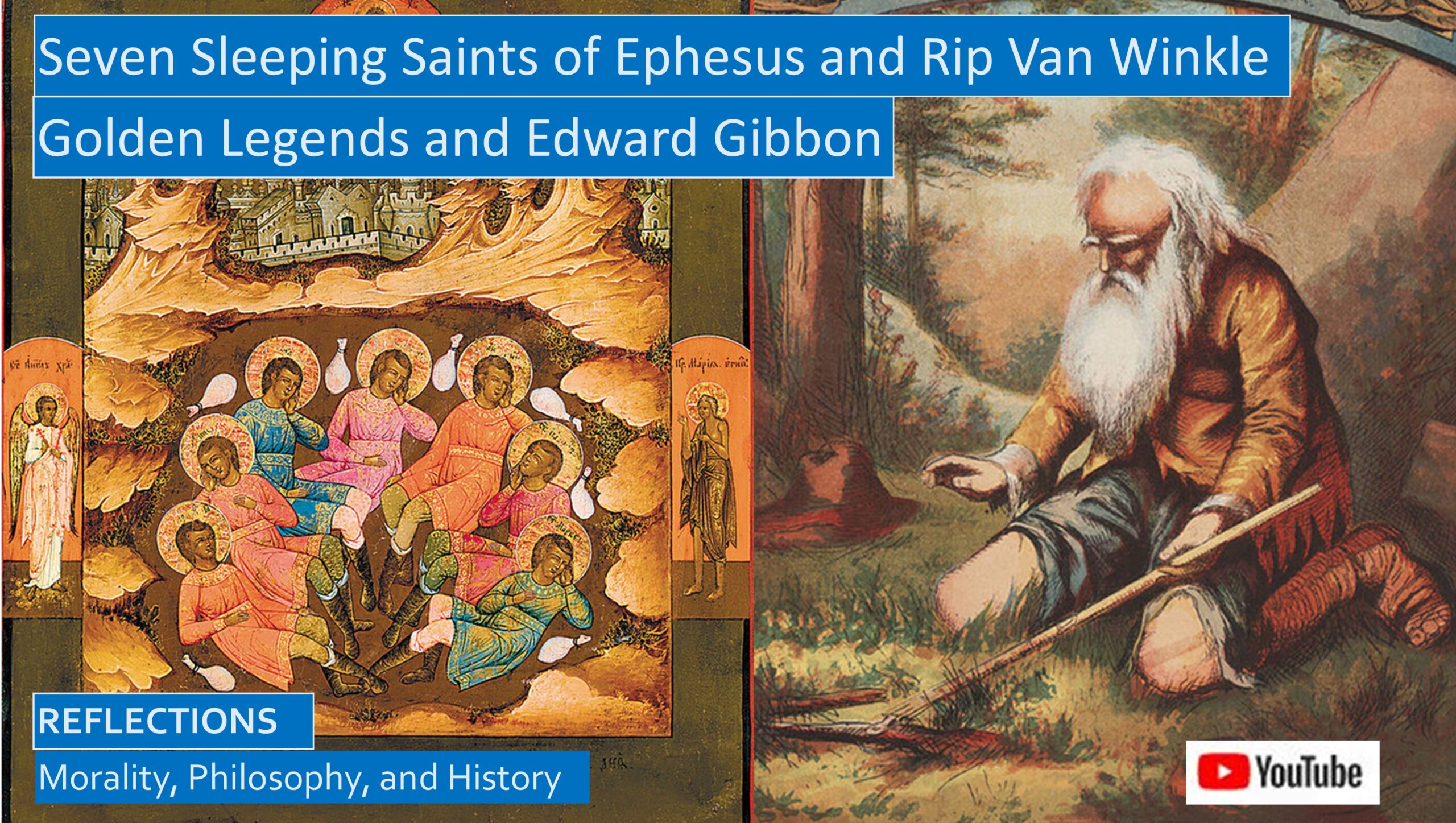
Comparing Seven Sleepers’ Saint Golden Legend to Rip Van Winkle, and Edward Gibbons’ Observations

Gibbon wonders what it would be like for eons to pass quickly by while one is asleep, especially for the “two centuries between the reigns of the pagan Decius and the Christian emperor Theodosius the Younger. During this period, the seat of government has been transported from Rome to a new city,” Constantinople, “on the banks of the Thracian Bosphorus,” with a loss of the pagan military spirit. “The throne of the persecuting Decius was filled by a succession of Christian and orthodox princes, who had extirpated the fabulous gods of antiquity. Instead, the public devotion of this new age exalted the saints and martyrs of the Catholic Church on the altars of Diana and Hercules. The union of the Roman Empire was dissolved: its genius was humbled in the dust, and armies of unknown barbarians, issuing from the frozen regions of the North, had established their victorious reign over the fairest provinces of Europe and Africa.” […]
Spiritual Proof That Jesus Lives, The Famous Hymn, He Lives in My Heart
Bible Stories and Parables

Spiritual Proof That Jesus Lives, The Famous Hymn: He Lives in My Heart

Bob De Moor, a Christian Reformed pastor, recalled an incident from many decades ago when he was a delegate to his denomination’s convention, where he was assigned to the advisory committee that evaluated which hymns should be included in their hymnal. He remembers:
“The most difficult decision, one we debated endlessly, was whether or not to advise synod to include a perennial favorite hymn, He Lives. Throughout the process, the song had been included, tossed out, reintroduced, and tossed out again. Reason? The closing line in the refrain goes like this: ‘You ask me how I know he lives? He lives within my heart.’”
Bob De Moor continues: “That line was perceived by many to be subjective, basing our belief in the resurrection on our own (subjective) experience rather than on the (objective) Word of God that clearly tells us that Jesus rose. Others argued that the hymn does not actually deny the importance of the objective truth of Scripture, but that it merely highlights the reality that the Holy Spirit also confirms the truth of the resurrection in our personal experience, or in our hearts. But, of course, the song doesn’t actually say that.” […]

Pope Leo XIV, Dilexi Te, On Love for the Poor. Is Leo a Woke Pope?
Vatican II

Pope Leo XIV, Dilexi Te, On Love for the Poor. Is Leo a Woke Pope?

Pope Leo XIV teaches us: “Love for the Lord, then, is one with love for the poor” ““This is not a matter of mere human kindness but a revelation: contact with those who are lowly and powerless is a fundamental way of encountering the Lord of history. In the poor, he continues to speak to us.” “Care for the poor was also a great concern of St Francis of Assisi: in the person of a leper, Christ himself embraced Francis and changed his life.”
Pop Leo XIV teaches us: “By embracing poverty, he wanted to imitate Christ, who was poor, naked, and crucified. In his Rule, he asks that “the brothers should not appropriate anything, neither house, nor place, nor anything else. And as pilgrims and strangers in this world, serving the Lord in poverty and humility, they should go about begging with confidence, and should not be ashamed, because the Lord made himself poor for us in this world.” […]