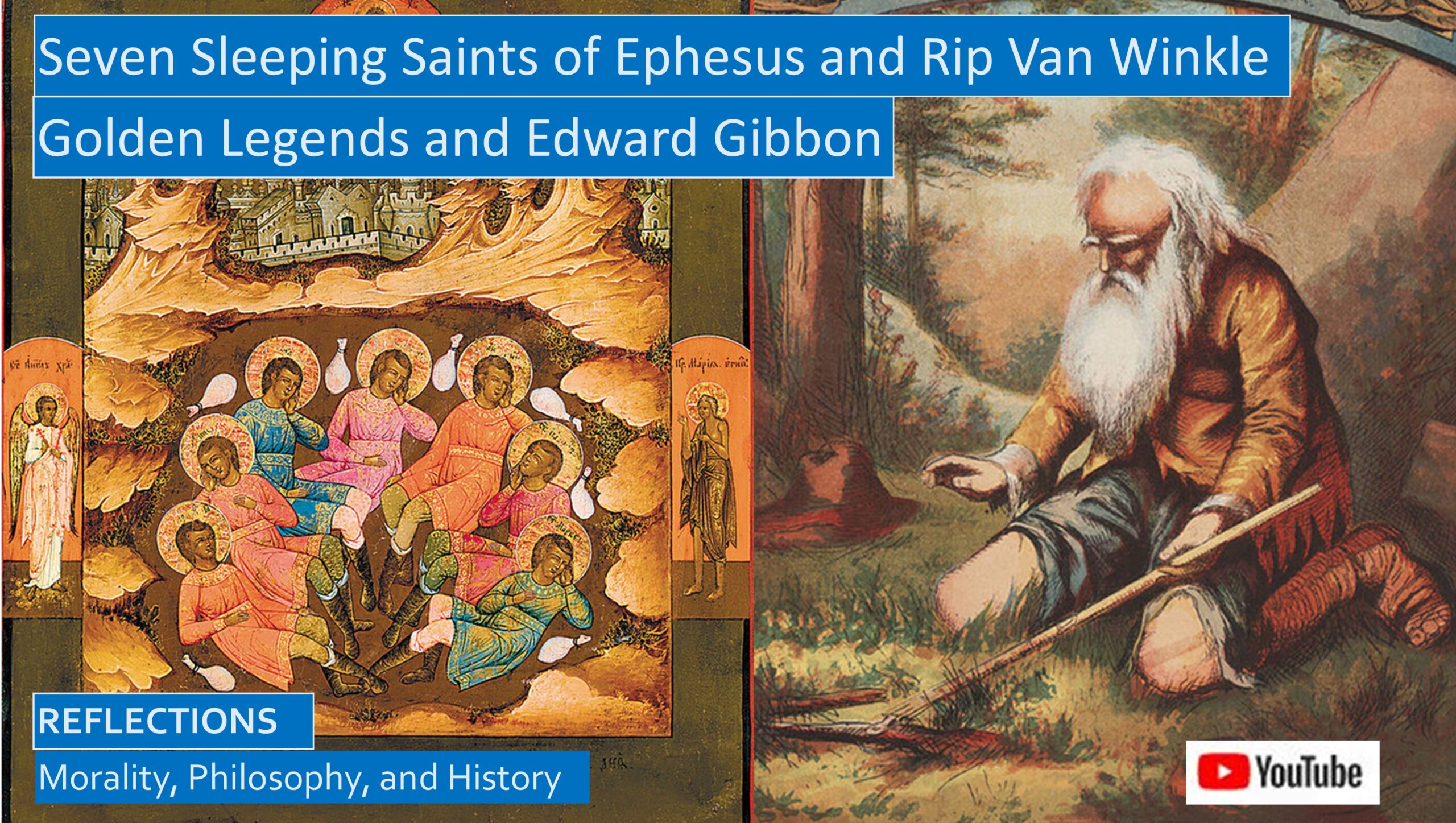
Did the story of the Seven Sleepers in the Golden Legend’s Lives of the Saints inspire Washington Irving to write his short story about another deep sleeper, Rip Van Winkle?
Why did Edward Gibbon mention the legend of the Seven Sleepers in his Decline and Fall of the Roman Empire?
Were there other stories of men who slept for decades or centuries?
What moral and spiritual lessons can be learned from the legends of the Seven Sleepers and the story of Rip Van Winkle?
YouTube video for this blog: https://youtu.be/xtJTxYchxbI
THE SEVEN SLEEPERS IN THE GOLDEN LEGENDS
We read in the Golden Legend: “When the emperor Decius came to Ephesus to persecute the Christians, he built temples there” so “all the Ephesians could join him in worshipping the idols. When he ordered that all Christians should be hunted down, put in chains, and forced either to sacrifice or be put to death, everyone was terrified.” “Friend betrayed friend, fathers disowned their sons, and sons their fathers.”
“There were seven Christians in that city, Maximianus, Malchus, Marcianus, Dionysius, Johannes, Serapion, and Constantinus, who were deeply distressed by what they witnessed. Though they were among the important palace officials, they utterly refused to sacrifice to the idols, hiding in their homes, fasting and praying.”
“They were accused and brought before Decius. There was no doubt they were Christians,” but the emperor gave them time to come to their senses. They then gave all they owned to the poor and went into hiding in a cave “on Mount Celion. There they stayed for some time, and each day one of them would dress up in rags and, pretending to be a beggar, go off to the city to obtain food.”
When Malchus went into town, he learned that the emperor had summoned them to perform sacrifices. When he told the others, they were all terrified. “As they sat down to eat, weeping and sighing as they spoke together, suddenly God willed them to fall asleep.”
The emperor was enraged when he learned that these seven Christians were hiding in Mount Celion. Decius was “prompted by God to block up the mouth of the cave with stones so they would starve to death. These orders were carried out, and two Christians” “wrote an account of their martyrdom and hid it carefully among the stones.”
But these Seven Sleepers were not martyred; they were put into a deep sleep. They slept deeply for 372 years, “when Decius and all his generation were long dead, until the thirtieth year of the Christian emperor Theodosius.”[1]
This is the wrong number of intervening years, what does it mean? Perhaps it is the 365 days of the year, plus the seven sleepers, spanning more than the four seasons. That is my speculation.
Was this the inspiration for the latter American short story by Washington Irving, Rip Van Winkle, who slept for decades, only to awaken long after the American Revolution?
EDWARD GIBBON MENTIONS THE SEVEN SLEEPERS
Why was the crusty atheist, Edward Gibbon, author of the History of the Decline and Fall of the Roman Empire, so interested in the lives of these ancient saints?
Gibbon recounts that when they awoke, one of the Seven Sleepers went into town to purchase bread. “The youth could no longer recognize the once familiar countryside. To his surprise, there was a large cross triumphantly erected over the principal gate of Ephesus. His singular dress and obsolete language confounded the baker, to whom he offered an ancient medal of Decius as the current coin of the empire.” As this raised suspicion of a hidden treasure, he “was dragged before the judge.” The townspeople were amazed that these young men escaped the rage of a pagan tyrant. The bishop of Ephesus, the clergy, the magistrates, the people, and the emperor Theodosius himself, hastened to visit the cavern of the Seven Sleepers.”
Gibbon wonders what it would be like for eons to pass quickly by while one is asleep, especially for the “two centuries between the reigns of the pagan Decius and the Christian emperor Theodosius the Younger. During this period, the seat of government has been transported from Rome to a new city,” Constantinople, “on the banks of the Thracian Bosphorus,” with a loss of the pagan military spirit. “The throne of the persecuting Decius was filled by a succession of Christian and orthodox princes, who had extirpated the fabulous gods of antiquity. Instead, the public devotion of this new age exalted the saints and martyrs of the Catholic Church on the altars of Diana and Hercules. The union of the Roman Empire was dissolved: its genius was humbled in the dust, and armies of unknown barbarians, issuing from the frozen regions of the North, had established their victorious reign over the fairest provinces of Europe and Africa.”[2]
In the Decline and Fall of the Roman Empire, Edward Gibbon reflects on the legend of the Seven Sleepers before he tells how the unarmed Pope Leo the Great bravely marched into the camp of Attila the Hun, persuading him to spare Rome from the usual sacking and plundering. Rome likely paid a generous tribute.
Pope Leo the Great, Confronting Attila the Hun, and the Fourth Ecumenical Council of Chalcedon
https://seekingvirtueandwisdom.com/pope-leo-the-great-confronting-attila-the-hun-and-his-role-in-fourth-ecumenical-council-of-chalcedon/
https://youtu.be/4XwZYxDWAtA
We also reflected on this turn of history, in the beginning of the evolution of the Mediterranean-focused Roman Empire to the numerous Christian regimes from France to Germany that arose from the splintered barbarian kingdoms.
Did Rome Fall, or Evolve Into the Barbarian Kingdoms? Sacks of Rome, and Attila the Hun’s Invasions
https://seekingvirtueandwisdom.com/did-rome-fall-or-evolve-to-barbarian-kingdoms-sack-of-rome-and-attila-the-huns-invasions/
https://youtu.be/0pVNIggTbnM
THE REST OF THE STORY FROM THE GOLDEN LEGEND
The Lord was prompted to awaken our seven youthful saints when there was a widespread heresy denying the resurrection of the dead during the reign of Emperor Theodosius.
How was the cave opened? The Golden Legend continues: “A certain citizen of Ephesus built shelters for his shepherds on Mount Celion. When the masons were opening up the cave, the saints awoke and greeted each other, thinking that they had been asleep for just one night.” Evidently, unlike Rip Van Winkle, none of their beards grew long during that centuries-long night. It was Malchus’ turn to go into town to buy bread, when he was dumbfounded. He asked himself, “How can it be that yesterday nobody dared speak the name of Christ, and today everyone seems to be a Christian? I do believe this is not Ephesus at all.” He searched the crowds for someone he knew, a sibling, a friend, an acquaintance, but they were strangers all.
The Golden Legend continues: “After giving the matter deep thought, the bishop said to the proconsul: ‘There is some miracle which God wishes to reveal to us through this young man.” After reaching the cave on Mount Celion, they found and read the martyrs’ account written so many centuries before. After reading the story, they noticed “the saints sitting in the cave, their faces as pink as roses in bloom. The people fell to the ground glorifying God, and the bishop and proconsul immediately sent word to the emperor Theodosius, asking him to come quickly and see the miracle God had just worked.”
Theodosius immediately departed from Constantinople to Ephesus, glorifying God. Upon arriving, he “climbed up to the cave. As soon as the saints saw the emperor, their faces shone like the sun; and the emperor went in and fell on his face before them, then rose, embraced them, and wept for each one of them in turn.”
“Seeing you now,” the emperor said, “I feel as if I were seeing the Lord raise Lazarus from the dead!”
St Maximianus said to him: “Believe us, it is for your sake that the Lord has raised us to life before the day of the general resurrection, so that you should have absolute faith that there is a resurrection of the dead, for we have really been raised from the dead. We are alive, and just as a baby lives in his mother’s womb and comes to no harm, so we have lain here and slept and lived on without feeling a thing.”
“Then, as everyone watched, they laid their heads on the ground, fell asleep, and obedient to the will of God, gave up the ghost.”
The belief in the physical bodily resurrection of the dead was a key Christian teaching of the early church.
At the end of the story, our medieval editor corrects the duration, noting that our seven saints slept for only 196 years.[3]
COMPARING SEVEN SLEEPERS TO RIP VAN WINKLE
Was Rip Van Winkle in Washington Irving’s short story a saint, or simply a good man? The tales of the Golden Legend were written a millennium after the lives of many of the saints it memorializes, and it preceded the founding of the American Republic by another half millennium.
Irving’s fictional narrator, Diedrich Knickerbocker, “observed that Rip Van Winkle was a simple, good-natured man, a kind neighbor, and an obedient, henpecked husband.”
Like Jesus, he was fond of children. “The children of the village shouted with joy whenever he approached. He assisted at their sports, made their playthings, taught them to fly kites and shoot marbles, and told them long stories of ghosts, witches, and Indians.”
But “the great error in Rip’s composition was an insuperable aversion to all kinds of profitable labor.” “His children, too, were as ragged and wild as if they belonged to nobody. His son Rip, an urchin begotten in his own likeness, promised to inherit the habits with the old clothes of his father.” “Rip’s sole domestic adherent was his dog Wolf, who was as much henpecked as his master, for Dame Van Winkle regarded them as companions in idleness.”
“Times grew worse and worse with Rip Van Winkle as years of matrimony rolled on; a tart temper never mellows with age, and a sharp tongue is the only edged tool that grows keener with constant use. For a long while, he used to console himself when driven from home, by frequenting a kind of perpetual club of the sages, philosophers, and other idle personages of the village which held its session on a bench before a small inn, designated by a rubicund portrait of his majesty King George the Third.”
When traipsing through the Catskills squirrel hunting, he came upon a short, stout man who called for him to assist with the carrying of a keg. They came to “a company of odd-looking personages playing at ninepins.” “What seemed particularly odd to Rip was that though these folks were evidently amusing themselves, yet they maintained the gravest faces, the most mysterious silence, and were, withal, the most melancholy party of pleasure he had ever witnessed.”
Rip found that the ale was delicious. “One taste provoked another, and he reiterated his visits to the flagon so often that at length his senses were overpowered, his eyes swam in his head, and his head gradually declined, and he fell into a deep sleep.”
But unlike the Seven Sleepers, he did not wake unchanged after snoozing for twenty years: he visibly aged during his long snooze. He started concocting in his head the excuses that might quiet his nagging wife.
Irving’s narrator continues: “He looked around for his gun, but in place of the clean well-oiled fowling piece, he found an old firelock lying by him, the barrel encrusted with rust; the lock falling off, and the stock worm eaten.” His dog Wolf was nowhere to be found. “As he arose to walk, he found himself stiff in the joints and wanting in his usual activity.” He was astonished when he saw that the gully he previously ascended now had a “mountain stream foaming down it, leaping from rock to rock.”
In the two decades he snoozed, Rip Van Winkle had missed the world-changing events of the American Revolution. The village had changed. “A troop of strange children ran at his heels, hooting after him and pointing at his grey beard.” “The very village was altered; it was larger and more populous. There were rows of houses he had never seen before.” His own former house had gone into decay, with its roof caved in, doors off their hinges, windows shattered. He was henpecked no longer, as his wife had passed away, but his son looked as he did when he last went squirrel hunting. His daughter remembered him, and he met his granddaughter.
Just as in the Ephesus of the Seven Sleepers, this sleepy town had changed during his twenty-year snooze. Rip’s old inn was likewise gone, but near where it once stood was a hotel, with a flagpole “fluttering a flag with a singular assemblage of stars and stripes, which was strange and incomprehensible.” But in place of the “ruby face of King George under which he had smoked so many a peaceful pipe” was a figure for which “the red coat was changed for one of blue and buff; a sword was held in the hand instead of a scepter; the head was decorated with a cocked hat, and underneath was printed in large characters: GEORGE WASHINGTON.”
The moral of the story differs from the Seven Sleeper Saints of the Golden Legend. Irving’s narrator closes with what is the “common wish of all henpecked husbands in the neighborhood, that they might have a quieting draught out of Rip Van Winkle’s flagon.”[4]
The Mystagogy Orthodox website also has an interesting page on the Seven Sleepers and the history it describes.[5]
DISCUSSING THE SOURCES
The earliest manuscripts of the Seven Sleepers date from between the fifth and sixth centuries. The earliest is found in the writings of a Syriac bishop, which was derived from an earlier lost Greek manuscript. Gregory of Tours also has an account of this legend. Including the version in the Golden Legend, in subsequent centuries there were over two hundred manuscripts in nine medieval languages of the Seven Sleepers legend.[6]
Washington Irving was inspired after reminiscing with his brother-in-law. He locked himself in his room all night writing the tale of Rip Van Winkle. Dr Wikipedia speculates that the most likely inspiration was Johann Karl Christoph Nachtigal’s German folktale Peter Klaus, set in a German village, in which a goatherd likewise drinks wine from strangers in the wood, waking twenty years later.[7] The Koran also has a version of this legend.[8]
Washington Irving is a master word crafter. In future reflections, we may read from his essays on Indians, Christmas, rural churches, and of course, for Halloween, his other masterpiece on the headless horseman in the Legend of Sleepy Hollow. Listen how he describes the evening mists of the Catskills that set the mood for Rip Van Winkle’s misadventures:
Washington Irving writes: “When the weather is fair and settled, the Catskills are clothed in blue and purple, and print their bold outlines on the clear evening sky; but sometimes, when the rest of the landscape is cloudless, they will gather a hood of grey vapors about their summits, which, in the last rays of the setting sun, will glow and light up like a crown of glory.”[9]
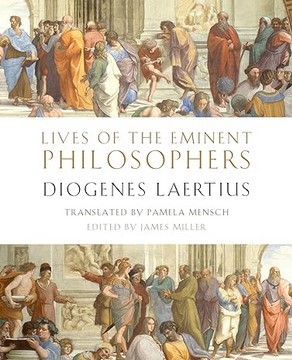
A similar story is told by Diogenes of Laërtius about Epimenides, who fell asleep in a cave for 57 years while looking for his father’s sheep. According to Diogenes, Various sources differ on how long he lived: one source says 154 years, another 157 years, and yet another, 299 years. He was a seer, and Diogenes reports that he halted a pestilence, which is usually accomplished by sacrificing to the gods.[10]
We learn again that just because two stories told centuries apart may have similar plot points does not necessarily mean that one inspired the other. For example, in the ancient ribald Italian novel the Golden Ass, the protagonist is a man who turns into a donkey when his magical spell backfires.
Metamorphosis of Apuleius, the Golden Ass, Possible Inspiration for Pinocchio
https://seekingvirtueandwisdom.com/metamorphosis-of-apuleius-the-golden-ass-possible-inspiration-for-pinocchio/
https://youtu.be/PZuFkxhfOaI
But this story is very different from the original Pinocchio story, just as different as the legend of the Seven Sleepers is from the Rip Van Winkle short story. Whereas the Golden Ass is an entertaining ribald story, the Pinocchio story is a moral story of sin, confession, and redemption.
The Original Pinocchio, Deeply Repentant, Unlike the Disney and Jordan Peterson Pinocchio
https://seekingvirtueandwisdom.com/the-original-pinocchio-deeply-repentant-unlike-the-disney-and-jordan-peterson-pinocchio/
https://youtu.be/SsnZamvvhdw
We have book reviews of the Golden Legend and other lives of the saints.
Book Reviews: Golden Legend, Butler’s, OCA, and Pope Benedict XVI’s Lives of Saints
https://seekingvirtueandwisdom.com/book-reviews-golden-legend-oca-and-butlers-lives-of-the-saints/
https://youtu.be/RFUeBLPMyqI
[1] Jacobus De Voragine, The Seven Sleepers of Ephesus, translated by Christopher Stace, included in The Golden Legend (New York: Penguin Classics, 1998, originally 1266), pp. 178-179.
[2] Edward Gibbon, The History of the Decline and Fall of the Roman Empire, abridged by David Womersley, (New York: Penguin Books, 2000, originally 1776), Chapters XXIX-XXXIII, pp. 362-364.
[3] Jacobus De Voragine, The Seven Sleepers of Ephesus, included in The Golden Legend, pp. 179-182.
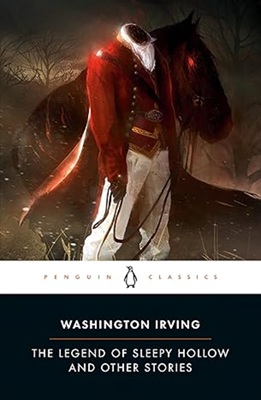
[4] Washington Irving, Rip Van Winkle, included in The Legend of Sleepy Hollow and Other Stories (New York: Penguin Classics, 2014, 1978, originally 1819), pp. 33-47.
[5] https://www.johnsanidopoulos.com/search?q=seven+sleepers
[6] https://en.wikipedia.org/wiki/Seven_Sleepers
[7] https://en.wikipedia.org/wiki/Rip_Van_Winkle
[8] https://en.wikipedia.org/wiki/Seven_Sleepers
[9] Washington Irving, Rip Van Winkle, included in The Legend of Sleepy Hollow and Other Stories, p. 33.
[10] Diogenes, “Lives of Eminent Philosophers,” translated by Pamela Mensch, (New York: Oxford University Press, 2018, originally 200s), Epimenides, Book 1.107-110, pp. 52-54.


Be the first to comment