Literature and Myths

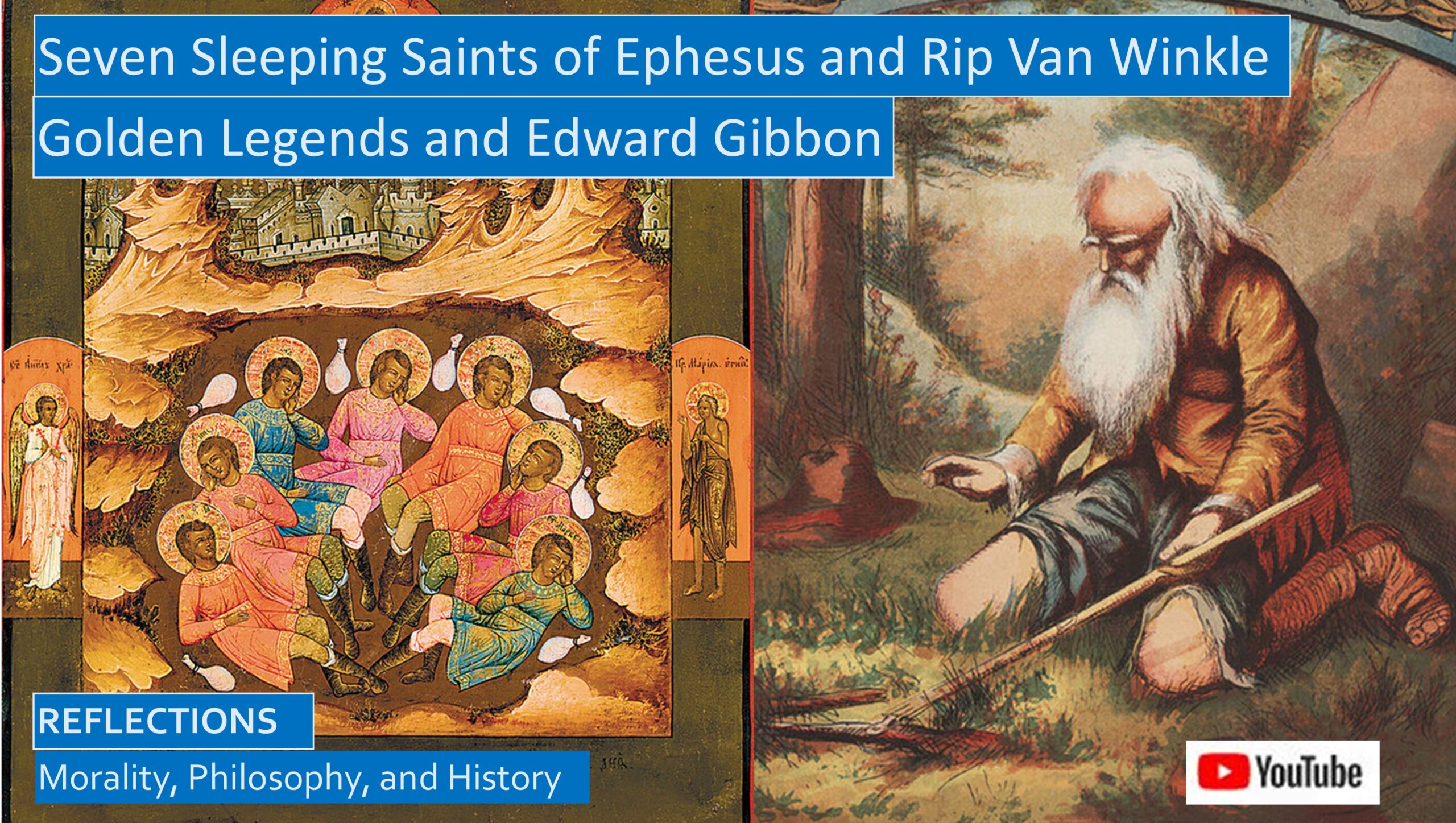
Comparing Seven Sleepers’ Saint Golden Legend to Rip Van Winkle, and Edward Gibbons’ Observations

Gibbon wonders what it would be like for eons to pass quickly by while one is asleep, especially for the “two centuries between the reigns of the pagan Decius and the Christian emperor Theodosius the Younger. During this period, the seat of government has been transported from Rome to a new city,” Constantinople, “on the banks of the Thracian Bosphorus,” with a loss of the pagan military spirit. “The throne of the persecuting Decius was filled by a succession of Christian and orthodox princes, who had extirpated the fabulous gods of antiquity. Instead, the public devotion of this new age exalted the saints and martyrs of the Catholic Church on the altars of Diana and Hercules. The union of the Roman Empire was dissolved: its genius was humbled in the dust, and armies of unknown barbarians, issuing from the frozen regions of the North, had established their victorious reign over the fairest provinces of Europe and Africa.” […]
Spiritual Proof That Jesus Lives, The Famous Hymn, He Lives in My Heart
Bible Stories and Parables

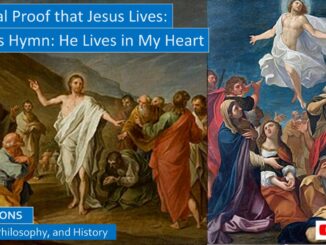
Spiritual Proof That Jesus Lives, The Famous Hymn: He Lives in My Heart

Bob De Moor, a Christian Reformed pastor, recalled an incident from many decades ago when he was a delegate to his denomination’s convention, where he was assigned to the advisory committee that evaluated which hymns should be included in their hymnal. He remembers:
“The most difficult decision, one we debated endlessly, was whether or not to advise synod to include a perennial favorite hymn, He Lives. Throughout the process, the song had been included, tossed out, reintroduced, and tossed out again. Reason? The closing line in the refrain goes like this: ‘You ask me how I know he lives? He lives within my heart.’”
Bob De Moor continues: “That line was perceived by many to be subjective, basing our belief in the resurrection on our own (subjective) experience rather than on the (objective) Word of God that clearly tells us that Jesus rose. Others argued that the hymn does not actually deny the importance of the objective truth of Scripture, but that it merely highlights the reality that the Holy Spirit also confirms the truth of the resurrection in our personal experience, or in our hearts. But, of course, the song doesn’t actually say that.” […]

Summary of St Augustine’s Confessions of Faith and Repentance
Morality

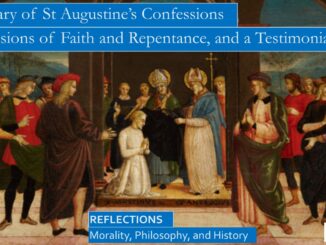
Summary of St Augustine’s Confessions of Faith and Repentance

The Confessions are both a testimonial and a prayer. St Augustine tells us how he embraced Christianity after he was active in the Manichean sect, a New Age dualistic system where good and evil competed more or less evenly, and where Jesus was totally divine without a trace of mortality. St Augustine had many of the same questions that we hear atheists and agnostics raise today, such as: How can intelligent and sophisticated men believe in superstitions about an Almighty God? How can God be Almighty when sin has such a hold in the world? What is the nature of evil? […]

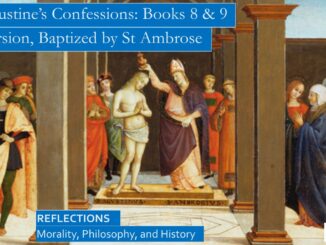
St Augustine’s Confessions, His Conversion, Baptism, St Monica’s Death, and Philosophy, Books 8 & 9
Morality

St Augustine’s Confessions, His Conversion, Baptism, St Monica’s Death, and Philosophy, Books 8 & 9

Baptism and confession in ancient Rome were very viewed much more seriously in the ancient world than they are today, as the Christian persecutions were in living memory. St Augustine was baptized in the year 387 while the former Emperor Constantine the Great started favoring Christianity in the year 312, putting to an end the vicious persecution of Christians under the preceding Emperor Diocletian, which was only seventy-five years ago.

Although the severe Diocletian persecutions were fading into history, many Christians had parents or grandparents who suffered and martyred for their Christian faith. There was a strong feeling among the Christians that they needed to be serious about baptism, that committing mortal sins after baptism could endanger their immortal soul. Constantine was baptized on his deathbed since he feared damnation for those enemies that were killed on the battlefield. Monica had delayed her son’s baptism because she was not sure he could repent of the inevitable sins teenagers with raging hormones would commit, and he declined to be baptized until he left the Manichean heresy in his middle age. Many Christians in the time of St Augustine desired to be as serious about their faith as the martyrs were about the faith that they sacrificed their life for.

This explains Augustine’s anxieties as he prepares himself for the challenge of living as perfect a Christian life as possible after his baptism. His anxiety was that he could not control his passions, a common concern in a Roman world so deeply influenced by Stoic philosophy. St Augustine tells us several conversion stories that were shared with him before his own conversion story. […]

Biblical Interpretation

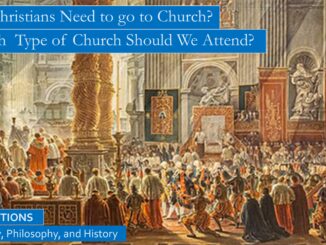
Do Christians Need To Go To Church? Which Type of Church Should You Attend?

St Augustine’s memorable reflection on our question appear in his Confessions, which is really one of the first testimonials. St Augustine tells us the story of Victorinus, a philosopher who studies the Gospels and the Church Fathers but declines to attend services, asking “Do the walls of the Church make you a Christian?” Victorinus was a learned man, an erudite pagan Platonic philosopher, the Word of the Lord spoke directly to him from the page, perhaps he felt intellectually superior to many simple Christians he knew.

In the words of St Augustine, in his studies Victorinus became “resolute, he was seized by the fear that Christ might deny him before the holy angels if he was too faint-hearted to acknowledge Christ before men, and he felt himself guilty of a great crime in being ashamed of the sacraments instituted by the Word of God in his lowly state.” […]