
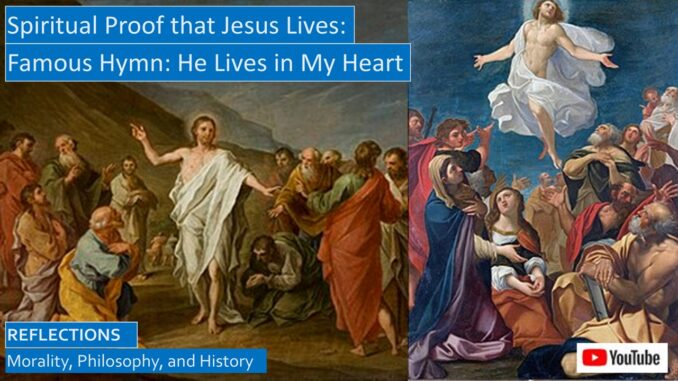
How can we truly know Jesus lives? How can we prove to ourselves that Jesus lives? Perhaps the famous hymn that we sang this past Easter, He Lives, answers our anxieties:
CHORUS: He lives, He lives, Christ Jesus lives today!
He walks with me and talks with me along life’s narrow way.
He lives, He lives, salvation to impart!
You ask me how I know He lives?
He lives within my heart.[1]
YouTube video for this blog: https://youtu.be/qa3geXkZvzY
Is Christianity as easy as this declaration, or must it be more difficult? Whether Christianity is hard or easy is a question CS Lewis ponders at the conclusion of his masterpiece, Mere Christianity. Is Christianity hard? Or easy? CS Lewis’ answer is: categorically, YES, Christianity is both.
CS Lewis’ Mere Christianity: Is Living the Christian Life Hard or Easy?, Book 4
https://seekingvirtueandwisdom.com/cs-lewis-mere-christianity-is-christianity-easy-or-hard/
https://youtu.be/jZuWmInLh7s
He Lives was the most famous of the three thousand hymns composed by BD Ackley, who lived from 1872 to 1958. He was the organ-master for several churches and played several other instruments. He wrote hymns for Rodeheaver Publishers, and toured the country holding revivals with Billy Sunday, a famous evangelist.[2] Ackley wrote the hymn in reaction to the question “Why should I worship a dead Jew?”[3]
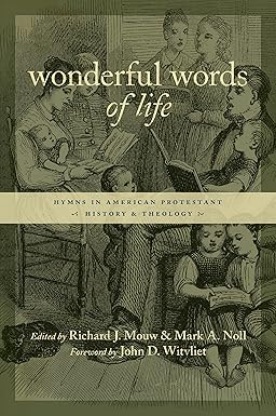
Today, there is little controversy about which hymns are sung in most Protestant or Catholic churches. But in the aftermath of the American Great Awakening revivals lasting from before the American Revolution through the Civil War era, there was heated discussion in various denominations about what hymns would be sung in church. The conservatives in the Reformation traditions imitated their founders, including Charles Wesley and Martin Luther, who appealed to the Scriptures in their hymns. But the later hymns in the Romantic tradition often appealed to the emotions.
Some decades ago, Susan Bauer suggested to her conservative Presbyterian campus music director that they include this hymn in their program. She recalls that he was deeply shocked: “I certainly hope that is not the basis of your faith! That is not how you know Christ has risen! We have the testimony of eyewitnesses in the Scriptures! We have the changed experience of the disciples! To say that you just know he lives within your heart is to appeal to experience. That can lead you straight to liberal heresy!”
In the Seventies, the mainline Protestants were considered conservative, whereas today the evangelicals are recognized as the true conservatives. Emotional religious experiences define evangelicalism, especially charismatic evangelicalism. But thirty years ago, Michael Horton explained: “Pietism, a reaction against Reformation orthodoxy, represented a turn inward, from God to self. Instead of focusing on God and his saving work in Christ, it shifted the focus to me and my personal relationship with Jesus.”[4]
Bob De Moor, a Christian Reformed pastor, recalled an incident from many decades ago when he was a delegate to his denomination’s convention, where he was assigned to the advisory committee that evaluated which hymns should be included in their hymnal. He remembers:
“The most difficult decision, one we debated endlessly, was whether or not to advise synod to include a perennial favorite hymn, He Lives. Throughout the process, the song had been included, tossed out, reintroduced, and tossed out again. Reason? The closing line in the refrain goes like this: ‘You ask me how I know he lives? He lives within my heart.’”
Bob De Moor continues: “That line was perceived by many to be subjective, basing our belief in the resurrection on our own (subjective) experience rather than on the (objective) Word of God that clearly tells us that Jesus rose. Others argued that the hymn does not actually deny the importance of the objective truth of Scripture, but that it merely highlights the reality that the Holy Spirit also confirms the truth of the resurrection in our personal experience, or in our hearts. But, of course, the song doesn’t actually say that.”
When there was a floor discussion on the decision to reject this hymn, an elderly delegate took the microphone and gently asked: “Mister chairman, before we ditch this song, can we at least sing it?” The chair shrugged his shoulders and said, “Why not?”
The organist led the delegates “in such a thrilling, soul-stirring singing of He Lives that it nearly brought down the thousand ceiling lights in Calvin College’s Fine Arts Center.” Few protested when the delegates overwhelmingly voted to have this favorite hymn live on in their hymnal.
As Paster De Moor concludes: “As long as the Holy Spirit still finds ways through and around our due process, I have hope for our church.” “May those among us who have ears to hear, hear. And may the rest of us receive the grace to listen to them.[5]
Another recent hymn is another favorite written by the Catholic priest Father Peter Scholtes in the Sixties:[6]
“We are one in the Spirit, we are one in the Lord
We are one in the Spirit, we are one in the Lord
And we pray that our unity will one day be restored
And they’ll know we are Christians by our love, by our love
Yeah, they’ll know we are Christians by our love.”
“We will work with each other, we will work side by side
We will work with each other, we will work side by side
And we’ll guard each man’s dignity and save each man’s pride
And they’ll know we are Christians by our love, by our love
Yeah, they’ll know we are Christians by our love.”
What is wrong with appealing to the emotions in our hymns? Martin Luther understood how ordinary Christians needed hymns to teach them the faith, and he wrote many classical Protestant hymns.
How do we know Jesus lives in our heart? When we Love God with all of our heart and soul and mind, and love our neighbor as ourselves. That is the core teaching of both Christianity and Judaism. And love is an emotion.
Hillel and Jesus, Reflections on Rabbi Telushkin’s Observations
http://www.seekingvirtueandwisdom.com/hillel-and-jesus-reflections/
Comparing Hillel and Shammai to Jesus
http://www.seekingvirtueandwisdom.com/comparing-hillel-and-shammai-to-jesus/
More Stories and Sayings of Hillel and Shammai
http://www.seekingvirtueandwisdom.com/more-stories-and-sayings-of-hillel-and-shammai/
Jesus, Hillel, and Shammai, Loving God and Neighbor
https://youtu.be/ygxn2qqGnOI
PONDERING THE STANZAS OF THE HYMN, HE LIVES
I serve a risen Savior
He’s in the world today.
I know that He is living,
Whatever men may say.
I see His hand of mercy;
I hear His voice of cheer;
And just the time I need Him
He’s always near.
In all the world around me
I see His loving care,
And though my heart grows weary,
I never will despair;
I know that He is leading,
Through all the stormy blast;
The day of His appearing
Will come at last.[7]
Is the psalmist promising us that, if we believe in Jesus, our lives will always be cheerful, or if he is singing that, even in our darkest hour, Christ’s voice of cheer will always grant us hope? We can draw inspiration from CS Lewis’ Mere Christianity, which was derived from a series of BBC radio discussions of Christianity that encouraged the British public to persevere in the dark days of the struggle against Nazism. This same message was relayed in Viktor Frankl’s book, Man’s Search for Meaning, which revealed how those prisoners motivated by love and service were more likely to survive the concentration camps. Martin Luther King’s Letter from a Birmingham Jail and his I Have a Dream speech likewise encouraged the Christians in the Civil Rights Movement of the Sixties.
Facing the Nazi Menace: CS Lewis’ Mere Christianity and Viktor Frankl’s Memoirs on Auschwitz, Books 1-4
https://seekingvirtueandwisdom.com/facing-the-nazi-menace-cs-lewis-mere-christianity-and-viktor-frankls-mans-search-for-meaning/
https://youtu.be/x-9FeH9Gyng
Viktor Frankl, Man’s Search For Meaning, His Life in a Nazi Concentration Camp in WWII
http://www.seekingvirtueandwisdom.com/viktor-frankl-mans-search-for-meaning-his-life-in-a-nazi-concentration-camp-in-wwii/
https://youtu.be/O-YtC9qGWPI
Comparing MLK’s Letter from Birmingham Jail with Hannah Arendt’s Banality of Evil in Nazi Germany
http://www.seekingvirtueandwisdom.com/comparing-martin-luther-kings-letter-from-the-birmingham-jail-with-hannah-arendts-the-banality-of-evil/
https://youtu.be/PqFAUEXbi8k
Martin Luther King, I Have a Dream Speech, March on Washington DC, Biography Chapter 8
https://seekingvirtueandwisdom.com/martin-luther-king-i-have-a-dream-speech-march-on-washington-dc-biography-chapter-8/
https://youtu.be/IJ64y3nQA4Q
Should our worries and anxieties rule our life? Or should the two-fold Love of God and neighbor rule our life instead?
Jesus can comfort us if we open our hearts, as we read in Matthew: “Look at the birds of the air; they neither sow nor reap nor gather into barns, and yet your heavenly Father feeds them. Are you not of more value than they? And can any of you, by worrying, add a single hour to your span of life? And why do you worry about clothing? Consider the lilies of the field, how they grow; they neither toil nor spin, yet I tell you, even Solomon in all his glory was not clothed like one of these. But if God so clothes the grass of the field, which is alive today and tomorrow is thrown into the oven, will he not much more clothe you—you of little faith?”
“Therefore, do not worry, saying, ‘What will we eat?’ or ‘What will we drink?’ or ‘What will we wear?’ For it is the Gentiles who strive for all these things; and indeed your heavenly Father knows that you need all these things. But strive first for the kingdom of God and his righteousness, and all these things will be given to you as well.”[8]
This hymn concludes:
Rejoice, rejoice, O Christian,
Lift up your voice and sing
Eternal hallelujahs
To Jesus Christ the King!
The Hope of all who seek Him,
The Help of all who find,
None other is so loving,
So good and kind.[9]
In his essay on interpreting the Psalms, CS Lewis reminds us that the Psalms are poetry, and should not be judged too harshly for their technical theological content. The same is true for the many hymns we sing during our church services. We only caution that many of the Reformation-era hymns contain anti-Catholic polemics.
YOUTUBE
PROBABLE REFERENCES TO NEW TESTAMENT VERSES
Dr Wikipedia lists these two New Testament verses as the probable inspiration for the hymn, He Lives:
Galatians 2:19-20:
“For through the law, I died to the law, so that I might live to God. I have been crucified with Christ; and it is no longer I who live, but it is Christ who lives in me. And the life I now live in the flesh I live by faith in the Son of God, who loved me and gave himself for me.”[10]
Marius Victorinus asks, in his commentary on Galatians, whether St Paul was dead to the Jewish law? Can the Christian say, “I am dead through the law of Christ to the law formerly given to the Jews?” Perhaps St Paul is echoing Jesus, perhaps he is referring to the old carnal law of the Old Testament, whereas the law invigorated by Christ is the spiritual law. Victorinus wonders: “Am I dead to the carnal law because I understand the law spiritually, so that I live for God.”[11]
What does it mean that Christ lives in me? St Ambrose teaches us that those of us who accept the gift of Jesus as the “living bread, which comes from heaven, there lives wisdom, there lives righteousness, there lives the resurrection.”[12]
Martin Luther emphasizes that the letter of the law killleth, but the spirit gives life.
“St Paul is referring to a twofold law. One is the law of spirit and of faith, by which we live for God once our sins have been paid for and the law has been fulfilled. The other is the law of the letter and of works, by which people live for sin because it has not been fulfilled, even though they pretend that it has.”
“The law provokes a hatred for itself, but faith gives us a love for the law. The person who does the works of the law hates it. Inwardly, he wants one thing, but outwardly, he pretends that he wants something quite different. The spirit of faith keeps the law and installs a love for it. The person who has this spirit fulfills the law in the best way possible way, even though it appears on the surface that he is struggling with his sins. It is through the law of faith, therefore, that St Paul lives for God in his spirit.”[13]
Ephesians 3:16-17
I pray that, according to the riches of his glory, he may grant that you may be strengthened in your inner being with power through his Spirit, and that Christ may dwell in your hearts through faith, as you are being rooted and grounded in love.[14]
John Calvin teaches us: “The highest perfection of the godly in this life is an earnest desire on their part to grow in their faith. St Paul says this is a work of the Holy Spirit,” not from “merely human strength. Just as the beginning of all good things comes from the Holy Spirit, so too does progress in them.”
“The fruit of Christ’s indwelling is love. This is the true and substantial virtue of the soul.” “Many are touched by love, but it soon fades away because is lacks deep roots. St Paul wants it to be fixed in our minds, so that it resembles a deeply rooted tree. We ought to be so thoroughly grounded in love that nothing can shake us.”[15]
DISCUSSING THE SOURCES
We reflected on several sources referenced by Dr Wikipedia’s entry on the hymn, He Lives. He referenced a wonderful collection of essays on the history of famous Protestant hymns by various professors, Wonderful Words of Life.
We also consulted the Ancient Christian Commentary and the Reformed Commentary on Scriptures. We quoted from the works of Victorinus, who was a Roman grammarian, rhetorician, and Neoplatonic philosopher. He translated at least two of Aristotle’s books into Latin, St Jerome was one of his students.
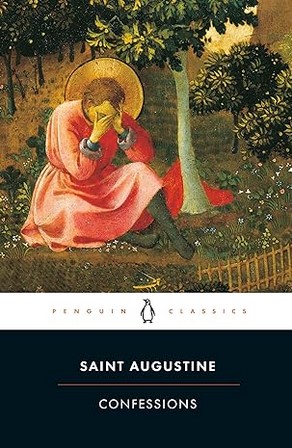
St Augustine, in his Confessions, tells us how Victorinus formally converted to Christianity late in his life:[16] “Victorinus had read the Holy Scriptures, and made the most painstaking and careful study of all Christian literature. Privately, between friends, though never in public, he used to say to Simplicianus, ‘I want you to know that I’m now a Christian.’ Simplicianus replied, ‘I shall not believe it or count you as a Christian until I see you in the Church of Christ.’ At this, Victorinus would laugh and say, ‘Is it then the walls of the church that make the Christian?’”
St Augustine continues, “But later on, as a result of his attentive reading, he became resolute. He was seized by the fear that Christ might deny him before the holy angels if he was too faint-hearted to acknowledge Christ before men, and he felt himself guilty of a great crime in being ashamed of the sacraments instituted by Your Word in his lowly state.”[17]
Victorinus came to realize that the walls do indeed make the church.
St Augustine’s Confessions, His Conversion, Baptism, St Monica’s Death, and Philosophy, Books 8 & 9
https://seekingvirtueandwisdom.com/st-augustines-confessions-his-conversion-baptism-st-monicas-death-and-philosophy-books-8-9/
https://youtu.be/Vijtjxm3Ta0
[1] https://www.hymnal.net/en/hymn/h/503
[2] https://en.wikipedia.org/wiki/B._D._Ackley
[3] https://en.wikipedia.org/wiki/He_Lives
[4] Susan Wise Bauer, Protestant Hymns, Narrative Theology, and Heresy, included in Wonderful Words of Life (Grand Rapids, Michigan, Wm D Eerdmans Publishing, 2004), pp. 205-207. She quotes from papers written by Michael Horton with the Alliance of Confessing Evangelicals.
[5] https://www.thebanner.org/departments/2015/01/he-lives-within-my-heart
[6] https://en.wikipedia.org/wiki/They%27ll_Know_We_Are_Christians
[7] https://www.hymnal.net/en/hymn/h/503
[8] https://www.biblegateway.com/passage/?search=matthew%206%3A25-33&version=NRSVCE
[9] https://www.hymnal.net/en/hymn/h/503
[10] https://www.biblegateway.com/passage/?search=Galatians%202%3A19-20&version=NRSVCE
[11] Marius Victorinus, Epistle to the Galatians 1.2.19, included in Ancient Christian Commentary on Scripture, New Testament Volume VIII (Downers Grove, IL: Intervarsity Press, 1999), p. 32.
[12] St Ambrose, On Paradise 76, included in Ancient Christian Commentary on Scripture, New Testament Volume VIII, p. 32.
[13] Martin Luther, First Lecture on Galatians, included in Reformation Commentary on Scripture, New Testament Volume X (Downers Grove, IL: Intervarsity Press, 2011), p. 77.
[14] https://www.biblegateway.com/passage/?search=Ephesians%203%3A16-17&version=NRSVCE
[15] John Calvin, Commentary on Ephesians, included in Reformation Commentary on Scripture, New Testament Volume X (Downers Grove, IL: Intervarsity Press, 2011), p. 321.
[16] https://en.wikipedia.org/wiki/Gaius_Marius_Victorinus
[17] St Augustine, Confessions, translated by RS Pine-Coffin (New York: Dorset Press, 1986, 1961, originally 400 AD), Book 7, Chapter 2, pp. 159-161.

1 Trackback / Pingback