Literature and Myths

Comparing Seven Sleepers’ Saint Golden Legend to Rip Van Winkle, and Edward Gibbons’ Observations

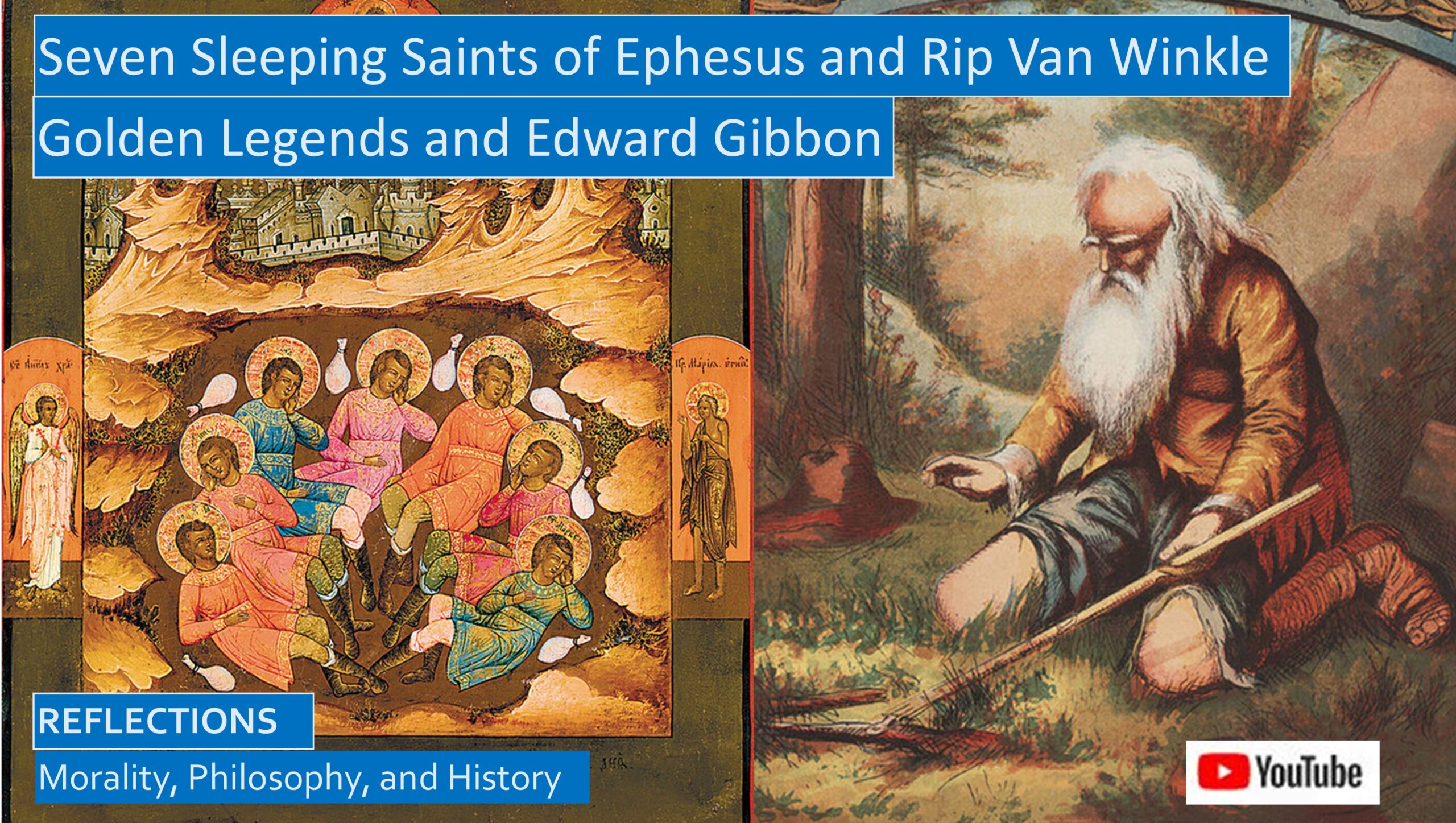
Gibbon wonders what it would be like for eons to pass quickly by while one is asleep, especially for the “two centuries between the reigns of the pagan Decius and the Christian emperor Theodosius the Younger. During this period, the seat of government has been transported from Rome to a new city,” Constantinople, “on the banks of the Thracian Bosphorus,” with a loss of the pagan military spirit. “The throne of the persecuting Decius was filled by a succession of Christian and orthodox princes, who had extirpated the fabulous gods of antiquity. Instead, the public devotion of this new age exalted the saints and martyrs of the Catholic Church on the altars of Diana and Hercules. The union of the Roman Empire was dissolved: its genius was humbled in the dust, and armies of unknown barbarians, issuing from the frozen regions of the North, had established their victorious reign over the fairest provinces of Europe and Africa.” […]
Spiritual Proof That Jesus Lives, The Famous Hymn, He Lives in My Heart
Bible Stories and Parables

Spiritual Proof That Jesus Lives, The Famous Hymn: He Lives in My Heart

Bob De Moor, a Christian Reformed pastor, recalled an incident from many decades ago when he was a delegate to his denomination’s convention, where he was assigned to the advisory committee that evaluated which hymns should be included in their hymnal. He remembers:
“The most difficult decision, one we debated endlessly, was whether or not to advise synod to include a perennial favorite hymn, He Lives. Throughout the process, the song had been included, tossed out, reintroduced, and tossed out again. Reason? The closing line in the refrain goes like this: ‘You ask me how I know he lives? He lives within my heart.’”
Bob De Moor continues: “That line was perceived by many to be subjective, basing our belief in the resurrection on our own (subjective) experience rather than on the (objective) Word of God that clearly tells us that Jesus rose. Others argued that the hymn does not actually deny the importance of the objective truth of Scripture, but that it merely highlights the reality that the Holy Spirit also confirms the truth of the resurrection in our personal experience, or in our hearts. But, of course, the song doesn’t actually say that.” […]

Paul Tournier, Christian Psychologist on Marriage and Widows in Old Age and Retirement
Aging

Paul Tournier, Christian Psychologist on Marriage and Widows in Old Age and Retirement

What is the ideal, according to Paul Tournier? “Growing old together, husband and wife can come to know a love which is, in a way, a prefiguration of heaven, for it is less tumultuous than the love of youth, being less directed towards selfish pleasure-seeking, and because a slow advance in mutual comprehension permits more authentic communication.” […]

Epictetus, Eminent Roman Stoic Philosopher, on Living Well, Dying Well, and Opposing Suicide
Aging

Epictetus, Eminent Roman Stoic Philosopher, on Living Well, Dying Well, and Opposing Suicide

Is it wise to complain? Epictetus observes: “If someone dies young, he blames the gods because he is being taken before his time. If someone lingers on into extreme old age, he too blames the gods.” “Despite this, at the approach of death, he wants to stay alive; he sends for the doctors and begs him to do all he can.” “It is quite remarkable to see how people want neither to live nor to die.”
“Is health good and illness bad? No, man. What, then? Health managed well is good, but when badly managed, it is bad.”
Epictetus points out: “If you look at yourself in isolation, it is natural for you to live to an old age, to be rich, to be healthy. But if you look at yourself as a human being and as part of some whole, for the sake of that whole, it may be appropriate for you to be ill, or risk your life at sea, or be poor, or die young. Why get angry then?” “What is a human being? A part of a city made up of gods and human beings,” “a small copy of the universal city.” […]

Classical Christian Psychologist Paul Tournier on Old Age, Death, and Faith
Aging

Classical Christian Psychologist Paul Tournier on Old Age, Death, and Faith

Tournier reminds us that we may experience many successes, but as we grow older, “success retreats, and escapes us, it is limited, unfulfilled.” “When one comes to the end, a man’s life is nothing much.” “Professional life is over, and it finishes unfinished. This is a prefiguration of death, in which the whole of life will finish it, too, being unfinished. That is the dramatic contradiction of death.” Quoting Robert Mehl: “An end, but not a fulfilment, that is the face of death.” […]

Eugenics Under Jim Crow America and Nazi Germany: Sterilization, Euthanasia, Lynchings, and Holocaust
Civil Rights

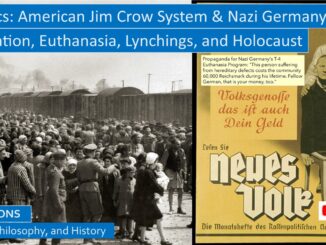
Eugenics and Scientific Racism in the Jim Crow Deep South and Nazi Germany

Was there a similar Final Solution in America? True, there were no gas chambers in the Deep South, nor was there a similar system of systematic mass murder, but there were riots such as the Tulsa Riots where the homes, businesses, and churches of thousands of blacks were torched and looted, and many blacks were injured and murdered. In these riots, mostly occurring in many cities during the interwar years, on rare occasions when there were police arrests, they arrested the black victims who fought back. The major difference is that the Nazis murdered far more people much quicker, and their regime lasted only a decade, as opposed to the seventy-year reign of Jim Crow racism in America. […]

Summary of Mere Christianity, WWII Ecumenical Broadcast: Morality, Not Polemics
CS Lewis

Summary of CS Lewis’ Mere Christianity, WWII Ecumenical Broadcast: Morality Not Polemics

Many scholars speculate on whether CS Lewis was inspired by the writings of Richard Baxter, a Puritan and prolific author who first coined the phrase “Mere Christianity.” Baxter lived during the intense religious struggle in the late 1600’s, a century after Henry VIII split from the Catholic Church to form the Anglican Church. Baxter was appointed to the royal chaplaincy, but he left his post after the passage of the Act of Uniformity in 1662, which required that all pastors exclusively use the Book of Common Prayer and be ordained as Anglican ministers. Baxter was reluctant to adopt a denomination, proclaiming that “I am a Christian, a MEER CHRISTIAN, of no other religion,” and “I am against all sects and dividing parties.” He did not want to identify either with Catholics, or Anglicans, or Presbyterians. […]

Preparing the Way for Vatican II: CS Lewis' Mere Christianity
CS Lewis

Preparing the Way for Vatican II: CS Lewis’ Mere Christianity

CS Lewis did not wave the flag of ecumenicism, attending this conference or that on interfaith dialogues, but instead prepares the way, saying that what denominational creed you profess is less important than whether you truly believe the core Christian teaching of the two-fold Love of God and neighbor. This was the key change wrought by Vatican II, no longer did the Catholic Church believe you needed to be Catholic to be saved. Likewise, CS Lewis is against the notion that Catholics cannot be saved. […]

Facing the Nazi Menace: CS Lewis' Mere Christianity and Viktor Frankl's Man's Search for Meaning
CS Lewis

Facing the Nazi Menace: CS Lewis’ Mere Christianity and Viktor Frankl’s Man’s Search for Meaning

Mere Christianity was compiled from a series of radio addresses by CS Lewis explaining the tenets of Christianity which were broadcast during the dark days of World War II, when Londoners fled to the safety of the underground subway tunnels while Nazi bombers destroyed their homes above. We will reflect on the many instances where CS Lewis referred often to this monumental struggle, one of the rare political struggles that actually pitted the forces of good and evil against each other, in Mere Christianity. […]

Modern Stoic Philosophers: My Favorite Maxims: Viktor Frankl, Nelson Mandela, and Others
Philosophy

Modern Stoic Philosophers: My Favorite Maxims: Viktor Frankl, Nelson Mandela, and Others

Why don’t the Roman Stoics discuss justice as much as Plato? In the direct Radical Democracy of Athens, the citizens served on the juries and passed the laws, which meant that ordinary citizens participated in rendering justice. This is why Socrates sought to educate ordinary citizens on justice. But in the Roman Empire, the totalitarian Emperors and their servants were responsible for the administration of justice, the ordinary citizens no longer directly influenced the administration of justice. But that is not the case in modern America and most democracies, many ordinary citizens serve on juries and vote for many political officials, local and national. Justice should be our concern.
You can make a strong argument that Stoicism, like Judaism and Christianity, is founded on the two-fold Love of God and neighbor, that you should Love God with all your heart and all your soul and all your mind and all your strength and love your neighbor as yourself. Plus, we have the St Maximus the Confessor corollary, that we should be eager to forgive our neighbor. […]