Literature and Myths

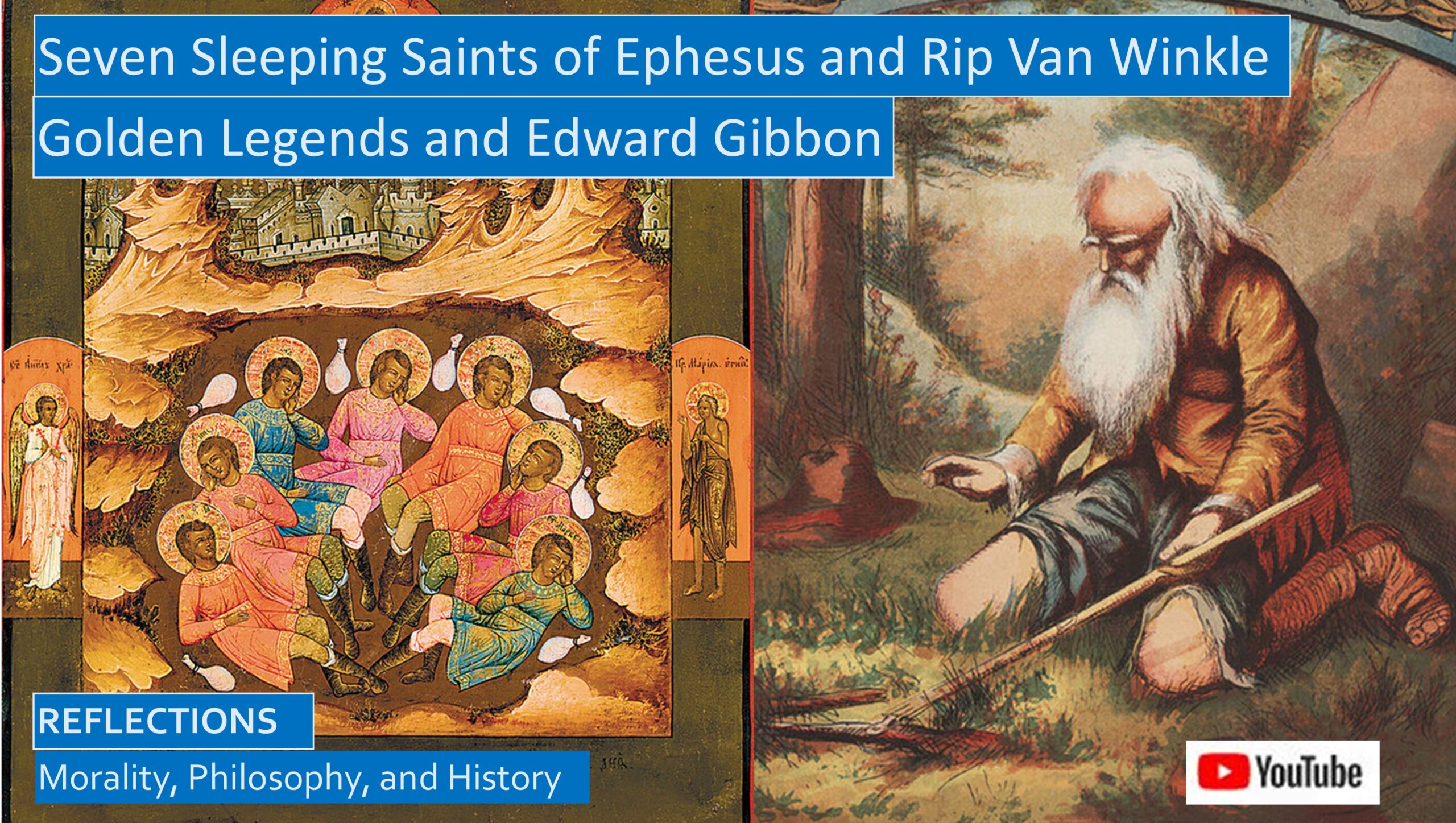
Comparing Seven Sleepers’ Saint Golden Legend to Rip Van Winkle, and Edward Gibbons’ Observations

Gibbon wonders what it would be like for eons to pass quickly by while one is asleep, especially for the “two centuries between the reigns of the pagan Decius and the Christian emperor Theodosius the Younger. During this period, the seat of government has been transported from Rome to a new city,” Constantinople, “on the banks of the Thracian Bosphorus,” with a loss of the pagan military spirit. “The throne of the persecuting Decius was filled by a succession of Christian and orthodox princes, who had extirpated the fabulous gods of antiquity. Instead, the public devotion of this new age exalted the saints and martyrs of the Catholic Church on the altars of Diana and Hercules. The union of the Roman Empire was dissolved: its genius was humbled in the dust, and armies of unknown barbarians, issuing from the frozen regions of the North, had established their victorious reign over the fairest provinces of Europe and Africa.” […]
Spiritual Proof That Jesus Lives, The Famous Hymn, He Lives in My Heart
Bible Stories and Parables

Spiritual Proof That Jesus Lives, The Famous Hymn: He Lives in My Heart

Bob De Moor, a Christian Reformed pastor, recalled an incident from many decades ago when he was a delegate to his denomination’s convention, where he was assigned to the advisory committee that evaluated which hymns should be included in their hymnal. He remembers:
“The most difficult decision, one we debated endlessly, was whether or not to advise synod to include a perennial favorite hymn, He Lives. Throughout the process, the song had been included, tossed out, reintroduced, and tossed out again. Reason? The closing line in the refrain goes like this: ‘You ask me how I know he lives? He lives within my heart.’”
Bob De Moor continues: “That line was perceived by many to be subjective, basing our belief in the resurrection on our own (subjective) experience rather than on the (objective) Word of God that clearly tells us that Jesus rose. Others argued that the hymn does not actually deny the importance of the objective truth of Scripture, but that it merely highlights the reality that the Holy Spirit also confirms the truth of the resurrection in our personal experience, or in our hearts. But, of course, the song doesn’t actually say that.” […]

Was St Paul a Former Slave
Biblical Interpretation

Was St Paul a Former Slave? Were His Parents Enslaved by the Romans?

Our authors in Christianity Today note that several prominent Biblical scholars in past 150 years have speculated that Paul’s parents were enslaved, perhaps in “the uprising in 4 BC, when Varus, Roman governor of Syria, burned entire cities and crucified 2,000 people. In Galilean cities like Sepphoris, Josephus wrote in Antiquities of the Jews, ‘troops made its inhabitants slaves.’” Furthermore, in St Jerome’s commentary on Philemon, written around the end of the fourth century, likely using Origen’s commentary as a source, states St Paul’s parents were Gischala in Judea, and were among the Jews exiled to Tarsus by the Romans. A few centuries later, St Photius, the scholarly bishop of Constantinople, confirms this, adding that St Paul was born to enslaved parents in Tarsus. These ancient sources are highly regarded by modern scholars. […]

History

Slaves in the Ancient World, Blog 1, Were Slaves the Employees of the Ancient World?

We are tempted to view slavery as something that went away with the Civil War, that with regards to slavery the modern world is so morally superior to the ancient world. The truth is that there were no employees in the ancient world, that slaves in the ancient worlds did the work that employees are hired to do in today’s world.

To understand the role of slaves in the ancient world we have a totally distorted picture when we only focus on the moral wrong of owning another person, treating servants like talking draft animals. The other aspect of slavery is paying someone such low wages that they cannot feed their family with dignity, that they feel like they live forever on the edge of the abyss, where the slightest crisis could force them to live in the streets. Someone who earns starvation wages is very much a modern-day slave. […]

Early Church Writing

Epistles of St Ignatius to the Romans and Polycarp

Repeatedly St Ignatius begs the Romans not to seek a pardon to prevent his martyrdom. He writes his rhapsody, “in the fullness of life I am yearning for death with all the passion of a lover. Earthly longings have been crucified; in me there is left no spark of desire for mundane things, but only a murmur of living water that whispers within me, ‘Come to the Father’. There is no pleasure for me in any meats that perish, or in the delights of this life; I am fain for the bread of God, even the flesh of Jesus Christ, who is the seed of David; and for my drink I crave that Blood of His which is Love imperishable.” “I am His wheat, ground fine by the lion’s teeth to be made purest bread for Christ.” […]

Early Church Writing

St Ignatius Epistles to the Ephesians, Magnesians, and Smyrnaeans

The early writings of St Ignatius of Antioch gave the early church a shining example of martyrdom. He was arrested by the authorities for his faith, like St Paul, and was being escorted to Rome to be fed to the wild animals in the arena. During the stops in his journey he received delegations from the various churches who received epistles from him to be read to their flocks. In his epistles to the churches St Ignatius insists that there be unity in the churches, that the members respect the bishops. He also tells them that a liturgy or sacrament that is not blessed by the bishop is not valid, that the faithful should be loyal and obedient to their bishop. These epistles were revered by the early church and were quoted often by the church fathers. […]