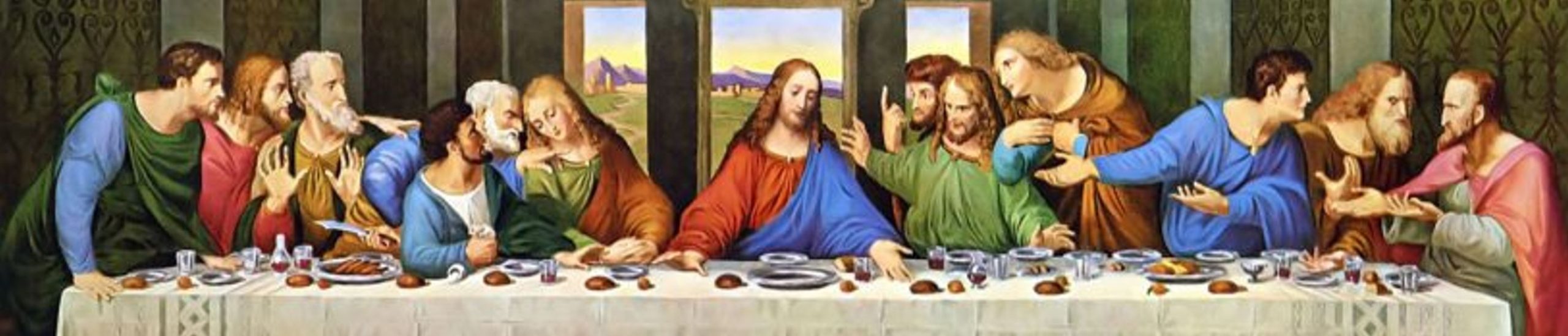
The Hymn Inspired by John I AM the Bread of Life
Bible Stories and Parables

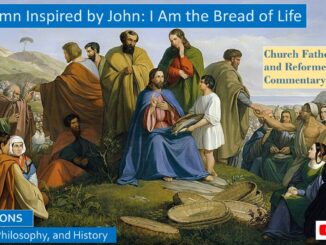
The Hymn inspired by John, I Am the Bread of Life, with Commentary by Church Fathers and Reformed Preachers

John Chrysostom teaches us: “Jesus calls this the true bread, not because the miracle of the manna was false, but because it was a type and not the very truth itself.” “After Jesus says, ‘Moses did not give,’ he does not say, ‘I give,’ but says that the Father, and not Moses, gives.”
“When they heard this, the people replied: ‘Give us this bread to eat.’ They still thought it was something material, and they yet expected to satisfy their appetites, and so they quickly ran to him. What does Christ do? Leading them on little by little, he says, ‘The bread of God is he who comes down from heaven and gives life to the world.’” […]

Psalm 137: Should We Bash the Babylonian Babies? Spiritual and Historical Interpretations
Biblical Interpretation

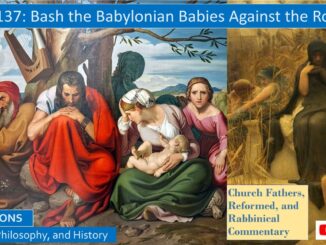
Psalm 137: Should We Bash the Babylonian Babies Against the Rocks? Spiritual and Historical Interpretations

Happy shall they be who take your little ones
and dash them against the rock!
Origen was one of the first Church Fathers who interpreted this troublesome verse allegorically, as did St Ambrose, who catechized and baptized the young St Augustine. Origen teaches us that “the little ones of Babylon, which signifies confusion, are those troublesome sinful thoughts that arise in the soul, and one who subdues them by striking their heads against the firm and solid strength of reason and truth, is the person who ‘dashes the little ones against the stones;’ and he is therefore truly blessed.”[2] Likewise, St Ambrose comments that we should “dash all corrupt and filthy thoughts against Christ.” […]

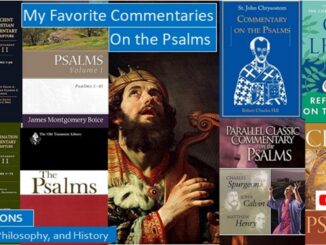
My Favorite Commentaries on the Psalms
Book Reviews and Miscellaneous

My Favorite Commentaries on the Psalms

One excellent example of reading the Bible allegorically is the verse in Psalm 137 where the Jews are encouraged to bash the brains of Babylonian babies against the rocks. The Church Fathers equate these babies with our small sins, that we should strive to be perfect, even as our Heavenly Father is perfect, bashing both our large and small sins.
We must remember that the Psalms are poetry, and Hebrew poets are like poets in any language, they sometimes use obscure words for better rhythm. This means the Psalms pose more translation problems than most of the books in the Bible. If you cannot make sense of a passage, it may be that scholars are not quite sure what the original passage meant. […]

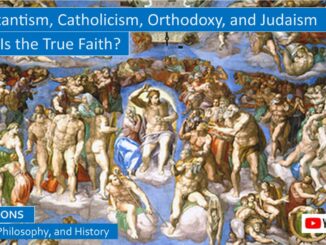
Protestantism, Catholicism, Orthodoxy, and Judaism: Which Is True
christianity

Protestantism, Catholicism, Orthodoxy, and Judaism: Which Is True?

We agree with CS Lewis when, in his Preface to Mere Christianity, he states that “the reader should be warned that I offer no help to anyone who is hesitating between two Christian denominations. You will not learn from me whether you ought to become an Anglican, a Methodist, a Presbyterian, or a Roman Catholic.” CS Lewis compares his Mere Christianity to a central hall opening up to many rooms, representative of the various denominations, saying that this hall is a place to wait while you try the different doors.
CS Lewis continues: “There is no mystery of my own position. I am a very ordinary layman of the Church of England, not especially high, nor especially low, nor especially anything else.” […]

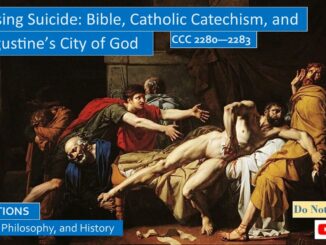
Opposing Suicide: According to the Bible, Catholic Catechism, and St Augustine’s City of God
Command 6 Do Not Murder

Opposing Suicide: Biblical Exhortations, Catholic Catechism, and St Augustine’s City of God

CCC 2281. “Suicide contradicts the natural inclination of the human being to preserve and perpetuate his life. It is gravely contrary to the just love of self. It likewise offends love of neighbor because it unjustly breaks the ties of solidarity with family, nation, and other human societies to which we continue to have obligations. Suicide is contrary to love for the living God.” […]

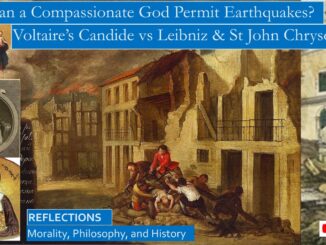
St John Chrysostom, Voltaire, and Leibniz Ask: Why Would a Loving God Permit Earthquakes?
Early Church Writing

St John Chrysostom, Voltaire, and Leibniz Ask: Why Would a Loving God Permit Earthquakes?

Theodicy is the term that Gottfried Leibniz coined in 1710 to describe this so-called problem of how an Almighty God permits suffering in the world.[1] The famed textual critic Bart Ehrman describes how he lost his faith over his concern about Theodicy in his book, On God’s Problem: Why We Suffer. As he points out, different books of the Bible answer this question differently. Many of the prophets, like St John Chrysostom, proclaim that natural disasters are often punishment meted out because we do not take care of the widows, orphans, and the poor.
On the other hand, in the Book of Job God does not give a reason for Job’s suffering, instead asking if Job can fathom the purposes of any of God’s inscrutable actions. why God permits the actions of God.  Although I often do not agree with Bart Ehrman’s conclusions, I rarely disagree with the evidence he cites in his works. Another recent best seller is by Rabbi Harold Kushner: When Bad Things Happen to Good People. We plan to reflect on both these works sometime in 2025. […]

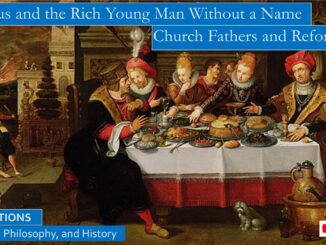
Parable of Lazarus and the Rich Man: Church Fathers, Reformers, and Commentators
Bible Stories and Parables

Parable of Lazarus and the Rich Man: Church Fathers, Reformers, and Commentators

James Boice teaches us: “It is true that the rich man’s riches worked to his hurt, for he lived for those and nothing else. It is hard for the rich to enter heaven, as Jesus said elsewhere in Luke. It is also true that Lazarus’ poverty worked to his spiritual good, for lacking earthly joys and comfort he turned his eyes to heaven and sought divine consolation.”
James Boice remarks on the contrasts in the parable. Spiritually, “the rich man was actually poor, and the poor man was actually rich. This contrast continues after their death: the poor rich man grew poorer, and the rich poor man grew richer.” “The final contrast is between the hopelessness of the rich man’s condition after death and the hopefulness of his condition before. After death there is no possibility of change, but in this life there is.” […]

St John Chrysostom On Reading Scriptures, Preaching, and Chariot Races
Eastern Church Fathers

St John Chrysostom On Reading Scriptures, Preaching, and Chariot Races

“What are you saying, man? That attending to the Scriptures is not for you, since you are surrounded by a multitude of cares? Rather it is for you more than them. Monks do not need the help of the divine Scriptures as much as those who are involved in many occupations. The monks, who are released from the clamor of the marketplace and have fixed their huts in the wilderness, who own nothing in common with anyone, but practice wisdom in the calm of that quiet life, as if resting in a harbor, enjoy great security; but we, as if tossing in the midst of the sea, driven by a multitude of sins the continuous aid of the Scriptures.” […]

St John Chrysostom: Lazarus and the Rich Man: When Are the Poor Unworthy? On Wealth and Poverty
Bible Stories and Parables

St John Chrysostom: Lazarus and the Rich Man: When Are the Poor Unworthy? On Wealth and Poverty

St John Chrysostom entreats us: “The poor man has one plea:” “Do not require anything else from him; but even if he is the most wicked of all men and is at a loss for his necessary sustenance, let us free him from hunger.”
“Christ also commands us to do this, when He said, ‘Be like your Father in heaven, for He makes His sun rise on both the evil and the good, and sends rain on the just and on the unjust.’ The alms giver is a harbor those in necessity:” “whether they are bad or good or whatever they are who are in danger.”
A virtuous almsgiver is not a judge. “Charity is charity when we give it even to the unworthy.” “Need alone is the poor man’s worthiness.” “For if we investigate the worthiness of our fellow servants, God will do the same for us.” […]

St Basil On Social Justice To the Rich SMALL
Cappodocian Church Fathers

St Basil the Great, On Social Justice, His Homily to the Rich

St Basil speaks to the Rich Young Man: “It is thus evident that you are far from fulfilling the commandment, and that you bear false witness within your own soul that you have loved your neighbor as yourself. Look, the Lord’s offer shows just how distant you are from true love! For it what you say is true, that you have kept from your youth the commandment of love and have given to everyone the same as to yourself, then how did you come by this abundance of wealth?”
“The more you abound in wealth, the more you lack in love. If you had truly loved your neighbor, it would have occurred to you long ago to divest yourself of this wealth. But now your possessions are more a part of you than the members of your own body, and separation from them is as painful as the amputation of one of your limbs.”
St Basis warns the wealthy: If you have “sound judgment, you should should recognize that you have received wealth as a stewardship, and not for your own enjoyment; thus, when you are parted from it, you rejoice as those who relinquish what is not really theirs, instead of becoming downcast like those who are stripped of their own.” […]