
Psalm 137: Should We Bash the Babylonian Babies? Spiritual and Historical Interpretations
Biblical Interpretation

Psalm 137: Should We Bash the Babylonian Babies Against the Rocks? Spiritual and Historical Interpretations

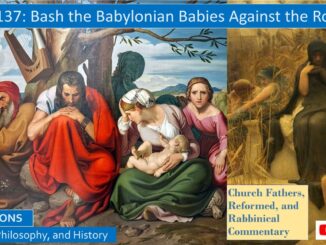
Happy shall they be who take your little ones
and dash them against the rock!
Origen was one of the first Church Fathers who interpreted this troublesome verse allegorically, as did St Ambrose, who catechized and baptized the young St Augustine. Origen teaches us that “the little ones of Babylon, which signifies confusion, are those troublesome sinful thoughts that arise in the soul, and one who subdues them by striking their heads against the firm and solid strength of reason and truth, is the person who ‘dashes the little ones against the stones;’ and he is therefore truly blessed.”[2] Likewise, St Ambrose comments that we should “dash all corrupt and filthy thoughts against Christ.” […]

Psalm 71: Encouraging Us In Our Old Age
Biblical Interpretation

Psalm 71: Encouraging Us In Our Old Age

John Calvin speculates that David composed Psalm 71 after experiencing the trauma of losing the life of his son Absalom during his rebellion against him, which was sparked by the favoritism Davis showed towards his newly resented wife, Bathsheba. “The particular reference which David makes to his old age renders this conjecture not improbable.”
If so, this psalm should be a comfort to those who old age is lonelier due to mistakes, miscalculations or misfortunes occurring many years earlier. […]

Psalms 40 and 70: Deliver Both Young and Old from Suffering and Trials
Biblical Interpretation

Psalms 40 and 70: Deliver Both Young and Old from Suffering and Trials

St Ambrose rejoices: “Christ has heard the prayer of his own servants and has brought us out from the pit of misery and from the mire of dregs. We were drowning there; our whole flesh was clinging to the mire, trapped in the whirlpool of our sins. Our soul was powerless to save itself; fallen and ruined as it was by the multiplicity and dreadfulness of our offenses.”
St Ambrose continues: “Christ came to save us from the pit and slime of this world, from the mud and mire of this earth, from this body doomed to death.” “May that rock, which follows those who thirst, confirm the weak and unsteady; may that water never be lacking to those who long for it; and may that firm foundation never be wanting to those in danger of falling.” […]

Book of Ruth: Historical-Critical Commentaries. Was Ruth an Old Testament Illegal Alien?
Bible Stories and Parables

Book of Ruth: Historical-Critical, Patristic, and Rabbinical Commentaries. Was Ruth an Old Testament Illegal Alien?

Was Ruth an Old Testament version of an illegal alien? Marriages between Jews and Moabites were definitely illegal under Jewish law, and Ruth was seen as a sojourner, which is the Biblical term for immigrant, or alien. Ancient Jews were just as suspicious of Moabites just as many Americans are suspicious of Mexicans. Ruth emigrates to Judah because of economic hardship, just as hardship drives many Mexicans to seek to enter the United States.
Is the term illegal alien a misnomer? Are illegal aliens criminals because they are doing illegal things? We can all agree that someone who robs a bank or steals a car or shoots or beats his neighbor is a criminal, but is someone who is fleeing gangs who threaten their lives a criminal? Is someone who flees grinding poverty to take his chances swimming the Rio Grande truly a criminal? […]

Ladder of Divine Ascent, SMALL Steps 6,7, 13
Ladder of Divine Ascent

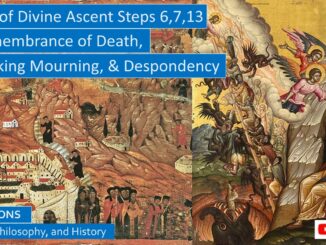
Ladder of Divine Ascent, Remembrance of Death, Joy Making Mourning, and Despondency, Steps 6,7, & 13

St John Climacus continues:
Step 6.3. “Fear of death” “comes from disobedience, but trembling at death is a sign of unrepented sins.” Those who fear death the most are the disobedient who live only to party, who live for today, who live for themselves, and do not live for others, they are the unrepentant who tremble at death’s gates. Even “Christ fears death, but does not tremble,” so He can show us that he is both God and man.
Step 6.24. “It is impossible, someone says, impossible to spend the present day devoutly unless we regard it as the last of our whole life.” […]

Pinocchio
Literature and Myths

The Original Pinocchio, Deeply Repentant, Unlike the Disney and Jordan Peterson Pinocchio

The original Pinocchio was very different from the happy-go-lucky Disney and Jordan Peterson Pinocchio. Although the Disney movie included the most memorable most memorable stories of the original, the short length of the movie fails to render the deeply penitential tone of the original, which emphasizes how daily struggle is needed to replace bad habit with good habits, how salvation and spiritual growth is never instantaneous but is rather a life long-term process, where for every two steps forward we take one step backwards. The original rebellious Pinocchio was much more of a rogue than the pleasant Disney, he is a juvenile delinquent from the moment he has been carved. […]

Ladder of Divine Ascent

St John Climacus: Ladder of Divine Ascent, Step 5, Repentance, and Perseverance of Winston Churchill

Repentance is not merely a quick apology to St John Climacus. Repentance is not quick in the Ladder of Divine Ascent. The first four rungs, where we renounce the world, detach ourselves from worldly things, become an exile and pilgrim from the affairs of the world, and with daily discipline internalize God’s will in holy obedience, these first four rungs prepare us for the rung of repentance. Repentance is more an attitude and a process than an event. An attitude of humility and repentance will prepare us for the slow ascent up the remaining twenty-five steps of the Ladder of Divine Ascent. Without daily heartfelt repentance we cannot continue the climb to a godly life. […]

Command 9&10 Do Not Envy

Dr Laura and Her Rabbi Stewart Vogel on Ten Commandments: Do Not Envy

If in your heart you keep shouting, I want! I want! I WANT!
Not only are you acting and living like a child, but when you focus excessively on getting more possessions and success, you risk becoming jealous of what your neighbor’s possessions and success, you risk becoming obsessed and possessed by jealousy and envy. Coveting and envy is a sin that is unique because it is a sin of our thoughts and mind, our “thoughts, desires, and feelings.” […]

Command 8 Do Not Bear False Witness

The Decalogue in the Torah, Blog 6, Do Not Bear False Witness Against Your Neighbor

A common misconception is that this Commandment only forbids us to lie. However, this Mitzvah goes deeper. Not only should we not destroy the reputation of our neighbor, we should also guard the reputation of our neighbor like we should build a parapet on our roof. Not only does this Mitzvah forbid us to lie, it also forbids us from telling the truth in a mean and heartless and cruel manner. […]