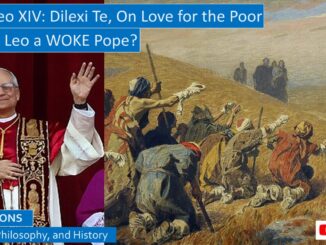
Pope Leo XIV, Dilexi Te, On Love for the Poor. Is Leo a Woke Pope?
Vatican II

Pope Leo XIV, Dilexi Te, On Love for the Poor. Is Leo a Woke Pope?

Pope Leo XIV teaches us: “Love for the Lord, then, is one with love for the poor” ““This is not a matter of mere human kindness but a revelation: contact with those who are lowly and powerless is a fundamental way of encountering the Lord of history. In the poor, he continues to speak to us.” “Care for the poor was also a great concern of St Francis of Assisi: in the person of a leper, Christ himself embraced Francis and changed his life.”
Pop Leo XIV teaches us: “By embracing poverty, he wanted to imitate Christ, who was poor, naked, and crucified. In his Rule, he asks that “the brothers should not appropriate anything, neither house, nor place, nor anything else. And as pilgrims and strangers in this world, serving the Lord in poverty and humility, they should go about begging with confidence, and should not be ashamed, because the Lord made himself poor for us in this world.” […]
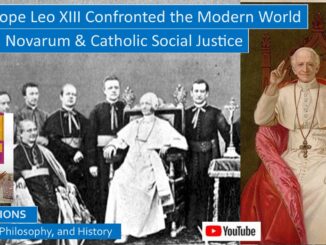
Pope Leo XIV, First American Pope, Successor to Pope Francis and Social Justice of Pop Leo XIII
Modern Catholic Popes

Pope Leo XIV, First American Pope, Successor to Pope Francis and Social Justice of Pope Leo XIII

Pope Leo XIV notes: “What is striking about these two attitudes is their relevance today. They embody notions that we could easily find on the lips of many men and women in our own time, even if, while essentially identical, they are expressed in different language.”
“Even today, there are many settings in which the Christian faith is considered absurd, meant for the weak and unintelligent. Settings where other securities are preferred, like technology, money, success, power, or pleasure.” […]

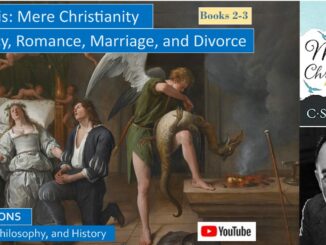
CS Lewis’ Mere Christianity: Reflections on Intimacy, Romance, Marriage, and Divorce
CS Lewis

CS Lewis’ Mere Christianity: Intimacy, Romance, Marriage, and Divorce

CS Lewis continues: “Being in love is a good thing, but it is not the best thing.” “You cannot make it the basis of a whole life. It is a noble feeling, but it is still a feeling.” But CS Lewis warns us that the initial excitement will not last, that “love in the second sense is not merely a feeling, but is a deep unity, maintained by the will and deliberately strengthened by habit, reinforced in Christian marriages by the grace which both partners ask, and receive, from God.” […]

Modern Catholic Popes

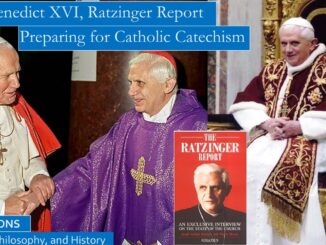
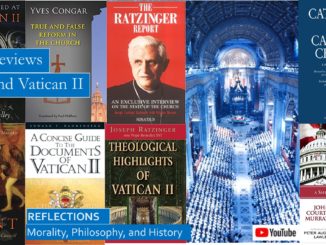
Ratzinger Report, by Future Pope Benedict XVI, Preparing for Catholic Catechism

Cardinal Ratzinger teaches us: “Every council that bears fruit must be followed by a wave of holiness. Thus it was after Trent, and it achieved its aim of real reform for this reason. Salvation for the Church comes from within her,” not solely “from the decrees of the hierarchy. Whether Vatican II and its results will be considered as a luminous period of Church history will depend upon all the Catholics who are called to give it life. As Pope John Paul II said in his commemoration of Charles Borromeo in Milan, ‘the Church of today does not need any new reformers, the Church needs new saints.’” […]

History

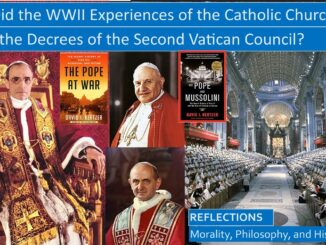
How Did the Experiences of World War II Influence the Second Vatican Council?

Vatican II marks a shift in the Church’s attitude towards the modern secular world. Gone are the anathemas of the Council of Trent and many other councils that condemn those who may disagree with the teachings of the church, instead Vatican II seeks dialogue with the modern world in with a pastoral rather than a condemning attitude. The Vatican II decree on religious freedom announced that democracy and freedom of religion and conscience were the friends of the church, that a totalitarian form of government could never be a trustworthy friend of the Catholic or Christian Church. […]

Book Reviews and Miscellaneous

Book Reviews, Reform Councils of Trent and Vatican II, and Vatican I

IMHO, you cannot truly understand the modern Catholic Church without reading William O’Malley’s histories of Trent and Vatican II. O’Malley argues that Vatican II restated the theology of Trent, countering the notion that Trent was a reactionary rather than a reforming council. This polemic view of Trent was influenced by the fact that the Vatican had closed the archives of the Trent Council until early in the twentieth century. […]

Catholic Catechism

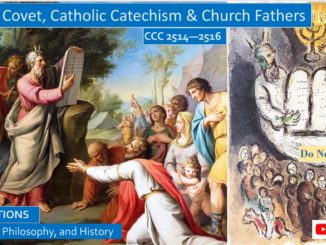
Catholic Catechism, Do Not Covet, CCC 2514-2516

Surprisingly, the Catholic Catechism discusses concupiscence not when reflecting on the commandment prohibiting adultery but on the commandment forbidding coveting your neighbor’s wife.  Concupiscence is not itself a sin, and although it is commonly thought of as a sexual sin, it can “refer to any intense form of human desire.”  “Concupiscence stems from the disobedience of the first sin.  It unsettles man’s moral faculties and, without being in itself an offense, inclines man to commit sins.” The Catholic Catechism footnotes the decrees of the Council of Trent, which teaches that “concupiscence or the tinder of sin remains in the baptized.  Since it is left for us to wrestle with, it cannot harm those who do not consent but manfully resist it by the grace of Jesus Christ.”  This decree of Trent then confirms that concupiscence is not sin itself, but inclines us to sin. […]

Morality

Can Good Catholics Read Hans Kung? Should Devout Catholics Read Hans Kung?

Can Good Catholics Read Hans Kung?  Should Devout Catholics Read Hans Kung?  We should all read books on theology, philosophy, and psychology with discernment, testing them first against Scripture then Church teaching, and you should definitely read the books by Hans Kung with discernment.  Most importantly, by learning more about why the Catholic Church was goaded into announcing this discipline against Hans Kung, we can learn anyone who wishes to read and discuss these timeless topics can do so with humility, without succumbing to pride. […]