Biblical Morality of Deceiving Those Who Suffer From Dementia In Order to Help Them
Biblical Interpretation

Biblical Morality of Deceiving Those Who Suffer From Dementia In Order to Help Them

Often adult children just do not want to lie to their parents. They want to empower them and involve them in the decisions about their care. They expect their parents suffering from dementia to reason with them, and that is impossible.

On rare occasions, you are compelled to tell a white lie for their own good. The commandment is not worded: Do not lie. Rather, it is worded: Do not bear false witness against your neighbor. In part, this reflects the reality that ancient jurisprudence relied heavily on eyewitness testimony, unlike modern jurisprudence that relies more on forensic evidence. […]

Mental Illness, Demons, and Free Will in the Bible and Ancient Israel, Greece, and Rome
Dementia and Alzheimers Disease

Do We Have Free Will? Mental Illness and Demons in the Bible, Church Fathers, and the Ancient World

Did the early Christians believe in free will? Or could demons rob them of their free will; just as dementia and mental illness rob modern patients today? The New Testament does not discuss whether we have free will, it simply accepts that we are subject to forces in the divine realm. Jesus often heals those who have lost their minds, driving out their demons. Also, St Paul in his epistles argues for divine determination, which St Augustine later develops into his doctrine of predestination. […]

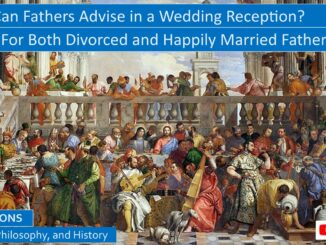
What Spiritual Advice Can Fathers Suggest at Their Daughter’s Wedding Reception
Marriage and Divorce

What Beneficial Advice Can Fathers Suggest in Their Speech at Their Daughter’s Wedding?

For all our close friendships, and our marriages, we need to ask ourselves: Do we bring out the best in each other? Or, do we bring out the worst in each other? Our marriage should be a monastic calling: our marriage should be for our children. The prospective bride should ask herself the key question: Will he be a good father? Will he be good with our children? We cannot love some and hate others, hatred infects all our relationships. […]

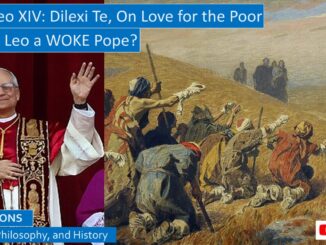
Pope Leo XIV, Dilexi Te, On Love for the Poor. Is Leo a Woke Pope?
Morality

Pope Leo XIV, Dilexi Te, On Love for the Poor. Is Leo a Woke Pope?

Pope Leo XIV teaches us: “Love for the Lord, then, is one with love for the poor” ““This is not a matter of mere human kindness but a revelation: contact with those who are lowly and powerless is a fundamental way of encountering the Lord of history. In the poor, he continues to speak to us.” “Care for the poor was also a great concern of St Francis of Assisi: in the person of a leper, Christ himself embraced Francis and changed his life.”
Pop Leo XIV teaches us: “By embracing poverty, he wanted to imitate Christ, who was poor, naked, and crucified. In his Rule, he asks that “the brothers should not appropriate anything, neither house, nor place, nor anything else. And as pilgrims and strangers in this world, serving the Lord in poverty and humility, they should go about begging with confidence, and should not be ashamed, because the Lord made himself poor for us in this world.” […]

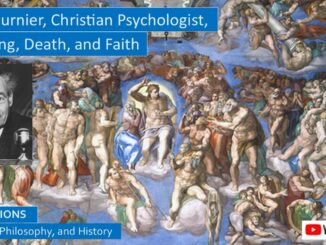
Classical Christian Psychologist Paul Tournier on Old Age, Death, and Faith
Aging

Classical Christian Psychologist Paul Tournier on Old Age, Death, and Faith

Tournier reminds us that we may experience many successes, but as we grow older, “success retreats, and escapes us, it is limited, unfulfilled.” “When one comes to the end, a man’s life is nothing much.” “Professional life is over, and it finishes unfinished. This is a prefiguration of death, in which the whole of life will finish it, too, being unfinished. That is the dramatic contradiction of death.” Quoting Robert Mehl: “An end, but not a fulfilment, that is the face of death.” […]

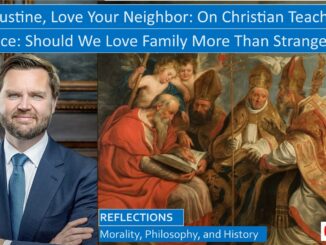
St Augustine’s On Christian Teaching and JD Vance, Order of Love
Politics

St Augustine’s On Christian Teaching and JD Vance, Order of Love

St Augustine clearly teaches us: “All people should be loved equally. But you cannot do good to all people equally, so you should take particular thought for those who, as if by lot, happen to be particularly close to you in terms of place, time, or any other circumstances.”
St Augustine explains further: “Suppose you have plenty of something which had to be given to someone in need but could not be given to two people, and you met two people,” you could flip a coin for who would receive it. But if one of them was a relative, Jesus would not object if you benefited him. In other words, if your children are starving, you need not share what little food you have with strangers.
Should we love everyone, even our enemies? Definitely, Christians are exhorted to love their enemies. As St Augustine teaches us: “We do not fear our enemies, for they do not take away from us what we love, but we pity them, for they hate us all the more because they are separated from the one we love,” since they are separated from God. […]

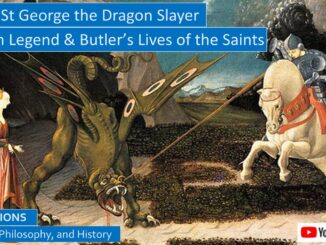
St George the Dragon Slayer, From the Golden Legend and Butler’s Lives of the Saints
Lives of Saints

St George the Dragon Slayer, From the Golden Legend and Butler’s Lives of the Saints

Dacian then sought to trick St George with persuasion, and our saint played along. St George was led into a pagan temple where the people expected he would sacrifice to the gods. “But instead of sacrificing, St George knelt and prayed for the Lord to destroy the temple and all its idols, and destroy it so completely that, for the glory of God and the conversion of the people, absolutely nothing was to be left. At once fire fell from heaven and burnt the temple, its idols and priests, to a cinder, and the earth gaped open and swallowed up the remains.” […]

Book Reviews: Golden Legend, Butler’s, OCA, and Pope Benedict XVI’s Lives of Saints
Book Reviews and Miscellaneous

Book Reviews: Golden Legend, Butler’s, OCA, and Pope Benedict XVI’s Lives of Saints

The compiler of the Golden Legend was the Dominican friar Jacobus de Voragine. The Dominicans historically have been concerned about historical accuracy to guard the faith against heresy. He lists as his three primary sources the lives from Ecclesiastical History by Eusebius, bishop and advisor to Emperor Constantine; the Tripartite History by Cassiodorus; and the Scholastic History by Peter Comestor. In addition, he refers to more than 120 other sources. He was also influenced by earlier collections of lives of the saints by two other Dominican scholars. When his sources were apocryphal and not trustworthy, he points this out. When possible, he tries to reconcile dates and details, but is more concerned with the spiritual lessons than historical accuracy. […]

Parable of Lazarus and the Rich Man: Church Fathers, Reformers, and Commentators
Bible Stories and Parables

Parable of Lazarus and the Rich Man: Church Fathers, Reformers, and Commentators

James Boice teaches us: “It is true that the rich man’s riches worked to his hurt, for he lived for those and nothing else. It is hard for the rich to enter heaven, as Jesus said elsewhere in Luke. It is also true that Lazarus’ poverty worked to his spiritual good, for lacking earthly joys and comfort he turned his eyes to heaven and sought divine consolation.”
James Boice remarks on the contrasts in the parable. Spiritually, “the rich man was actually poor, and the poor man was actually rich. This contrast continues after their death: the poor rich man grew poorer, and the rich poor man grew richer.” “The final contrast is between the hopelessness of the rich man’s condition after death and the hopefulness of his condition before. After death there is no possibility of change, but in this life there is.” […]

Did May Give Birth to Jesus in a Cave With a Midwife? Infancy Gospels of James and Pseudo-Matthew
Bible Stories and Parables

Did Mary Give Birth to Jesus in a Cave With a Midwife? Infancy Gospels of James and Pseudo-Matthew

The Infancy Gospel of James was well known by the early Church Fathers, especially Origen, and possibly Clement of Alexandria. Although this infancy narrative was condemned by Pope Innocent I in 405 and was considered apocryphal by the Gelasian Decree around the year 500, it was one source of the early church tradition of the perpetual virginity of the Virgin Mary, Theotokos, Mother of God. It was especially treasured by the faithful in both the ancient and medieval worlds. St Jerome even speculated that Joseph was also perpetually virgin, and that the Hebrew word translated as his sons were actually his cousins.
Should we reject the Infancy Gospel of James as apocryphal? Would it be fair to label them as heretical? Although this infancy gospel contains many fanciful stories, there are no obviously heretical teachings, nor are the actions by anyone in the Holy Family morally or doctrinally objectionable. Rather, they are similar to the many Jewish midrash Talmudic stories, many of which are similarly fantastic, but are instead cherished for their moral teachings. Indeed, they wouldn’t be midrash if they weren’t improbable. […]