St John Climacus on Mad Pride and Vainglory : Ladder of Divine Ascent, Steps 22-23
Ladder of Divine Ascent

St John Climacus on Mad Pride and Vainglory: Ladder of Divine Ascent, Steps 22-23

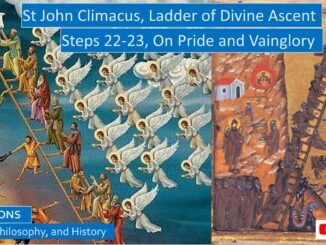
What is the difference between vainglory and pride? Today, vainglory is an archaic word that has not been replaced in common usage, so we usually consider them to be synonymous. Although St John Climacus concedes they are similar, except vainglory progresses to mad pride. He examines vainglory in Step 22, and mad pride in Step 23.
Let us compare the definitions:
Step 22.1. “Some like to distinguish vainglory from pride, and to give it a special place and chapter.” “The only difference between them” is like the difference “between a child and a man, between wheat and bread: for the one is the beginning and the other the end.”
Step 22.2. “With regard to its form, vainglory is a change of nature, a perversion of character, a note of blame. With regard to its quality, it is a dissipation of labors, a waste of sweat, a betrayal of treasure, a child of unbelief, the precursor of pride, shipwreck in harbor, an ant on the threshing floor which, though small, has designs upon all one’s labor and fruit. The ant waits for the gathering of the wheat, and vainglory for the gathering of the riches of virtue: for the one loves to steal and the other to squander.” […]

CS Lewis’ Mere Christianity: Forgiveness, Pride, and Envy. Can Pride Ever Be Good?
CS Lewis

CS Lewis’ Mere Christianity: Forgiveness, Pride, and Envy. Can Pride Ever Be Good?

CS Lewis notes that in the middle of the Lord’s Prayer we pray: “Forgive us our sins as we forgive those who sin against us.” He observes: “There is no slightest suggestion that we are offered forgiveness on any other terms. It is made perfectly clear that if we do not forgive, we shall not be forgiven.”
Indeed, immediately after the Lord’s Prayer in Matthew, Jesus exhorts us: “For if you forgive men their trespasses, your heavenly Father also will forgive you; but if you do not forgive men their trespasses, neither will your Father forgive your trespasses.” […]

Man Who Mistook His Wife for a Hat
Dementia and Alzheimers Disease

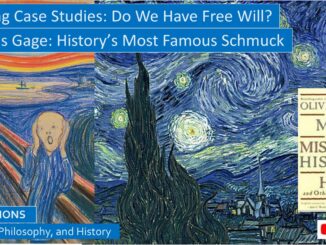
Do We Have Free Will? Phineas Gage and Case Studies From the Man Who Mistook His Wife for a Hat

The concept that someone could be so demented that they are no longer responsible for their behavior is hard for people to accept. After all, the concept that we are all responsible for our actions, that we always act out of free will, is a bedrock principle in our legal and even religious institutions. But unfortunately, as psychologists know, there are many mentally ill who cannot control their actions.
One early and famous case history is that of Phineas Gage, who is perhaps the most famous and influential schmuck in human history. I have listened to many psychology lectures in Wondrium, the Teaching Company, and university lectures on Youtube that retell the story of Phineas Gage, which I have heard a dozen times. When my daughter in medical school told me that she was starting her psychology section, I told her that she would hear the remarkable story of Phineas Gage, which she did a few days later. […]

Wellness Checks for Dementia: Police and Mental Illness
Dementia and Alzheimers Disease

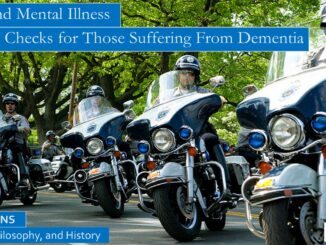
Wellness Checks for Dementia: Police and Mental Illness

I joke with the members of my over-55 community that if one of our elderly neighbors is ornery, that we should be patient with them, as they may suffering from dementia, and we do not know it. This is literally true. While you can often sense if someone is autistic, or has a drug problem, or is schizophrenic, often you cannot tell if someone is in the early stages of dementia. […]

AntiSemitism

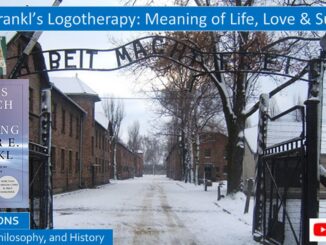
Viktor Frankl’s Logo-therapy, Man’s Search For Meaning in Life, Love, and Suffering

Viktor Frankl’s book, Man’s Search for Meaning, is a life-changing book and one of my favorites, it touched me deeply when I first read it many years ago. The main theme of the book is no matter what challenges you face in your life, or how busy you are, you always have time to be kind to all those whom you encounter, to be a positive influence on the lives whom you touch. Although he does not directly mention stoicism, his account of how he survived Auschwitz is a living example how a stoic mindset can help you survive and thrive through any challenge life may throw at you. […]