
St John Climacus on Mad Pride and Vainglory : Ladder of Divine Ascent, Steps 22-23
Ladder of Divine Ascent

St John Climacus on Mad Pride and Vainglory: Ladder of Divine Ascent, Steps 22-23

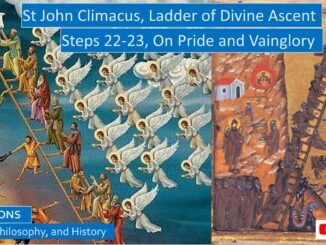
What is the difference between vainglory and pride? Today, vainglory is an archaic word that has not been replaced in common usage, so we usually consider them to be synonymous. Although St John Climacus concedes they are similar, except vainglory progresses to mad pride. He examines vainglory in Step 22, and mad pride in Step 23.
Let us compare the definitions:
Step 22.1. “Some like to distinguish vainglory from pride, and to give it a special place and chapter.” “The only difference between them” is like the difference “between a child and a man, between wheat and bread: for the one is the beginning and the other the end.”
Step 22.2. “With regard to its form, vainglory is a change of nature, a perversion of character, a note of blame. With regard to its quality, it is a dissipation of labors, a waste of sweat, a betrayal of treasure, a child of unbelief, the precursor of pride, shipwreck in harbor, an ant on the threshing floor which, though small, has designs upon all one’s labor and fruit. The ant waits for the gathering of the wheat, and vainglory for the gathering of the riches of virtue: for the one loves to steal and the other to squander.” […]

FDR’s Inaugural Address and St John Climacus, Ladder of Divine Ascent, on Fear & Cowardice, Step 21
Ladder of Divine Ascent

FDR’s First Inaugural Address and St John Climacus, Ladder of Divine Ascent, on Fear & Cowardice, Step 21

The chapter on fear is both one of the shortest and one of the most puzzling chapters of St John Climacus’ Ladder of Divine Ascent. In part, that is because there are many flavors of fears that spring from our most basal fears: the fear of the dark, the distressing, the dangerous.
More common are those fears that cause us to hesitate. Perhaps we fear what others think of us when we champion the good others do not see. Perhaps we fear rejection and failure. Perhaps we fear that past failures will rob us of future success. Perhaps we fear to do good when we are not encouraged. […]

Should You Leave Your MAGA Church? Or Should You Choose To Stay?
Current Events and History

Should You Leave Your MAGA Church? Or Should You Stay?

Rev Trevors does not address the common situation where the pastor or priest is setting the MAGA tone when he is leading the congregation, which is so often true in congregations in America. This generates another concern: Should you stay in a church where you will be challenging the teaching authority of the pastor or priest?
Is this a special case for this more basic question: Does the Decalogue exhort us that respect precedes love? Is love impossible when we disrespect either God or those in authority?
There is no verse in Scripture that directly commands the believer to attend weekly services. Several verses in the Psalms sing on how the believer should joyfully be drawn to the house of God, but in the New Testament we only have the verse in Hebrews that simply exhorts:
“Let us consider how to stir up one another to love and good works, not neglecting to meet together, as is the habit of some, but encouraging one another.” […]

Anders Nygren, On Christian Agape-Love and Eros-Love in Gospels and Pauline Epistles
Biblical Interpretation

Anders Nygren, On Christian Agape-Love and Eros-Love in Gospels and Pauline Epistles

Anders Nygren emphasizes that “Old Testament piety with its devotion to the Law was by no means the external legalism it is often assumed to have been. There was an inward bond that held the godly man to the Law. The righteous felt no sense of external compulsion when confronted by the Law, but a sense of inner solidarity with it. Its observance gave him value and made him acceptable to God. His prevailing mood was expressed in Psalm 1,” the Psalm that sings of Law as Gospel. […]

Catholic Middle Ages and Beyond

St John of the Cross, Dark Night of the Soul, Seven Capital Sins and Best Type of Close Friend

Before you can truly deepen your interior life of prayer and communion with God, you must first purify your soul by combating your spiritual capital vices, strengthening your inner virtues, which are revealed by how you think of your neighbor, what you say about your neighbor, how you act towards your neighbor, and how eagerly you seek to forgive and overlook the shortcomings of your neighbor. […]

Judaism

The Decalogue in the Torah, Blog 2, How One Sin Can Lead to Many More, Up to a Perfect 10

The Decalogue is symmetrical. The commandments to Love G_d with all of your heart and with all of your soul and with all of your possessions are mirrored in the commandments to love your neighbor as yourself. If you steal, murder, or adulter today, yesterday you coveted that which was not yours and could never properly be yours. Coveting is wanting. Coveting is looking. Looking, if not sinful, and it is sinful, is inviting sin to cross under our doorposts. […]

Command 9&10 Do Not Envy

St Cyprian on Envy and Jealousy

St Cyprian warns us of the pernicious evils of envy. “What a gnawing worm of the soul envy is, what a plague-spot of our thoughts, what a rust of the heart, to be jealous of another.” How envy gnaws at our soul when we hate our neighbor for their prosperity, their good luck, their inheritance, when we make other people’s glory our penalty, when we allow envy to be the executioner of our soul. When we are consumed by envy, “no food is joyous, no drink is cheerful. The envious are every sighing and groaning and grieving,” our envy torments us day and night. […]