St John Climacus on Mad Pride and Vainglory : Ladder of Divine Ascent, Steps 22-23
Ladder of Divine Ascent

St John Climacus on Mad Pride and Vainglory: Ladder of Divine Ascent, Steps 22-23

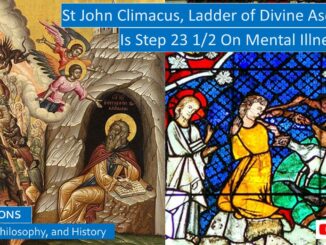
What is the difference between vainglory and pride? Today, vainglory is an archaic word that has not been replaced in common usage, so we usually consider them to be synonymous. Although St John Climacus concedes they are similar, except vainglory progresses to mad pride. He examines vainglory in Step 22, and mad pride in Step 23.
Let us compare the definitions:
Step 22.1. “Some like to distinguish vainglory from pride, and to give it a special place and chapter.” “The only difference between them” is like the difference “between a child and a man, between wheat and bread: for the one is the beginning and the other the end.”
Step 22.2. “With regard to its form, vainglory is a change of nature, a perversion of character, a note of blame. With regard to its quality, it is a dissipation of labors, a waste of sweat, a betrayal of treasure, a child of unbelief, the precursor of pride, shipwreck in harbor, an ant on the threshing floor which, though small, has designs upon all one’s labor and fruit. The ant waits for the gathering of the wheat, and vainglory for the gathering of the riches of virtue: for the one loves to steal and the other to squander.” […]

FDR’s Inaugural Address and St John Climacus, Ladder of Divine Ascent, on Fear & Cowardice, Step 21
Ladder of Divine Ascent

FDR’s First Inaugural Address and St John Climacus, Ladder of Divine Ascent, on Fear & Cowardice, Step 21

The chapter on fear is both one of the shortest and one of the most puzzling chapters of St John Climacus’ Ladder of Divine Ascent. In part, that is because there are many flavors of fears that spring from our most basal fears: the fear of the dark, the distressing, the dangerous.
More common are those fears that cause us to hesitate. Perhaps we fear what others think of us when we champion the good others do not see. Perhaps we fear rejection and failure. Perhaps we fear that past failures will rob us of future success. Perhaps we fear to do good when we are not encouraged. […]

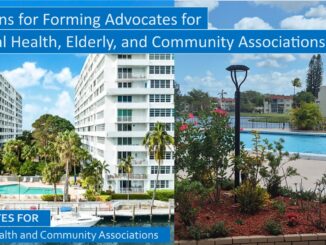
Why are we starting an advocacy group for the mentally ill, elderly, and community associations?
and Community Associations

Why Are We Starting Advocates For Mental Health, Elderly, and Community Associations?

The overall theme of our Advocacy Group is: How To Love Your Neighbor, and the corollary: How To Love Your Neighbor, even when they suffer from dementia, autism, or mental illness. SUMMARY of purpose:
Conduct educational and lobbying efforts under 501c6. Also, conduct programs and activities; raise funds to reimburse advocacy efforts; and raise funds separately for 501c3 charities and political action committees.
[…]

Criminology

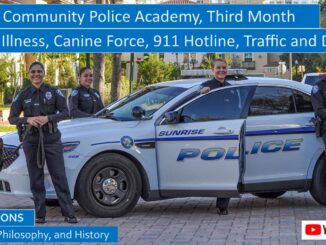
Sunrise Community Police Academy: Police and Mental Health, Canine Officers, 911 Call Center

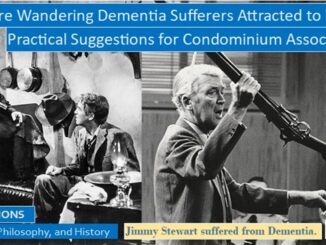
On homicide week in our Sunrise Community Police Academy, the police instructor showed us the ghoulish face of a dementia patient found face down in a canal. The officer commented that for some strange reason, dementia patients have a strange attraction to water, often drowning.
Roughly sixty percent of dementia patients wander. Experts note that when someone suffering from dementia wanders away, one in four will lose their lives if they are not found within two days. This is why police urge citizens to report a missing person sooner rather than later. […]

Why Are Dementia Patients Who Wander So Drawn to Water? Why Do They Drown?
Dementia and Alzheimers Disease

Why Are Wandering Dementia Patients Drawn to Water? Why Do They Drown?

The biggest objection property managers and association boards raised against performing health and wellness checks on their owners and residents is they are not nursing homes: they do not want to be held responsible for the welfare of their owners and residents. But even if they wanted to, they cannot take on the responsibility of care. Instead, they should call the police and request that they conduct a health and wellness check. They should inform the police about the possible foreclosure of a dementia patient, as this will better enable them to receive any care they may need. Any known family members must also be informed.
Alternatively, or additionally, they can request that the Broward County Council of Aging, or an appropriate local agency, refer the case to a professional. The Alzheimer’s Association 24/7 support hotline at 800-272-3900 is also an excellent resource. […]

Paul Tournier on Aging and Retirement
Aging

Classical Christian Psychologist Paul Tournier on Old Age and Retirement

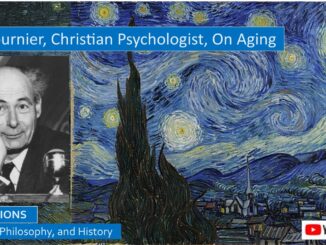
Paul Tournier notes: “Freud defined psychological health under the double heading of aptitude for love and for work.” But Paul Tournier cautions that “the superficial relationships of working life and of sexual attraction must lead to a deeper personal commitment. And I believe that no commitment can be truly personal unless it takes on a transcendent dimension and become love, in the biblical meaning of the word.”
Paul Tournier is grateful: “As an intellectual, I am specially privileged. It is true that the better educated people are, the more chance they have to enjoy their retirement. First, intellectual work” is not physically taxing. “Second, the capacity for intellectual work is retained longer than physical ability. It can even increase in old age as long as disease does not affect the mental faculties. But most of all, the more one exercises one’s mind, the more pleasure it gives to exercise it. The more one learns, the more one wants to learn, and the easier study becomes.” […]

Michael J Fox and Parkinsons: Symptoms and Struggles
Philosophy

Michael J Fox and Parkinson’s Disease: His Symptoms and Struggles

Where does Parkinson’s disease fall on the spectrum of neurological diseases? On one extreme, dementia, including Alzheimer’s disease, degrades the patient’s cognition, including memory and reasoning. Their motor functions decline only as their overall health declines. On the other extreme, ALS or Lou Gehrig’s disease degrades the patient’s motor functions, often starting with the legs, then the arms, then they have trouble breathing. […]

What are the Ten Early Signs and Symptoms of Alzheimer's?
Dementia and Alzheimers Disease

What are the Ten Early Signs and Symptoms of Alzheimer’s?

What are the Ten Early Signs and Symptoms of Alzheimer’s? We repeat these ten warning signs from the Alzheimer’s Association website in our book review of Kim Campbell’s biography of the celebrity country music star Glen Campbell from before his diagnosis of Alzheimer’s disease through his passing. We reflected on […]

CS Lewis’ Mere Christianity: Forgiveness, Pride, and Envy. Can Pride Ever Be Good?
CS Lewis

CS Lewis’ Mere Christianity: Forgiveness, Pride, and Envy. Can Pride Ever Be Good?

CS Lewis notes that in the middle of the Lord’s Prayer we pray: “Forgive us our sins as we forgive those who sin against us.” He observes: “There is no slightest suggestion that we are offered forgiveness on any other terms. It is made perfectly clear that if we do not forgive, we shall not be forgiven.”
Indeed, immediately after the Lord’s Prayer in Matthew, Jesus exhorts us: “For if you forgive men their trespasses, your heavenly Father also will forgive you; but if you do not forgive men their trespasses, neither will your Father forgive your trespasses.” […]

Why I Joined Rotary
Business and Science

History and Philosophy of Rotary International, and My Personal Experience

Early in its history, the Rotary Clubs adopted the Four Way Test. The Rotary website states that “the Four-Way Test is a nonpartisan and nonsectarian ethical guide for Rotarians to use for their personal and professional relationships.
Of the things we think, say, or do:
Is it the TRUTH?
Is it FAIR to all concerned?
Will it build GOODWILL and BETTER FRIENDSHIPS?
Will it be BENEFICIAL to all concerned?” […]